
Green Infrastructure and Low-Impact Development Technologies
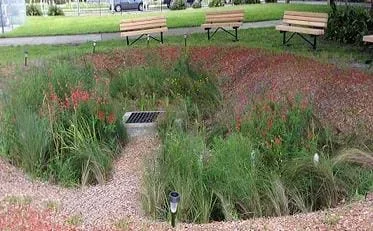 A rain garden designed and constructed by students in Florida.Copyright Ryan Locicero, WARE raingardens.us (author)
Students are introduced to innovative stormwater management strategies that are being used to restore the hydrology and water quality of urbanized areas to pre-development conditions. Collectively called green infrastructure (GI) and low-impact development (LID) technologies, they include green roofs and vegetative walls, bioretention or rain gardens, bioswales, planter boxes, permeable pavement, urban tree canopy, rainwater harvesting, downspout disconnection, green streets and alleys, and green parking. These approaches differ from the traditional centralized stormwater collection system with the idea of handling stormwater at its sources, resulting in many environmental, economic and societal benefits. A PowerPoint® presentation provides photographic examples, and a companion file gives students the opportunity to sketch in their ideas for using the technologies to make improvements to 10 real-world design scenarios.
Green infrastructure and low-impact development are decentralized stormwater management strategies that provide on-site water quantity and water quality treatment. These systems utilize physical, chemical and biological principles to improve the water quality of urban stormwater runoff. Under natural conditions (pre-development), stormwater runoff has unabated access to the soil surface. This stormwater runoff recharges the groundwater supply and provides a certain level of stormwater cleansing, improving the long-term security of drinking water supplies and supporting ecosystem function. Green infrastructure is considered a new technology and significant civil and environmental engineering research is underway. Engineers are taking a look at how nature naturally manages stormwater and nutrients and conducting research to understand how to best design, install and maintain these systems over their anticipated lifespans.
After this lesson, students should be able to:
- Describe the guiding principles of green infrastructure and low-impact development.
- Explain the advantages of green infrastructure and low-impact development technologies compared to traditional stormwater infrastructure.
- Select location-appropriate green infrastructure and low-impact development technologies.
- SC.7.E.6.6 Identify the impact that humans have had on Earth, such as deforestation, urbanization, desertification, erosion, air and water quality, changing the flow of water.
Grade 7
Do you agree with this alignment?
- Students will develop an understanding of the effects of technology on the environment.
Grades K-12
Do you agree with this alignment? - Students will develop an understanding of the relationships among technologies and the connections between technology and other fields of study.
Grades K-12
Do you agree with this alignment? - STEL-3G Explain how knowledge gained from other content areas affects the development of technological products and systems.
Grades 6-8
Do you agree with this alignment? - STEL-4S Develop a solution to a technological problem that has the least negative environmental and social impact.
Grades 9-12
Do you agree with this alignment?
- MS-ESS3-4 Construct an argument supported by evidence for how increases in human population and per-capita consumption of natural resources impact Earth's systems.
Grades 6-8
This resource focuses on the following Three Dimensional Learning aspects of NGSS:
Science & Engineering Practices- Construct a scientific explanation based on valid and reliable evidence obtained from sources (including the students' own experiments) and the assumption that theories and laws that describe the natural world operate today as they did in the past and will continue to do so in the future.Do you agree with this alignment?
Disciplinary Core Ideas- Typically as human populations and per-capita consumption of natural resources increase, so do the negative impacts on Earth unless the activities and technologies involved are engineered otherwise.Do you agree with this alignment?
Crosscutting Concepts- All human activity draws on natural resources and has both short and long-term consequences, positive as well as negative, for the health of people and the natural environment.Do you agree with this alignment?
Do you agree with this alignment? - Construct a scientific explanation based on valid and reliable evidence obtained from sources (including the students' own experiments) and the assumption that theories and laws that describe the natural world operate today as they did in the past and will continue to do so in the future.
- MS-LS2-5 Evaluate competing design solutions for maintaining biodiversity and ecosystem services.
Grades 6-8
This resource focuses on the following Three Dimensional Learning aspects of NGSS:
Science & Engineering Practices- Evaluate competing design solutions based on jointly developed and agreed-upon design criteria.Do you agree with this alignment?
Disciplinary Core Ideas- There are systematic processes for evaluating solutions with respect to how well they meet the criteria and constraints of a problem.Do you agree with this alignment?
- Biodiversity describes the variety of species found in Earth's terrestrial and oceanic ecosystems. The completeness or integrity of an ecosystem's biodiversity is often used as a measure of its health.Do you agree with this alignment?
- Changes in biodiversity can influence humans' resources, such as food, energy, and medicines, as well as ecosystem services that humans rely on—for example, water purification and recycling.Do you agree with this alignment?
Crosscutting Concepts- The uses of technologies and any limitations on their use are driven by individual or societal needs, desires, and values; by the findings of scientific research; and by differences in such factors as climate, natural resources, and economic conditions. Thus technology use varies from region to region and over time.Do you agree with this alignment?
Do you agree with this alignment? - Evaluate competing design solutions based on jointly developed and agreed-upon design criteria.
Lesson Overview
- Prior to begining the lesson, consider the Just Breathe Green: Measuring Transpiration Rates activity to give students a fundamental understanding of how the following concepts and technologies work.
- Present the GI and LID Technologies Presentation (PPTX) (a PowerPoint® file) using the slide narration content provided below.
- At the same time as the main presentation, project on the classroom board the GI and LID Technologies Design Scenarios (PPTX) (also a PowerPoint® file), which is intended to engage students in selecting and sketching their designs for location-appropriate GI and LID technologies as they are covered in the presentation. After each technology is introduced in the presentation, refer to the coordinated design scenario slide and direct students to use chalk or whiteboard markers to draw in their design plans, applying the GI and LID technologies. You may want to tape large pieces of paper or poster board to the classroom board in order to capture the designs. If no second projector is available, or as an alternative way to do this, print out the design scenarios file as a multi-page handout and have teams use colored markers to sketch in their GI and LID designs over the 10 design scenarios.
Slide Narration for Green Infrastructure and Low-Impact Development Technologies Presentation (Slide 1) Traditional stormwater management practices focus on centralized systems. These systems are designed to capture and attenuate a specified volume (quantity) of water from large areas, typically 10 to 100 acres, at which they adequately perform. They also provide a level of treatment (quality) based on a one-size fits all approach, a method that is less reliable at targeting specific pollutants of concern.
A low-impact development approach to stormwater management is typically applied to areas less than 2 acres and favorably less than 1 acre, treating stormwater at the sites, in a decentralized fashion (Passeport, 2009). Instead of treating an entire neighborhood, these systems are designed to capture stormwater runoff from a handful of homes. This approach manages nutrients (quality) and volume (quantity) of stormwater runoff on-site as a result of increased infiltration and reduction in stormwater runoff.
The following green infrastructure and low-impact development technologies will be addressed in the lesson: green roofs and vegetative walls, bioretention or rain gardens, bioswales, planter boxes, permeable pavement, urban tree canopy, rainwater harvesting, downspout disconnection, green streets and alleys, and green parking.
(Slide 2) This table provides a list of green infrastructure practices and a summary of the benefits that GI can offer. Source of the image is a The Value of Green Infrastructure: A Guide to Recognizing Its Economic, Environmental and Social Benefits by the Center for Neighborhood Technology and American Rivers. (See the Additional Multimedia Support section for the link to this PDF document.)
(Slide 3) Green roofs and vegetative walls are rooftops or sides of buildings that are planted with a media membrane and native vegetation over a waterproofing membrane/root zone barrier, which may include a drainage and irrigation system. The depth of media defines two categories of green roofs: extensive green roofs typically have media layers between two and six inches, while intensive green roofs usually have media layers greater than six inches.
Green roofs and vegetative walls reduce environmental and human health impacts as a result of reduced stormwater runoff, a reduction in energy use, and an improvement of air quality. These benefits are obtained through the absorption and evapotranspiration of plant and media within the green roof system boundaries, an increase in insulation, reduction in the amount of solar radiation reaching the roof surface, and cooling effect due to evaporation on the media surface, reducing roof temperatures. Vegetation also takes up air pollutants and intercepts particulate matter, leading to improved air quality. Additional benefits include reduction in atmospheric CO2, reduced urban heat island effect, improvement in community livability, improved habitat, and the opportunity for public education and outreach.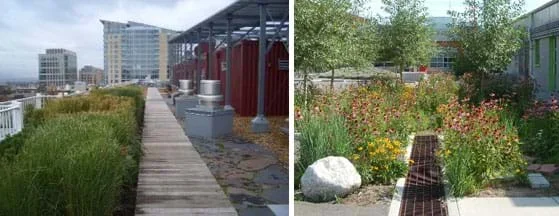 Green roofs are a component of Seattle's green stormwater infrastructure strategy in higher density neighborhoods (left). This native plant rain garden filters water from a Denver parking lot before it reaches the storm drain.Copyright Seattle Public Utilities, City of Seattle (left); Public Roads (magazine), Federal Highway Administration, U.S. Department of Transportation (right) http://atyourservice.seattle.gov/2010/09/23/seattle%E2%80%99s-rooftops-turning-green/ http://www2.epa.gov/region8/green-infrastructure
(Slide 4) Bioretention, or rain gardens, are typically constructed with high-permeability media consisting of soil, sand and organic matter, designed to maximize infiltration, improve water quality, promote vegetative growth and biological transformation processes. These systems are designed with a storage volume capacity, allow for overflow and exfiltration/underdrain. Students can explore the impact that media has on implementation of different gardens with the associated activity Does Media Matter? Infiltration Rates and Storage Capacities.
Rain gardens are ideally constructed in areas where stormwater collects, typically adjacent to roof runoff and impervious areas such as streets, parking lots and driveways. Benefits include improved local aesthetics, and the ability to trap and treat silts, fine particles, nutrients, heavy metals and bacteria from impacting downstream ecosystems. Refer to the associated activity A Guide to Rain Garden Construction where students culminate their learnings from the lesson in designing and creating their own personal rain gardens. These systems have been shown to increase property values, taxable revenue to local municipalities, biodiversity and habitat, provide groundwater recharge, reduce the quantity of potable water utilized for outdoor irrigation, reduce carbon dioxide emissions through direct carbon sequestration, minimize urban heat island effect, and provide sites for community outreach.
(Slide 5) Bioswales may be vegetated, mulched or xeriscaped linear channels that provide stormwater retention and infiltration. Bioswales are a linear form of a bioretention system with a length-to-width ratio greater than 2:1, typical of standard bioretention construction. They are designed as an alternative to traditional stormwater piping, integrated into parking lots and road medians. A xeriscaped landscape is designed in a way that limits or eliminates the need for irrigation.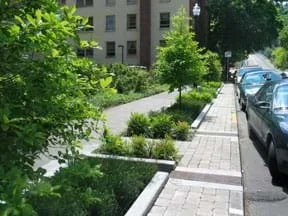 A stormwater planter in the sidewalk area manages street and sidewalk runoff.Copyright U.S. Environmental Protection Agency http://water.epa.gov/infrastructure/greeninfrastructure/
(Slide 6) Planter boxes are urban bioretention systems with vertical concrete walls designed to collect and retain a specified volume of stormwater runoff. A typical design collects stormwater runoff from sidewalks, parking lots and/or streets within the boundary of city owned property. These planter boxes may have an open or closed bottom allowing for percolation, exfiltration and evapotranspiration.
(Slide 7) Permeable pavement surfaces are similar to sidewalks and roadways, but dissimilar to those surfaces because they are able to absorb and infiltrate stormwater runoff through their materials to underlying media layers. Several different types of permeable pavement exist, including pervious or porous concrete, porous asphalt and interlocking permeable pavers. These systems are typically designed for pedestrian low-volume vehicle traffic areas such as parking lots, driveways and sidewalks. Permeable pavement surfaces do not have the same strength as traditional concrete and thus are limited to areas that do not receive constant traffic. Refer to the associated activity Making "Magic" Sidewalks of Pervious Pavement for students to complete a hands-on design challenge to create their own pervious pavement mixes.
Permeable pavement reduces stormwater runoff by allowing the underlying media layer to infiltrate and percolate stormwater runoff. This lets treatment mechanisms happen at the source, and helps to increase groundwater recharge. In cold weather climates, this technology reduces the formation of a frost layer, mitigating the need for salt use and reducing allocation of municipality money dedicated to de-icing roadways. Also, a reduction in energy use has been demonstrated due to a reduction in the urban heat island effect.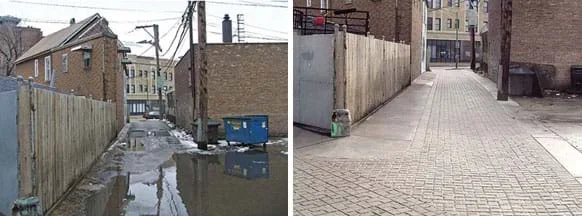 A Chicago alley that experienced frequent flooding was reconstructed with porous pavers so that it no longer retains water.Copyright Public Roads (magazine), Federal Highway Administration, U.S. Department of Transportation http://www.fhwa.dot.gov/publications/publicroads/10mayjun/05.cfm
(Slide 8) The planting and protection of an urban tree canopy provides many social, ecological and economic benefits. These include interception of rainfall and runoff, an increased infiltration and soil storage capacity within the media layers, increased evapotranspiration rates, the ability to support biological communities within root zones or rhizospheres. The urban tree canopy can also significantly reduce residential heating and cooling costs by providing shade and by acting as a windbreak. The canopy also provides a reduction in air pollution contaminants such as nitrogen dioxide, sulfur dioxide and ozone, as well as increasing habitat for many species.
(Slide 9) Rainwater harvesting includes the capturing and storing of rainwater within cisterns or rain barrels to be used for onsite irrigation, toilet flushing, car washing or any other later use. By reducing the volume of water leaving a site from impervious surfaces, you reduce the mass of pollutants entering the receiving downstream ecosystems, restoring the health and vitality of the local watershed. These systems are also extremely effective in arid climates by reducing the dependency on limited water supplies.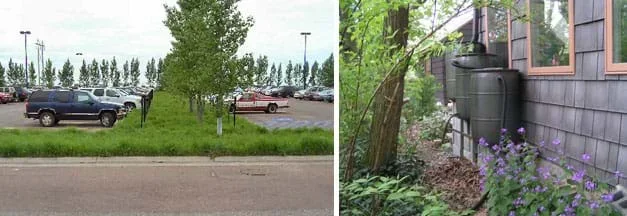 The vegetation in and around this Fargo, ND, parking lot catches all stormwater runoff and filters it. Rain barrels catch roof runoff for use to water nearby plants and trees.Copyright U.S. EPA (left); Prince George's County, MD (right) http://www2.epa.gov/region8/green-infrastructure#4 http://www.princegeorgescountymd.gov/sites/StormwaterManagement/CleanWaterActFees/BMP/Pages/default.aspx
(Slide 10) Downspout disconnection is the process of redirecting roof runoff away from traditional storm sewer collection systems to rain gardens, bioswales, planter boxes, and other GI technologies on-site. These systems allow for infiltration, improved water quality and treatment efficiency on-site and at the source of runoff. Shown to reduce directly connected impervious areas (DCIA) by 40-44%. (Salim, 2002)
(Slide 11) Green streets and alleys refers to the integration of permeable pavement, bioswales, planter boxes, bioretention and native vegetation into the urban streetscape. These systems are designed to store storm event volume, promote evapotranspiration and biogeochemical processes. Benefits of green streets are equivalent to the benefits of green infrastructure and low-impact development. Green streets combine the principles of GI and LID into a product that can be implemented into the urban landscape.
(Slide 12) Parking lots have low traffic volume, high impervious area and vegetative islands, making them great locations to implement green infrastructure design. Green parking refers to the use of GI technologies in parking lots—most commonly pervious pavement, porous concrete, interlocking pavers, rain gardens, bioswales and tree canopies.
Today we will discuss green infrastructure and low-impact development, which are beneficial technologies that provide controls for water quantity (volume) and water quality (treatment) of stormwater runoff within urban watersheds. The guiding principle of low-impact development (LID) is to manage water resources at their sources, that is, where the rain falls, and where it would go without human influence. Green infrastructure (GI) is a type of LID that uses natural systems to manage stormwater runoff in a decentralized fashion, typically receiving stormwater from areas less than two acres in size, and preferably less than one acre.
Green infrastructure systems are sustainable solutions to the traditional centralized stormwater treatment. The most well-known definition of sustainable development was introduced in the Brundtland Report (WCED, 1987), "Sustainable development is development that meets the needs of the present without compromising the ability of future generations to meet their own needs." To achieve sustainable development, three pillars of sustainability must be addressed: 1) environment, 2) social and 3) economic. Sometimes this is referred to as the "triple bottom line."
From an environmental perspective, green infrastructure increases groundwater, provides natural stormwater management, reduces energy usage, improves water quality, and increases natural habitat.
Social aspects to consider are the beautification and increase in recreational opportunities, improved health through cleaner air and water, and improved psychological well-being.
Economic concerns that are met range from reduced future costs of stormwater management to increasing property values and local tourism. (Katzenmoyer, 2013)
- attenuation
- To retain a specified quantity of stormwater from a storm event.
- bioretention
- A rain garden typically constructed with high-permeability media consisting of soil, sand and organic matter, designed to maximize infiltration, improve water quality, promote vegetative growth and biological transformation processes.
- bioswale
- A vegetated, mulched or xeriscaped linear channel that provides stormwater retention and infiltration.
- downspout disconnection
- The process of redirecting roof runoff away from traditional storm sewer collection systems to rain gardens, bioswales, planter boxes and other on-site GI technologies.
- extensive
- Green roof and vegetative walls media layer between 2 to 6 inches.
- green infrastructure
- A type of LID that uses natural systems to manage stormwater runoff in a decentralized fashion, typically receiving stormwater from areas less than 2 acres. Abbreviated as GI.
- green parking
- A parking area that utilizes the principles of GI and LID.
- green roof
- A rooftop planted with a media membrane and native vegetation over a waterproofing membrane/root zone barrier.
- green streets and alleys
- The integration of permeable pavement, bioswales, planter boxes, bioretention and native vegetation into an urban streetscape.
- intensive
- Green roof and vegetative walls media layer greater than 6 inches.
- low-impact development
- To manage water resources at their sources (that is, where the rain falls, and where it would go without human influence). Abbreviated as LID.
- nutrients
- Major chemical compounds derived from nitrogen, phosphorus and potassium that plants need to survive.
- particulate matter
- A complex mixture of extremely small particles and liquid droplets.
- permeable pavement
- A surface that is similar to sidewalks and roadways in terms of allowing vehicular traffic, but dissimilar due to its ability to absorb and infiltrate stormwater runoff through its surface to underlying media layers.
- planter box
- An urban bioretention system with vertical concrete walls designed to collect and retain a specified volume of stormwater runoff.
- ponding zone
- Rainfall runoff collection area.
- rainwater harvesting
- The capturing and storing of rainwater within cisterns or rain barrels to be used for on-site irrigation, toilet flushing car washing or any other later use.
- storage volume
- The volume of water capable of being stored within a GI or LID system.
- stormwater quality
- A measure of the pollution collected from pervious and impervious surfaces from stormwater runoff during a storm event.
- stormwater quantity
- The volume of water from stormwater runoff.
Pre-Lesson Assessment
Questions: Sustainable development is most commonly defined as meeting the needs of the present without compromising the ability of future generations to meet their own needs. (WCED, 1987) The three pillars of sustainability are the environment, economy and society, referred to the triple bottom line.
- Come up with several ideas of how stormwater management can address the three pillars of sustainability. (Example answer: Protect the environment, create jobs and benefit the community.)
- What is a rain garden? Describe it in your own words. (Example answers: A rain garden is a natural system used for collecting stormwater runoff. A rain garden uses plant roots and soil to soak up rain.)
Lesson Embedded Assessment
GI and LID Design Sketching: Before starting the GI and LID Technologies Presentation (PPTX), divide the class into groups of two to three students each. After each slide in the presentation, refer students to the coordinated slide in the GI and LID Technologies Design Scenarios (PPTX) (also a PowerPoint® file) projected on the classroom board. Have groups discuss and free draw on paper their ideas for possible solutions to each real-world scenario and come to a consensus on the best solution. Have the students debate the pros and cons of their design solutions to form a class consensus and sketch on the board the GI and LID solution they would use for each of the 10 urban environment scenarios. Ask and discuss why students would choose to use certain plant types over others and where they would place them. Example plant options might include native vs. non-native, wetland vs. upland or terrestrial, tree vs. shrub, vegetables vs. bees and butterflies). Also, discuss the benefits of each green infrastructure and low-impact development improvement and how it relates to the three pillars of sustainability (environment, economy, society). This process engages students in selecting and sketching on images of real-world scenarios their designs for location-appropriate solutions as they are introduced and described in the presentation. (If no second projector is available, or as an alternative way to do this, print out the design scenarios file as a multi-page handout and have teams use colored markers to sketch in their GI and LID designs over the 10 design scenarios.) Review students' designs see if they incorporate location-appropriate GI and LID technologies in order to gauge their comprehension of the lesson's stormwater management concepts.
Post-Lesson Assessment
Wrap-Up Questions: Conclude the lesson by asking students the following questions, in either class discussion format or as individual writing assignments.
- You are an engineer and advisor to the local city council. The city council has requested your expertise in selecting locations appropriate for permeable pavement such as porous concrete, porous asphalt and pervious interlocking pavers. What areas within the city would you recommend? (Answer: Recommend use of these permeable pavement materials for low-volume traffic areas such as parking lots, driveways, sidewalks, bike paths, outdoor basketball courts, amphitheaters and pedestrian walking malls throughout the urban environment. Discourage implementation in high traffic areas and areas where heavy trucks travel.)
- What are the guiding principles of green infrastructure and low-impact development? (Answer: The guiding principles of these technologies are to manage stormwater at its sources using natural means and to establish conditions so that hydrology and water quality of developed sites approach that of undeveloped sites.)
- What are the environmental and human health benefits of green roofs and vegetative walls? Answer: Benefits include the reduction in quantity of pollution entering downstream ecosystems due to a reduction in stormwater runoff, a reduction in energy use due to an increased insulation factor, an improvement in air quality due to plant species' abilities to take up air pollutants and intercept particulate matter, and an increase in community livability.)
- Describe ideal locations to construct a rain garden. (Answer: Rain gardens are ideally constructed in areas where stormwater collects, typically adjacent to roof runoff and impervious surfaces, such as streets, parking lots and driveways.)
- What are the advantages of GI and LID compared to traditional stormwater infrastructure practices? (Answer: By reducing the volume of water leaving a site from impervious surfaces, you reduce the mass of pollutants entering receiving downstream ecosystems, restoring the health and vitality of the local watershed. Traditional stormwater practices capture stormwater from large watersheds and provide water quality and quantity attenuation at centralized locations. This concentrates the pollutants over a smaller area, making it harder for natural systems to provide high stormwater quality removal efficiency. GI and LID practices allow for the stormwater to infiltrate at the source, restoring the natural hydrology of the developed site compared to traditional stormwater infrastructure that provides limited infiltration and releases the stormwater into downstream surface water ecosystems.)
An excellent online resource (including photograph examples) for the technologies introduced in this lesson is The Value of Green Infrastructure: A Guide to Recognizing Its Economic, Environmental and Social Benefits by the Center for Neighborhood Technology and American Rivers, available at http://www.cnt.org/repository/gi-values-guide.pdf.
Another excellent online resource (including photos) is the U.S. EPA's What Is Green Infrastructure? Website, at http://water.epa.gov/infrastructure/greeninfrastructure/gi_what.cfm.
A source for many good installation photographs of GI and LID technologies at the U.S. EPA's "Green Infrastructure: LID and GI in the Semi-Arid West" at http://www2.epa.gov/region8/green-infrastructure.
Collins, K. A., Lawrence, T. J., Stander, E. K., Jontos, R. J., Kaushal, S. S., Newcomer, T. A., .and Ekberg, M. L. C. (2010). Opportunities and challenges for managing nitrogen in urban stormwater: A review and synthesis. Ecological Engineering, 36(11), 1507-1519. doi: 10.1016/j.ecoleng.2010.03.015
Dietz, M. E. (2007). Low-impact development practices: A review of current research and recommendations for future directions. Water Air and Soil Pollution, 186(1-4), 351-363. doi: 10.1007/s11270-007-9484-z
Holman-Dodds, J. K., Bradley, A. A., and Potter, K. W. (2003). Evaluation of hydrologic benefits of infiltration based urban storm water management. Journal of the American Water Resources Association, 39(1), 205-215. doi: 10.1111/j.1752-1688.2003.tb01572.x
Katzenmoyer, C., Marengo, B. G., Potts, A., and Finneran, C. (2013). Going green to save green – The City of Lanacaster, PA, develops an integrated green infrastructure plan to reduce CSOs and stormwater and nutrient runoff. Water Environment & Technology-WEFTEC, V25,N4.
Passeport, E., Hunt, W. F., Line, D. E., Smith, R. A., and Brown, R. A. (2009). Field Study of the Ability of Two Grassed Bioretention Cells to Reduce Storm-Water Runoff Pollution. Journal of Irrigation and Drainage Engineering-Asce, 135(4), 505-510. doi: 10.1061/(asce)ir.1943-4774.0000006
Salim, Imad, Rabbaig, M., Grazioli, M.. Igwe, A., Sherrill, J. (2002) "Demonstration of Downspout Disconnection Effectiveness." Proceedings of the Water Environment Federation, WEF/CWEA Collection Systems 2002, pp. 65-76(12). http://www.ingentaconnect.com/content/wef/wefproc/2002/00002002/00000006/art00004
World Commission on Environment and Development (WCED; aka Brundtland Commission), United Nations. Our Common Future. (aka Brundtland Report). Oxford, UK: Oxford University Press, 1987. ISBN 019282080X. http://conspect.nl/pdf/Our_Common_Future-Brundtland_Report_1987.pdf
- Urban Stormwater Management
- Natural and Urban "Stormwater" Water Cycles
- Green Infrastructure and Low-Impact Development Technologies
Contributors
Ryan Locicero; Maya Trotz; Krysta Porteus; Jennifer Butler; William Zeman; Brigith Soto
Supporting Program
Water Awareness Research and Education (WARE) Research Experience for Teachers (RET), University of South Florida, Tampa
Acknowledgements
This curriculum was developed by Water Awareness Research and Education (WARE) Research Experience for Teachers (RET) at the University of South Florida, funded by National Science Foundation grant no. EEC 1200682. However, the contents do not necessarily represent the policies of the NSF, and should not be assumed an endorsement by the federal government.
Copyright
2014 by Regents of the University of Colorado; original copyright 2013 University of South Florida