
Does Media Matter? Infiltration Rates and Storage Capacities
Students gain a basic understanding of the properties of media—soil, sand, compost, gravel—and how these materials affect the movement of water (infiltration/percolation) into and below the surface of the ground. They learn about permeability, porosity, particle size, surface area, capillary action, storage capacity and field capacity, and how the characteristics of the materials that compose the media layer ultimately affect the recharging of groundwater tables. They test each type of material, determining storage capacity, field capacity and infiltration rates, seeing the effect of media size on infiltration rate and storage. Then teams apply the testing results to the design their own material mixes that best meet the design requirements. To conclude, they talk about how engineers apply what students learned in the activity about the infiltration rates of different soil materials to the design of stormwater management systems.
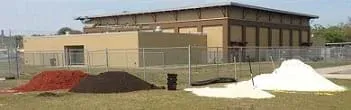 Does the particle size of different types of media affect the infiltration rate of stormwater?Copyright 2013 Ryan Locicero, WARE raingardens.us (author)
The goal of low-impact development and green infrastructure design is to manage stormwater at its sources using natural means, and to establish conditions so that the hydrology and, more specifically, water quality, of developed sites approaches that of pre-development conditions. (Davis, 2006) An understanding of porosity, volume storage, void space and infiltration rates is necessary for the correct design of these systems. Civil and geotechnical engineers must have a comprehensive understanding of in-situ soil mechanics and groundwater flow in order to design effective systems to manage stormwater and design safe foundations for buildings, roads and bridges. Environmental engineers must understand the movement of water as it percolates through different soil layers in order to design technologies that address water quality and treatment of stormwater, groundwater and remediation projects.
After this activity, students should be able to:
- Describe the key soil mechanics and properties of media that determine infiltration rate and storage volume.
- Calculate the storage capacity and infiltration rate of different types of media and media combinations.
- Create a media layer that promotes infiltration, maximizes below-ground water storage, and provides an environment for healthy plants and microbial communities
- CCSS.Math.Content.6.RP.A.1 Understand the concept of a ratio and use ratio language to describe a ratio relationship between two quantities.
Grade 6
Do you agree with this alignment? - CCSS.Math.Content.6.RP.A.3 Use ratio and rate reasoning to solve real-world and mathematical problems, e.g., by reasoning about tables of equivalent ratios, tape diagrams, double number line diagrams, or equations.
Grade 6
Do you agree with this alignment? - CCSS.Math.Content.7.RP.A.2 Recognize and represent proportional relationships between quantities.
Grade 7
Do you agree with this alignment? - CCSS.Math.Content.8.EE.B.5 Graph proportional relationships, interpreting the unit rate as the slope of the graph. Compare two different proportional relationships represented in different ways.
Grade 8
Do you agree with this alignment? - CCSS.Math.Content.8.F.B.4 Construct a function to model a linear relationship between two quantities. Determine the rate of change and initial value of the function from a description of a relationship or from two (x, y) values, including reading these from a table or from a graph. Interpret the rate of change and initial value of a linear function in terms of the situation it models, and in terms of its graph or a table of values.
Grade 8
Do you agree with this alignment? - CCSS.Math.Content.8.SP.A.2 Know that straight lines are widely used to model relationships between two quantitative variables. For scatter plots that suggest a linear association, informally fit a straight line, and informally assess the model fit by judging the closeness of the data points to the line.
Grade 8
Do you agree with this alignment?
- SC.7.E.6.6 Identify the impact that humans have had on Earth, such as deforestation, urbanization, desertification, erosion, air and water quality, changing the flow of water.
Grade 7
Do you agree with this alignment? - SC.7.L.17.3 Describe and investigate various limiting factors in the local ecosystem and their impact on native populations, including food, shelter, water, space, disease, parasitism, predation, and nesting sites.
Grade 7
Do you agree with this alignment? - SC.8.L.18.1 Describe and investigate the process of photosynthesis, such as the roles of light, carbon dioxide, water and chlorophyll; production of food; release of oxygen.
Grade 8
Do you agree with this alignment? - SC.8.P.8.4 Classify and compare substances on the basis of characteristic physical properties that can be demonstrated or measured; for example, density, thermal or electrical conductivity, solubility, magnetic properties, melting and boiling points, and know that these properties are independent of the amount of the sample.
Grade 8
Do you agree with this alignment?
- STEL-2V Analyze the stability of a technological system and how it is influenced by all the components in the system, especially those in the feedback loop.
Grades 9-12
Do you agree with this alignment? - STEL-3G Explain how knowledge gained from other content areas affects the development of technological products and systems.
Grades 6-8
Do you agree with this alignment? - STEL-4S Develop a solution to a technological problem that has the least negative environmental and social impact.
Grades 9-12
Do you agree with this alignment?
- describe the water cycle, the composition and structure of the atmosphere and the impact of oceans on large-scale weather patterns
Grades 5-8
Do you agree with this alignment?
- MS-ESS2-4 Develop a model to describe the cycling of water through Earth's systems driven by energy from the sun and the force of gravity.
Grades 6-8
This resource focuses on the following Three Dimensional Learning aspects of NGSS:
Science & Engineering Practices- Develop a model to describe unobservable mechanisms.Do you agree with this alignment?
Disciplinary Core Ideas- Water continually cycles among land, ocean, and atmosphere via transpiration, evaporation, condensation and crystallization, and precipitation, as well as downhill flows on land.Do you agree with this alignment?
- Global movements of water and its changes in form are propelled by sunlight and gravity.Do you agree with this alignment?
Crosscutting Concepts- Within a natural or designed system, the transfer of energy drives the motion and/or cycling of matter.Do you agree with this alignment?
Do you agree with this alignment? - Develop a model to describe unobservable mechanisms.
- MS-ESS3-3 Apply scientific principles to design a method for monitoring and minimizing a human impact on the environment.
Grades 6-8
This resource focuses on the following Three Dimensional Learning aspects of NGSS:
Science & Engineering Practices- Apply scientific principles to design an object, tool, process or system.Do you agree with this alignment?
Disciplinary Core Ideas- Human activities have significantly altered the biosphere, sometimes damaging or destroying natural habitats and causing the extinction of other species. But changes to Earth's environments can have different impacts (negative and positive) for different living things.Do you agree with this alignment?
Crosscutting Concepts- The uses of technologies and any limitations on their use are driven by individual or societal needs, desires, and values; by the findings of scientific research; and by differences in such factors as climate, natural resources, and economic conditions. Thus technology use varies from region to region and over time.Do you agree with this alignment?
- Relationships can be classified as causal or correlational, and correlation does not necessarily imply causation.Do you agree with this alignment?
Do you agree with this alignment? - Apply scientific principles to design an object, tool, process or system.
- MS-ETS1-1 Define the criteria and constraints of a design problem with sufficient precision to ensure a successful solution, taking into account relevant scientific principles and potential impacts on people and the natural environment that may limit possible solutions.
Grades 6-8
This resource focuses on the following Three Dimensional Learning aspects of NGSS:
Science & Engineering Practices- Define a design problem that can be solved through the development of an object, tool, process or system and includes multiple criteria and constraints, including scientific knowledge that may limit possible solutions.Do you agree with this alignment?
Disciplinary Core Ideas- The more precisely a design task's criteria and constraints can be defined, the more likely it is that the designed solution will be successful. Specification of constraints includes consideration of scientific principles and other relevant knowledge that is likely to limit possible solutions.Do you agree with this alignment?
Crosscutting Concepts- The uses of technologies and any limitations on their use are driven by individual or societal needs, desires, and values; by the findings of scientific research; and by differences in such factors as climate, natural resources, and economic conditions.Do you agree with this alignment?
- All human activity draws on natural resources and has both short and long-term consequences, positive as well as negative, for the health of people and the natural environment.Do you agree with this alignment?
Do you agree with this alignment? - Define a design problem that can be solved through the development of an object, tool, process or system and includes multiple criteria and constraints, including scientific knowledge that may limit possible solutions.
- MS-ETS1-2 Evaluate competing design solutions using a systematic process to determine how well they meet the criteria and constraints of the problem.
Grades 6-8
This resource focuses on the following Three Dimensional Learning aspects of NGSS:
Science & Engineering Practices- Evaluate competing design solutions based on jointly developed and agreed-upon design criteria.Do you agree with this alignment?
Disciplinary Core Ideas- There are systematic processes for evaluating solutions with respect to how well they meet the criteria and constraints of a problem.Do you agree with this alignment?
Do you agree with this alignment? - Evaluate competing design solutions based on jointly developed and agreed-upon design criteria.
- MS-ETS1-3 Analyze data from tests to determine similarities and differences among several design solutions to identify the best characteristics of each that can be combined into a new solution to better meet the criteria for success.
Grades 6-8
This resource focuses on the following Three Dimensional Learning aspects of NGSS:
Science & Engineering Practices- Analyze and interpret data to determine similarities and differences in findings.Do you agree with this alignment?
Disciplinary Core Ideas- There are systematic processes for evaluating solutions with respect to how well they meet the criteria and constraints of a problem.Do you agree with this alignment?
- Sometimes parts of different solutions can be combined to create a solution that is better than any of its predecessors.Do you agree with this alignment?
- Although one design may not perform the best across all tests, identifying the characteristics of the design that performed the best in each test can provide useful information for the redesign process—that is, some of the characteristics may be incorporated into the new design.Do you agree with this alignment?
Do you agree with this alignment? - Analyze and interpret data to determine similarities and differences in findings.
Each group needs:
- 12-inch biodegradable coir hanging basket or planter
- 5-gallon bucket, to catch draining water
- stopwatch
- measuring cup, volumetric cylinder or some other graduated plastic container, for measuring water volume
- Does Media Matter? Worksheet (PDF), one per student
To share with the entire class:
- 50-lb. bag construction/playground sand
- 50-lb. bag soil compost
- 50-lb. bag 3/8-inch limestone or pea gravel
- 2-cu. ft. bag sustainably harvested hardwood mulch, such as Melaleuca or eucalyptus
- (4) 5-gallon plastic buckets
- access to water and sink/drain
Remember from our Green Infrastructure and Low-Impact Development Technologies lesson that soil is a combination of sand, silt, clay, minerals and other organic and inorganic compounds. The organic matter gives soil a black or dark brown color and provides nutrients for plants and bacteria. Typically, the darker the soil, the healthier both plant and microbial communities will be. So that we do not confuse soil with other earth materials that do not contain organic matter, such as rocks, gravel, limestone and granite, we refer to the combination of earth materials as media. The texture of the media is based on the proportion of mineral particles, sand, silt and clay within the media.
Have you ever thought about how water moves once it goes into the ground? Where does it go? What controls how fast it moves into the ground?
From the Natural and Urban "Stormwater" Water Cycles lesson, remember that infiltration is the movement of water into the media layer and percolation is the movement of water within the media layer. The infiltration rate is dependent on intensity and duration of precipitation, vegetative cover and the percolation rate. The percolation rate is affected by gravity, grain size, geology, depth to groundwater table and ability of the surrounding soil to hold water.
Once in the ground, water can be accessed by the plant roots and transpire through the stomata in the plant's leaves. Stomata are pores found in plants' leaves that control gas exchange (that is, carbon dioxide, oxygen and water). An entire world of bacteria and microbial activity also takes place below the ground and within the soil. Water is a critical element to all life and most soil bacteria would not survive if water did not percolate into the ground. The water may then take weeks, months or even years to reach the groundwater table, depending on the permeability of the media that it is passing through. Permeability is the ability of water to pass through media, typically dependent on the porosity and connectivity of open spaces within the media. This water plays a key role in recharging the groundwater table and providing sources for fresh drinking water that makes its way into our everyday lives.
Soil properties are used to classify the infiltration rate and storage capacity, which are both important design considerations for green infrastructure and low-impact development projects. Soil properties are also a key factor in stormwater infrastructure design (for example, dry detention/retention ponds and swales). Storage capacity is defined as the volume of water that can be absorbed within a given media layer. Some of the properties that relate to infiltration rate and storage capacity are texture, porosity, permeability, surface area, grain size distribution, mineralogy and friction.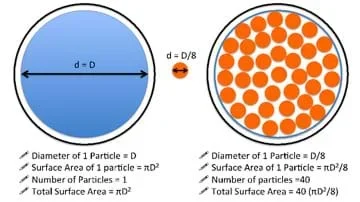 Figure 1. How does the overall surface area differ between different size particles?Copyright 2013 Ryan Locicero, WARE raingardens.us (author)
Let's talk about particle size. Smaller particles have more surface area for the same mass or volume of larger particles. This increase in surface area causes an increase in soil friction due to water contact area. (Illustrate this by drawing a picture of open spaces and surface area such as shown in Figure 1, or by describing how the powdered activated carbon works in a Brita water filter.) Looking at this drawing (Figure 1), we can see that 40 of the smaller orange particles fit into the same area as one of the blue particles. The smaller particles have a diameter that is 1/8 of the larger particle. However, when we calculate the total surface area, we see that the smaller particle has five times the surface area of the larger particle for the same overall area.
Now let's review a few examples to help us understand some of the lesser-known soil properties terms. Imagine we have a bucket of sand. The space between the sand particles is known as the porosity, or the amount of open space between sand particles. Now imagine that we add water to the bucket filling in all of the spaces between the sand particles until the water level reaches the top of the sand. If we kept track of the volume of water added to the bucket, we would know the storage capacity of the sane. If we then drained the water from the bucket and subtracted the drained volume from the storage capacity we would be left with the field capacity. The field capacity is the amount of water remaining in the soil after all water has been drained. The water that is held within the field capacity can be removed through evaporation, plant uptake and transpiration, or by bacteria living within the media. The water remaining in the sand is held in place by capillary action as a result of adhesion, cohesion and surface tension between water and the open spaces within the media. Smaller-sized particles hold more water within their available open spaces due to their increased surface areas. This results in a higher permeability in course sand particles vs. fine clay pa rticles, which is counterintuitive to the fact that clay typically has a higher porosity.
Before the Activity
- You may want to perform this activity in a science classroom or outdoors if weather permits.
- Gather materials and make copies of the Does Media Matter? Worksheet (PDF), one per student.
- Prepare four 5-gallon buckets by placing a different media type into each bucket: sand, soil, gravel, mulch. Fill each bucket with 4 liters of material.
- Have handy a measuring cup or volumetric cylinder for measuring water volume.
- Have stopwatches ready.
- Note that students will need their completed worksheets, coir baskets and media mixes for subsequent activities in this unit.
With the Students
- Divide the class into groups of two or three students each, depending on the class size and availability of resources. Hand out the worksheets.
- Present the Introduction/Motivation content to students, covering the following main points:
- Introduce students to the definition of media. In the context of this activity and the unit as a whole, media is defined as a combination of organic and/or inorganic earth materials. Describe the properties of inorganic vs. organic materials. Have students record the definition of media on the worksheet.
- Ask students if they know where water goes once it enters the ground and if they can define the terms used to describe the movement of water. Direct them to record their answers after the worksheet question: "What do we call the movement of water INTO media layers and define percolation?"
- Familiarize students with the different soil properties and have students record on their worksheets the definitions for the following properties: permeability, capillary action, porosity, percolation, storage capacity and field capacity.
- As a class, calculate the storage capacity of each of the media within the prepared 5-gallon buckets by pouring water into the media layer until the water level reaches the top surface of the material. Keep track of the volume of water being poured into each bucket by first accounting for the water with a measuring cup or volumetric cylinder. This is the storage capacity, have students record these measurements in the worksheet table for each material type.
- Let each group select a media type that it wishes to investigate (make sure at least one group tests each material type) and place the same volume of media as used in step 3 into its planter/basket. Ask students if they think more, less or the same volume of water will drain from the media in the planter/basket and why. Have groups each place a 5-gallon bucket under the planter/basket and then pour the same volume of water that was added to the 5-gallon bucket in step 3 (that is, the known storage capacity). Measure and record on the worksheets the amount of water that drains from the planter/basket graduated containers to get an accurate measurement of the drained volume of water.
- Have students subtract the storage capacity (obtained in step 3) from the volume of water drained from the planter/basket (obtained in step 4) to obtain the field capacity, filling in the worksheet table. Also record comparative observations amongst the media types.
- Continuing on, have groups make sure the media is fully saturated by filling their planters/baskets with water to the top of the media surface. Then have students determine the infiltration rate of the media in their planters/baskets. To determine the infiltration rate, add a known volume of water (such as 1 or 2 liters) and record the time it takes for the water to drain through the planter/basket, making sure to collect, measure and record the volume of water that leaves the planter/basket as well. The volume of water drained from the planter/basket divided by the time it takes for the water to drain is the infiltration rate (ml/sec). Note: It is likely that water will continue to drip from the media after the bulk of the water has passed through. So, make a judgment call to record the time it takes for the bulk of the water to pass through the media.
- Have groups present the data that they collected on their selected media types. As data is presented on media types other than what each group investigated, have them fill in the data from other groups into their worksheet tables, so that everyone has infiltration rates and observations on all media types.
- Next, challenge teams to use what they learned from the group presentations to create their own media mix combinations to best meet the design requirements. Inform them of the design objectives: Create a media layer that promotes infiltration, maximizes below-ground water storage and provides an environment for healthy plants and microbial communities. Make and test a media mix amount that has a total volume of between 2-3 liters. Direct students to first brainstorm as a group and then decide on their designs, recording on their worksheets the types of media and volumes or ratio of each material added.
- Have each group determine the infiltration rate of its media mix combination (ml/sec) by running three experiments on the same media mix, each with different water quantities. Each experiment includes three identical trials, from which average infiltration rates can be calculated. On their worksheets, have students record the measured water volumes and infiltration times, and then calculate the infiltration rates.
- Have students plot the volume of water vs. time. The slopes of the lines are the infiltration rates.
- Conclude by leading a class discussion to share, compare and review student results and solutions, as described in the Assessment section. Collect and review the worksheets.
- capillary action
- Movement of water within the open spaces of a material due to surface tension, adhesion and cohesion forces.
- field capacity
- The amount of water remaining in the soil after all gravitational water is drained.
- infiltration
- The movement of water into media layers.
- media
- A combination of organic and/or inorganic earth materials, such as sand, silt, clay, and minerals.
- percolation
- The movement of water within the media layer.
- permeability
- The ability of water to pass through media, typically dependent on the porosity and connectivity of open space within the media.
- porosity
- The amount of open space within media.
- recharge
- A hydrologic process in which water moves downward from surface water to groundwater; to replenish. Example: We hope that stormwater eventually recharges the groundwater table.
- stomata
- The pores in plant leaves that control gas exchange (of carbon dioxide, oxygen and water).
- storage capacity
- The volume of water that can be absorbed within a media layer.
- water cycle
- The continual movement of water through the Earth and its atmosphere, converting into different states through the processes of evaporation, transpiration, condensation and precipitation.
Pre-Activity Assessment
Predictions: Ask students the following questions:
- What do you think happens to water once it enters into the ground? (Answer: Once in the ground, many types of bacteria and the roots of plants and trees can access the water. The water that does not leave the soil through evapotranspiration may then take weeks, months or even years to reach the groundwater table, depending on the properties of the media that the water must pass through. This water plays a key role in recharging the groundwater table and providing fresh drinking water that makes its way into our everyday lives.)
- Imagine you have a plastic bottle full of sand and you fill the bottle to the top with water and place the cap on it. Now imagine poking holes in the top of the bottle and turning it upside down and draining the water from the bottle. Would you expect less, the same or more water to leave the bottle then you put in, why? (Answer: Less water will leave the bottle then you put in; the technical term for this is the field capacity of the media. This is caused by frictional and surface tension forces between particles. The amount of water remaining in the soil after all water was drained is called the field capacity.)
Activity Embedded Assessment
Worksheet: Have students complete the Does Media Matter? Worksheet (PDF) as they conduct the activity by recording definitions, answering questions, recording measurements and observations, making calculations and graphing data. Review their worksheets to gauge their depth of comprehension.
Media Mix: Challenge teams to design their own media mix combinations based on what they learned from all the group presentations. Design objectives: Create a media layer that promotes infiltration, maximizes below-ground water storage and provides an environment for healthy plants and microbial communities. Have students brainstorm as a group and decide on their designs, recording on their worksheets the types of media and volumes or ratio of each material added. Make and test a media mix amount that has a total volume of between 2-3 liters, recording test results on the worksheets.
Post-Activity Assessment
Wrap-Up: Lead a class discussion to share, compare and review student results and solutions, including the worksheet questions and graph. Ask the students:
- How do the infiltration rates compare across groups' media mixes and the individual media alone? (Have students share their results. Include a comparison of graphs. Make sure students understand that the slopes of the lines are the infiltration rates.)
- Which media mixes worked the best to meet our design criteria? (Answers will vary; let students share their logic and results. See if students have an understanding of what characteristics each media brings to the mix. Many different types of media mix combinations meet the criteria of increasing infiltration and below-ground storage while creating an environment conducive to successful plant establishment and growth. One popular media mix recommended for rain gardens consist of topsoil, sand and mulch in a 2:2:1 ratio. This media mix ratio has produced successful growth and storage results for several rain gardens in East Tampa, FL and Prince George County, MD.)
- How would engineers use the information from this activity? What might they be designing that they need information on infiltration rates? And would they want to use materials with high or low infiltration rates in their designs? (Answer: Engineers would use this information when designing stormwater management systems for new housing/office/shopping/school developments or to improve existing infrastructure. Knowing the infiltration rates of different soil materials can be helpful to reduce standing water in areas that are prone to flooding and to design traditional [such as stormwater ponds] and green infrastructure [such as rain gardens] projects. An infiltration rate is a particularly important factor for understanding how long an area will remain flooded after and between storm events.)
- What happens to fine-grain materials (sand, silt or clay) when we add water to them? How does this differ from courser materials such as rocks or gravel? (Answer: The smaller particles create soil friction, causing the particles to stick together when wet and reducing the movement of water passing through, compared to the coarser materials.)
- Will a smaller or larger particle have a greater field capacity? (Answer: Smaller-sized particles hold more water within their macro-pores due to an increased surface area resulting in a greater field capacity.)
- How does size of media affect the infiltration rate? (Answer: The larger the particle size, the greater the infiltration rate.)
- What media would you use if you wanted to maximize below-ground storage? (Answer: Media with a high infiltration and permeability rate.)
- What media would you use if you wanted to assure healthy plants and bacteria community? (Answer: A media layer with a high organic content and above-average field capacity.)
For additional resources on the water cycle, soil properties and particle size, see the Internet links provided in the Additional Multimedia Support section.
Additional resources on the water cycle, soil properties and particle size:
- The USGS Water Science School: http://ga.water.usgs.gov/edu/
- The Water Cycle: http://studyjams.scholastic.com/studyjams/jams/science/ecosystems/water-cycle.htm • Soil Stories—The Whole Story (a 30-minute video): http://www.youtube.com/watch?feature=player_detailpage&v=Ego6LI-IjbY
- How is powdered activated carbon used? (as in a Brita water filter system): http://science.howstuffworks.com/environmental/energy/powdered-activated carbon.htm
Davis, A. P., Shokouhian, M., Sharma, H., and Minami, C. (2006). Water quality improvement through bioretention media: Nitrogen and phosphorus removal. Water Environment Research, 78(3), 284-293. doi: 10.2175/106143005x94376
- Urban Stormwater Management
- Natural and Urban "Stormwater" Water Cycles
- Green Infrastructure and Low-Impact Development Technologies
- Just Breathe Green: Measuring Transpiration Rates
- Does Media Matter? Infiltration Rates and Storage Capacities
- Making "Magic" Sidewalks of Pervious Pavement
- A Guide to Rain Garden Construction
Contributors
Ryan Locicero; Maya Trotz; Krysta Porteus; Jennifer Butler; William Zeman; Brigith Soto
Supporting Program
Water Awareness Research and Education (WARE) Research Experience for Teachers (RET), University of South Florida, Tampa
Acknowledgements
This curriculum was developed by Water Awareness Research and Education (WARE) Research Experience for Teachers (RET) at the University of South Florida, funded by National Science Foundation grant no. EEC 1200682. However, the contents do not necessarily represent the policies of the NSF, and should not be assumed an endorsement by the federal government.
This material is based upon work supported by the Tampa Bay Estuary Program and the Southwest Florida Water Management District. Any opinions, findings, and conclusions or recommendations expressed in this material are those of the authors and do not necessarily reflect the views of the funding agencies.
Copyright
2014 by Regents of the University of Colorado; original © 2013 University of South Florida