
Just Breathe Green: Measuring Transpiration Rates
Through multi-trial experiments, students are able to see and measure something that is otherwise invisible to them—seeing plants breathe. Student groups are given two small plants of native species and materials to enclose them after watering with colored water. After being enclosed for 10, 20, and 30 minutes, teams collect and measure the condensed water from the plants' "breathing," and then calculate the rates at which the plants breathe. A plant's breath is known as transpiration, which is the flow of water from the ground where it is taken up by roots (plant uptake) and then lost through the leaves. Students plot volume/time data for three different native plant species, determine and compare their transpiration rates to see which had the highest reaction rate and consider how a plant's unique characteristics (leaf surface area, transpiration rate) might figure into engineers' designs for neighborhood stormwater management plans.
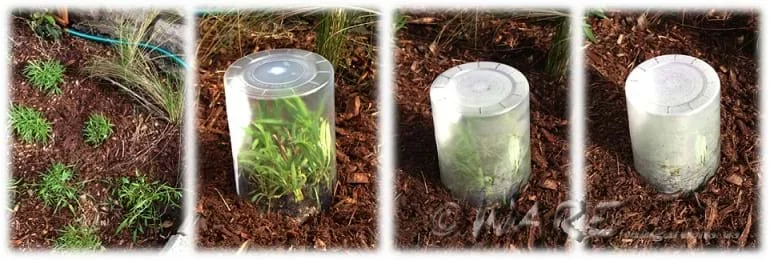 Do plants breathe?Copyright 2013 WARE raingardens.us (used with permission)
Estimating the total amount of water within various processes of the water cycle has been a topic of scientific exploration for more than 150 years and a central focus of hydrology. Practical applications of hydrology are found in such tasks as the design and operation of hydraulic structures, water supply, wastewater treatment and disposal, recreational use of water, and fish and wildlife protection. The role of applied hydrology is to analyze the problems involved in these tasks and provide guidance for planning, and management of water resources. Like engineers, students account for a component of the water budget, calculating the rate of a reaction. Being able to understand and calculate rates is important to engineering design, modeling and research.
After this activity, students should be able to:
- Explain what the rate of a reaction is and how it applies to the urban water cycle.
- Calculate the transpiration rate of reaction for a plant species.
- Create a graph of collected data and select native plant species based on transpiration data.
- CCSS.Math.Content.6.RP.A.1 Understand the concept of a ratio and use ratio language to describe a ratio relationship between two quantities.
Grade 6
Do you agree with this alignment? - CCSS.Math.Content.6.RP.A.3 Use ratio and rate reasoning to solve real-world and mathematical problems, e.g., by reasoning about tables of equivalent ratios, tape diagrams, double number line diagrams, or equations.
Grade 6
Do you agree with this alignment? - CCSS.Math.Content.7.RP.A.2 Recognize and represent proportional relationships between quantities.
Grade 7
Do you agree with this alignment? - CCSS.Math.Content.8.EE.B.5 Graph proportional relationships, interpreting the unit rate as the slope of the graph. Compare two different proportional relationships represented in different ways.
Grade 8
Do you agree with this alignment? - CCSS.Math.Content.8.F.B.4 Construct a function to model a linear relationship between two quantities. Determine the rate of change and initial value of the function from a description of a relationship or from two (x, y) values, including reading these from a table or from a graph. Interpret the rate of change and initial value of a linear function in terms of the situation it models, and in terms of its graph or a table of values.
Grade 8
Do you agree with this alignment?
- SC.7.E.6.6 Identify the impact that humans have had on Earth, such as deforestation, urbanization, desertification, erosion, air and water quality, changing the flow of water.
Grade 7
Do you agree with this alignment? - SC.7.L.17.3 Describe and investigate various limiting factors in the local ecosystem and their impact on native populations, including food, shelter, water, space, disease, parasitism, predation, and nesting sites.
Grade 7
Do you agree with this alignment? - SC.8.L.18.1 Describe and investigate the process of photosynthesis, such as the roles of light, carbon dioxide, water and chlorophyll; production of food; release of oxygen.
Grade 8
Do you agree with this alignment? - SC.8.P.8.4 Classify and compare substances on the basis of characteristic physical properties that can be demonstrated or measured; for example, density, thermal or electrical conductivity, solubility, magnetic properties, melting and boiling points, and know that these properties are independent of the amount of the sample.
Grade 8
Do you agree with this alignment?
- STEL-2V Analyze the stability of a technological system and how it is influenced by all the components in the system, especially those in the feedback loop.
Grades 9-12
Do you agree with this alignment? - STEL-3G Explain how knowledge gained from other content areas affects the development of technological products and systems.
Grades 6-8
Do you agree with this alignment? - STEL-4S Develop a solution to a technological problem that has the least negative environmental and social impact.
Grades 9-12
Do you agree with this alignment?
- describe the water cycle, the composition and structure of the atmosphere and the impact of oceans on large-scale weather patterns
Grades 5-8
Do you agree with this alignment?
- MS-ESS2-4 Develop a model to describe the cycling of water through Earth's systems driven by energy from the sun and the force of gravity.
Grades 6-8
This resource focuses on the following Three Dimensional Learning aspects of NGSS:
Science & Engineering Practices- Develop a model to describe unobservable mechanisms.Do you agree with this alignment?
Disciplinary Core Ideas- Water continually cycles among land, ocean, and atmosphere via transpiration, evaporation, condensation and crystallization, and precipitation, as well as downhill flows on land.Do you agree with this alignment?
- Global movements of water and its changes in form are propelled by sunlight and gravity.Do you agree with this alignment?
Crosscutting Concepts- Within a natural or designed system, the transfer of energy drives the motion and/or cycling of matter.Do you agree with this alignment?
Do you agree with this alignment? - Develop a model to describe unobservable mechanisms.
- MS-ESS3-3 Apply scientific principles to design a method for monitoring and minimizing a human impact on the environment.
Grades 6-8
This resource focuses on the following Three Dimensional Learning aspects of NGSS:
Science & Engineering Practices- Apply scientific principles to design an object, tool, process or system.Do you agree with this alignment?
Disciplinary Core Ideas- Human activities have significantly altered the biosphere, sometimes damaging or destroying natural habitats and causing the extinction of other species. But changes to Earth's environments can have different impacts (negative and positive) for different living things.Do you agree with this alignment?
Crosscutting Concepts- The uses of technologies and any limitations on their use are driven by individual or societal needs, desires, and values; by the findings of scientific research; and by differences in such factors as climate, natural resources, and economic conditions. Thus technology use varies from region to region and over time.Do you agree with this alignment?
- Relationships can be classified as causal or correlational, and correlation does not necessarily imply causation.Do you agree with this alignment?
Do you agree with this alignment? - Apply scientific principles to design an object, tool, process or system.
- MS-ETS1-1 Define the criteria and constraints of a design problem with sufficient precision to ensure a successful solution, taking into account relevant scientific principles and potential impacts on people and the natural environment that may limit possible solutions.
Grades 6-8
This resource focuses on the following Three Dimensional Learning aspects of NGSS:
Science & Engineering Practices- Define a design problem that can be solved through the development of an object, tool, process or system and includes multiple criteria and constraints, including scientific knowledge that may limit possible solutions.Do you agree with this alignment?
Disciplinary Core Ideas- The more precisely a design task's criteria and constraints can be defined, the more likely it is that the designed solution will be successful. Specification of constraints includes consideration of scientific principles and other relevant knowledge that is likely to limit possible solutions.Do you agree with this alignment?
Crosscutting Concepts- The uses of technologies and any limitations on their use are driven by individual or societal needs, desires, and values; by the findings of scientific research; and by differences in such factors as climate, natural resources, and economic conditions.Do you agree with this alignment?
- All human activity draws on natural resources and has both short and long-term consequences, positive as well as negative, for the health of people and the natural environment.Do you agree with this alignment?
Do you agree with this alignment? - Define a design problem that can be solved through the development of an object, tool, process or system and includes multiple criteria and constraints, including scientific knowledge that may limit possible solutions.
- MS-ETS1-3 Analyze data from tests to determine similarities and differences among several design solutions to identify the best characteristics of each that can be combined into a new solution to better meet the criteria for success.
Grades 6-8
This resource focuses on the following Three Dimensional Learning aspects of NGSS:
Science & Engineering Practices- Analyze and interpret data to determine similarities and differences in findings.Do you agree with this alignment?
Disciplinary Core Ideas- There are systematic processes for evaluating solutions with respect to how well they meet the criteria and constraints of a problem.Do you agree with this alignment?
- Sometimes parts of different solutions can be combined to create a solution that is better than any of its predecessors.Do you agree with this alignment?
- Although one design may not perform the best across all tests, identifying the characteristics of the design that performed the best in each test can provide useful information for the redesign process—that is, some of the characteristics may be incorporated into the new design.Do you agree with this alignment?
Do you agree with this alignment? - Analyze and interpret data to determine similarities and differences in findings.
- MS-LS1-6 Construct a scientific explanation based on evidence for the role of photosynthesis in the cycling of matter and flow of energy into and out of organisms.
Grades 6-8
This resource focuses on the following Three Dimensional Learning aspects of NGSS:
Science & Engineering Practices- Construct a scientific explanation based on valid and reliable evidence obtained from sources (including the students' own experiments) and the assumption that theories and laws that describe the natural world operate today as they did in the past and will continue to do so in the future.Do you agree with this alignment?
- Science knowledge is based upon logical connections between evidence and explanations.Do you agree with this alignment?
Disciplinary Core Ideas- Plants, algae (including phytoplankton), and many microorganisms use the energy from light to make sugars (food) from carbon dioxide from the atmosphere and water through the process of photosynthesis, which also releases oxygen. These sugars can be used immediately or stored for growth or later use.Do you agree with this alignment?
- The chemical reaction by which plants produce complex food molecules (sugars) requires an energy input (i.e., from sunlight) to occur. In this reaction, carbon dioxide and water combine to form carbon-based organic molecules and release oxygen.Do you agree with this alignment?
Crosscutting Concepts- Within a natural system, the transfer of energy drives the motion and/or cycling of matter.Do you agree with this alignment?
Do you agree with this alignment? - Construct a scientific explanation based on valid and reliable evidence obtained from sources (including the students' own experiments) and the assumption that theories and laws that describe the natural world operate today as they did in the past and will continue to do so in the future.
- MS-LS2-5 Evaluate competing design solutions for maintaining biodiversity and ecosystem services.
Grades 6-8
This resource focuses on the following Three Dimensional Learning aspects of NGSS:
Science & Engineering Practices- Evaluate competing design solutions based on jointly developed and agreed-upon design criteria.Do you agree with this alignment?
Disciplinary Core Ideas- There are systematic processes for evaluating solutions with respect to how well they meet the criteria and constraints of a problem.Do you agree with this alignment?
- Biodiversity describes the variety of species found in Earth's terrestrial and oceanic ecosystems. The completeness or integrity of an ecosystem's biodiversity is often used as a measure of its health.Do you agree with this alignment?
- Changes in biodiversity can influence humans' resources, such as food, energy, and medicines, as well as ecosystem services that humans rely on—for example, water purification and recycling.Do you agree with this alignment?
Crosscutting Concepts- The uses of technologies and any limitations on their use are driven by individual or societal needs, desires, and values; by the findings of scientific research; and by differences in such factors as climate, natural resources, and economic conditions. Thus technology use varies from region to region and over time.Do you agree with this alignment?
- Small changes in one part of a system might cause large changes in another part.Do you agree with this alignment?
- Scientific knowledge can describe the consequences of actions but does not necessarily prescribe the decisions that society takes.Do you agree with this alignment?
Do you agree with this alignment? - Evaluate competing design solutions based on jointly developed and agreed-upon design criteria.
Each group needs:
- 2 plants of different native plant species, in 4-inch or 1-gallon containers; usually ~$2.50 for a plant in a 4-inch pot and ~$7 for a plant in a 1-gallon pot
- (2) 2-liter or 20-ounce plastic bottles, for 1-gallon and 4-inch plants respectively, or (4) produce baggies
- (if using produce baggies) 4 twist ties
- black permanent marker, such as a Sharpie®
- scale, accurate to 0.1 gram, such as a triple beam balance or laboratory scale
- 2 stopwatches or timers
- gallon jug half filled with water
- calculators
- pencils, colored pencils or markers, ruler (for graphing)
- Just Breathe Green Worksheet (PDF), one per student
For the entire class to share:
- scissors, for teacher to cut plastic bottles
- liquid food coloring, for teacher to prepare colored water, 10 drops per group
Students should know how to draw a best-fit lines from a sets of data points and be able to determine the slope of a line.
Have you ever seen a plant breathe? We learned about plants breathing in our previous lesson, Natural and Urban "Stormwater" Water Cycles. Who remembers—what is this process called? That's right, transpiration. As you remember, plants take up stormwater after it infiltrates into the ground or from groundwater sources. Through the biological process of photosynthesis, plants move water from their roots to their leaves, where it then moves to another phase in the water cycle.
Does anybody remember the hydrologic cycle phase that happens prior to transpiration? (Plant uptake.) How does the water get into the ground for the plants to take it up? (Infiltration and percolation.) What comes after transpiration? (Evaporation.)
As you recall, we can calculate the transpiration rate, or the rate that plants breath, in units of (volume)/(time), such as ml per minute or gallons per day.
Before the Activity
- Gather materials and make copies of the Just Breathe Green Worksheet (PDF), one per student.
- Acquire at least three different plant species, so that at least two different plants are examined by each group and data on all three species can be collected from other groups for graphing and comparison. For example, horsetail, tickseed and tropical sage, all native Florida plants, were used as examples in the Just Breathe Green Worksheet Example Answers (PDF).
- Gather information on each selected native plant species: scientific name, common name and characteristics such as light, water and soil requirements, and height. Alternatively, have students research this information as part of the activity. Usually, state food and agricultural sciences divisions and/or county master gardener programs provide significant native plant data online, such as the University of South Florida Water Atlas at http://www.florida.plantatlas.usf.edu.
- Make sure the main wide part of each plastic bottle is wide enough to fit over the potted plants. Then cut the tops off the plastic bottles where the necks begin to widen, so you essentially have clear plastic domes to cover each plant. Alternatively use plastic produce bags that are big enough to each cover a plant.
- Mix up some colored tap water for each team to water its plants. In each one-gallon jug, mix 10 drops of food coloring into one-half gallon of water.
- This activity works best conducted outside on a sunny day. Bring materials and plants to an outside area that receives direct sunlight. Assign areas for evapotranspiration observation and areas for other experiment work (researching, calculating, graphing, writing).
- Note that students will need their completed worksheets for the last activity in this unit.
With the Students
- Divide the class into groups of two or three students each, depending on the size of the class and resources. Hand out the worksheets.
- Direct students to record the time of day, temperature, humidity, dew point and weather conditions on their worksheets. Refer to an online weather website that provides localized weather conditions, such as Weather Underground at http://www.wunderground.com.
- Assign each plant species with a Plant ID #.
- Water the plants with dyed water until plant media is fully saturated and have students predict what will happen to the dyed water as it moves through the soil and evaporates after transpiration.
- Have each group select two different plant species to study.
- Provide students with the plant species' characteristics (or have students research this information) to record on their worksheets.
- Have students draw an overall sketch of what the plant looks like, providing a detailed drawing of its leaf or grass strand structure.
- Use a black marker to label one plastic bottle/produce baggie with the plant ID #.
- Weigh the bottle or bag on the scale and record its weight to the nearest 0.1 gram. (A more precise measurement may be made, depending on the scale.)
- Place the bottle/bag around the plant. If you are using a produce bag, use a twist tie to secure the bag at the plant base.
- Set a stopwatch or timer for 10 minutes.
- When 10 minutes are up, carefully remove the bottle/bag, without letting any of the accumulated water escape.
- Place plastic bottle/bag on the scale and record its weight on the worksheet.
- Replace the bottle/bag on the plant and repeat steps 10 through 13; in 20 and 30 minute increments, respectively.
- Remember to record your observations of the plants and the bottles/bags covering them for 10, 20, and 30 minute increments.
- Have students sketch overall diagrams of two additional plant species, making sure to include identifying details of the overall plant and its leaf or grass strand structure.
- Collect transpiration data from students in other groups on the two additional plant species and record it on the worksheets.
- Return to the classroom (or use an outdoor classroom) to discuss results and create a data plot. Use different colors or symbols to identify the line for each plant species, and provide a key. Use a ruler to draw a best-fit line of the data.
- Determine the slope of the best-fit lines. To determine the slope of each line, select two points from the best-fit line (x1, y1), (x2, y2) and determine the slope (y2-y1)/(x2-x1). The slope of the line is the transpiration rate.
- Have students finish their worksheets by answering the questions on the last page.
- Conclude by leading a class discussion to share, compare and review student results and conclusions, as described in the Assessment section. Collect and review the worksheets.
- adsorption
- The property of a solid or liquid to attract and hold to its surface a gas, liquid, solute or suspension. A surface-based process while absorption involves the whole volume of the material.
Pre-Activity Assessment
Predictions: Ask students the following questions:
- What phase of the water cycle is a plant's breath? Describe the phases before and after. (Answer: A plant's breath is known as transpiration. It is the flow of water from the ground, where it is taken up by roots [plant uptake] and then lost through the leaves. The transpired water evaporates and then condenses.)
- What do you predict that you will see accumulate on the bottle/bag? Write this on your worksheet. (Answer: Condensed water.)
- Predict the color of water as it evaporates from the plant. Write this on your worksheet. (Answer: Clear.)
Activity Embedded Assessment
Worksheet: Have students complete the Just Breathe Green Worksheet (PDF) as they conduct the activity. Students record and plot data, determine transpiration rates and answer comprehension questions. Review their worksheet predictions, data, calculations, graph and answers to gauge their comprehension.
Post-Activity Assessment
Wrap-Up: Lead a class discussion to share, compare and review student results and conclusions, including the graph and questions on the last page of the worksheet. Ask the students:
- What is a reaction rate and how does it apply to the water cycle? (Answer: Reaction rates are a critical factor in the design of engineered systems. A reaction rate is how fast or slow a reaction takes place. Within the water cycle, the reaction rate is the speed at which water transfers from one phase to another, for example, from plant uptake to transpiration.)
- What was the color of the condensed water, why? (Answer: Clear. Only pure water can evaporate. Any pollutants in the water are adsorbed by soil or remain in the plants' organic biomass.)
- Let's look at your graphs. You plotted the transpiration rate data as volume over time for each plant species, using different colors or line styles for each plant species. (Answer: Investigate with students to discover that 1 ml = 1 g.) If the slope of the line is the transpiration rate, what does the graph tell us? Which plant has the highest transpiration rate? The lowest?
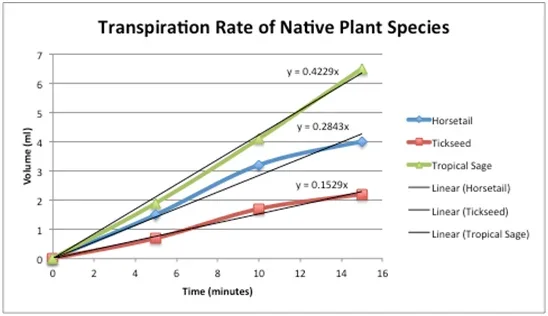 Copyright 2013 Ryan Locicero, University of South Florida
 - What were the physical differences in the plants? Might their physical differences make a difference in their transpiration rates? (Example answer: Tropical sage had the highest transpiration rate. Its physical characteristics include a high leaf surface area to overall plant ratio compared to tickseed, and its leaves have a rough textured surface compared to the horsetail. The increase in leaf surface area provides more area for transpiration to occur.)
- How could engineers use this information in their designs of neighborhood stormwater management plans? (Answer: This information can be used to recommend native plant species to install within a neighborhood's stormwater features. Engineers can base the design of these systems on the volume of water each plant species is capable of removing, transforming it from stormwater runoff to evaporation. Note: Plant characteristics and traits are important to consider when selecting plants. Transpiration values are one of many characteristics to consider and this question asks students how to use the data they collected to design plans and select plants. It is not necessarily true that you would use the plant with the highest transpiration rate. Engineers may decide to add more plants or increase the storage volume within a ponding zone or media layers to account for a specific volume of water for an intended design.)
- Urban Stormwater Management
Contributors
Ryan Locicero; Maya Trotz; Krysta Porteus; Jennifer Butler; William Zeman; Brigith Soto
Supporting Program
Water Awareness Research and Education (WARE) Research Experience for Teachers (RET), University of South Florida, Tampa
Acknowledgements
This curriculum was developed by Water Awareness Research and Education (WARE) Research Experience for Teachers (RET) at the University of South Florida, funded by National Science Foundation grant no. EEC 1200682. However, the contents do not necessarily represent the policies of the NSF, and should not be assumed an endorsement by the federal government.
This material is based upon work supported by the Tampa Bay Estuary Program and the Southwest Florida Water Management District. Any opinions, findings, and conclusions or recommendations expressed in this material are those of the authors and do not necessarily reflect the views of the funding agencies.
Copyright
2014 by Regents of the University of Colorado; original copyright 2013 University of South Florida