
Natural and Urban "Stormwater" Water Cycles
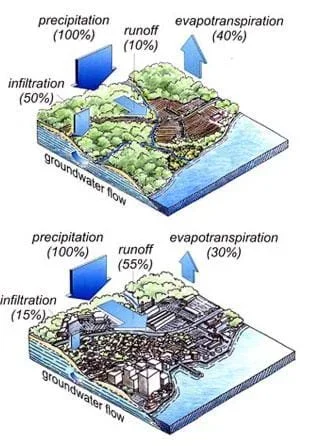 How does the natural water cycle (top) differ from what you would find in your neighborhood?Copyright Commonwealth of Massachusetts http://www.mass.gov/envir/smart_growth_toolkit/pages/mod-lid.html
Through an overview of the components of the hydrologic cycle and the important roles they play in the design of engineered systems, students' awareness of the world's limited fresh water resources is heightened. The hydrologic cycle affects everyone and is the single most critical component to life on Earth. Students examine in detail the water cycle components and phase transitions, and then learn how water moves through the human-made urban environment. This urban "stormwater" water cycle is influenced by the pervasive existence of impervious surfaces that limit the amount of infiltration, resulting in high levels of stormwater runoff, limited groundwater replenishment and reduced groundwater flow. Students show their understanding of the process by writing a description of the path of a water droplet through the urban water cycle, from the droplet's point of view. The lesson lays the groundwork for rest of the unit, so students can begin to think about what they might do to modify the urban "stormwater" water cycle so that it functions more like the natural water cycle. A PowerPoint® presentation and handout are provided.
The hydrologic cycle is the central focus of hydrology. In fluid mechanics, the application of the basic principles of mass, momentum and energy to a fluid flow system is accomplished with a control volume. A comprehensive understanding of the hydrologic cycle is important for civil and environmental engineers who design critical infrastructure systems such as stormwater ponds, control structures, earthen dams, levees, treatment facility influent and effluent; sheet, overland and channelized flows; and stream flow and base flow. They are responsible to account for stormwater runoff, infiltration rates and treatment processes that occur as a result of the stochastic nature of storm events.
After this lesson, students should be able to:
- Discuss the planet's limited freshwater resources.
- Explain how water transforms from one phase to another within the natural water cycle.
- Describe how humans affect the movement of water within the urban water cycle.
- Explain how reaction rates and transformation processes are critical to engineering design.
- SC.6.E.7.In.b Identify components in the water cycle, including evaporation, condensation, precipitation, ground water, and runoff.
Grade 6
Do you agree with this alignment? - SC.6.E.7.Su.b Recognize parts of the water cycle such as clouds (condensation), rain (precipitation), and evaporation.
Grade 6
Do you agree with this alignment? - SC.8.L.18.1 Describe and investigate the process of photosynthesis, such as the roles of light, carbon dioxide, water and chlorophyll; production of food; release of oxygen.
Grade 8
Do you agree with this alignment?
- STEL-3G Explain how knowledge gained from other content areas affects the development of technological products and systems.
Grades 6-8
Do you agree with this alignment?
- describe the water cycle, the composition and structure of the atmosphere and the impact of oceans on large-scale weather patterns
Grades 5-8
Do you agree with this alignment?
- MS-ESS3-4 Construct an argument supported by evidence for how increases in human population and per-capita consumption of natural resources impact Earth's systems.
Grades 6-8
This resource focuses on the following Three Dimensional Learning aspects of NGSS:
Science & Engineering Practices- Construct an oral and written argument supported by empirical evidence and scientific reasoning to support or refute an explanation or a model for a phenomenon or a solution to a problem.Do you agree with this alignment?
Disciplinary Core Ideas- Typically as human populations and per-capita consumption of natural resources increase, so do the negative impacts on Earth unless the activities and technologies involved are engineered otherwise.Do you agree with this alignment?
Crosscutting Concepts- All human activity draws on natural resources and has both short and long-term consequences, positive as well as negative, for the health of people and the natural environment.Do you agree with this alignment?
Do you agree with this alignment? - Construct an oral and written argument supported by empirical evidence and scientific reasoning to support or refute an explanation or a model for a phenomenon or a solution to a problem.
- MS-LS1-6 Construct a scientific explanation based on evidence for the role of photosynthesis in the cycling of matter and flow of energy into and out of organisms.
Grades 6-8
This resource focuses on the following Three Dimensional Learning aspects of NGSS:
Science & Engineering Practices- Science knowledge is based upon logical connections between evidence and explanations.Do you agree with this alignment?
Disciplinary Core Ideas- Plants, algae (including phytoplankton), and many microorganisms use the energy from light to make sugars (food) from carbon dioxide from the atmosphere and water through the process of photosynthesis, which also releases oxygen. These sugars can be used immediately or stored for growth or later use.Do you agree with this alignment?
- The chemical reaction by which plants produce complex food molecules (sugars) requires an energy input (i.e., from sunlight) to occur. In this reaction, carbon dioxide and water combine to form carbon-based organic molecules and release oxygen.Do you agree with this alignment?
Crosscutting Concepts- Within a natural system, the transfer of energy drives the motion and/or cycling of matter.Do you agree with this alignment?
Do you agree with this alignment? - Science knowledge is based upon logical connections between evidence and explanations.
- Natural and Urban "Stormwater" Water Cycle Presentation (pptx)
- Natural and Urban "Stormwater" Water Cycle Presentation (pdf)
- Natural and Urban "Stormwater" Water Cycle Handout (docx)
- Natural and Urban "Stormwater" Water Cycle Handout (pdf)
- Natural and Urban "Stormwater" Water Cycle Handout Answer Key (docx)
- Natural and Urban "Stormwater" Water Cycle Handout Answer Key (pdf)
A general understanding of the water cycle and its processes, and the concept of density.
Lesson Overview
- Before the presenting the Natural and Urban "Stormwater" Water Cycle Presentation (PPTX) (a PowerPoint® file), distribute the Natural and Urban "Stormwater" Water Cycle Handout (PDF) and instruct students to fill in the blanks in the left column, "Your Predictions," with what they know or their best guesses. Let students know that the class will discuss what they answered correctly and incorrectly, examining their preconceived notions and what they learned.
- As a class, go through the presentation using the handout, allowing adequate time for students to fill in the right column, "From the Presentation." Use the slide narration for the presentation, provided below.
- At the conclusion of the presentation, discuss with the class the assumptions they made, what they answered correctly and what they answered incorrectly and why.
- After a detailed explanation of the urban water cycle, assign students the RAFT project described in the Assessment section. For this project, students take on the role of a travel magazine journalist as they describe the journey through the urban water cycle from a water droplet's point of view. Consider having students then conduct the associated activity Natural and Urban "Stormwater" Water Cycle Models to have students experiment with both the natural and urban "stormwater" water cycle models to develop and test hypotheses on how human development impacts the flow of stormwater runoff.
Slide Narration for Natural and Urban "Stormwater" Water Cycles Presentation
(Slide 1) Our planet is covered by nearly 71% water, so why do we call it "planet Earth?" Why not "planet water?" (This question gets students thinking about water." From where does all this water come? Some scientists think it came from comets during the late heavy bombardment period, approximately 3.8 to 4.1 billion years ago, a period when the Earth, our moon and neighboring planets were slammed by an unusually large number of asteroids and comets. One theory, called the "Nice (say 'neece') model," proposes that the gas giant planets of Jupiter, Saturn, Uranus and Neptune swapped orbital paths, forcing objects contained within the asteroid belt to propel towards the terrestrial planets.
(Slide 2) How much water is that? The total volume of water on Earth is estimated at 1,386,984,610 km3 or 366.1 quintillion gallons (18 zeros), fresh water 35,029,210 km3 or 9.3 quintillion gallons (18 zeros), groundwater 10,530,000 km3 or 2.7 quintillion gallons (18 zeros), surface and atmosphere 12,900 km3 or 3.4 quadrillion gallons (15 zeros). (Chow, 1998) (If desired, give students time to do conversions from km3 to gallons.)
The volume of water that goes over Niagara Falls every second is 750,000 gallons. It would take more than 15 billion years for that amount of water to go over the Niagara Falls! (From these numbers, students begin to grasp the enormous quantity of water that makes up our world.) We then must ask the question, is this enough water for everyone, and how much of this water is available to drink?
(Slide 3) How much of that water is available to drink and what portion of drinkable water is part of the water cycle? Generally, we estimate the quantities of water in various forms on Earth to be: 96.5% in the oceans 96.5% and 2.5% as fresh water. Of that fresh water, 1.7% is trapped as polar ice, 0.76% is fresh groundwater, and 0.1% is in the planet's surface and atmosphere. (Chow, 1988)
How many gallons for each person per day? Fresh groundwater sources (0.76%) equate to 391 million gallons per person per year or enough water to fill 521 Olympic sized swimming pools. This is about 1.1 million gallons per person per day. However, groundwater sources are not evenly distributed around the world, which leaves us with surface and atmospheric water as the accessible sources of drinking water. When we investigate these numbers, we find that the volume of surface and atmospheric water is approximately 479,300 gallons per person per year or 1,313 gallons per person per day.
Assuming that only 10% of the water evaporated over water makes it onto land, this means approximately 131 gallons per person per day are available. The average American uses 100 gallons of water per day. And that doesn't count the great amounts of water used by industry to produce clothing, electricity, food and products, and the estimated growth of the future population of the planet. Do you see the water crisis?
Yes, a global water crisis exists, as well as disparity between global drinking water resources and people who do not have access to safe drinking water and sanitation services. The global water crisis will only increase with population growth. It will take innovative thinkers, scientists and engineers to solve these grand challenges.
(Slide 4) When we turn on the faucet, water always comes out. But how does it get there and how do we know that it is safe to drink? Civil and environmental engineers design systems to move this water from surface water and groundwater sources to water treatment facilities and then to our homes. It is their job to provide quality drinking water, assuring our health and safety, and a sufficient quantity of water.
(Slide 5) Civil and environmental engineers use the rates of reaction to design treatment systems and must understand the phase transformation occurring as a result of the reaction, in order to provide water that is safe to drink and release back into nature. As an engineering example, denitrification, the transformation of nitrate (NO3, a fertilizer) to nitrogen gas (N2, 78% of atmosphere) is a critical component in the design and management of wastewater treatment systems.
(Slide 6) Like everything on Earth, the water cycle owes its existence to the sun. The heat from the sun provides energy that drives the water cycle. What are the different components of the natural water cycle? (Answers: Evaporation, condensation, precipitation, infiltration, stormwater runoff, groundwater flow, plant uptake, transpiration. Note: The slide is animated so each mouse click reveals another answer.)
What are the different phases before and after each of these listed phases? (Listen to student descriptions and correct as necessary.) What part of the water cycle creates the clouds that we see in the sky? (Condensation) What is the water cycle phase that happens before condensation? (Evaporation) And what phase(s) may occur after a cloud is formed? This one is kind of tricky; a water molecule may evaporate again or fall from the sky as rain or precipitation. This is a good example of why we call the movement of water from one phase to another a water cycle, because it continuously cycles around and around with no defined beginning or end.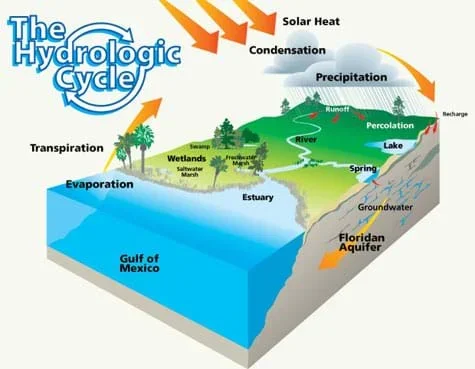 Diagram of the hydrologic cycle.Copyright Southwest Florida Water Management District via Miami-Dade County, FL http://www.miamidade.gov/water/water-cycle.asp
(Slide 7) Evaporation is when water changes from a liquid to a gas (water vapor). By definition, the water cycle has no beginning or end, but if we were going to pick a place to start, evaporation would be a good place. The sun's energy breaks the bonds that hold water molecules together, transforming it from a liquid to a gaseous phase. Net evaporation occurs when the rate of evaporation exceeds the rate of condensation.
(Slide 8) Condensation is when water vapor changes from its gaseous state (vapor) to the liquid phase. As water vapor rises into the atmosphere, it begins to condense as a result of the lower temperatures encountered at higher elevations where atmospheric pressure is less. When the temperature drops below the dew-point temperature, net condensation occurs, which means that the rate of condensation exceeds the rate of evaporation. As a result of net condensation, clouds form.
(It may be a challenge to relate the idea that air higher in the atmosphere weighs less than air at the ground surface. Mention the following examples.) Have you ever flown in a plane? Do you remember feeling the pressure change when you went up and then again as you went down? This change in pressure is a result of the weight of the atmosphere at different elevations. Have you ever dived to the bottom of a pool and felt the pressure change in your ears. This is due to the weight of water, causing an increase in pressure. (After students begin to understand the concept of pressure with change in elevation and how it relates to density, move on, asking the next question.)
A large cumulonimbus cloud can weigh as much as a 747 jumbo jet. So why does it not come crashing down to the ground? (Answer: The rising air responsible for the cloud formation keeps the cloud floating in the air because the air below the cloud is denser than the cloud.)
Moisture in warm air changes to liquid phase as a result of condensation. For example, think of the droplets that form on the side of the glass of your favorite iced drink on a hot day. Likewise, if airplane exhaust contains water vapor, and if the air is very cold (which it often is at high altitudes), then the water vapor in the exhaust "condenses out," resulting in what we call contrails—those white streams we see behind a plane's path in the sky. It is anecdotally believed that if contrails disappear quickly or do not even form, continuing good weather can be expected. On days when these contrails persist and remain in the sky, a change in the weather pattern may be expected.
(Slide 9) Precipitation is condensed water vapor that falls to Earth as rain, snow or hail. It is theorized that water molecules (drops, 10 microns to 5 mm in size) combine with tiny dust, salt and particulate matter (~2.5 microns) that act as a nucleus to form cloud droplets that develop into clouds.
If you look closely at a cloud you can see some parts disappearing (evaporating) while other parts are growing (condensation). Most of the condensed water in clouds does not fall as precipitation because the fall speed is not large enough to overcome updrafts that support the clouds.
Water droplets may grow as a result of additional condensation of water vapor when the particles collide. If enough collisions occur to produce a droplet with a fall velocity that exceeds the cloud updraft speed, then it falls out of the cloud as precipitation. This is not a trivial task since millions of cloud droplets are required to produce a single raindrop. When the evaporation rate is less than the condensation rate, a droplet can grow into a cloud drop.
(Slide 10) Infiltration is the movement of water into the media layer. Media layers consist of sand, soil, and/or organic matter (such as dirt). Factors affecting infiltration rate are: the intensity and duration of a storm event (precipitation), directly connected impervious areas (DCIA, impervious surfaces that are connected to each other without any pervious separation), vegetative land cover and percolation rate. Percolation is the movement of water within the media layer. Factors affecting percolation rate are gravity, grain size, geological formations, depth to groundwater table and the infiltration rate of the surrounding soil. The percolation rate controls the infiltration rate by limiting the flow of above ground water into the media layer.
(Slide 11) Stormwater runoff is the flow of rainwater that occurs as a result of the precipitation rate exceeding the soil infiltration and percolation rate. Stormwater runoff also occurs as a result of impervious surfaces, such as roofs, roads and sidewalks. This excess water flows over the land and impervious surfaces into stormwater sewers and then into stormwater ponds, affecting our ecosystems. Stormwater runoff picks up everything (particulates, nutrients, heavy metals) that settles onto the roofs, roads, sidewalks, grass and any other outdoor surfaces. This process creates a place where all the pollution from our environment collects and is an example of how humans have changed the flow of water as a result of urbanization.
(Slide 12) As stormwater infiltrates and then percolates into the ground, it begins to contribute to groundwater flow. Groundwater flow is the lateral or horizontal flow of water beneath the ground surface. Groundwater levels are typically the surface level at which you can see water in a lake or the level of a well. Water is recharged (replenished) to the groundwater system by percolation of water from precipitation that flows to streams and lakes, and into the groundwater table.
(Slide 13) Plant uptake is the process of plants absorbing water and nutrients in order to grow. Plants use the energy from the sun (photosynthesis) to transform inorganic nutrients into organic above-ground and below-ground biomass. Above-ground biomass uptake begins in spring, peaks in mid-summer, and is very minimal in fall and winter months. A good example of the rate of biomass formation is to think about how often you need to cut the grass in the summer vs. winter.
(Slide 14) Transpiration the process by which plants release water into the air. Transpiration is defined as the water lost from the surface media and groundwater due to plant uptake. Plant roots draw water and nutrients into the stems and leaves through plant uptake. Plants then transpire this water into the atmosphere, which is similar to breathing. To conserve water in the dry season, plants drop their leaves, essentially eliminating transpiration and the growth of the plant.
As an engineering example, a concentration gradient between the moisture inside the plants and the moisture in the atmosphere and capillary action drives the transpiration rate from plant uptake to evaporation. Plants utilize this transformation process to cycle inorganic nutrients into organic biomass, hence growing and removing heat generated from the photosynthesis process.
Transpiration rate examples: An acre of corn gives off about 11,400-15,100 liters (or 3,000-4,000 gallons) of water each day, and a large oak tree can transpire 151,000 liters (or 40,000 gallons) per year. (USGS, 2013) (If desired, give students time to do conversions from liters to gallons.)
(At this point, have students compare their predicted worksheet answers to the correct answers. Lead a class discussion to share observations, examine preconceived notions, recognize any erroneous assumptions and reflect on what they learned.)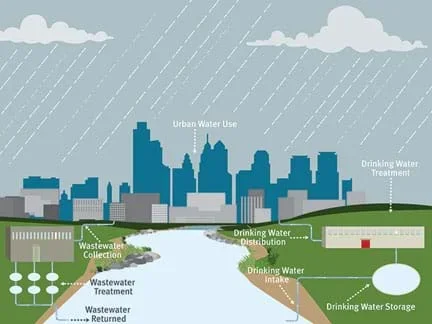 Diagram of the urban water cycle.Copyright City of Philadelphia http://www.phila.gov/water/PublishingImages/urbanwatercycle.jpg
(Slide 15) Urban Water Cycle Overview. (During this section, have students notice any new vocabulary words and their definitions as they are used.) Engineers describe rainfall as stormwater and the quantity (amount and intensity) of rain and duration (time) of rainfall as a storm event. But, where does this stormwater go within the urban environment and how does the urban water cycle differ from the natural water cycle? Let's follow the urban water cycle, starting with stormwater, and see where the water travels.
As stormwater enters the urban water cycle it encounters both pervious and impervious surfaces. An impervious surface is something that water can NOT pass through, such as concrete sidewalks and driveways, asphalt roads, roofs and parking lots. So, a pervious surface is something that water can pass through, allowing stormwater to infiltrate and percolate into the ground.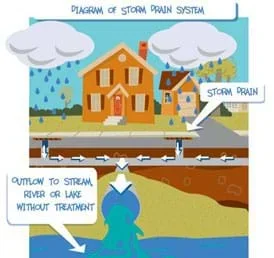 Diagram of storm sewer system.Copyright Monroe County, NY https://www.monroecounty.gov/des-stormwater-coalition
Stormwater that collects on impervious surfaces becomes stormwater runoff. Stormwater runoff is guided along parking lots, curbs and streets to gutters and then into a storm sewer or combined sewer system. A storm sewer is a series of pipes that collects and transports only stormwater. A combined sewer is a series of pipes that collects and transports stormwater and wastewater. Combined sewers are common in several of the oldest U.S. cities such as New York, Boston and Chicago. However, newer cities such as Tampa, Austin, Asheville, San Diego, Portland and Seattle do not have combined sewers.
Stormwater runoff that enters a storm sewer system is transported to surface water collection areas. Surface water may include stormwater ponds, rivers, lakes, estuaries, bays, dams, wetlands, canals, levees, oceans or Gulf Coast areas.
Water is extracted from surface water systems and groundwater sources by drinking water facilities to produce the clean water that comes out of our sink faucets and shower heads, and fills our washing machines, dishwashers and toilets. But where does this water go when it leaves our homes?
The water that leaves our homes is typically classified as wastewater and enters into a combined sewer system or a sanitary sewer system. A sanitary sewer collects only wastewater and does not include stormwater. Both sanitary and combined sewer systems travel under the urban environment as part of the urban infrastructure, transporting our wastewater to a wastewater treatment facility. Here, water is cleaned/treated and released back into the surface water collection systems or used for irrigation, often on city property.
By contrast, the natural water cycle is free of human-made objects and infrastructure, and is mostly composed of pervious surfaces. These pervious surfaces promote infiltration, resulting in high levels of groundwater recharge (absorption or replenishment) and groundwater flow when compared to stormwater runoff.
(Slide 16) Urban Water Cycle RAFT Assignment. Explain to students the assignment, as described on the slide and in the Assessment section: To take on the role of a travel magazine journalist as they describe the journey through the urban water cycle from a water droplet's point of view.
Today we will discuss the important role the water cycle plays in our everyday lives and how the urban "stormwater" water cycle is linked to civil and environmental engineering.
Do you usually hear our planet referred to as "planet Earth?" Why might we better describe our planet as "planet water?" (Answer: Nearly three-quarters of the Earth's surface is covered by water.)
Who can describe for me one of the steps in the water cycle? (Expect students to be able to identify several steps from previous knowledge, such as evaporation, condensation, precipitation).
It is common for engineers to determine the rate of a reaction or what causes transformation processes to take place, for example, speed or velocity, flow rate, kinetics, biological reaction rates, chemical reaction rates. Engineers must know how fast or slow reactions are expected to take in order to correctly design systems. Examples of typical designs relating to the urban water cycle are drinking water treatment plants, wastewater treatment plants and stormwater management facilities.
Today we will focus on understanding the parts of the water cycle, specifically focusing on the urban environment, the causes of transformations from one state to another, how to determine rates of reaction, and the flow of water through the urban water cycle.
The world population is currently 7.2 billion (as of May 2014) and is not equally distributed around freshwater resources. If our planet had equal distribution of freshwater resources, it is estimated that each person would have access to 131 gallons per person per day. The average American uses 100 gallons of water per day, however we must consider water used by industries, for example, the manufacturing of 1 gallon of milk uses 1,000 gallons of water. If the world's population reaches 9 billion by 2050, do we have a global water crisis, and what will you do about it? (Example answer: Yes, a global water crisis exists, as well as a disparity between global drinking water resources and people who do not have access to safe drinking water and sanitation services. The global water crisis will only increase with population growth. It will take innovative thinkers, scientist and engineers to solve these grand challenges.)
What is a sustainable source of drinking water? Is there enough water for everyone? (Answer; A water source that meets internationally recognized water quality standards, is accessible and/or delivered to a home or dwelling, of sufficient quantity and constant pressure, and doesn't negatively affect surrounding ecosystems is recognized as a sustainable source of drinking water. No, there is no enough water for everyone; there is a global water crisis)
- combined sewer
- A series of pipes that collects and transports stormwater and wastewater.
- condensation
- The process in which water vapor changes from a gaseous state (vapor) to the liquid phase.
- directly connected impervious areas
- Impervious surfaces that are connected to each other without any pervious separation. Examples: Driveway to road, gutter to storm sewer. Abbreviated as DCIA.
- evaporation
- The process in which water changes from liquid to a gas or vapor.
- groundwater flow
- A lateral or horizontal flow of water beneath the ground surface.
- impervious surface
- A surface that water can NOT pass through.
- infiltration
- The movement of water into the media layer.
- media layer
- A mix of inorganic and/or organic earth materials, such as sand, soil, mulch, compost, gravel.
- percolation
- The movement of water within a media layer.
- pervious surface
- A surface that water can pass through.
- plant uptake
- The process of plants absorbing water and nutrients in order to grow.
- precipitation
- Condensed water vapor that falls to Earth as rain, snow or hail.
- reaction rate
- The speed of a reaction; how fast or slow a reaction takes place.
- sanitary sewer
- A series of pipes that collects and transports only wastewater and does not include stormwater.
- stochastic
- Unpredictable nature of storm events; random.
- storm duration
- The length of a storm (in hours).
- storm intensity
- The rate of rainfall (in inches per hour).
- storm sewer
- A series of pipes that collects and transports only stormwater.
- surface water
- Water that is contained by stormwater ponds, rivers, lakes, estuaries, bays, dams, wetlands, oceans or Gulf Coast areas.
- transpiration
- A process by which plants release water into the air.
- urban infrastructure
- A structure or system that supports the urban environment. Examples: Roads, bridges, buildings, water distribution, sanitary and storm sewers, stormwater pond, electricity transmission lines, cable and internet.
- wastewater
- Water that exits your home through a drain.
Pre-Lesson Assessment
Predictions: Hand out the Natural and Urban "Stormwater" Water Cycle Handout (PDF) and give students time to write in their known answers or best guesses under the "Your Predictions" column.
Questions: As a class, ask students the following questions to gauge their baseline understanding of the natural water cycle and its transformative phases:
- Can you name and describe the different parts that make up the water cycle? (Answers may include but are not limited to: Evaporation is when water changes from liquid to gas phase; condensation is when water vapor changes from gas to a liquid phase; precipitation is condensed water vapor that falls to the Earth as rain, snow or hail. Tell students that this will be covered in more detail in the lesson presentation.)
- How does the water cycle transform from one phase to another, and are these phases connected? (Answer: All phases within the water cycle are connected to one or more phases, for instance, water condenses in the atmosphere to create precipitation, and precipitation creates stormwater runoff that can be taken up by plants, transpirated, infiltrated or evaporated back into the atmosphere. One phase transforms to the other by following the physical, chemical and biological processes of our natural and urban environment. For example: When a material changes phase, say from liquid to solid, or gaseous to liquid, energy is either released [exothermic reaction, that is, fuel combustion] or absorbed [endothermic reaction, that is, melting, boiling, evaporation, a chemical reaction that absorbs heat from its environment]. This is why you cool off when water evaporates from your skin.)
Lesson Embedded Assessment
Presentation/Handout: Use the Natural and Urban "Stormwater" Water Cycle Presentation (PPTX) to provide the class with an overview of fresh drinking water supplies, the phases within the water cycle and how understanding the water cycle is critical for water resources engineering design. During the slide presentation, have students complete the second column, "From the Presentation," on the Natural and Urban "Stormwater" Water Cycle Handout (PDF). At presentation end, have students compare their pre-assessment predictions to the correct answers and discuss their preconceived notions and assumptions as a class. Then move on to explain the urban water cycle and present students with the RAFT assignment.
Post-Lesson Assessment
Argument: Have students construct an argument (written and/or oral) supported by what they learned for how increases in human population and per-capita consumption of natural resources impact Earth's systems.
RAFT Assignment: An acronym for role, audience, format and topic, RAFT is an approach to creating imaginative and interpretive student projects through varied viewpoints for specific audiences in order to aid in students' processing of ideas and information. For this project, students take on the role of a travel magazine journalist as they describe the journey through the urban water cycle from a water droplet's point of view. Provide students with the guidance below. Review their writings to gauge their depth of comprehension of the facts and concepts related to the urban "stormwater" water cycle.
- You are a travel magazine journalist for Urban Environment Weekly.
- Your assignment this week is to follow the life of a drop of water as it makes its way through the urban environment.
- In your article, include all the descriptive details of whom the drop met and what it encountered along the way.
(Answer: Expect students' creative descriptions to generally follow this sequence of events: Water is drawn from natural surface water sources > cleaned at drinking water facility > delivered to homes via water pipes > leaves homes as wastewater > collected via sewer system > cleaned at water treatment facility > released into surface water collection systems or used for irrigation. Expect them to incorporate new vocabulary words and/or their concepts related to the urban water cycle: impervious surface, pervious surface, storm sewer, combined sewer, surface water, wastewater, sanitary sewer, urban infrastructure, as well as words and concepts related to the natural water cycle.)
An alternate (and better) diagram for the urban water cycle may be found at http://www.pacificwater.org/pages.cfm/water-services/water-demand-management/water-distribution/the-water-cycle.html.
A comprehensive interactive urban water cycle diagram may be found at SEQ Healthy Waterways Partnership at http://www.healthywaterways.org/map.htm.
A great online source for weather data is Weather Underground at http://www.wunderground.com.
Learn the current world human population size at the Worldommeters website at http://www.worldometers.info/world-population/.
Chow, V. T., Maidment, D. R., and Mays, L. W. Applied Hydrology. New York, NY: McGraw-Hill, 1988.
Harrison, J. T. (1996). Managing wastewater in coastal urban areas – Natural Resources Council. Ocean Development and International Law, 27(4), 413-415.
Hsieh, C. H., and Davis, A. P. (2005). Evaluation and optimization of bioretention media for treatment of urban storm water runoff. Journal of Environmental Engineering-ASCE, 131(11), 1521-1531. doi: 10.1061/(asce)0733-9372(2005)131:11(1521)
Hsieh, C. H., Davis, A. P., and Needelman, B. A. (2007). Nitrogen removal from urban stormwater runoff through layered bioretention columns. Water Environment Research, 79(12), 2404-2411. doi: 10.2175/106143007x183844
Hunt, W. F., Smith, J. T., Jadlocki, S. J., Hathaway, J. M., and Eubanks, P. R. (2008). Pollutant removal and peak flow mitigation by a bioretention cell in urban Charlotte, NC. Journal of Environmental Engineering-ASCE, 134(5), 403-408. doi: 10.1061/(asce)0733-9372(2008)134:5(403)
Li, Houng, and Davis, Allen P. (2008). Urban particle capture in bioretention media. II: Theory and model development. Journal of Environmental Engineering-ASCE, 134(6), 419-432. doi: 10.1061/(asce)0733-9372(2008)134:6(419)
Niagara Falls Facts and Information. Last updated 2012. Amazing Niagara Facts, Delaware North Companies Parks and Resorts, Inc., Niagara Falls, NY. Accessed March 5, 2013. http://www.niagarafallsstatepark.com/Amazing-Facts.aspx
Nice model. Last updated August 17, 2013. In Wikipedia, The Free Encyclopedia. Accessed March 5, 2013. http://en.wikipedia.org/wiki/Nice_model
U.S. Geological Survey. "The Water Cycle: Transpiration." Water-Science School. Accessed March 5 2013. http://ga.water.usgs.gov/edu/watercycletranspiration.html
- Urban Stormwater Management
- Natural and Urban "Stormwater" Water Cycles
- Green Infrastructure and Low-Impact Development Technologies
Contributors
Ryan Locicero; Maya Trotz; Krysta Porteus; Jennifer Butler; William Zeman; Brigith Soto
Supporting Program
Water Awareness Research and Education (WARE) Research Experience for Teachers (RET), University of South Florida, Tampa
Acknowledgements
This curriculum was developed by Water Awareness Research and Education (WARE) Research Experience for Teachers (RET) at the University of South Florida, funded by National Science Foundation grant number EEC 1200682. However, the contents do not necessarily represent the policies of the NSF, and should not be assumed an endorsement by the federal government.
This material is based upon work supported by the Tampa Bay Estuary Program and the Southwest Florida Water Management District. Any opinions, findings, and conclusions or recommendations expressed in this material are those of the authors and do not necessarily reflect the views of the funding agencies.
Copyright
2014 by Regents of the University of Colorado; original © 2013 University of South Florida