
The Great Pacific Garbage Patch
The Great Pacific Garbage Patch (GPGP) is an intriguing and publicized environmental problem. This swirling soup of trash up to 10 meters deep and just below the water surface is composed mainly of non-degradable plastics. These plastic materials trap aquatic life and poison them by physical blockage or as carriers of toxic pollutants. The problem relates to materials science and the advent of plastics in modern life, an example of the unintended consequences of technology. Through exploring this complex issue, students gain insight into aspects of chemistry, oceanography, fluids, environmental science, life science and even international policy. As part of the GIS unit, the topic is a source of content for students to create interesting maps communicating something that they will likely begin to care about as they learn more.
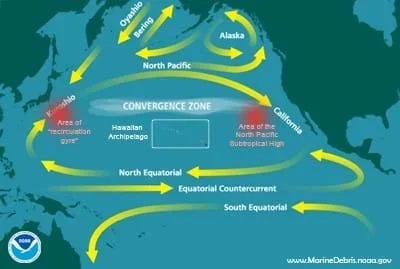 Figure 1. This circulation schematic of the Great Pacific Garbage Patch shows two larger regions of trash, one eastern and one western.Copyright 2010 Marine Debris Program, Office of Response and Restoration, National Oceanographic and Atmospheric Administration http://marinedebris.noaa.gov/info/patch.html#acknow
As with many concepts related to our environment, it is engineers that have enabled the mass application of technology that can influence natural environments such as the global oceans. It is fortunate, however, that it is also engineers that can help solve these problems. In the case of the GPGP (see Figure 1), environmental engineers and scientists help characterize toxicity of these plastics and formulate understanding about their fate and transport. Also, the engineering field has developed and will continue to develop products that do what plastics can do but without the negative consequences (for example, bioplastics) seen at the North Pacific Subtropical Gyre.
After this lesson, students should be able to:
- Explain in a general sense the Great Pacific Garbage Patch (GPGP).
- Describe how the GPGP is formed.
- Explain their relationship to the GPGP and their potential for shared fault.
- Describe how the consumption of goods can result in environmental degradation.
- Describe how plastics are created and explain why it is that some plastics are so resistant to degradation in the ocean.
- Name two or three major environmental impacts of the GPGP and brainstorm solutions to solve related problems.
- Explain how environmental engineers could apply knowledge to try to solve this problem.
- Students will develop an understanding of the effects of technology on the environment.
Grades K-12
Do you agree with this alignment? - The management of waste produced by technological systems is an important societal issue.
Grades 6-8
Do you agree with this alignment? - STEL-4K Examine the ways that technology can have both positive and negative effects at the same time.
Grades 6-8
Do you agree with this alignment? - STEL-4L Analyze how the creation and use of technologies consumes renewable and non-renewable resources and creates waste.
Grades 6-8
Do you agree with this alignment?
- MS-ESS3-4 Construct an argument supported by evidence for how increases in human population and per-capita consumption of natural resources impact Earth's systems.
Grades 6-8
This resource focuses on the following Three Dimensional Learning aspects of NGSS:
Science & Engineering Practices- Construct an oral and written argument supported by empirical evidence and scientific reasoning to support or refute an explanation or a model for a phenomenon or a solution to a problem.Do you agree with this alignment?
Disciplinary Core Ideas- Typically as human populations and per-capita consumption of natural resources increase, so do the negative impacts on Earth unless the activities and technologies involved are engineered otherwise.Do you agree with this alignment?
Crosscutting Concepts- Cause and effect relationships may be used to predict phenomena in natural or designed systems.Do you agree with this alignment?
- Scientific knowledge can describe the consequences of actions but does not necessarily prescribe the decisions that society takes.Do you agree with this alignment?
- All human activity draws on natural resources and has both short and long-term consequences, positive as well as negative, for the health of people and the natural environment.Do you agree with this alignment?
Do you agree with this alignment? - Construct an oral and written argument supported by empirical evidence and scientific reasoning to support or refute an explanation or a model for a phenomenon or a solution to a problem.
- Earth and space. The student knows that natural events and human activity can impact Earth systems. The student is expected to:
Grade 7
Do you agree with this alignment? - Matter and energy. The student knows that matter is composed of atoms and has chemical and physical properties. The student is expected to:
Grade 8
Do you agree with this alignment?
Time Required Note: Plan on 30 minutes to introduce students to most of the lesson concepts. For the Digital Mapping and Geographic Information Systems (GIS) unit, not all of the concepts are essential. Since the unit simply uses the GPGP as subject material for a class mapping project, all that is required is enough time to at least introduce the issue, a minimum of 15 minutes. But if the GPGP is itself to be an important source of learning materials, then this topic could easily be extended to two or even three 55-minute class periods.
Topic Background & Concepts: The Great Pacific Garbage Patch is a complex issue of environmental contamination because it is involves different contaminant types (solid waste, heavy metals, chlorinated organics), complex environmental phenomena (photodegradation, biodegradation, sorption, biomagnifications and food web effects, ocean scale fluid mechanics, runoff entrainment of plastics) and many kind of biological receptors (small fish, plankton, large marine mammals and humans). It is valuable that the issue is in some respects overwhelming because 1) it provides many various tie-ins for all kinds of science, math and technology classes, and 2) it illustrates the reality of the world that students live in—that it is both complex and not necessarily easy to grasp. Climate change is another example of a well known environmental issue at a similar level of complexity.
Much more could be said about the water flow aspects of the problem, which are mainly aspects of runoff, stream flow and ocean currents. Put simply, the water moves the plastics through two main sources, those that are truly marine in origin and those that are land-based than subsequently become marine. Expect students to be able to identify with the prospect of something they throw away eventually finding its way to the ocean, but the source of plastics that are as significant and sometimes more significant to the ocean pollution problem are those from ship waste. NOAA lists three main sources of marine-based wastes: fishing vessels, stationary platforms and cargo ships [7]. All of these marine sources can and do release plastics, even though international conventions (such as MARPOL 73/78 [12]) are in place to limit this behavior. This dumping still occurs as in a famous Nike shoe spill incident that confirmed some ocean current theories and the movements they make. [13]
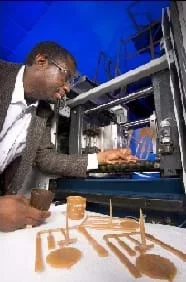 Figure 6. Food technologist Charles Onwulata inspects bioplastics made from excess whey protein and polyethylene, which are readily biodegradable.Copyright U.S. Department of Agriculture {PD} https://www.ars.usda.gov/is/pr/2007/070501.htm
Persistent organic pollutants (POPs) are one often neglected aspect of the GPGP discussion because it is not as visible as the shock of seeing so much plastic floating in the ocean or animals trapped in plastic. POPs are practically any compound that was generally created (at least primarily) by humans that is both organic and heavily resistant to environmental degradation. In a sense, plastics themselves might be considered POPs if not for the general rule that POPs are generally considered to be contaminants that are molecular in size and soluble (at least to some degree) in water. The term is most associated with the international Stockholm Convention on Persistent Organic Pollutants (POPs), and in that convention are listed 12 major chemical classes including more infamous ones like dichlorodiphenyltrichloroethane (DDT), polychlorinated dibenzo-p-dioxin ("dioxins"), and polychlorinated biphenyls (PCBs). [14] Most of these compounds are no longer produced intentionally, but they have remained in the environment because they are very stable. Most POPs are hydrophobic and thus absorb to hydrophobic surfaces, which include organic-rich sediments, suspended particles, and the lipid tissue of animals. Plastic, unfortunately, is also an organic rich substance that removes POPs that might be in a low concentration in ocean waters such that they become highly concentrated on the plastic sorbent. If animals ingest these plastic bits, the POPs come with them, and then the compounds adsorb strongly in their lipid tissues.
Another issue that students may want to consider regarding plastics and plastics in the GPGP are bioplastics. These plastics are made from readily available biological materials that may be turned into plastic. In some sense, all plastics are made from "biological" materials because hydrocarbon fuels are considered themselves to be derived from biological decay thousands of years in the past. The difference with current bioplastics is that they are able to degrade (photolitically and biodegradatively) in the marine environment and possibly even before they are introduced into the marine environment. They are made from many different feedstocks such as corn, potatoes, sugar beets, sugar cane, cassava, wheat, tapioca and soybean oil. [15, 16] Though they are not currently in prominent use, they are gradually garnering a large share of the market, and new companies are springing up to make them while traditional plastics producers like DuPont are switching over from their previous industrial processes. One of the most common examples of bioplastics today is in Target gift cards [17], which are made of Mirel®, a bioplastic of sugar produced by microorganisms housed at the manufacturing company, Metabolix [18].
The Rise of Plastics
June 12, 1958, was the date that the Disneyland opened its "House of the Future" built by Monsanto (show Figure 2 and the online video in the Additional Multimedia Support section). It was a free attraction that featured the most modern conveniences such as dishwashers, in-home intercoms, microwaves, televisions and especially all the uses of plastic. With closets full of polyester clothes, plastic furniture and the main structure of eight pre-fabricated white plastic sections, it showed what the modern home of the future would look like.
By 1967, when the exhibit closed, it was clear that houses would not actually be built completely of plastics.[1, 2] Yet this illustrated the way that the U.S. felt about plastics at the time. Plastics were a modern marvel. They were long-lasting, relatively resistant to bacterial growth, non-toxic, moldable into many shapes, easily colored and often lightweight yet durable. They were also made from petroleum, which at the time seemed in limitless supply. The world seemed brighter with plastics, and there was not much downside to be found.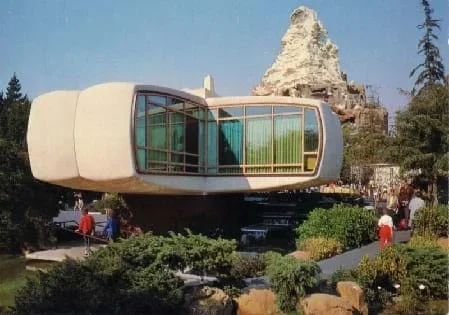 Figure 2. The "House of Tomorrow" created almost entirely out of plastic by the Monsanto Company for Disneyland in Anaheim, CA, in 1957.Copyright 1957 Wikimedia Commons {PD} (original author waived usage rights) http://en.wikipedia.org/wiki/File:Monsanto_House_of_the_Future.jpg
So what do you think? Did we get the "House of Tomorrow" that Monsanto was selling? In one sense, no (we do not live in plastic houses that look like spaceships), but in another sense yes. Look around the room. How many things today do you use that are made of plastic? We often sit in plastic. Our electronics are often composed of much plastic. Probably no one is walking around today in school who is not wearing at least something made of plastic. If you are an amputee, it is likely that you are now yourself made of plastic in some way! [3] So what does that mean? Is it a good thing? Can you imagine your life without plastic? If tomorrow, plastic was outlawed, then suddenly you would not have prosthetic limbs, plastic soda bottles and appliance casings. Entire portions of your car would be missing. As it stands, we are hopelessly dependent on plastic in our daily lives.
How do we arrive at plastic? Consider plastic beverage bottles. We see them everywhere, every day. How did something like this get made? It was made with petroleum (see Figure 3). The same black substance that comes out of the ground that finds its way into cars. It's as if somewhere in that oil barrel there are, in a sense, plastic bottles. Just reach into the barrel and take one! How different is oil in appearance, texture, smell from a plastic bottle? Yet it contains many of the same substances. Beverage bottles are a form of plastic called a polymer. Polymers are chemical substances made from the same repeating chemical unit over and over again usually in long chains. These chains cannot be seen when you look at a plastic bottle visually, but they are present in a much different chemical configuration than oil out of the ground. This explains the differences in appearance and feel and why it is safe to drink out of a plastic bottle though not out of an oil barrel.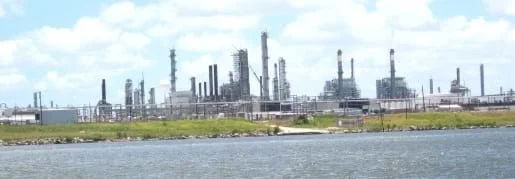 Figure 3. At the Shell oil refinery in Deer Park, TX, plastic monomers such as vinyl chloride and ethylene are made and then polymerized into commercial grade plastics. These monomers or monomer precursors are purified in distillation columns such as these towers seen. Heavier components come out the bottom and lighter ones towards the top.Copyright 2009 Nathan L. Howell, NSF GK-12 Program, College of Engineering, University of Houston
Plastics in the Great Pacific Garbage Patch
What am I describing? Swirling masses of tiny plastic pieces just below the water surface down to 10 meters in depth. [4] An ocean trash dump hundreds to thousands of miles in size. [5] A plastic soup. [6] A place of plastic death for fish and animals that either get trapped in plastic debris or mistake it for food.
For those who have never heard of the Great Pacific Garbage Patch (GPGP), it is shocking to realize that something so large with so much plastic from many nations and even many generations resides in the middle of the Pacific Ocean, thousands of miles from land (see Figure 1) and will likely continue to do so. Students are challenged to inform customers at a local restaurant of how their use and disposal of plastics relates/contributes to the Great Pacific Garbage Patch (GPGP) with the associated activity Plastic in the Ocean: Get the Word Out at McDonalds! Charles Moore, surfer, sailor, volunteer environmentalist, was credited with the discovery of the GPGP in 1997 when, on returning to California in a catamaran from a boat race in Hawaii, took an unusual short cut across the North Pacific Subtropical Gyre. Sailors generally avoid the area because it is a high pressure region of the ocean where winds swirl gently causing the waters to swirl. [4] Navigation is generally not efficient in these conditions. This trip and many since then have revealed the presence of large quantities of floating trash and 90% of it plastic.
Gyres are "a large-scale circular feature[s] made up of ocean currents that spiral around a central point, clockwise in the Northern Hemisphere and counterclockwise in the Southern Hemisphere." They are natural and exist because of oceanic eddies and frontal meanders that act on the fluid in ways that cause it to consistently swirl for years at a time. [7] Gyres exist in many parts of the world, and are not themselves a problem. The waters are hard to navigate and are generally poor in terms of large fish species, but life exists in gyres.
The problem is that any kind of floatable waste that ends up in oceanic waters eventually finds its way to one of these gyres, the most famous of which is the North Pacific Subtropical Gyre that contains the GPGP. NOAA estimates the area to be 7-9 million square miles [7] which, if correct, is 26-34 times the area of Texas. It cannot be seen from an airplane or by satellite because all of the plastic is just below the water surface. This is why Charles Moore only just discovered it upon passing through in 1997. It was likely the GPGP was at some significant size decades before his discovery of it.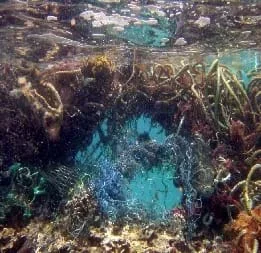 Figure 4. An example of the kind of marine debris masses found in the GPGP.Copyright National Oceanographic and Atmospheric Administration {PD} http://www.noaanews.noaa.gov/stories2006/s2733.htm
You might wonder how all of the plastic from far-away continents gets all the way to the middle of the Pacific Ocean. Consider what happens if you were to put a plastic fork out in a field. Will that ever fork ever end up the GPGP? Is it at least possible? All that the fork has to do is end up in fresh waterways, and that water then flows towards a bay or estuary that takes it to the coastal ocean, then further out to sea (see Figure 4). If a rainstorm comes and has enough runoff to move your plastic fork into a local stream, then it could end up in the GPGP. In this way, you might argue that everyone bears some responsibility for the GPGP. Do you think you could say for sure that there isn't at least some piece of plastic you have used that has NOT ended up in the GPGP? Even if you put it in a trash truck, that plastic could have fallen off and then moved to a stream by wind and rain. Students are challenged to investigate and map plastic debris around them in the associated activities Where Are the Plastics Near Me? (Field Trip) and Where Are the Plastics Near Me? (Mapping the Data).
The consequences of having so much plastic in one location are primarily on marine life. We often see photographs of animals trapped in plastic, and it is especially poignant to see a turtle or a seal trapped in netting or a six-pack plastic ring. Most of the GPGP research, however, indicate that plastic does not exist as the large constituents that they are produced as (such as bottles, forks, packaging and cases). Rather, in the GPGP they exist as small plastic pellets called nurdles. [8] Fish and other wildlife confuse nurdles for food because they are the size of smaller fish that they usually eat (see Figure 5). What's even worse and less predicted is that another environmental problem, chemical contaminants, combines with the plastics to concentrate them for fish to ingest. Pesticides such as DDT, chlordane and dieldrin, and industrial products such as PCBs, readily absorb to nurdles from the ocean water making the plastic pieces even more harmful. [9]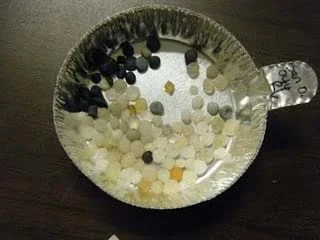 Figure 5. Nurdles collected from beach sands near Bolsa Chica and Newport Beaches in California. These are the tiny bits of plastic that can be confused for food and that can carry organic contaminants.Copyright National Oceanographic and Atmospheric Administratio {PD} http://marinedebrisgov.blogspot.com/search/label/Nurdles.
Future Solutions for the GPGP
So what can be done about the GPGP? What do you think? An obvious action that we already do is to recycle plastic. The EPA estimated in 2008 that recycling for various kinds of plastics was at a rate of 27-29%. [10] It's good, but not great. Far better is to use less plastic or none at all. Recycling and reduction helps to slow the rate of more waste being added to the GPGP, but if population grows faster than each person reduces his/her rate of plastic waste, the overall rate of plastic to ocean still increases.
The larger problem with the GPGP is how to clean up what already exists. Many believe that this problem is too large for one government or agency to deal with, and because even getting a more exact estimate of the patch size or plastic mass is not easy, a cleanup cost estimate is difficult to determine. Given enough time the plastics should photodegrade, but this will likely take more time than would be hoped because much of the plastic does not receive a much sunlight since it as much as 10 meters below the surface and blocked by other plastics above it. One effort to try to clean up the largest pieces of plastic in the GPGP is happening through a recently launched research vessel out of San Francisco [11], and hopefully this is only the beginning. Also, a 19-year old Dutch man has proposed what is being called an efficient and financial viable solution (see The Ocean Cleanup).
In order to most effectively solve the problems associated with GPGP, environmental engineers must develop methods to collect and analyze data that help them better define the specific areas of the problem. For example, environmental engineers and scientists help characterize toxicity of these plastics and formulate an understanding about their fate and transport. Also, the engineering field has developed and will continue to develop products that do what plastics can do but without the negative consequences (for example, bioplastics) seen at the North Pacific Subtropical Gyre.
The lesson of plastics is similar to the lesson of many kinds of technologies that have been developed and used heavily—sometimes the environmental consequences of a technology are not understood well enough before the technology is suddenly everywhere. With plastics, the very characteristics that originally stimulated so much excitement about them, their durability, low toxicity, ease of production, are the same attributes that have created the environmental problem in the GPGP. We have all embraced a world of plastic. Some of the problems with plastic are well-known and easily seen (roadside garbage, landfills containing recyclable material), and some are not as well-known and are mostly unseen. Most people will never see the GPGP, but does that mean that it should not be understood and dealt with?
- plastic
- Any of various organic compounds produced by polymerization, capable of being molded, extruded, cast into various shapes and films, or drawn into filaments used as textile fibers. [19]
- polymer
- Macromolecules composed of repeating structural units called monomers typically connected by covalent chemical bonds.
- great pacific garbage patch
- A mass of floating debris, mostly plastic, in the Northwest Pacific Ocean that spins around central point. It is hundreds to thousands of miles long, floats just below the surface, and extends to a depth of about 10 meters.
- gyre
- A circular or spiral motion, especially a circular ocean current. [19]
- nurdle
- A small piece of plastic broken down from larger plastics by photodegradation in the ocean. Also called mermaid tears.
- photodegrade
- Degradation of chemicals or substances in the environment by sunlight.
- persistent organic compound
- An organic compound that is resistant to degradation chemically, biologically and photolytically.
- hydrophobic
- A characteristic of a chemical species indicating that it thermodynamically prefers to adsorb to substances that are chemically more dissimilar from water rather than similar. Literally "water-fearing."
- bioplastic
- Plastics that still fit the conventional definition of plastics (moldable, colorable, extrudable, etc.) but produced from readily produced biological sources that are usually plant grown or microbial grown. This is in contrast to traditional plastics, which are also polymeric, but are derived from fossil fuel feedstocks.
Class Discussion
Especially after showing the suggested videos to students ask them questions, such as those listed below. Their responses, particularly to questions about the GPGP cause, reveal whether or not they are grasping the issue.
- Why is so much trash out in the middle of the ocean and thousands of miles from land?
- How does human consumerism contribute to this?
- Would the patch be smaller if we recycled more?
- What is that trash mostly made of?
- How do plastics and trash get from your yard all the way to the mid-Pacific Ocean?
- What are some major problems with the GPGP?
- Why is it that the patch does not collect banana peels, but instead collects plastic?
- What type of information would environmental engineers need to collect about the GPGP in order to start to solve the problem?
- Tie-in for GIS If I wanted to use GIS to communicate to someone about the GPGP, how could I do it?
As an alternative, use these questions as a short-answer essay assignment to assess independent thinking on the part of the students rather than class discussion and cooperative thinking. Have students construct an argument supported by evidence for how increases in human population and per-capita consumption of natural resources impact Earth's systems. Additionally, have them further analyze the cause and effect of the GPCP.
Newsletter
The Great Pacific Garbage Newsletter assignment (activity 3: Plastic in the Ocean: Get the Word Out at McDonalds!) serves as assessment and an ongoing learning tool. If this lesson is thoroughly presented, then expect students to have less trouble learning more about using the Internet and putting what they are learning into a simple written format with a few images.
The following videos can be very helpful to engage and explain to student the GPGP issue.
- Good Morning America special on the GPGP: https://www.schooltube.com/watch/gma-the-great-pacific-garbage-patch_lk8h5s4q8bf958.html
- Associated Press' "Disney's House of the Future" video c. 1957 (57 seconds): https://www.youtube.com/watch?v=1NQ5OlY40bA
- HowStuffWorks Show: Episode 1: Corn Plastic video: https://www.youtube.com/watch?v=jwc-n3W9rNY
[1] Icon: Disney's Monsanto House of the Future. Posted April 8, 2009. Daily Icon. Accessed March 23, 2010. http://www.dailyicon.net/2009/04/icon-disneys-monsanto-house-of-the-future/
[2] Monsanto House of the Future. Davelandweb.com. Accessed March 23, 2010. (Many great photographs.) http://www.davelandweb.com/hof/
[3] Advanced Technology in Upper Extremity Prosthetics: Hanger Introduces the i-LIMB® Hand Revolutionary Technology for Upper Limb Amputees. Hanger Inc. Accessed March 23, 2010. http://www.hanger.com/prosthetics/services/Technology/Pages/FeatureArea.aspx
[4] Grant, Richard. "Drowning in Plastic: The Great Pacific Garbage Patch is Twice the Size of France." Posted April 24, 2009. The Daily Telegraph Accessed March 23, 2010. http://www.telegraph.co.uk/news/earth/environment/5208645/Drowning-in-plastic-The-Great-Pacific-Garbage-Patch-is-twice-the-size-of-France.html
[5] Erdman, Shelby L. "Scientists Study 'Garbage Patch' in Pacific Ocean." Posted August 4, 2009. Cable News Network (CNN) Accessed March 23, 2010. http://www.cnn.com/2009/TECH/science/08/04/pacific.garbage.patch/index.html
[6] Howden, Daniel Howden, and Marks, Kathy. "The world's rubbish dump: a tip that stretches from Hawaii to Japan." Posted February 4, 2008. The Independent Accessed March 23, 2010. http://www.independent.co.uk/environment/the-worlds-rubbish-dump-a-garbage-tip-that-stretches-from-hawaii-to-japan-778016.html
[7] NOAA Marine Debris Program. Office of Response and Restoration, NOAA. Accessed March 23, 2010. http://marinedebris.noaa.gov/
[8] Silverman, Jacob. "Why is the world's biggest landfill in the Pacific Ocean?" Published September 19, 2007. Howstuffworks. Accessed March 23, 2010. http://science.howstuffworks.com/great-pacific-garbage-patch.htm
[9] Kostigen, Thomas M. "Better Planet The World's Largest Dump: The Great Pacific Garbage Patch: In the central North Pacific, plastic outweighs surface zooplankton 6 to 1." Published July 10, 2008. Discover. Accessed March 23, 2010. http://discovermagazine.com/2008/jul/10-the-worlds-largest-dump
[10] Municipal Solid Waste Generation, Recycling, and Disposal in the United States: Facts and Figures for 2008. Published November 2009. U.S. Environmental Protection Agency (EPA), Washington, DC. Accessed March 23, 2010. https://www.epa.gov/sites/production/files/2015-09/documents/2012_msw_fs.pdf
[11] Pope, Frank. "Mission to break up Pacific island of rubbish twice the size of Texas." Published May 2, 2009. The Times. Accessed March 23, 2010. http://www.timesonline.co.uk/tol/news/environment/article6206498.ece
[12] International Convention for the Prevention of Pollution from Ships (MARPOL). Adoption 1973. International Maritime Organization. Accessed March 23, 2010. http://www.imo.org/About/Conventions/ListOfConventions/Pages/International-Convention-for-the-Prevention-of-Pollution-from-Ships-(MARPOL).aspx
[13] Sullivan, Walter. "If the Shoe Floats, Follow It." Published September 22, 1992. The New York Times. Accessed March 23, 2010. http://www.nytimes.com/1992/09/22/science/if-the-shoe-floats-follow-it.html?scp=1&sq=hansa+carrier&st=nyt
[14] Stockholm Convention on Persistent Organic Pollutants (POPs). United Nations Environment Program (UNEP). Accessed March 23, 2010. http://chm.pops.int/Home/tabid/2121/mctl/ViewDetails/EventModID/871/EventID/407/xmid/6921/Default.aspx
[15] Ryan, Denise "One Word: Bioplastics | The Technology Gains Momentum, But Hurdles Remain." Published March 2008. Nerac Insights. Accessed March 23, 2010. http://www.nerac.com/nerac_insights.php?category=articles&id=79
[16] Greenemeir, Larry. "Making Plastic Out of Pollution: An emerging crop of companies making plastic out of renewable resources and waste products promises to deliver an environmentally friendly harvest." Published November 8, 2007. Scientific American. Accessed March 23, 2010. https://www.scientificamerican.com/article/making-plastic-out-of-pol/
[17] Der Hovanesian, Mara. "I Have Just One Word for You: Bioplastics." Published August 14, 2008. Business Week. Accessed March 23, 2010.
[18] Mirel: Metabolix. (Mirel is a family of high-performance bioplastics that are biobased and biodegradable plastic alternatives to many petroleum-based plastics.) Bioplastics by Telles. Accessed March 23, 2010. http://www.mirelplastics.com/
Contributors
Nathan Howell; Andrey Koptelov
Supporting Program
National Science Foundation GK-12 and Research Experience for Teachers (RET) Programs, University of Houston
Acknowledgements
This digital library content was developed by the University of Houston's College of Engineering under National Science Foundation GK-12 grant number DGE 0840889. However, these contents do not necessarily represent the policies of the NSF and you should not assume endorsement by the federal government.
Copyright
2013 by Regents of the University of Colorado; original © 2010 University of Houston