
Stop the Flopping: Designing Soccer Shin Guards
Students engineer a working pair of shin guards for soccer or similar contact sport from everyday materials. Since many factors go into the design of a shin guard, students follow the engineering design process to create a prototype. Along the way, students keep a notebook documenting each stage of the process and reflect on what they learned during the design.
 A student tests out her shin guard design in class.Copyright Diane M. Walsh, University of Connecticut RET
Each group will decide on the appropriate supplies to use based on their selected design. The teacher can determine what materials are available for the class; however, in order to adhere to the principle of designing within constraints, encourage students to bring in and use recycled materials and donated items! Some materials the teacher might wish to have on hand for groups to share are below; this is by no means an exhaustive list.
- glue gun (one per group)
- glue sticks
- duct tape
- elastic of varying lengths
- fabric cut into “fat quarters” or 45.75 cm x 55.90 cm (18 in. x 22 in.)
- sewing needles
- spools of thread in various colors
- flexible plastic from recycled three-ring binders or two-liter soda bottles
- Styrofoam or similar packing material saved from shipping packages
- sponges or “magic” erasers
- cardboard of varying thickness, such as cereal boxes or moving boxes)
The men’s and women’s World Cup tournaments are broadcast worldwide and leave only a two-year gap that are filled with professional games and smaller tournaments in virtually every country. Casual soccer (or football as it is known internationally) fans and diehard supporters alike are familiar with “flopping” which is when a player dives to the ground after a hard or light tackle by an opponent. In fact, sometimes players “flop” without being touched! This leaves referees to determine if an injury is real or if the player is faking one as a strategic maneuver for adding stoppage time to the end of the game.
Whether a player is flopping or not, soccer comes with its own specific set of protective gear—the most common being shin guards. Fractures of the tibia, or shinbone, are a dangerous soccer injury and often requiring surgery to implant a metal rod. This can result in months of recovery. Sports and sporting equipment are big businesses and protective gear is one lucrative subset of these businesses. Shin guards are a necessity meant to reduce leg injuries. Although shin guards cannot guarantee tibia fracture prevention, they can reduce lacerations and contusions and minimize the risk of a tibia fracture. Since 2008, the National Operating Committee on Standards for Athletic Equipment (NOCSAE) requires all high school players in the United States to wear NOCSAE-approved shin guards.
Today you will take on the role of an engineer and design a shin guard that reduces lacerations and contusions and minimizes the risk of a tibia fracture. You will only use everyday materials like sponges, foam, cardboard, etc. to design and construct your shin guards, and you will also following the engineering design process and design within the constraints of your materials. Good luck!
- Identify the need/constraints. Ask students to identify the need and constraints in their Engineering Design Process Notebook (PDF). As a group, students should brainstorm what factors are taken into consideration in terms of form, fit, and functionality:
Form: What are the size and the weight constraints of a shin guard? What material choices might engineers consider?
Fit: How can you ensure the product will fit the leg as intended? Brainstorm the shape of the product and what materials might be appropriate ensure a proper fit. Do you need to consider various ages, heights, or weights? Is your product adjustable? For whom are you designing your product?
Function: What is the purpose of the shin guard? Should comfort be a consideration?
Aside from the three factors above, students should discuss the following and add to the list if they have not already:
- comfort
- durability
- adjustability
- protectiveness
- affordability
- wash-ability
- marketability
- product name
- design appeal
- budget (a group should spend $25 or less on their design)
- Research the problem. Ask students, “What designs already exist? What works and what needs improvement? What new innovation can you add to products already on the market?” See Resources listed below.
- Brainstorm/create possible solutions. Have students list ALL the ideas in the group and include sketches. Make sure each person in the group has a chance to share and keep all ideas judgement-free.
- Plan a solution. Discuss all of the possible ideas and agree on the best solution for a prototype. Make sure students keep all of the constraints and research findings in mind as they move forward. Choose and list appropriate materials. Students should decide and document who will be responsible for bringing materials to school for the prototype-building day if they are sourcing recycled or other materials from home.
- Create (build a prototype). Students will have one class period in school to work on building their prototype. They will have one week to put the final changes on their design as homework.
- Evaluate the prototype. A faculty panel will test, evaluate, and score student designs as well as provide feedback. As a group, students should honestly assess how their model compares to other group designs. Teachers and students can follow a rubric in the Stop the Flopping Score Sheet (PDF).
- Improve the design as needed. Based on the faculty evaluations and their own assessment of other group designs, students should discuss what they would change if they had the time to refine their concept.
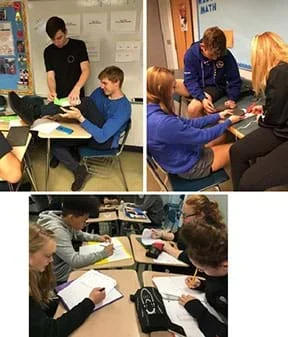 Students brainstorm, sketch, and begin prototyping in class.Copyright Diane M. Walsh, University of Connecticut RET
 Students show off their near-complete designs.Copyright Diane M. Walsh, University of Connecticut RET
Students display their final product as well as their Engineering Design Process Notebook (PDF). Teachers can act as judges to score the shin guards according to the criteria indicated in the provided Stop the Flopping Score Sheet (PDF).
Any safety concerns will depend upon the materials and tools your students use in class. Follow your school rules and provide proper training and safety measures when using any tools.
Teachers may wish to divide the groups so that at least one person in each group is familiar with or has played the game of soccer. Likewise, students who have taken or are currently enrolled in a Physics course should be dispersed evenly amongst the groups.
How to Choose the Best Soccer Shin Guards at Soccer.com: https://www.soccer.com/guide/shin-guard-guide
National Operating Committee on Standards for Athletئic Equipment – Performance Standards: https://nocsae.org/standards/soccer/
Contributors
Diane Walsh; Soliman Alhudaithy; Dr. Kazunori Hoshino; Ashley LaPane
Supporting Program
The Joule Fellows Program, School of Engineering, University of Connecticut RET
Acknowledgements
This material was developed based upon work supported by the National Science Foundation under grant no. EEC 1711706—Sustainable Energy for an Inclusive Society RET site at the University of Connecticut. Any opinions, findings and conclusions or recommendations expressed in this material are those of the authors and do not necessarily reflect the views of the National Science Foundation.
Copyright
2019 by Regents of the University of Colorado; original © 2018 University of Connecticut