
Simon Says Big Amplitude, Small Wavelength!
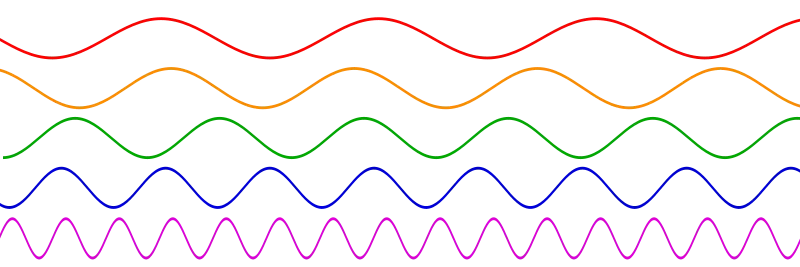 Students make various wavelengths.Copyright Wikimedia Commons http://commons.wikimedia.org/wiki/File:Sine_waves_different_frequencies.svg
In this activity, students play the game Simon Says to make the amplitudes and wavelengths defined by the teacher. First they play alone, and then they play with a partner using a piece of rope.
Engineers use the words wavelength and amplitude to describe the size and shape of a wave. Engineers also design ways to detect when a really big wave, a tsunami, is coming.
After this activity, students should be able to:
- Define wavelength.
- Define amplitude.
- Create waves of varying amplitudes and wavelengths.
- Identify and describe the variety of energy sources
Grade 4
Do you agree with this alignment?
- STEL-3D Explain how various relationships can exist between technology and engineering and other content areas.
Grades 3-5
Do you agree with this alignment?
- DCI.PS4.A.3-5.3 Waves of the same type can differ in amplitude (height of the wave) and wavelength (spacing between wave peaks).
Grade 4
Do you agree with this alignment?
Each group should have:
- 2 m length of rope (about the thickness of a clothesline) (Note: You can re-use the ropes from Lesson 1: Surf's Up, Make Some Waves Activity of this unit.)
- Measuring tape that measure in centimeters
Definitions of longitudinal and transverse waves (Lesson 1 of this unit), and ability to measure in centimeters.
Now that you all understand the two special words that engineers and scientists use to describe the shape and size of waves, we are going to play a version of Simon Says in which you act out different kinds of waves. In order to play this game, you are going to have to be super good listeners, so put on your super listening ears and we will get started!
First, let's review what wavelength and amplitude are. Who can explain the definitions for us? Great! Now, I'm going to demonstrate a few ways to walk with different wavelengths (walk at various stride lengths). Do you see how sometimes my feet are close together and sometimes they are far apart? When did I have a really big wavelength? (Answer: When I took the biggest stride). And when did I have the shortest wavelength? (Answer: When I took the smallest steps).
Now I am going to walk with different amplitudes (walk with various amounts of head bobbing and legs squatting up and down). Did you see how sometimes my head moved up a lot and sometimes not much at all? When did I have the biggest amplitude? (Answer: When my head moved up a lot). How about the smallest amplitude? (Answer: When my head hardly moved at all).
Now we are almost ready to play! Here's how it works – I will tell you an amplitude and wavelength, and you'll get to act it out! Once you are really good at acting out waves, I'll give you a chance to work with a partner to create your own waves out of rope.
Before the Activity
- Gather all necessary materials.
Background
A wave is partially described by its wavelength and amplitude. The wavelength is the distance that it takes for the wave to repeat itself, and the amplitude is the maximum variation of the wave from its equilibrium position. For this activity, you can think of wavelength as width, and amplitude as height.
In the case of Simon Says, a big amplitude and a big wavelength would mean taking very large steps while bobbing your body up and down as much as possible. A small amplitude with a medium wavelength would create a slow, stately walk like you were trying to keep a teacup on your head and not bob up and down much. Walking with a tiny wavelength and big amplitude means legs taking tiny steps while your head bobs up and down a lot. It should be fun to watch!
With the students
- After demonstrating walking with different wavelengths and amplitudes, remind the students that they should only do what you say if your sentence begins with "Simon Says..."
- Make up commands for the students. Suggestions are:
"Simon says...walk with a really big wavelength." (They should be taking large steps).
"Simon says...jump with a tiny amplitude." (They should be taking tiny jumps).
"Simon says...walk with a small wavelength and a big amplitude." (They should be taking tiny steps, with a lot of head bobbing or jumping.)
"Simon says...stand still with an amplitude of 0." (They could lie down.)
- Now give the students rope and the measuring tapes and place them in pairs. With their partner, ask them to create waves of certain wavelengths and amplitudes. Demonstrate first: make a wave (out of the rope) that has a wavelength of 100 centimeters and an amplitude of 30 centimeters. Then let the students work together to figure out how to create that wave. When they are ready, play Simon Says again with the rope.
For example:
"Simon says...make a wave with a wavelength of 60 centimeters and amplitude of 15 centimeters."
"Simon says...make a wave with a wavelength of 80 centimeters and amplitude of 30 centimeters."
Pre-activity Assessment
Act it Out!: Jump up 50 centimeters. Ask the students that considering the lesson they just had, do they think the height of your jump is an example of wavelength or amplitude. (Answer: Amplitude is the best answer, but wavelength is conceivable.) Now walk towards one side of the room, and take large, consistent steps, about half a meter apart. Ask the students if they think the length of your step is an example of wavelength or amplitude. (Answer: Both answers are conceivable, but wavelength is the best answer). What is the wavelength of your walking? (Answer: It is 1 meter; after 2 steps you look exactly like you did before you made the first step). See if they can guess what wavelength and amplitude you are performing with other examples, and put a value on it (e.g., you are walking with a wavelength of 2 feet, or you are clapping with a very big amplitude (it is very loud!).)
Activity Embedded Assessment
You're the Judge!: You are the judge of Simon Says! Use this time to evaluate student comprehension. If a particular student appears to grasp the concepts especially well, invite them to take a turn as Simon.
Post-Activity Assessment
Student Volunteers: Draw a wave on the board with a wavelength of 30 centimeters and an amplitude of 10 centimeters. Ask if there is a student who would like to make this wave with their body or with the rope. Call on multiple students to volunteer.
Remind students to use caution with the ropes; whipping and snapping them can cause injuries to other students.
The students should not use the rope as a lasso.
Use Slinkys® to attempt to create various waves. Have students try to copy a Slinky-wave created by another student.
Draw waves of certain wavelengths and amplitudes on the board and have students estimate their sizes using various units of measurement.
For upper grades, use Excel® to create plots of waves with different wavelengths, amplitudes.
For lower grades, do activity as is.
- Sound and Light
Contributors
Frank Burkholder; Abigail Watrous; Janet Yowell
Supporting Program
Integrated Teaching and Learning Program, College of Engineering, University of Colorado Boulder
Acknowledgements
The contents of this digital library curriculum were developed under a grant from the Fund for the Improvement of Postsecondary Education (FIPSE), U.S. Department of Education, and National Science Foundation GK-12 grant no 0338326. However, these contents do not necessarily represent the policies of the Department of Education or National Science Foundation, and you should not assume endorsement by the federal government.
Copyright
2006 by Regents of the University of Colorado.