
The Visual Spectrum
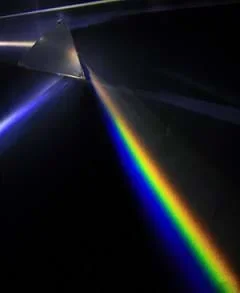 Students explore the visual spectrumCopyright D-Kuru. Wikimedia Commons http://commons.wikimedia.org/wiki/File:Light_dispersion_of_a_mercury-vapor_lamp_with_a_flint_glass_prism_IPNr%C2%B00125.jpg
Students make simple spectroscopes (prisms) to look at different light sources. The spectroscopes allow students to see differing spectral distributions of different light sources. Students also shine a light source through different materials with varying properties and compare the differences.
Engineers design many devices that use different types of electromagnetic waves, including x-rays, microwaves and radio waves. Although they may not realize it, students interact with many of these waves and their applications on a daily basis. Lighting engineers focus on the visible spectrum of electromagnetic waves, and design creative lighting systems for both small and large applications.
After this activity, students should be able to:
- Explain that "white" light is actually made up of many different colors of the visual spectrum.
- Explain how a diffraction grating works.
- STEL-1H Design solutions by safely using tools, materials, and skills.
Grades 3-5
Do you agree with this alignment? - STEL-3D Explain how various relationships can exist between technology and engineering and other content areas.
Grades 3-5
Do you agree with this alignment?
- 4-PS4-2 Develop a model to describe that light reflecting from objects and entering the eye allows objects to be seen.
Grade 4
This resource focuses on the following Three Dimensional Learning aspects of NGSS:
Science & Engineering Practices- Develop models to describe phenomena.Do you agree with this alignment?
Disciplinary Core Ideas- An object can be seen when light reflected from its surface enters the eyes.Do you agree with this alignment?
Crosscutting Concepts- Cause and effect relationships are routinely identified.Do you agree with this alignment?
Do you agree with this alignment? - Develop models to describe phenomena.
Each group needs:
- A mailing tube about 2 in (5 cm) in diameter and about 1 ft (30 cm) long. (Note: To save cost, a tube could also be made by rolling stiff paper into a tube and taping it together.)
- A card-mounted diffraction viewer (available from Edmund Scientifics)
- Three index cards, cut in half
- 4-6 6" lengths of masking or cellophane tape
For groups to share:
- Various light sources: a flashlight, a camping lantern, yellow streetlights (sodium produces the color), blue streetlights (mercury vapor produces the color), neon signs, and slide projector lamps. Note: students can also look at the solar spectrum by looking at the light from the sun reflected off of white paper. Students should NOT look directly as the sun, as serious injury to the eye may occur.
- Various materials to place in front of the light source for the second part of the activity. These materials should include at least one of each: transparent (clear plastic), translucent (wax paper), opaque (cardboard), and reflective (mirror).
Students should be comfortable with the material covered in the following lessons from this unit: Longitudinal and Transverse Waves (Lesson 1), Wavelength and Amplitude (Lesson 2), Frequency (Lesson 3), Light (Lesson 6), and Electromagnetic Waves (Lesson 7).
All right, students, now it's time for our exciting engineering activity! In our lesson, we learned that light is an electromagnetic wave, and that visible light is the only part of the electromagnetic spectrum that we can usually see (without any special equipment). Today we are going to discover that what we think of as white light is actually a combination of many different colors. When all these colors are combined together, the light appears white to our eyes. But, actually, different sources of light give off different combinations, or spectrum, of light.
If white light is really a combination of many different colors of light, how do you think we can break apart the light so that we can see all the colors? Well, we use something really neat called a diffraction grating — I'm going to write that on the board so that you can see what the words look like. A diffraction grating works to break up the different components of the light. It has thousands of very, very tiny grooves etched onto its surface. When light hits the grating, the light diffracts — or, bends — through the grating. (This means that the light actually bends as it goes through the grooves in the grating.)
Since light has many different wavelengths within it, these different wavelengths diffract at different angles. And, since different wavelengths produce different colors, separating the wavelengths means that the colors are separated, so we can see all the different colors within the light.
The name of the device that we are going to make today is called a spectroscope — I'll write that on the board also for you to see. Once you all have made your spectroscopes, you can look at different lights in the classroom to see what different colors they produce. I have one very important warning for you though: you may not take your spectroscope outside, and you may never look directly at the sun with it! Looking at the sun through any type of device is very dangerous, and it will seriously injure your eyes. So, who would like to remind me what we are not going to do with our inventions? Correct! We are not going to look at the sun. Great, now that you all know the safety rules, I think we're ready to begin building!
Background
Spectroscopes divide light into its component wavelengths. White light is especially dramatic because many different colors of the visual spectrum can combine to make white light. Two "white" light sources can have very different spectral compositions.
The diffraction grating acts like a prism. When white light shines on a prism, the colors in white light separate from each other because they refract at different angles depending on their wavelength. This can sometimes be seen in nature when water droplets in the air refract sunlight to create rainbows.
Light can be absorbed, reflected (or diffused), and refracted. Some materials can affect how light bends in more than one way, refracting and reflecting light at the same time. Objects made of more than one substance will likely have different reflective, refractive and absorptive properties.
Light reflects at a predictable angle: the angle of the light that strikes a surface equals the angle of the light that bounces off the surface. Rough surfaces scatter (diffuse) light, which can cause glare, blur an image or prevent us from actually seeing an image.
Light changes speed and direction — or, refracts — when it moves from one transparent medium to another. The refractive property of transparent materials can be used to make lenses that focus light (e.g., cameras, eyeglasses, telescopes).
Before the Activity
- Collect different light sources to bring into the classroom. Possible sources include: flashlights, camping lanterns, an overhead projector and neon lights.
- Cut the mailing tubes to 12" long, (or build tubes out of thick paper and tape) and cut the index cards in half.
With the Students
- Go over all the instructions, demonstrating and explaining each step to the students as they watch.
- Divide the students into groups and pass out materials. Each group should get two halves of an index card, one tube and one diffraction grating.
- Have the students cover one open end of the tube with pieces of index card to create a vertical slit in the middle of the opening about 3/16 inch (5 mm) wide. Tell the students to tape these pieces lightly in place at first. They may wish to adjust these cards later.
- Instruct students to place the diffraction grating at the other end. They should use tape and index cards to attach it, making sure that the grooves on the grating are oriented the same direction that the slit is at the other end.
- Their spectroscope is ready to use. Ask students to turn the tube so that the slit is facing a light source. An ordinary incandescent lamp is a good start. (Note: Be sure students hold the tube so that the slit is oriented vertically.)
- Instruct students to look through the end of the tube with the diffraction grating on the end. They should see lines of different colors corresponding to different wavelengths of light. This is called a spectrum. One of the lines of color is a spectra. It should extend to the right and left. If they do not see the spectrum extending to both sides, the scratches on the grating are not parallel to the slit. Instruct students to turn the grating 90 degrees and look again. They should adjust further as necessary until the spectrum extends to the left and right of the vertical slit, and then tape the grating securely in place.
- Ask students to carefully adjust the slit width until they obtain a spectrum that is both reasonably bright and reasonably well defined.
- Have students compare the spectra of different light sources. Note differences in the colors and the spacing of the spectra. An incandescent bulb should produce a continuous spectrum where one color blends into another. A fluorescent bulb should create more distinct spectra, with less power in many wavelengths.
- After students have finished with their spectroscopes, have them investigate placing different objects in front of one of the light sources. Distribute a light source to each group; these can be different from the light source the group used already in the activity.
- Have student groups take turns with each of the materials (suggested materials: clear plastic, wax paper, cardboard, mirror). Have them record their observations for the different types of materials and discuss the differences.
- diffraction grating
- A grating that uses the diffraction of light to separate light into its various component wavelengths, and thus its component colors.
- spectroscope
- A device that divides light into its component wavelengths; acts like a prism separating the colors of visible light.
Pre-Activity Assessment
Sharing About Light: Ask students to share what they know about light. Ask if any students have ever seen a prism. Does anyone know how a prism works? Let students know that "white" light is actually a combination of many different colors.
Activity Embedded Assessment
Interactive Assistance: As you assist students with the activity, ask what they are learning and discovering through the process. Encourage students to try their spectroscope on many different light sources in the classroom.
Post-Activity Assessment
Think-Pair-Share: Tell students you are going to ask them a question, and you want them to think about it for a minute, then turn to the person next to them and talk about their answers together for one minute. Then you will call on pairs of students to share their answers. The question is: how does a diffraction grating work?
Remind students NEVER to look at the sun with their spectroscopes.
If spectroscopes do not work, rotate the diffraction grating 90 degrees.
Remind students that they may need to be patient as they get their spectroscopes to work. It will take some tinkering to get the spectrums to appear on the index cards.
- Students can make posters of the spectral power distribution of the light sources in the classroom.
- Students may take a "light field trip" to different rooms in the school to see what different types of light spectrum they can discover.
- For upper grades, have students figure out a way to quantify the amount of color at each wavelength. They can make freehand or computer charts.
- For lower grades, do activity as is.
- Sound and Light
Contributors
Luke Simmons; Frank Burkholder; Abigail Watrous; Janet Yowell
Supporting Program
Integrated Teaching and Learning Program, College of Engineering, University of Colorado Boulder
Acknowledgements
The contents of this digital library curriculum were developed under a grant from the Fund for the Improvement of Postsecondary Education (FIPSE), U.S. Department of Education, and National Science Foundation GK-12 grant no 0338326. However, these contents do not necessarily represent the policies of the Department of Education or National Science Foundation, and you should not assume endorsement by the federal government.
Copyright
2007 by Regents of the University of Colorado.