
Sound and Light
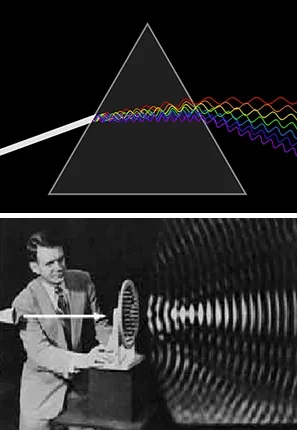 Students investigate sound and light wavesCopyright Lucas V. Barbosa; Woods Hole Science Center, U.S. Geolotical Survey
https://commons.wikimedia.org/wiki/File:Light_dispersion_conceptual_waves.gif
http://woodshole.er.usgs.gov/operations/sfmapping/soundhist.htm
Students investigate sound and light wavesCopyright Lucas V. Barbosa; Woods Hole Science Center, U.S. Geolotical Survey
https://commons.wikimedia.org/wiki/File:Light_dispersion_conceptual_waves.gif
http://woodshole.er.usgs.gov/operations/sfmapping/soundhist.htm
Students are provided with an understanding of sound and light waves through a "sunken treasure" theme—a continuous storyline throughout the lessons. In the first five lessons, students learn about sound, and in the rest of the lessons, they explore light concepts.
Engineers create new things for the benefit of society; they apply their understanding of the science of sound and light waves to the invention and evolution of many devices and products used daily for improved living, safety or prevention of harm. Sonar, reading glasses, light bulbs, stereo equipment and lasers, are just a few of the many items that engineers are involved in designing. To develop the technologies necessary to create these items, engineers must thoroughly understand how sound and light waves work, as well as wavelengths and amplitudes of waves. For example, engineers design vessels that travel on ocean waves and tsunami detection devices to warn people of approaching danger.
Engineers apply their understanding of frequencies to design many commonly used items such as lights, televisions and even traffic signals. Frequency is an important aspect of music; notes with different frequencies make different sounds. Acoustic engineers help to design theatres and auditoriums in order to optimize the sounds produced on stage for the benefit of the audience.
Being able to see is crucial for many everyday tasks. Engineers have developed electricity and lighting to help us see in the dark. Lighting engineers design the lighting systems where we live and work, customizing them for specific needs and conditions.
The list of how engineers apply their understanding of waves goes on and on, such as the use of electromagnetic waves in gamma radiation emitted by fuel rods in nuclear power plants, x-rays to peer inside our bodies, ultraviolet light for sanitation, microwaves for cooking, and radio waves to communicate over large distances.
- 4-PS3-2 Make observations to provide evidence that energy can be transferred from place to place by sound, light, heat, and electric currents.
Grade 4
This resource focuses on the following Three Dimensional Learning aspects of NGSS:
Science & Engineering Practices- Make observations to produce data to serve as the basis for evidence for an explanation of a phenomenon or test a design solution.Do you agree with this alignment?
Disciplinary Core Ideas- Energy can be moved from place to place by moving objects or through sound, light, or electric currents.Do you agree with this alignment?
- Energy is present whenever there are moving objects, sound, light, or heat. When objects collide, energy can be transferred from one object to another, thereby changing their motion. In such collisions, some energy is typically also transferred to the surrounding air; as a result, the air gets heated and sound is produced.Do you agree with this alignment?
- Light also transfers energy from place to place.Do you agree with this alignment?
- Energy can also be transferred from place to place by electric currents, which can then be used locally to produce motion, sound, heat, or light. The currents may have been produced to begin with by transforming the energy of motion into electrical energy.Do you agree with this alignment?
Crosscutting Concepts- Energy can be transferred in various ways and between objects.Do you agree with this alignment?
Do you agree with this alignment? - Make observations to produce data to serve as the basis for evidence for an explanation of a phenomenon or test a design solution.
- 4-PS4-1 Develop a model of waves to describe patterns in terms of amplitude and wavelength and that waves can cause objects to move.
Grade 4
This resource focuses on the following Three Dimensional Learning aspects of NGSS:
Science & Engineering Practices- Develop a model using an analogy, example, or abstract representation to describe a scientific principle.Do you agree with this alignment?
- Science findings are based on recognizing patterns.Do you agree with this alignment?
Disciplinary Core Ideas- Waves, which are regular patterns of motion, can be made in water by disturbing the surface. When waves move across the surface of deep water, the water goes up and down in place; there is no net motion in the direction of the wave except when the water meets a beach. (Note: This grade band endpoint was moved from K-2.)Do you agree with this alignment?
- Waves of the same type can differ in amplitude (height of the wave) and wavelength (spacing between wave peaks).Do you agree with this alignment?
Crosscutting Concepts- Similarities and differences in patterns can be used to sort and classify natural phenomena.Do you agree with this alignment?
Do you agree with this alignment? - Develop a model using an analogy, example, or abstract representation to describe a scientific principle.
- Day 1: Surf's Up! lesson and Make Some Waves activity
- Day 2: Checking the Surf lesson
- Day 3: Simon Says Big Amplitude, Small Wavelength! activity
- Day 4: Making Music lesson and Simple Instruments activity
- Day 5: Plumbing the Deep - Using Sound Waves to See lesson and Echolocation in Action! activity
- Day 6: To Absorb or Reflect... That is the Question lesson and Controlling Sound activity
- Day 7: Needing Illumination – Investigating Light lesson and Light Scavengers activity
- Day 8: Visible Light and the Electromagnetic Spectrum lesson
- Day 9: The Visual Spectrum activity
- Day 10: Building a Fancy Spectrograph activity
- Day 11: Pictures Please – Traveling Light lesson and Create a Pinhole Camera activity
Supporting Program
Integrated Teaching and Learning Program, College of Engineering and Applied Science, University of Colorado Boulder
Acknowledgements
The contents of this digital library curriculum were developed under grants from the Fund for the Improvement of Postsecondary Education (FIPSE), U.S. Department of Education, and the National Science Foundation (GK-12 grant no. 0338326). However, these contents do not necessarily represent the policies of the Department of Education or National Science Foundation, and you should not assume endorsement by the federal government.
Copyright
2009 by Regents of the University of Colorado