
Checking the Surf
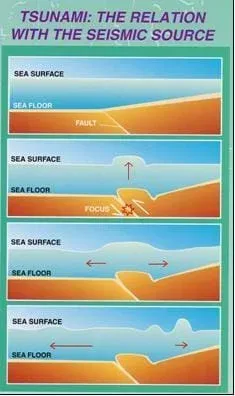 Figure 1. An illustration of tsunami waves.Copyright National Environment Agency, Singapore, http://app.nea.gov.sg/cms/htdocs/article.asp?pid=1085#whattunami
This lesson introduces the concepts of wavelength and amplitude in transverse waves. In the associated activity, students use ropes and their bodies to investigate different wavelengths and amplitudes.
Engineers use wavelengths and amplitude to quantify different types of waves. They have developed tsunami detection devices to help warn people of the approach of a tsunami, which can be very dangerous — oftentimes destroying entire coastal communities. The amplitude of an ocean wave is typically 2 to 3 meters, but an undersea earthquake can create tsunamis with amplitudes greater than 10 meters. Engineers must have a good understanding of how waves can amplify under what conditions to create technology to help prevent disaster and even death.
After this lesson, students should be able to:
- Define wavelength.
- Define amplitude.
- Draw and label the wavelength and amplitude of a wave.
- STEL-3D Explain how various relationships can exist between technology and engineering and other content areas.
Grades 3-5
Do you agree with this alignment?
- 4-PS4-1 Develop a model of waves to describe patterns in terms of amplitude and wavelength and that waves can cause objects to move.
Grade 4
This resource focuses on the following Three Dimensional Learning aspects of NGSS:
Science & Engineering Practices- Develop a model using an analogy, example, or abstract representation to describe a scientific principle.Do you agree with this alignment?
Disciplinary Core Ideas- Waves, which are regular patterns of motion, can be made in water by disturbing the surface. When waves move across the surface of deep water, the water goes up and down in place; there is no net motion in the direction of the wave except when the water meets a beach. (Note: This grade band endpoint was moved from K-2.)Do you agree with this alignment?
- Waves of the same type can differ in amplitude (height of the wave) and wavelength (spacing between wave peaks).Do you agree with this alignment?
Crosscutting Concepts- Similarities and differences in patterns can be used to sort and classify natural phenomena.Do you agree with this alignment?
Do you agree with this alignment? - Develop a model using an analogy, example, or abstract representation to describe a scientific principle.
Definitions of longitudinal and transverse waves; Lesson 1 of this unit.
A wave is a moving disturbance in a medium. Ripples in a pond are good examples of waves. If there is no wind, a pond will be smooth until a rock is thrown in and disturbs the water. Then ripples, or disturbances, in the pond travel in circles to the edge. The "medium" in this case is the water through which the ripples travel. The medium that a wave moves in can be almost anything, even a 3rd grade student!
As described in Lesson 1, ocean waves are a combination of longitudinal and transverse waves. The "wave" that students see at the beach is the up and down motion of water molecules as the wave travels horizontally towards the shore. This motion is the transverse behavior of the wave. Let's expand on this description of transverse behavior using the concepts of amplitude and wavelength.
The amplitude of a wave is the maximum variation of the wave from its equilibrium position. In some cases it is a distance, so it is measured in meters (m), kilometers (km), centimeters (cm), feet (ft) or miles. The amplitude could also be volume, so it could be measured in decibels (dB). You could imagine other things that the amplitude could be, with corresponding units, such as electrical power (watts) and plants (number of plants). The diagram below has the amplitude labeled both above and below the equilibrium line — it is the same distance (1 m) either way you measure it.
The wavelength is the distance that it takes for a wave to repeat itself. As shown in Figure 2, the wavelength can be thought of the distance from crest 1 to crest 2 (2 meters), or trough 1 to trough 2 (2 meters again), or any 2 similar (but opposite) points on the wave.
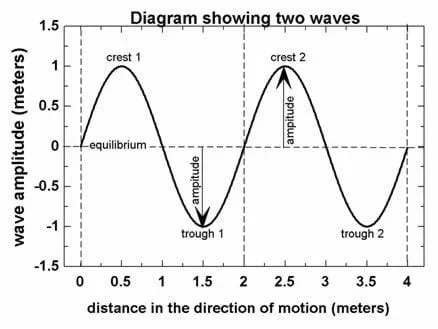 Figure 2. Wavelength and amplitude.Copyright Image created by Frank Burkholder, University of Colorado at Boulder, ITLL, 2006.
Waves are typically described using charts and diagrams, but the idea of a wave — a traveling disturbance — is very broad, and methods besides graphing can be used to get a more kinesthetic understanding of waves, wave amplitude and wavelength. For example, the Simon Says Activity (see Associated Activity) uses body motion to generate waves.
Tsunamis are one example of the amazing power of ocean waves. The following definition of a tsunami is paraphrased from the National Weather Service and National Oceanic and Atmospheric Administration website:
A tsunami is a series of ocean waves of extremely long wavelength (miles from crest to crest) and small amplitude (a few feet or more) that move at up to 500 mph in deep water towards shore. As they approach shore, their speed slows, and their amplitude often grows to 50 feet or more. Underwater earthquakes, eruptions or landslides can create tsunamis.
Tsunamis can be very dangerous for coastal communities, as was seen in destruction and loss of life as a result of the 2004 Indian Ocean tsunami. But, scientists and engineers are working together to warn communities of approaching tsunamis. Off the coasts of Alaska and California, pressure sensors on the ocean floor measure the amplitude of the ocean waves traveling over them, and then radio buoys broadcast that information to sailors and the public. This data allows engineers and scientists to know immediately whether a wave will become a tsunami or not. For Angie and Harmon standing on shore, the only way they would know that a tsunami is coming is if the tide receded (went way out). This more immediate warning, but one which is often too late, is when the coastal water is sucked into the tsunami before it hits shore. In this case, the coastal water may drop far below low-tide levels, exposing coral reefs and wildlife. Unfortunately some people take this opportunity to walk out to the reefs and look at wildlife, when instead they should be fleeing inland and moving to the highest possible location in order to save their lives.
After figuring out that the longitudinal action of the ocean waves pushed the gold coin towards the shore, Angie and Harmon want to boat further out into the ocean to determine the origins of the coin. They convince Fisherman Frank to take them out in his boat. However, as they are getting ready to head out, they hear on the radio that a tsunami warning is in effect due to an undersea earthquake that occurred an hour ago not far away. Yet, from the beach, they cannot see anything wrong. What should they do? Is there any way for them to know that a tsunami is coming?
To answer these questions, let's talk more about waves. When engineers and scientists want to talk about how big a wave is, and what sort of shape it has, they use two special words: amplitude and wavelength. (Note: Teachers write these words on the board.) These words help other engineers and scientists know how big or small the wave is and what it looks like. This is similar to how we use height to talk about how tall people are — if I said, "She was 7 feet tall," then you would know that that person was quite big. In the same way, engineers use amplitude and wavelength to explain the size and shape of a wave.
So, what do these words really mean? Let's talk about amplitude first. Amplitude is how tall a wave is, and it is measured from the top of the wave to the bottom. Pretty easy, right? I am going to draw a picture of a wave on the board now, and see if you can tell where the amplitude is. Great! Now I'll draw a line showing just how to measure it so you can all see.
What was that second word again? Right – wavelength! What does wavelength sound like? (Answer: The length of a wave.) Perfect! And that is a really good way to think about it: wavelength is the distance it takes for a wave to repeat itself and start over again. Okay, let me draw another picture of waves on the board. Can you figure out how to find the wavelength? Excellent. Have students reinforce their understanding of wavelength vs. amplitude with the fun game of Simon Says Big Amplitude, Small Wavelength!
Now that you know about the special words engineers and scientists use for waves, does anyone know what a tsunami is? A tsunami is an event that creates huge, humungous, enormously big waves. The big waves are created when an earthquake happens deep under the ocean on the ocean floor. The power from the Earth moving causes waves to ripple out, and by the time they hit the shore, they can be even taller than your school. Tsunamis can be very dangerous, but, fortunately, engineers have figured out ways to tell when one is coming. Engineers care a lot about keeping people safe, and they continually work on even better ways to detect tsunamis.
In our last lesson, we learned about two different types of waves (transverse and longitudinal), and in this lesson we learned about two special words that engineers and scientists use to describe the shape and size of waves. Who would like to say what those two special words are? Right! Wavelength and amplitude tell us about the shape and size of a wave. We also talked a little bit about how tsunamis, which are enormous waves, are formed. In our next lesson we are going to learn another important word that engineers use to describe how often something happens – frequency. And, we will also find out what our two courageous heroes, Angie and Harmon, are up to next!
- amplitude
- The maximum distance a wave moves away from its equilibrium position; in ocean waves its unit is usually feet or meters.
- wavelength
- The distance a wave takes to repeat itself, measured from trough to trough or crest to crest. In ocean waves, wavelength is measured in feet or meters; light waves are measured in nanometers (10-9 m), and radio waves are measured in meters. Radio waves can vary between one meter (FM) and 1000 meters (AM).
- tsunami
- A series of traveling ocean waves of very long wavelength and small amplitude that race toward shore very quickly after an undersea disturbance, such as an earthquake or eruption. These waves slow in speed and grow in amplitude as they approach shore, sometimes becoming more than 50 feet high.
Pre-Lesson Assessment
Draw a Wave!: Ask students to take out a piece of paper and draw 3 or 4 ocean waves approaching a beach. Ask them to show the waves from the side, as if the students were out in a boat some distance from shore. You may want to help the students by drawing an example wave on the board. Then ask them to draw, on the same picture, much bigger waves approaching the same beach. Ask them what the differences are between the smaller waves and bigger waves. Tell the students that today they will learn new words to help explain the differences between the waves they drew.
Post-Introduction Assessment
Label Away!: Ask students to label the wavelength and amplitude of the waves they drew in the Pre-Assessment. Circulate the room to answer questions and assist.
Lesson Summary Assessment
Class Discussion Question: Solicit, integrate and summarize student responses to the following questions:
- How do engineers detect tsunamis before they hit? (Answer: Right now they monitor underwater earthquakes and eruptions using equipment that detects seismic waves created by these disturbances. The greater the amplitude of the seismic wave, the bigger the earthquake and the more likely that a tsunami will form.)
Students may explore wavelength, amplitude and wave period (the amount of time between crests) of ocean waves and watch a sailboat navigate them using the Wave Simulator found on the National Geographic website at: http://www.nationalgeographic.com/volvooceanrace/interactives/waves/index.html
Markey, Sean. National Geographic.com, "Wave Simulator," accessed January 25, 2007. http://www.nationalgeographic.com/volvooceanrace/interactives/waves/index.html
Russel, Dan, 1999. Ketterling University Applied Physics, Acoustics Animations, "Longitudinal and Transverse Wave Motion," accessed January 18, 2007. http://www.acs.psu.edu/drussell/Demos.html
U.S. Department of Commerce, National Oceanic and Atmospheric Administration, National Weather Service, Intergovernmental Oceanographic Commission, International Tsunami Information Center, "Tsunami: The Great Waves," accessed January 25, 2007. http://www.nws.noaa.gov/om/brochures/tsunami.htm
Contributors
Frank Burkholder; Abigail Watrous; Janet Yowell
Supporting Program
Integrated Teaching and Learning Program, College of Engineering, University of Colorado Boulder
Acknowledgements
The contents of these digital library curricula were developed by the Integrated Teaching and Learning Program under National Science Foundation GK-12 grant no. 0338326. However, these contents do not necessarily represent the policies of the National Science Foundation, and you should not assume endorsement by the federal government.
Copyright
2007 by Regents of the University of Colorado.