
Needing Illumination – Investigating Light
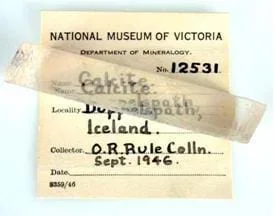 Figure 1. Light bends, or refracts, as it moves through calcite, as shown by text that appears twice.Copyright Museum Victoria, http://www.museum.vic.gov.au/scidiscovery/ light/wavepart.asp
Students learn the five words that describe how light interacts with objects: transparent, translucent, opaque and refraction. This is the first lesson of this unit to introduce light. Lessons 1-5 focus on sound, while 6-9 focus on light.
Being able to see is crucial for many things that we do everyday. Engineers and scientists have created lighting devices to help us see in the dark. Lighting engineers design the illumination systems in the places we live and work. Without their expertise, our day-to-day sight could be worse (than it might already be) due to poor lighting conditions and eye strain. Their understanding of how light works enables engineers to create new types of lighting and design light bulbs and fixtures that are more energy efficient and easier on our eyes.
After this lesson students should be able to:
- Explain reflection and refraction.
- Give examples of something that refracts light and something that reflects light.
- Provide a basic explanation of the following terms: transparent, translucent and opaque.
- Identify and describe the variety of energy sources
Grade 4
Do you agree with this alignment?
- STEL-2J Demonstrate how tools and machines extend human capabilities, such as holding, lifting, carrying, fastening, separating, and computing.
Grades 3-5
Do you agree with this alignment? - STEL-3D Explain how various relationships can exist between technology and engineering and other content areas.
Grades 3-5
Do you agree with this alignment?
- 4-PS4-2 Develop a model to describe that light reflecting from objects and entering the eye allows objects to be seen.
Grade 4
This resource focuses on the following Three Dimensional Learning aspects of NGSS:
Science & Engineering Practices- Develop models to describe phenomena.Do you agree with this alignment?
Disciplinary Core Ideas- An object can be seen when light reflected from its surface enters the eyes.Do you agree with this alignment?
Crosscutting Concepts- Cause and effect relationships are routinely identified.Do you agree with this alignment?
Do you agree with this alignment? - Develop models to describe phenomena.
Students should be comfortable with the material covered in lessons 1-5 of the Sound and Light unit.
Light, as common as it is, is difficult to figure out. Specifically, we do not know if light is a wave or a particle, or both. In 1951, near the end of his life, Einstein said:
All the 50 years of conscious brooding have brought me no closer to the answer to the question, "What are light quanta?" Of course today every rascal thinks he knows the answer, but he is deluding himself. (From, Catching the Light, p. ix)
Arthur Zajonc, quantum physicist of the layperson's text Catching the Light, concludes that the best way to approach the study of light is not as an "object," but as an event in which the observer participates. He tells a story of an eight-year-old boy who was blind from birth because of cataracts. After a successful operation, the doctors removed the bandages. Waving a hand in front of the boy's eyes, they asked him what he could see. "I don't know," he replied. He could see only shifting patterns of brightness. It was by touching the hand and hearing it move that he realized it was moving. Over the course of the next months and years, the boy had to learn to see, a laborious process that he never fully mastered.
According to Zajonc, a study of the properties of light cannot be separated from an understanding of how the eye and mind see. Being a good light detective is as much a matter of how we see as what we see.
An ongoing discussion in many science texts is about the wave-particle duality of light. Because light is simply a subset (a range of wavelengths) in the electromagnetic spectrum, the real discussion is not only about light but the nature of electromagnetic radiation. Sometimes light acts like a wave. Consider the diffraction pattern created by light "waves" below.
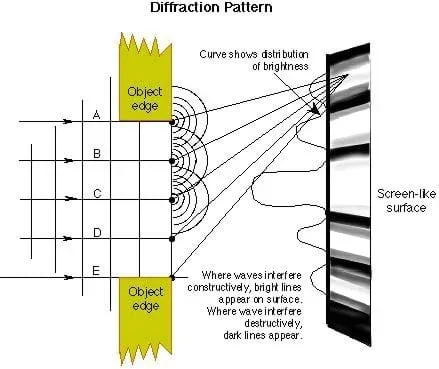 Figure 2. Diffraction interference pattern.Copyright National Aeronautic and Space Administration http://planetquest.jpl.nasa.gov/images/diffraction3.jpg
If light moved like a particle, then it should be stopped by the diffraction grating and not curve around it as waves do to form an interference pattern. But light can act as a wave in this instance.
And of course light can also act like a particle, like a discrete entity. Students learned in an earlier lesson in this unit that waves move through a medium. Sound waves need to move through air, or water, or some other type of medium to exist – it is the movement of particles in the medium that define the amplitude and frequency of the wave. But light (and electromagnetic radiation) does not require a medium. There is no sound in space, but light reaches the Earth from the sun, which shows that light can still travel in space.
Another way that light acts like a particle is that it has a certain amount of energy in it, or in other words, it is quantitized — think light quanta. A wave can carry any amount of energy by simply increasing its amplitude. But the amount of energy light carries is discretized into quanta (look into the photoelectric effect if you would like more information on this topic).
If you recall, the natural gas bubbles were good sound absorbers, preventing the sonar from reaching the galleon on the bottom of the sea. But the bubbles have passed, and Angie, Harmon and Fisherman Frank can now see the outline of a ship on the ocean floor using the sonar. They want to go down and take a look, but there is no light on the bottom of the ocean. How are they going to see underwater?
Teacher demonstration: Without saying anything to students, turn off some of the overhead classroom lights and turn on a small lamp in front the students. Using a flashlight, shine light on a dark wall, on a mirror and on aluminum foil. Dip a pencil in a glass of water while shining some light on it (to see the pencil bend at the water/air interface). Ask students what they think this lesson is going to be about.
Angie, Harmon and Fisherman Frank desperately want to see the ship with their own eyes, and to do that they need light. Light, even though it is all around us, can be tough to understand. Today we are going to focus on learning five words that scientists and engineers use to explain how light interacts with different types of objects, or materials. The five words that we are going to talk about today are: transparent, translucent, opaque, reflection and refraction. Now I need you all to watch carefully while I show you some examples of light in action!
Teacher demonstration:
- Hold up a flashlight to a clear piece of glass. Ask students if the glass transmits (lets through) the light. (Answer: Yes) Tell them that the glass is transparent to light.
- Next, hold up the flashlight to a piece of wax paper. Again, ask the students if wax paper transmits light. (Answer: Some light goes through, but some does not.) Explain that some of the light is transmitted through the paper, but some is absorbed and some of it is reflected (bounces off). The wax paper is translucent to light. Can they think of anything else that is translucent? (Possible answers: Some bathroom shower windows, clouds, certain types of glassware, sheer curtains and fabrics, perhaps leaves.)
- Now hold the flashlight up to a book. Does the book transmit light? (Answer: No) What happens to the light? (Answer: It is absorbed, and a little is reflected.) The book is opaque to light. Ask the students to think of other examples of opaque objects. (Possible answers: Walls, trees, our bodies, furniture.)
- Next hold the flashlight up to a mirror, but with the silvered side facing you, not the students. Ask the students if this mirror is opaque. (Answer: Yes it is, none of the light goes through the silver side of the mirror.) Is all the light absorbed? (Answer: No) Show them that light reflects off the mirror to land on the wall. Mirrors and other surfaces reflect light.
- Finally, hold up a prism (or a magnifying glass or a bottle of water). Put an object behind it. Does the object look the same? (Answer: No) Why does it look different? (Answer: The transparent material is bending the light that comes through it, changing its shape.) The tendency of a light wave to bend as it passes from one transparent medium to another is called refraction.
Reflection and refraction are alike in that they change light's direction. What makes them different is whether light goes through the material or not. When light is reflected, it bends away from the surface and does not pass through the material. Refraction occurs at the border between two transparent mediums as light passes through the object. The light is bent, as in reflection, but it bends into the material, rather than away from it. Refer to the associated activity Light Scavengers to have students examine on their own how various objects interact with light, and record their observations using new vocabulary words.
Now let's think about our two brave adventurers! In order to see the sunken ship, Angie and Harmon are going to have to find some way to take light down with them to the ocean floor. Does anyone have any ideas how they can do this? Let's find out!
You have all earned a lot about light in this lesson! You learned that engineers design and build lights for us to see by, and lighting engineers design lighting systems for many different places. You also learned five new vocabulary words! Now you are going to get the chance to explore some of these amazing properties of light for yourselves, and use your new vocabulary words to explain what you discover. In our next lesson, we will continue to explore light and learn which lights Angie and Harmon use to explore the sunken ship.
- transparent
- Lets most of the light through; images are preserved.
- translucent
- Lets some of the light through; gives off a diffuse glow (not as image preserving as transparent glass).
- opaque
- None of the light goes through; it is either reflected or absorbed.
- reflection
- The direction of light is changed; it is as if it bounces from the surface.
- refraction
- The tendency of a wave to bend as it passes from one transparent medium to another.
Pre-Lesson Assessment
Know / Want to Know / Learn (KWL) Chart: Ask students to each write down in the top left corner of a piece of paper (or as a group on the board) under the heading, Know, all the things they know about light. Have students share their answers with the class.
Post-Introduction Assessment
Know / Want to Know / Learn (KWL) Chart: In the top right corners of their KWL Charts, under the heading, Want to Know, ask students to write down anything they want to know about light. Spend a few minutes walking around observing what they are writing. Invite students to share their answers with the class.
Lesson Summary Assessment
Know / Want to Know / Learn (KWL) Chart: Have students fill in the bottom half of their KWL charts, under the heading, Learn, the things they have learned in this lesson. Ask for volunteers to share some of the things they have learned; write their responses on the board and discuss.
Discuss with students how some types of lighting fixtures and light bulbs are more energy efficient than others.
Have students research the difference between incandescent and fluorescent lighting and report back to the class.
Invite a lighting engineer to talk with the class about some of their design projects.
Have students investigate light at one of the following websites:
- Jennifer Chappelle's lesson plans on light. Several age-appropriate activities. http://www.geocities.com/jchapple2002/expeditionguide.htm
- Difficult concepts can be easy to visualize and grasp at "Properties of Light," by Joseph F. Alward, PhD, Department of Physics, University of the Pacific, http://sol.sci.uop.edu/~jfalward/physics17/chapter12/chapter12.html
- A lesson plan created by Kristal Pride, Saddleback Valley Unified School District, offers a basic approach to the properties of light with links to definitions and activities:http://can-do.com/uci/lessons99/light.html
- Exploratorium Science Snacks is an excellent source for various engaging activities about light: http://www.exploratorium.edu/snacks/snacksbysubject.html
Jackson, Randal. National Aeronautic and Space Administration, Jet Propulsion Laboratory, California Institute of Technology, PlanetQuest: The Search for Another Earth, http://planetquest.jpl.nasa.gov/images/diffraction3.jpg. Accessed April 19, 2007.
Museum Victoria, Scientists & Discovery, Light, "Light Waves and Particles: Light can be described as both a wave and a particle," © Museum Victoria Australia 2003. museumvictoria.com.au. Accessed April 19, 2007.
Zajonc, Arthur. 1993. Catching the Light. Oxford University Press, New York.
Contributors
Luke Simmons; Frank Burkholder; Abigail Watrous; Janet Yowell
Supporting Program
Integrated Teaching and Learning Program, College of Engineering, University of Colorado Boulder
Acknowledgements
The contents of these digital library curricula were developed by the Integrated Teaching and Learning Program under National Science Foundation GK-12 grant no. 0338326. However, these contents do not necessarily represent the policies of the National Science Foundation, and you should not assume endorsement by the federal government.
Copyright
2007 by Regents of the University of Colorado.