
Let Your Ears Do the Walking
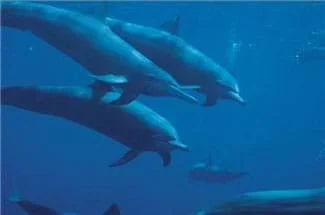 Studenta experience echolationCopyright 2004 Microsoft Corporation, One Microsoft Way, Redmond, WA 98052-6399 USA. All rights reserved. http://office.microsoft.com/en-us/images/results.aspx?qu=dolphin&ex=1#ai:MP900262825|mt:2|
Students experience a simulation of echolation, using the sensory method to walk along a path while blindfolded. This relates to the issue of bycatching by fisheries, which they learned about in the associated lesson. Bycatching affects marine animals, especially dolphins, which use echolocation to identify the location of objects in the water, but have difficulty identifying nets, and thus are often caught accidentally. Students learn how echolocation works, why certain animals use it to determine the size, shape and distance of objects, and how humans can potentially take advantage of dolphins' echolocation ability when developing bycatch avoidance methods.
After learning how echolocation works, students discuss how net designs can be made easier for dolphins to "see" using echolocation and thus less likely for dolphins to result in entanglement. This is an example of how engineers are inspired by nature in their designs. For instance, sonar and radar are technologies that utilize the concept of echolocation.
After this activity, students should be able to:
- Describe how difficult it can be to use only the sense of hearing to perceive their environment.
- Explain how echolocation works.
- CCSS.Math.Content.4.MD.B Represent and interpret data.
Grade 4
Do you agree with this alignment?
- The use of technology affects the environment in good and bad ways.
Grades 3-5
Do you agree with this alignment? - Models are used to communicate and test design ideas and processes.
Grades 3-5
Do you agree with this alignment? - STEL-3D Explain how various relationships can exist between technology and engineering and other content areas.
Grades 3-5
Do you agree with this alignment?
- 4-LS1-2 Use a model to describe that animals' receive different types of information through their senses, process the information in their brain, and respond to the information in different ways.
Grade 4
This resource focuses on the following Three Dimensional Learning aspects of NGSS:
Science & Engineering Practices- Use a model to test interactions concerning the functioning of a natural system.Do you agree with this alignment?
Disciplinary Core Ideas- Different sense receptors are specialized for particular kinds of information, which may be then processed by the animal's brain. Animals are able to use their perceptions and memories to guide their actions.Do you agree with this alignment?
Crosscutting Concepts- A system can be described in terms of its components and their interactions.Do you agree with this alignment?
Do you agree with this alignment? - Use a model to test interactions concerning the functioning of a natural system.
- CCSS.Math.Content.4.NF.C.6 Use decimal notation for fractions with denominators 10 or 100.
Grade 4
Do you agree with this alignment? - CCSS.Math.Content.6.NS.B.3 Fluently add, subtract, multiply, and divide multi-digit decimals using the standard algorithm for each operation.
Grade 6
Do you agree with this alignment?
- 4.L.1 Understand the effects of environmental changes, adaptations and behaviors that enable animals (including humans) to survive in changing habitats.
Grade 4
Do you agree with this alignment? - 4.L.1.2 Explain how animals meet their needs by using behaviors in response to information received from the environment.
Grade 4
Do you agree with this alignment? - 8.E.1.2 Summarize evidence that Earth's oceans are a reservoir of nutrients, minerals, dissolved gases, and life forms:
- Estuaries
- Marine ecosystems
- Upwelling
- Behavior of gases in the marine environment
- Deep ocean technology and understandings gained
Grade 8
Do you agree with this alignment?
- 1 blindfold per student
- large empty room
- masking tape, to mark paths on the floor
An understanding of data collection, calculating fractions/proportions, analyzing data.
If you had to figure out the location, shape, size and texture of an object without using your sense of sight, how would you do this? (Have students brainstorm different ideas, while you take notes on the classroom board.)
How do other animals do this? (Lead a discussion on how dolphins and other animals use echolocation as a method of navigation and "sight.")
(Then proceed to conduct the activity, in which students simulate echolocation to see how well it allows them to use their sense of sound to navigate without using their sense of sight.)
Before the Activity
Tape small straight-line paths on the floor for the kids to follow. Make multiple paths so a number of students can participate simultaneously.
With the Students
- Have students group into pairs.
- Blindfold one student in each pair and have the blindfolded student stand at the start of the path while the other student continues ahead on the path.
- For the blindfolded student to determine where to walk, have him/her say "Marco," while the partner student responds with "Polo." If s/he pays close attention to where the sound comes from, the blindfolded student is able to accurately follow the path.
Pre-Activity Assessment: Following the echolocation lesson, make sure that students understand the basic principles of echolocation. Encourage them to discuss their opinions on bycatching and how echolocation may be part of the solution.
Post-Activity Assessment: Assign students to write journal entries to describe their reaction to this activity and what they discovered while navigating with only the sense of sound. Have them relate this to bycatching and how humans can take advantage of sea animals' echolocation abilities when developing bycatch avoidance methods.
While blindfolded, have students walk fairly slowly and be careful of their surroundings.
Watch that students do not shout too loudly, since it might disturb other groups or classes.
"Echolocation and SONAR: Sound Rather than Sight" from https://exploresound.org/wp-content/uploads/2017/11/Echolocation-Indoors.pdf
How Echolocation Works. http://members.aol.com/bats4kids/echo.htm
"Echolocation Lab" by Donald Mills. http://www.accessexcellence.org/AE/AEC/AEF/1995/mills_echo.html
"Discovery of Sound in the Sea: Teacher Resources and Web Links." http://www.dosits.org/dosits.htm
Contributors
Angela Jiang; Matt Nusnbaum; Aruna Venkatesan; Vicki Thayer; Amy Whitt
Supporting Program
Engineering K-PhD Program, Pratt School of Engineering, Duke University
Acknowledgements
This content was developed by the MUSIC (Math Understanding through Science Integrated with Curriculum) Program in the Pratt School of Engineering at Duke University under National Science Foundation GK-12 grant no. DGE 0338262. However, these contents do not necessarily represent the policies of the NSF, and you should not assume endorsement by the federal government.
Copyright
2013 by Regents of the University of Colorado; original © 2004 Duke University