
Caught in the Net: Bycatch vs.Target Species in Ocean Fishing
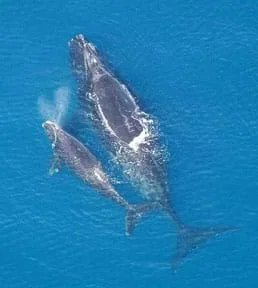 Right whales are one of the main bycatch constituents due to gillnet fisheries.Copyright Florida Fish and Wildlife Conservation Commission/NOAA http://www.nmfs.noaa.gov/pr/species/mammals/cetaceans/rightwhale_photos.htm
Bycatch is the act of unintentionally catching certain living creatures using fishing gear. A bycatched species is distinguished from a target species (the animal the gear is intended to catch) because it is not sold or used. Marine mammals (whales, dolphins, porpoises), seabirds, sea turtles and unwanted or undersized fish are examples of animals caught as bycatch. The incidental capture of these animals can significantly reduce their populations. The most well known example of bycatch may be the unintentional mortality of spotted and spinner dolphins in the tuna fishing industry. The marketing of "dolphin-safe" tuna is a result of people realizing and opposing this. One important aspect to consider when discussing this issue is that laws protect some of the animals caught as bycatch (Marine Mammal Protection Act and Endangered Species Act). In this lesson and its associated activity, students are shown pictures of entangled marine animals and then learn the definition of bycatch. This leads to discussions on why bycatching exists, how it impacts specific animals as well as humans, whether the students believe it is an important issue, and how bycatch can be reduced.
Students study bycatch from an engineering perspective with the idea to design technological solutions to addess the problem.
After conducting this lesson, students should be able to:
- Explain what is meant by "bycatch."
- Explain how bycatch affects their lives.
- Describe ways to reduce bycatch.
- Describe key issues relating to bycatch, such as fishermen's rights, ownership of the sea, and the economic impact of eliminating bycatch.
- CCSS.Math.Content.4.MD.B Represent and interpret data.
Grade 4
Do you agree with this alignment? - CCSS.Math.Content.5.MD.B Represent and interpret data.
Grade 5
Do you agree with this alignment? - CCSS.Math.Content.6.RP.A Understand ratio concepts and use ratio reasoning to solve problems.
Grade 6
Do you agree with this alignment? - CCSS.Math.Content.6.SP.B.4 Display numerical data in plots on a number line, including dot plots, histograms, and box plots.
Grade 6
Do you agree with this alignment?
- The use of technology affects the environment in good and bad ways.
Grades 3-5
Do you agree with this alignment? - STEL-3D Explain how various relationships can exist between technology and engineering and other content areas.
Grades 3-5
Do you agree with this alignment? - STEL-4F Describe the helpful and harmful effects of technology.
Grades 3-5
Do you agree with this alignment?
- 3-5-ETS1-2 Generate and compare multiple possible solutions to a problem based on how well each is likely to meet the criteria and constraints of the problem.
Grades 3-5
This resource focuses on the following Three Dimensional Learning aspects of NGSS:
Science & Engineering Practices- Generate and compare multiple solutions to a problem based on how well they meet the criteria and constraints of the design problem.Do you agree with this alignment?
Disciplinary Core Ideas- Research on a problem should be carried out before beginning to design a solution. Testing a solution involves investigating how well it performs under a range of likely conditions.Do you agree with this alignment?
- At whatever stage, communicating with peers about proposed solutions is an important part of the design process, and shared ideas can lead to improved designs.Do you agree with this alignment?
Crosscutting Concepts- Engineers improve existing technologies or develop new ones to increase their benefits, to decrease known risks, and to meet societal demands.Do you agree with this alignment?
Do you agree with this alignment? - Generate and compare multiple solutions to a problem based on how well they meet the criteria and constraints of the design problem.
- 5-ESS3-1 Obtain and combine information about ways individual communities use science ideas to protect the Earth's resources and environment.
Grade 5
This resource focuses on the following Three Dimensional Learning aspects of NGSS:
Science & Engineering Practices- Obtain and combine information from books and/or other reliable media to explain phenomena or solutions to a design problem.Do you agree with this alignment?
Disciplinary Core Ideas- Human activities in agriculture, industry, and everyday life have had major effects on the land, vegetation, streams, ocean, air, and even outer space. But individuals and communities are doing things to help protect Earth's resources and environments.Do you agree with this alignment?
Crosscutting Concepts- A system can be described in terms of its components and their interactions.Do you agree with this alignment?
- Science findings are limited to questions that can be answered with empirical evidence.Do you agree with this alignment?
Do you agree with this alignment? - Obtain and combine information from books and/or other reliable media to explain phenomena or solutions to a design problem.
- CCSS.Math.Content.4.MD.B Represent and interpret data.
Grade 4
Do you agree with this alignment? - CCSS.Math.Content.5.MD.B Represent and interpret data.
Grade 5
Do you agree with this alignment? - CCSS.Math.Content.6.RP.A Understand ratio concepts and use ratio reasoning to solve problems.
Grade 6
Do you agree with this alignment? - CCSS.Math.Content.6.SP.B.4 Display numerical data in plots on a number line, including dot plots, histograms, and box plots.
Grade 6
Do you agree with this alignment?
- 4.L.1 Understand the effects of environmental changes, adaptations and behaviors that enable animals (including humans) to survive in changing habitats.
Grade 4
Do you agree with this alignment? - 4.L.1.2 Explain how animals meet their needs by using behaviors in response to information received from the environment.
Grade 4
Do you agree with this alignment?
Review the explanation of bycatch (refer to the Summary text). Also review the Table 1 material, so that you can explain to students the different types of fishing gear that result in bycatch. Note also which species are affected the most by commercial fishing.
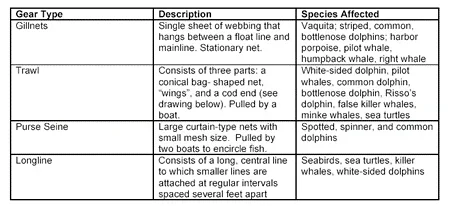 Table 1. Examples of types of fishing gear that catch protected species.
Vaquita, striped, common and bottlenose dolphins, harbor porpoises, pilot whales, humpback whales, and right whales get caught in stationary nets comprised of webbing (see Figure 1).
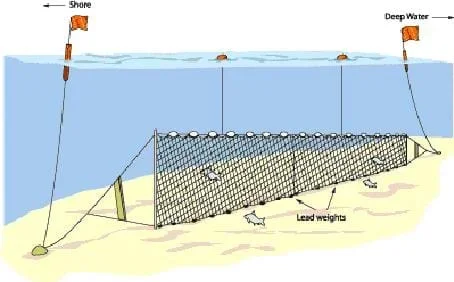 Figure 1. A stationary net comprised of webbing.
Within a trawl net, a turtle excluder device (TED) allows turtles to escape through a hole in the net, so they do not get collected (Figure 2). In addition, bycatch reduction devices (BRDs), such as "fish eyes" (see Figure 2), let certain fish species swim out through panels in the net while the target species is preferentially caught in the cod end.
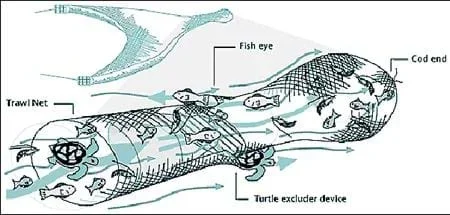 Figure 2. A diagram of a trawl net with a turtle excluder device (TED) and fish eye.
Severe Impact Examples
The vaquita is a small porpoise that lives only in the Gulf of California and is in imminent danger of extinction as a result of gillnet fisheries (refer to Table 1). Because gillnets are of uniform mesh size, they can entrap much larger non-target species and result in death. The total population of vaquita is now less than 1,000 animals, after declining by approximately 20% each year between 1986 and 1993.
The North Atlantic right whale population has been reduced to approximately 300 individuals due to bycatch and ship strikes, primarily off the New England coast. Refer to the All Caught Up: Acting Out Bycatching Points of View activity to have students investigate the challenges to prevent bycatching.
Albatrosses in the Southern Ocean suffered a decrease by 44,000 birds per year due to the Japanese longline fishery.
Ways to Minimize Bycatch
1. Acoustic alarms (pingers) deter marine mammals by emitting noise.
2. Gear modification:
- Breakaway links let large whales break out of nets when they struggle and exert force.
- Reflective nets are more detectable to marine mammals so they can avoid them.
- Turtle excluder devices (TEDs) help turtles to escape through a built-in hatch in trawls.
- Modification of mesh size helps marine mammals better detect nets so they can avoid them.
3. Time- area closures: Setting nets at different times of the day (setting longlines at night minimizes seabird bycatch); setting nets in areas that are less heavily frequented by mammals, birds and turtles.
If you have access to the video "Empty Oceans Empty Nets," produced by Habitat Media in 2002, show it to the class as a great introduction to what bycatch is and how it affects the lives of different species. If you do not have access to the video, pass around pictures of entanglements, such as the ones in this curricular unit. Have students comment on how the pictures make them feel, why they think that this type of entanglement occurs, and whether or not people should do anything about this. Then define bycatch and lead a discussion with a broader scope that combines marine science with government policies.
What is bycatch?
Bycatch is the unwanted capture of unprofitable species obtained during fishing attempts for a specific "target species." Animal populations such as dolphins, whales and seals, to name a few, are significantly affected by bycatch and can become endangered as a result.
Why is bycatch an issue that we should think about?
Students may have different opinions on this. Some may think that humans have no responsibility to reduce bycatch. They may believe that humans should have unlimited control over marine environments to fish and hunt, and it is acceptable to catch and kill animals that we are not going to eat. Some students may have family members that are fishermen and believe that bycatch avoidance methods are too expensive for small businesses who are trying to remain profitable and competitive. If students do not have such acquaintances, present this point of view. Others may strongly believe that people need to help reduce bycatch so that endangered species are preserved for future generations and/or because the loss of species has unforeseen affects on the food chain. Encourage a discussion surrounding this topic that encourages the sharing of a wide variety of viewpoints.
What steps can be taken to reduce bycatch?
Ask students to propose measures that can be taken to reduce bycatch, not limited to engineering solutions like different types of fishing gear or modified gear. Other potential methods include governmental legislation and policy surrounding fishing methods or the reduction of commercial fishing in general. Hopefully students will think of very creative solutions that others may not have thought of before. Encourage them, if they have an innovative idea, to write to their governor, congressman, or even the president about their idea and the importance of the bycatch issue.
- bycatch
- The portion of a fishing catch that is discarded as unwanted or commercially unusable.
- gillnet
- A single sheet of webbing that hangs between a float line and main line. Stationary net.
- trawl
- Consists of three parts: a conical bag-shaped net, "wings," and a cod end. Pulled by a boat.
- purse seine
- Large curtain-type nets with small mesh size. Pulled by two boats to encircle fish.
- longline
- Consists of a long, mainline to which smaller, baited hooklines are attached at regular intervals.
Written Reflection: As long as students are actively engaged in discussion and appear to understand the definition of bycatch, then they comprehend the most important aspects of this lesson. Encourage creative thought on the issue of bycatch by having each student write in his or her journal after the discussion. Ask students to reflect on the lesson, answering prompts such as: What is bycatch? Do you think it is important for fishermen to try to reduce it? Why or why not? Can you think of any ways that the government, fishermen and/or the average person could help to reduce bycatch?
Biology of Marine Mammals. 1999. Edited by: J. Reynolds III and S. Rommel. Smithsonian Institution, WDC, USA.
The Bottlenose Dolphin. 1990 Eds. S. Leatherwood and R. Reeves. Academic Press, Inc. London, UK.
Conservation and Management of Marine Mammals.1999. Eds. Twiss and Reeves. Smithsonian Institution, WDC, USA.
"Empty Oceans Empty Nets" (video). Produced by Habitat Media. 2002. http://www.shoppbs.org
Marine Mammal Biology, An Evolutionary Approach. 2002. Ed. R. Hoelzel. Blackwell Science, Ltd., Oxford, UK.
Seabird Bycatch: Trends, Roadblocks and Solutions. 2001. Eds. E. Melvin and J. Parrish. Univ. of Alaska Seagrant.
- All Caught Up: Bycatching and Design
- Caught in the Net: Bycatch vs.Target Species in Ocean Fishing
- Echolocation: Using Sound for Sight
Contributors
Aruna Venkatesan; Matt Nusnbaum; Angela Jiang; Vicki Thayer; Amy Whitt
Supporting Program
Engineering K-PhD Program, Pratt School of Engineering, Duke University
Acknowledgements
This content was developed by the MUSIC (Math Understanding through Science Integrated with Curriculum) Program in the Pratt School of Engineering at Duke University under National Science Foundation GK-12 grant no. DGE 0338262. However, these contents do not necessarily represent the policies of the NSF, and you should not assume endorsement by the federal government.
Copyright
2013 by Regents of the University of Colorado; original © 2004 Duke University