

Quick Look
Grade Level: 5 (4-6)
Time Required: 3 hours 45 minutes
(four 55-minute sessions)
Expendable Cost/Group: US $5.00
Group Size: 3
Activity Dependency: None
Subject Areas: Earth and Space, Measurement, Problem Solving, Reasoning and Proof
NGSS Performance Expectations:

| 3-5-ETS1-1 |
| 3-5-ETS1-2 |
| 3-5-ETS1-3 |
| MS-ETS1-1 |
Quick Look

- Grade Level:
- 5 (4 – 6)
- Time Required:
- 3 hours 45 minutes
(four 55-minute sessions)
- Group Size:
- 3
- Subject Areas:
-
Earth and Space Measurement Problem Solving Reasoning and Proof -
NGSS Performance Expectations:
3-5-ETS1-1 3-5-ETS1-2 3-5-ETS1-3 MS-ETS1-1
Summary
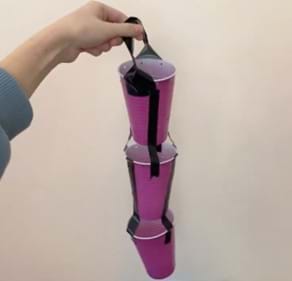
Students apply the engineering design process to design a shower-timer device (shower clock) that accurately measures a five-minute shower. After watching a NASA eClips video segment, students connect water-conservation strategies used aboard the International Space Station (ISS) to their own lives and explore three methods of conserving water: reducing, reusing, and recycling. Working in three-person teams with defined roles (research/design specialist, materials and construction specialist, and test specialist), students design, build, test, refine, and share their shower-clock prototypes.Engineering Connection
Water is one of the most valuable resources in space. Transporting a single liter to the International Space Station (ISS) can cost $20,000. To conserve every drop, NASA engineers designed the Water Recovery System, which reclaims 93% of wastewater on the ISS into safe drinking water. Creating and maintaining this system requires a team of engineers from multiple disciplines working together: Environmental and chemical engineers design the purification processes that remove contaminants, mechanical engineers build the hardware such as pumps and filtration units, aerospace engineers ensure the system functions reliably in the harsh conditions of space, and systems engineers coordinate all components so they operate efficiently as a whole. Biomedical engineers and microbiologists also play a role by monitoring water quality to ensure it remains safe for astronauts during long-duration missions.
Learning Objectives
After this activity, students should be able to:
- Follow the steps of the engineering design process to plan, construct, test, and improve a shower clock.
- Explain various ways to conserve water resources by reducing, reusing, and recycling.
- Compare water conservation methods on Earth to those used by scientists on the International Space Station.
Educational Standards
Each Teach Engineering lesson or activity is correlated to one or more K-12 science,
technology, engineering or math (STEM) educational standards.
All 100,000+ K-12 STEM standards covered in Teach Engineering are collected, maintained and packaged by the Achievement Standards Network (ASN),
a project of D2L (www.achievementstandards.org).
In the ASN, standards are hierarchically structured: first by source; e.g., by state; within source by type; e.g., science or mathematics;
within type by subtype, then by grade, etc.
Each Teach Engineering lesson or activity is correlated to one or more K-12 science, technology, engineering or math (STEM) educational standards.
All 100,000+ K-12 STEM standards covered in Teach Engineering are collected, maintained and packaged by the Achievement Standards Network (ASN), a project of D2L (www.achievementstandards.org).
In the ASN, standards are hierarchically structured: first by source; e.g., by state; within source by type; e.g., science or mathematics; within type by subtype, then by grade, etc.
NGSS: Next Generation Science Standards - Science
| NGSS Performance Expectation | ||
|---|---|---|
|
3-5-ETS1-1. Define a simple design problem reflecting a need or a want that includes specified criteria for success and constraints on materials, time, or cost. (Grades 3 - 5) Do you agree with this alignment? |
||
| Click to view other curriculum aligned to this Performance Expectation | ||
| This activity focuses on the following Three Dimensional Learning aspects of NGSS: | ||
| Science & Engineering Practices | Disciplinary Core Ideas | Crosscutting Concepts |
| Define a simple design problem that can be solved through the development of an object, tool, process, or system and includes several criteria for success and constraints on materials, time, or cost. Alignment agreement: | Possible solutions to a problem are limited by available materials and resources (constraints). The success of a designed solution is determined by considering the desired features of a solution (criteria). Different proposals for solutions can be compared on the basis of how well each one meets the specified criteria for success or how well each takes the constraints into account. Alignment agreement: | People's needs and wants change over time, as do their demands for new and improved technologies. Alignment agreement: |
| NGSS Performance Expectation | ||
|---|---|---|
|
3-5-ETS1-2. Generate and compare multiple possible solutions to a problem based on how well each is likely to meet the criteria and constraints of the problem. (Grades 3 - 5) Do you agree with this alignment? |
||
| Click to view other curriculum aligned to this Performance Expectation | ||
| This activity focuses on the following Three Dimensional Learning aspects of NGSS: | ||
| Science & Engineering Practices | Disciplinary Core Ideas | Crosscutting Concepts |
| Generate and compare multiple solutions to a problem based on how well they meet the criteria and constraints of the design problem. Alignment agreement: | Research on a problem should be carried out before beginning to design a solution. Testing a solution involves investigating how well it performs under a range of likely conditions. Alignment agreement: At whatever stage, communicating with peers about proposed solutions is an important part of the design process, and shared ideas can lead to improved designs.Alignment agreement: | Engineers improve existing technologies or develop new ones to increase their benefits, to decrease known risks, and to meet societal demands. Alignment agreement: |
| NGSS Performance Expectation | ||
|---|---|---|
|
3-5-ETS1-3. Plan and carry out fair tests in which variables are controlled and failure points are considered to identify aspects of a model or prototype that can be improved. (Grades 3 - 5) Do you agree with this alignment? |
||
| Click to view other curriculum aligned to this Performance Expectation | ||
| This activity focuses on the following Three Dimensional Learning aspects of NGSS: | ||
| Science & Engineering Practices | Disciplinary Core Ideas | Crosscutting Concepts |
| Plan and conduct an investigation collaboratively to produce data to serve as the basis for evidence, using fair tests in which variables are controlled and the number of trials considered. Alignment agreement: | Tests are often designed to identify failure points or difficulties, which suggest the elements of the design that need to be improved. Alignment agreement: Different solutions need to be tested in order to determine which of them best solves the problem, given the criteria and the constraints.Alignment agreement: | |
| NGSS Performance Expectation | ||
|---|---|---|
|
MS-ETS1-1. Define the criteria and constraints of a design problem with sufficient precision to ensure a successful solution, taking into account relevant scientific principles and potential impacts on people and the natural environment that may limit possible solutions. (Grades 6 - 8) Do you agree with this alignment? |
||
| Click to view other curriculum aligned to this Performance Expectation | ||
| This activity focuses on the following Three Dimensional Learning aspects of NGSS: | ||
| Science & Engineering Practices | Disciplinary Core Ideas | Crosscutting Concepts |
| Define a design problem that can be solved through the development of an object, tool, process or system and includes multiple criteria and constraints, including scientific knowledge that may limit possible solutions. Alignment agreement: | The more precisely a design task's criteria and constraints can be defined, the more likely it is that the designed solution will be successful. Specification of constraints includes consideration of scientific principles and other relevant knowledge that is likely to limit possible solutions. Alignment agreement: | All human activity draws on natural resources and has both short and long-term consequences, positive as well as negative, for the health of people and the natural environment. Alignment agreement: The uses of technologies and any limitations on their use are driven by individual or societal needs, desires, and values; by the findings of scientific research; and by differences in such factors as climate, natural resources, and economic conditions.Alignment agreement: |
Common Core State Standards - Math
-
Solve problems involving measurement and conversion of measurements from a larger unit to a smaller unit.
(Grade
4)
More Details
Do you agree with this alignment?
International Technology and Engineering Educators Association - Technology
-
Apply the technology and engineering design process.
(Grades
3 -
5)
More Details
Do you agree with this alignment?
Materials List
Each student needs:
- 1 NASA eClips Engineering Design Packet (digitally or as a hard copy)
Each group needs:
- 1 laptop or tablet with internet access
- 5 235 – 355 mL (8 – 12 oz) plastic cups
- 1 3 ft cotton string
- 1 thumbtack or pushpin
- 1 stopwatch or timer
- 1 permanent marker
- multiple containers for pouring water (e.g., pitchers or measuring jugs)
- 1 tub for catching water
- 1 scissors
- 1 roll of duct tape
- paper towels or rags for cleaning up spills
- access to tap water or another water source
- (optional) tape (masking or clear)
- (optional) pipe cleaners
- (optional) binder clips/clothespins
For the entire class to share:
- whiteboard and dry erase markers
- 1 laptop or tablet with a projector and internet access
- access to websites for learning more about NASA technologies and spinoffs: https://spinoff.nasa.gov or https://www.nasa.gov/technology
- access to NASA eClips video Our World: Recycling on the International Space Station (https://science.nasa.gov/eclips/videos/recycling-on-the-international-space-station)
- access to online water calculator such as the EPA WaterSense calculator (https://www.epa.gov/watersense/watersense-calculator)
- (optional) access to additional information on water clocks: https://www.childrensmuseum.org/stories/tell-time-water-clock
- testing station(s): Note: Determine how many testing stations will be in the classroom and determine how you want to set up each testing station (see images of sample testing stations). Recommended materials per testing station:
- 1 stand
- 1 hook or paper clip for suspending clocks being tested (a paper clip unbent to form an “S” shape works well)
- 1 large basin for catching water (for test site)
- access to tap water or another water source
- multiple containers for pouring water (e.g., pitchers or measuring jugs)
- paper towels or rags for cleaning up spills
For the teacher:
Worksheets and Attachments
Visit [www.teachengineering.org/activities/view/ind-3046-nasa-eclips-shower-clock-activity] to print or download.Pre-Req Knowledge
Familiarity with the engineering design process would be helpful but is not required.
Introduction/Motivation
The water on Earth has been around for approximately 4.6 billion years. In fact, the water we use today may have flowed in ancient rivers or even passed through dinosaurs!
How is this natural cycling of water occurring? (Let students offer answers.) This natural resource is constantly being recycled through evaporation, precipitation, and condensation. It is a process we know as the water cycle.
(Hold up a 1- liter container.) The average person in the United States uses between 300 and 380 liters of water (80 to 100 gallons) each day.
Because it costs nearly $20,000 to transport a single liter of water (approximately one quart) to the International Space Station (ISS), every single drop of water on the space station must be recycled, cleaned, and reused. NASA engineers designed special technology—a water recycler called the Water Recovery System—that recycles about 93 percent of the water it receives. This includes cleaning and recycling the urine, sweat, and other wastewater produced by astronauts!
On Earth, almost a quarter of all water use occurs in bathrooms. The flow of water from a showerhead ranges from 9 to 19 liters (2.5 to 5 gallons) per minute. One way we can conserve water in our daily lives is to take shorter showers.
Today, you are assuming the role of NASA engineers. Your challenge is to design a device called a shower clock that can be used to time a 5-minute shower.
As engineers assigned to this task, what information do you think would be helpful for you to know to successfully design your shower clock? (Possible answers: How much time will we have to work? What materials are available? What requirements will our shower clock have to meet? What restrictions/constraints do we need to consider?)
Let’s get started!
Procedure
Background
Nature has been recycling water on Earth for eons, and now NASA is doing the same thing above Earth on the International Space Station. Two refrigerator-sized racks packed with a distiller and an assortment of filters are designed to process an astronaut’s urine, sweat, and other wastewater into clean drinking water. Before the Water Recovery System arrived onboard the ISS, the station crew depended on water brought to the station via space shuttles or cargo rockets. The Water Recovery System has cut that need by 65 percent because it produces about 2,800 kilograms, or nearly 700 gallons, of potable (drinkable) water each year. That is enough fresh water to allow the station to host six crew members instead of three. Engineers are testing and refining the water recycling technology to make improvements that will support astronauts on future long-duration exploration missions.
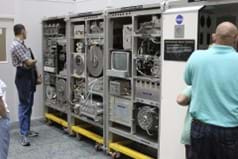
A major component of the water recycler is the distiller. On Earth, distilling is a simple process of boiling water and cooling the steam back into pure water. In the low-gravity environment of the ISS, the contaminants in water would never separate from the steam no matter how much heat is used. Therefore, the distiller is spun to simulate gravity. The contaminants in the water press against the sides of the drum while the steam gathers in the middle and is pumped to a filter. The filter is like those used on Earth. It uses charcoal-like materials to pull other unwanted elements from the water. Another process uses chemical compounds that bond with the remaining contaminants the charcoal left behind so another filter can remove these chemicals from the water. NASA’s water filter development has also helped produce filters that are now used in humanitarian efforts on Earth to help provide clean water in areas served only by contaminated water sources. This is just one example of NASA technology transferring into society.
Before the Activity
- Gather needed materials and organize the items for each team of three students.
- Determine how the NASA eClips Engineering Design Packet will be shared with each student (as a hard copy per or electronically).
- Get an overview of the activity by watching NASA eClips Best Practices: Designing a Shower Clock Overview.
- See a demonstration of the activity by viewing NASA eClips Best Practices: Our World: Designing a Shower Clock Demo.
During the Activity
Engage: Investigating Personal Water Use and Conservation (55 minutes)
- Give students a few minutes to brainstorm ways water is used in their daily lives.
- As a class, have students share their thoughts and record their ideas so they are visible to the class (e.g., on a whiteboard).
- Allow students to explore a water consumption calculator, such as the EPA’s WaterSense Calculator (https://www.epa.gov/watersense/watersense-calculator), to determine how much water they use each day. (Note: On average, a U.S. citizen uses approximately 310 liters [82 gallons] of water daily.)
- Discuss the following questions with students:
- Which activities use the most water? (Answers will vary, but could include watering the lawn, washing the car, taking baths.)
- Which uses surprised them? (Answers will vary.)
- Have students focus on water usage during showers by asking them to (a) first estimate how long their typical shower lasts and (b) then calculate the amount of water used during the shower.
- Note: Showerheads produced after 1992 were manufactured to limit water flow rate to conserve water. These low-flow showerheads use no more than 8.33 liters of water per minute.
- To find the estimated amount of water used during a shower, students multiply the estimated time spent taking a shower by 8.33 liters/minute. Showerheads produced prior to 1992 used more water.
- To determine the actual amount of water used, assign students the task of timing their next shower and multiplying the time by 8.33 liters/minute.
- Ask students why water conservation is important on Earth. (Possible answers: essential to life, limited amounts, environmental impacts, cost, equity of access.)
- Have students compare water conservation on Earth and in space. (Potential answers: limited supply of water, recycling requirements, system reliability, mission safety).
- As students identify similarities and differences on Earth and in space, help them recognize how NASA engineers must design solutions that work under extreme conditions and resource limitations.
- Show students the video NASA eClips video: “Our World: Recycling on the International Space Station” (https://science.nasa.gov/eclips/videos/recycling-on-the-international-space-station; 7:21 minutes).
- Encourage students to look for the three ways water is conserved onboard the ISS. (Answers: recycling, reusing, and reducing).
- Inform students that they will be tasked with designing a solution to conserve water through an engineering design challenge.
Explore: Shower Clock Engineering Design Challenge
Part 1: Ask, Imagine and Plan (55 minutes)
- Present students with the engineering design challenge: Acting as NASA engineers, students will use the engineering design process to design, build, test, and revise a shower clock (water clock) that can be used to time a five-minute shower.
- Distribute one NASA eClips Engineering Design Packet to each student, either digitally or in hard copy.
- Review the engineering design process. Note: The NASA eClips Engineering Design Packet can be used to review the design process using the graphics of Page 1 (i.e., second page) of the packet.
- Divide the students into teams of three.
- Have each team assign roles to each team member. Suggested roles include:
- Research/Design Specialist: Leads the team in selecting the best design from several possible ideas and ensures that each team member has the prototype illustrated and labeled in their design packet.
- Materials and Construction Specialist: Leads the team in the construction of the shower clock and assigns tasks for other team members to assist with.
- Test Specialist: Leads the testing process and ensures all team members record the results of the tests in their design packet.
Ask and (optional) Research
- Have students complete the first two questions of the Ask section of their NASA eClips Engineering Design Packet on Page 3:
- What is the problem?
- What solution is needed?
- Optional: Review student answers to ensure that they understand the task.
- Optional: Have students research what others have done to solve this problem.
- Ask the following questions to help students develop an understanding of the criteria (standards the shower clock must meet to solve the problem) and the constraints (limitations that might limit the shower clock prototype) that will guide their work.
- What is a shower clock? (Answer: A shower clock is a type of water clock. Water clocks are simple time-keeping devices that measure time using the steady flow of water. Typical water clocks consist of a system in which water drips from one elevated container into another. For more information about water clocks, visit: https://www.childrensmuseum.org/stories/tell-time-water-clock.)
- What materials can be used? (Show students the materials that will be available for each team.)
- Are there any requirements on how the shower clock can be built? The criteria for the challenge include:
- The water clock should be able to time a five-minute shower.
- The clock must be able to hang over a showerhead.
- Each team must use between two and five plastic cups in their design.
- What guidelines will teams need to follow? (It is important to establish guidelines BEFORE students begin the challenge.) Suggested guidelines might include:
- Teams may request additional materials from you.
- Students must work in teams to complete the challenge.
- Students will have specific roles within their team, but all team members are expected to assist with the design, build, and testing of the shower clock.
- Have students complete the Ask section of their design packet.
Imagine and Plan
- Encourage teams to brainstorm multiple possible solutions to the shower clock design challenge. Possible solutions should be sketched in the Image section (on Page 4) of the NASA eClips Engineering Design Packet.
- Instruct the Research/Design Specialist to facilitate a team discussion where team members share and justify their ideas/designs and then come to team consensus on one specific design, or a design that incorporates features from multiple designs that they want to try first. Students can take notes about what idea to try first in the Image section (on Page 4) of the NASA eClips Engineering Design Packet.
- Once each team has determined which design they will try first, instruct each group member to neatly draw a detailed diagram of their selected team design in the Plan section on Page 5 of their design packet, making sure to label all parts and list all materials to be used. Note: This will be their plan or blueprint for the shower clock they build next.
- Instruct students to make a list of the materials their team will need for their design. Students should record materials, amounts and reasons for selection on Page 5 of the NASA eClips Engineering Design Packet.
Explore: Shower Clock Engineering Design Challenge (continued)
Part 2: Create, Test and Refine (55 minutes)
Create
- Remind teams that they will build their shower clocks based on their plan/design drawn previously.
- Instruct the Materials and Construction Specialist to lead the team in building the shower clock by delegating tasks and eliciting help from team members.
- Have each team member complete the Build section questions (Page 6) of the NASA eClips Engineering Design Packet.
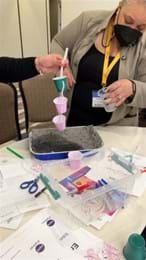
Test
- Before testing, discuss and agree on class testing rules. These rules can be chosen by the class or determined by you. Possible rules include:
- The shower clock will be suspended from a hook in the classroom (to simulate it hanging it from a showerhead).
- Each team will have three trials of their shower clock.
- Once students add water to the clock to begin the trial, they cannot touch it again until the trial is over.
- Instruct the Test Specialists for each team to coordinate the testing of their shower clocks and ensure that all team members record the test conditions and results in their NASA eClips Engineering Design Packet on Page 7.
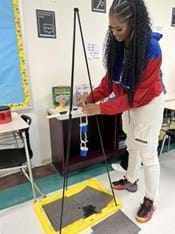
- Tell teams they should run at least three trials and then average the results. Note: The average time calculated by each team will be used to determine the accuracy of the shower clock in measuring a duration of five minutes.
- Optional: Consider allowing one member of each team to silently observe another team during testing.
Refine
- Have each group answer the questions in the Refine section of the NASA eClips Engineering Design Packet on page 8 BEFORE moving on to the next step.
Explain: Analyze, Refine, and Share Designs (55 minutes)
Compare Designs and Results (10 minutes)
- Pair up teams and have students compare the design and performance of their shower clocks and discuss how they support water conservation.
- Pose the following questions to help guide the discussion:
- What caused the water to flow from one cup to another? (Answer: Gravity caused the water to flow downward.)
- What effect does having more holes or different hole sizes in the cup make? (Answer: The size of the hole changes how quickly water flows and how long the shower clock runs. Larger holes allow water to flow faster, making the clock run for a shorter amount of time.)
- Could a shower clock be used onboard the ISS? (Answer: A shower clock would not work onboard the International Space Station because it operates in microgravity. In this environment, water does not flow downward like it does on Earth. Instead, surface tension causes water to form floating droplets that do not behave like flowing liquid.)
Improve and Redesign (25 minutes)
- Guide teams to consider how they could refine their shower clock to improve its performance.
- Pose the following questions to elicit student thinking:
- How would they change the design if they had more time?
- How might they change the design if they could use additional materials?
- What other materials might they use?
- Instruct students to record any modifications they would make to their design on Page 8 of their NASA eClips Engineering Design Packet.
- Optional: If time permits, allow students to build and test their new designs. Note: This task could also be given to students as an assignment to complete outside of class, involving families in the design challenge.
- Encourage students to take home the shower clock and test it out. Taking a five-minute shower uses significantly less water than taking a longer shower or a bath.
Share and Evaluate (20 minutes)
- Optional: Give each team an opportunity to present their final shower clock and explain their design thinking through a poster, presentation, video, or other format.
- Have students answer the questions in the Share section on Page 9 of the NASA eClips Engineering Design Packet.
- Give students a few minutes to answer the questions in the Engineering Design Student Checklist on Page 10 of the NASA eClips Engineering Design Packet.
- Summarize the design challenge and results: Student teams designed, built, tested, and improved a “shower clock” that can accurately time a 5-minute shower using a limited set of materials. Through multiple design iterations, students discovered that hole size, cup arrangement, and water flow affect the accuracy and reliability of the clock.
Vocabulary/Definitions
conservation: The protection and efficient use of natural resources such as water, forests, wildlife, and soil.
gravity: The force of attraction between any two bodies that have mass; on Earth, the force pulling objects downward.
International Space Station (ISS): A large, orbiting laboratory where astronauts live and conduct scientific experiments; many countries, including the U.S., collaborated to plan, build, and sustain the ISS.
natural resource: A material or living thing found in the environment that is useful for life on Earth.
recycle: A way to conserve resources by turning used or discarded materials into new products.
reduce: A way to conserve resources by using less material.
reuse: A way to conserve resources by using an item more than once, either for its original purpose or a different one.
spin-off: A product or technology that originated from NASA's research and development but has been adapted for everyday use.
water clock: A device that uses the flow of water to measure time.
Water Recovery System: Equipment that recycles and purifies wastewater from the International Space Station into drinkable water.
Assessment
Pre-Activity Assessment
- Water Consumption Calculator: Students explore personal water use as a class by brainstorming ways students use water in a typical day. If time allows, students may use a simple online water-consumption calculator (such as https://www.epa.gov/watersense/watersense-calculator) to quantify their usage. Students then analyze their usage results by answering the following questions:
- Which activity uses the most water?
- Which water use surprised you the most?
- Class Discussion: Lead a class discussion on why conserving water matters on Earth and why it is even more critical in space. Use the discussion to determine the following:
- Do students understand why water is a limited and valuable resource on Earth?
- Can students explain why conservation is even more critical in space (e.g., closed-loop systems, limited resupply, recycling)?
- Do students recognize that water is part of a system (use → waste → recycling/reuse)?
- What misconceptions or partial understandings do students express that may need correction later?
Activity Embedded (Formative) Assessment
- Engineering Design Packet: As student teams work on their NASA eClips Engineering Design Packet, monitor team discussions and review student work at each stage of the engineering design process. For example, ensure teams identify appropriate criteria and constraints and clearly document their brainstormed ideas before moving to the build phase.
- Design justification discussions: Circulate around the classroom and monitor evidence-based design justification discussions facilitated by the Research/Design Specialist. Have each team briefly explain to you (or another team) why they selected the design they will build and test. Encourage teams to explain their reasoning, including criteria, constraints, trade-offs, and practical considerations. This quick check reveals whether students are making informed engineering decisions rather than selecting design options at random.
Post-Activity (Summative) Assessment
- Engineering Design Packet: After students submit their design packets for evaluation, use them as artifact-based assessment evidence to determine whether students can:
- Follow the engineering design process.
- Use evidence to support design decisions.
- Reflect on and improve their solutions.
- Connect their work to real-world water conservation.
- Engineering Design Student Checklist: Individual students complete the student checklist on Page 10 of the NASA eClips Engineering Design Packet and then review their checklists with teammates to assess understanding of the engineering design process, collaboration skills, and content knowledge.
- Share out: Students explain how their shower clock could be used to conserve water during a shower. This can be done through a poster, presentation, video, or other format.
Troubleshooting Tips
Establish and review clear guidelines before starting the challenge with students to ensure a smooth activity. Suggested guidelines might include:
- How teams go about requesting additional materials.
- The establishment of teams to promote collaboration while tackling the challenge.
- Establishing specific roles within their teams.
Consider setting up multiple stations for teams to test their shower clocks. Possible rules include:
- The shower clock will be suspended from a hook in the classroom (to simulate it hanging it from a showerhead).
- Each team will have three trials of their shower clock.
- Once students add water to the clock to begin the trial, they cannot touch it again until the trial is over.
Activity Extensions
- Additional activities: Students can find out more about how NASA-developed technology is used in everyday life by visiting: https://spinoff.nasa.gov or https://www.nasa.gov/technology.
Activity Scaling
- For upper grades: A Secondary Engineering Design Packet is included for upper grades and students who are experienced with the engineering design process.
Subscribe
Get the inside scoop on all things Teach Engineering such as new site features, curriculum updates, video releases, and more by signing up for our newsletter!More Curriculum Like This

Students are introduced to the International Space Station (ISS) with information about its structure, operation and key experiments.

Whether on Earth or in space, life-threatening illnesses may occur if the water we drink is of poor quality. It’s up to your students to design and build a filtration system for the International Space Station so they can guarantee astronauts get the safe and clean water they need.

Students examine in detail the water cycle components and phase transitions, and then learn how water moves through the human-made urban environment. Students show their understanding of the process by writing a description of the path of a water droplet through the urban water cycle, from the dropl...

Students are introduced to the historical motivation for space exploration. They learn about the International Space Station as an example of space travel innovation and are introduced to new and futuristic ideas that space engineers are currently working on to propel space research far into the fut...

References
NASA eClips. “NASA’s Our World: Designing a Shower Clock.” NASA eClips, 2010 https://nasaeclips.arc.nasa.gov/resources/download/60.
Copyright
© 2026 by Regents of the University of Colorado; original © 2025 NASA eClipsContributors
NASA eClips Education Team, National Institute of Aerospace-Center for Integrative STEM EducationAcknowledgements
This document is based upon work supported by NASA under award No. NNX16AB91A. Any opinions, findings, and conclusions or recommendations expressed in this material are those of the author(s) and do not necessarily reflect the views of the National Aeronautics and Space Administration (NASA).
Last modified: May 24, 2026
User Comments & Tips