
Invent a Backscratcher from Everyday Materials
Being able to recognize a problem and design a potential solution is the first step in the development of new and useful products. In this activity, students create devices to get "that pesky itch in the center of your back." Once the idea is thought through, students produce design schematics (sketches). They are given a variety of everyday materials and recyclables, from which they prototype their back-scratching devices.
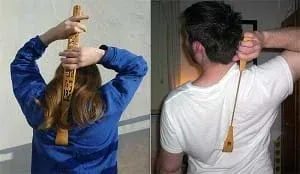 Students make their own backscratchersCopyright Wikimedia Commons http://upload.wikimedia.org/wikipedia/commons/e/e3/Backscratchers.jpg
When engineers design products, they must make sure that they meet the desired functions, as well as consider other important aspects of the designs for the users. Beyond being functional, in many cases the product must also be easy or comfortable to use, and aesthetically pleasing. Engineers also take into consideration material and labor costs, durability to withstand intended use, and efficient material use in manufacturing.
After this activity, students should be able to:
- Use creativity and everyday materials to build something useful.
- Utilize designs and sketches in creating a product.
- Students will develop an understanding of the attributes of design.
Grades K-12
Do you agree with this alignment? - STEL-1B Explain the tools and techniques that people use to help them do things.
Grades -1-2
Do you agree with this alignment? - STEL-1C Demonstrate that creating can be done by anyone.
Grades -1-2
Do you agree with this alignment? - STEL-2C Explain that materials are selected for use because they possess desirable properties and characteristics.
Grades -1-2
Do you agree with this alignment? - STEL-5B Explore how technologies are developed to meet individual and societal needs and wants.
Grades -1-2
Do you agree with this alignment? - STEL-7A Apply design concepts, principles, and processes through play and exploration.
Grades -1-2
Do you agree with this alignment? - STEL-7C Explain that design is a response to wants and needs.
Grades -1-2
Do you agree with this alignment? - STEL-7D Discuss that all designs have different characteristics that can be described.
Grades -1-2
Do you agree with this alignment? - STEL-7E Illustrate that there are different solutions to a design and that none are perfect.
Grades -1-2
Do you agree with this alignment?
- 1.K-2-ETS1-1 Ask questions, make observations, and gather information about a situation people want to change that can be solved by developing or improving an object or tool.
Grade 1
Do you agree with this alignment? - 1.K-2-ETS1-2 Generate multiple solutions to a design problem and make a drawing (plan) to represent one or more of the solutions.
Grade 1
Do you agree with this alignment?
- K-2-ETS1-1 Ask questions, make observations, and gather information about a situation people want to change to define a simple problem that can be solved through the development of a new or improved object or tool.
Grades K-2
This resource focuses on the following Three Dimensional Learning aspects of NGSS:
Science & Engineering Practices- Define a simple problem that can be solved through the development of a new or improved object or tool.Do you agree with this alignment?
Disciplinary Core Ideas- Asking questions, making observations, and gathering information are helpful in thinking about problems.Do you agree with this alignment?
- A situation that people want to change or create can be approached as a problem to be solved through engineering.Do you agree with this alignment?
- Before beginning to design a solution, it is important to clearly understand the problem.Do you agree with this alignment?
Do you agree with this alignment? - Define a simple problem that can be solved through the development of a new or improved object or tool.
- K-2-ETS1-2 Develop a simple sketch, drawing, or physical model to illustrate how the shape of an object helps it function as needed to solve a given problem.
Grades K-2
This resource focuses on the following Three Dimensional Learning aspects of NGSS:
Science & Engineering Practices- Develop a simple model based on evidence to represent a proposed object or tool.Do you agree with this alignment?
Disciplinary Core Ideas- Designs can be conveyed through sketches, drawings, or physical models. These representations are useful in communicating ideas for a problem's solutions to other people.Do you agree with this alignment?
Crosscutting Concepts- The shape and stability of structures of natural and designed objects are related to their function(s).Do you agree with this alignment?
Do you agree with this alignment? - Develop a simple model based on evidence to represent a proposed object or tool.
- tape
- string
- scrap cardboard
- paper towel tubes
- scissors
- glue
- any other materials you wish to use; students may also bring supplies from home
Engineers are constantly using their creativity to find solutions to everyday problems. To solve a problem, you must first recognize that the problem exists. This is the first step in the engineering design process. For example, have you ever had a pesky itch on your back that you just could not reach? Typically, when you have an itch on your body, your first reaction is to scratch it with your fingernails. However, this itch is an unreachable itch and no one is around to scratch it for you. What do you do? As an engineer, you use your creativity and the materials around you to come up with different solutions and design a backscratcher. What types of materials would you want to use for the backscratcher and why?
Note: It might be helpful to introduce the engineering design process to students before starting the activity.
Recommended Background Resources
- A helpful video about what the engineering design process is: https://www.teachengineering.org/k12engineering/designprocess
- Nice demonstration about balancing a mobile (levers): http://www.vectorpark.com/levers.html
- Examples of different types of levers and description of lever, fulcrum, load, effort: http://www.reachoutmichigan.org
- Short description of different lever classes with real-world examples: https://inventorsoftomorrow.com/levers-simple-machines-for-kids/
Before the Activity
- Gather materials.
- (optional) Build a backscratcher as an example to show the students.
- Have students bring in any backscratchers they might have at home to show.
With the Students
Class Discussion:
- Ask the students: Why is it hard to scratch your back?
- Discuss why new products are made and innovations take place. (They solve a problem or fill a need.)
- Have students show example backscratchers they brought in from home.
- Discuss what a backscratcher is and why it is a useful device or tool.
- Talk about formulating an idea and sketching a picture before construction.
- Talk about what makes a good sketch. Why are plans/sketches an important step in the design process?
- Point out how there is more than one way to make a backscratcher. (Bring up different brand names of the same product.)
Activity:
- Prepare a station with the materials available for students to use.
- Have students work alone or in pairs.
- Talk about safety; do not eat the glue, careful with scissors, etc.
- Introduce the activity to the students and let them examine the materials, brainstorm for ideas and sketch designs. Have the students explain their sketches to you before they start construction. Tell the students that they may use as much or as little of the materials available.
- Once students have completed their backscratchers, have them lay them out on a table so that everyone in the class can see each design. Encourage them to try out the different backscratchers, but remind them to be respectful of everyone's inventions.
- After everyone has tested the designs, have the class decide which of the backscratchers is the most useful and explain what features they liked about it.
- sketch
- A rough drawing or plan of an idea.
- lever
- A simple machine that utilizes a ridged bar and a fulcrum (pivot point) to raise or move an object.
Supporting Program
Center for Engineering Education Outreach, Tufts University
Copyright
2013 by Regents of the University of Colorado; original © 2004 Worcester Polytechnic Institute