
Grow Your Own Algae!
Students discover how tiny microscopic plants can remove nutrients from polluted water. They also learn how to engineer a system to remove pollutants faster and faster by changing the environment for the algae.
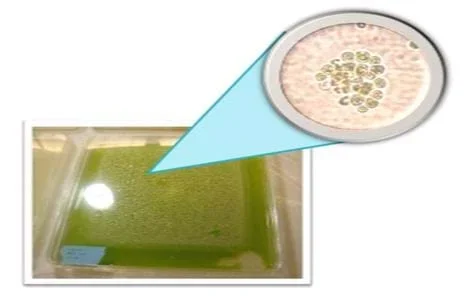 Example algae tray.Copyright 2011 Robert Bair. STARS – University of South Florida
Environmental engineers play a critical role in protecting the environment and public health by developing wastewater treatment systems that use microbes to break down dangerous contaminants and pollutants. They must consider factors such as pH and temperature when they design systems to remove nutrients from wastewater.
After this activity, students should be able to:
- Explain how the amount of light that passes through a sample can be used to determine the growth of microbes.
- Demonstrate that algae consume nutrients dissolved in water.
- SC.912.L.17.15 Discuss the effects of technology on environmental quality.
Grades 9-12
Do you agree with this alignment? - SC.912.L.17.17 Assess the effectiveness of innovative methods of protecting the environment.
Grades 9-12
Do you agree with this alignment?
- STEL-4P Evaluate ways that technology can impact individuals, society, and the environment.
Grades 9-12
Do you agree with this alignment?
- MS-LS1-5 Construct a scientific explanation based on evidence for how environmental and genetic factors influence the growth of organisms.
Grades 6-8
This resource focuses on the following Three Dimensional Learning aspects of NGSS:
Science & Engineering Practices- Construct a scientific explanation based on valid and reliable evidence obtained from sources (including the students' own experiments) and the assumption that theories and laws that describe the natural world operate today as they did in the past and will continue to do so in the future.Do you agree with this alignment?
Disciplinary Core Ideas- Genetic factors as well as local conditions affect the growth of the adult plant.Do you agree with this alignment?
Do you agree with this alignment? - Construct a scientific explanation based on valid and reliable evidence obtained from sources (including the students' own experiments) and the assumption that theories and laws that describe the natural world operate today as they did in the past and will continue to do so in the future.
- SEP.4.6-8.1 Develop a model to predict and/or describe phenomena.
Grades 6-8
Do you agree with this alignment?
Each group needs:
- coffee filter
- fish tank or large glass container
- liquid plant fertilizer
- small plastic soda bottle (591 ml)
- larger mason jar
- spoon
(Note to teacher: This activity was designed to help students understand how engineers use algae species to recover the nutrients found in wastewater. Students may be interested to know that some types of algae produce oils that can be processed to power cars and trucks.)
Here's our design challenge: You are an engineer given the task to develop a system for removing nutrients from a local stream. The stream is contaminated from rainwater that has picked up nutrients from the fertilizers used at a local golf course. You know that algae can naturally remove the nutrients when they are grown on nutrient-rich waters. You want to find algae species that are native to the area. Our activity focuses on finding the right species for the clean-up job. Ready to get started? Let's do it!
Background
See the associated Biological Processes: Putting Microbes to Work lesson for information on biological processes. Focus on what occurs when wastewater enters natural water bodies.
Before the Activity
- Collect water samples at a local lake or river, 591 ml in each soda bottle, one for each student group.
- Filter each water sample through a coffee filter into the larger mason jars.
- Store the samples in the refrigerator until the activity is ready to start.
With the Students
- Have students fill the fish tank or glass container three-quarters of the way with tap water.
- Add 10 ml liquid fertilizer per liter of tap water.
- Add an additional 20 ml sample lake or river water per liter of tap water.
- Use a spoon to mix the contents in the tank.
- Place the container on a window sill or near some artificial lights.
- Observe changes in the tank over a few weeks.
After the Activity
The activity takes a few weeks to run its course. The algae species go through all the growth phases described in the associated lesson. Once the color of the tank starts turning anything other than green, end the activity by dumping the tanks contents down the drain or on grass.
- microalgae
- An organism similar to a microscopic plant. Like plants, they use the Sun's energy to grow while taking in carbon dioxide.
Pre-Activity Assessment
Questions: Ask the students and discuss as a class:
- How do the nutrients in wastewater affect microbes? (Answer: The microbes, like algae, use the nutrients to grow.)
- For the nutrient removal system you are developing, do you think the species that you are growing in the tank are suitable? (Answer: Selecting for local species is important because they can already compete with the other bacteria that live in the area. They are also already accustomed to the regional climate.)
Activity Embedded Assessment
Questions: Ask the students:
- What is in the water collected from the stream or lake? Why are we taking that water sample and putting it in the tank? (Answer: The water sample contains all sorts of organisms naturally present in water bodies. Usually these organisms are kept in check by natural limitations in nutrients, food sources and climate. Of these organisms, we are hoping to select for some algae species.)
- Why is the water turning green? (Answer: In large quantities, we can see algae in water because as the algae begin to thrive, they multiply and cause the water to turn green.)
- Near the end of the experiment: Why is the green color vanishing from the tank? (Answer: The nutrients in the tank have all been used up. Now the algae are starting to die.)
Post-Activity Assessment
Questions: Ask the students:
- What tools can we use to measure growth? (Answer: Engineers use the color change as a way to measure growth. They send light through the container and measure how much is absorbed by all the cells. The more light that is absorbed, the more algae we have growing in the container.)
If the initial growth is anything other than green, it is advisable to end the experiment since it is possible that non-algal bacteria have colonized the tank.
- For ninth and tenth grade students, use this activity to model growth rates. For example, place a solar cell under the tank and connected to a voltmeter. As the algae begins to grow, take periodic measurements of how much light passes through the tank. Allow students to create a graph over time of the data they collect and have them explain why it might behave in a certain way.
- Biological Processes: Putting Microbes to Work
- Microbes Know How to Work!
- Grow Your Own Algae!
Contributors
Robert Bair; Patricio Rocha; Tapas K. Das; Dayna Lee Martinez
Supporting Program
STARS GK-12 Program, College of Engineering, University of South Florida
Acknowledgements
This curriculum was developed by the USF Students, Teachers and Resources in Sciences (STARS) Program under National Science Foundation grant numbers DGE 0139348 and DGE 0638709. However, these contents do not necessarily represent the policies of the NSF, and you should not assume endorsement by the federal government.
Copyright
2013 by Regents of the University of Colorado; original © 2010 College of Engineering, University of South Florida