

Quick Look

- Grade Level:
- 8 (6 – 8)
- Time Required:
- 1 hours 30 minutes
(two 45-minute sessions)
- Group Size:
- 2
- Subject Areas:
-
Biology Life Science Science and Technology -
NGSS Performance Expectations:

MS-ETS1-1 MS-ETS1-2 MS-LS2-1
Summary
This activity integrates life science, engineering, and materials science as students design a biome-specific robot. Students start by researching an assigned global biome, exploring its unique characteristics such as climate, terrain, and biodiversity. This research helps them understand the environmental challenges their robots will face. Next, they delve into the world of high-performance polymers, learning about their properties, uses, and applications. Using this knowledge and applying engineering design principles, students strategically select polymers to build a robot that can function effectively within their chosen biome's unique conditions.Engineering Connection
Just like engineers who design everything from space rovers to smart textiles, students must understand the operating environment, choose materials that match the conditions, and justify their design decisions with data. They will also revise their work based on feedback, mirroring the process of real engineering teams. This project reflects the interdisciplinary work of engineers across industries—whether they are designing prosthetics that withstand diverse weather, developing survival gear for extreme climates, or creating robots for deep-sea exploration.
Learning Objectives
After this activity, students should be able to:
- Describe how climate, terrain, and resource availability affect living organisms in different biomes.
- Select materials (polymers) based on their physical properties to solve environmental design challenges.
- Design and justify a biome-adapted robot using scientific reasoning and engineering principles.
Educational Standards
Each Teach Engineering lesson or activity is correlated to one or more K-12 science,
technology, engineering or math (STEM) educational standards.
All 100,000+ K-12 STEM standards covered in Teach Engineering are collected, maintained and packaged by the Achievement Standards Network (ASN),
a project of D2L (www.achievementstandards.org).
In the ASN, standards are hierarchically structured: first by source; e.g., by state; within source by type; e.g., science or mathematics;
within type by subtype, then by grade, etc.
Each Teach Engineering lesson or activity is correlated to one or more K-12 science, technology, engineering or math (STEM) educational standards.
All 100,000+ K-12 STEM standards covered in Teach Engineering are collected, maintained and packaged by the Achievement Standards Network (ASN), a project of D2L (www.achievementstandards.org).
In the ASN, standards are hierarchically structured: first by source; e.g., by state; within source by type; e.g., science or mathematics; within type by subtype, then by grade, etc.
NGSS: Next Generation Science Standards - Science
| NGSS Performance Expectation | ||
|---|---|---|
|
MS-ETS1-1. Define the criteria and constraints of a design problem with sufficient precision to ensure a successful solution, taking into account relevant scientific principles and potential impacts on people and the natural environment that may limit possible solutions. (Grades 6 - 8) Do you agree with this alignment? |
||
| Click to view other curriculum aligned to this Performance Expectation | ||
| This activity focuses on the following Three Dimensional Learning aspects of NGSS: | ||
| Science & Engineering Practices | Disciplinary Core Ideas | Crosscutting Concepts |
| Define a design problem that can be solved through the development of an object, tool, process or system and includes multiple criteria and constraints, including scientific knowledge that may limit possible solutions. Alignment agreement: | The more precisely a design task's criteria and constraints can be defined, the more likely it is that the designed solution will be successful. Specification of constraints includes consideration of scientific principles and other relevant knowledge that is likely to limit possible solutions. Alignment agreement: | All human activity draws on natural resources and has both short and long-term consequences, positive as well as negative, for the health of people and the natural environment. Alignment agreement: The uses of technologies and any limitations on their use are driven by individual or societal needs, desires, and values; by the findings of scientific research; and by differences in such factors as climate, natural resources, and economic conditions.Alignment agreement: |
| NGSS Performance Expectation | ||
|---|---|---|
|
MS-ETS1-2. Evaluate competing design solutions using a systematic process to determine how well they meet the criteria and constraints of the problem. (Grades 6 - 8) Do you agree with this alignment? |
||
| Click to view other curriculum aligned to this Performance Expectation | ||
| This activity focuses on the following Three Dimensional Learning aspects of NGSS: | ||
| Science & Engineering Practices | Disciplinary Core Ideas | Crosscutting Concepts |
| Evaluate competing design solutions based on jointly developed and agreed-upon design criteria. Alignment agreement: | There are systematic processes for evaluating solutions with respect to how well they meet the criteria and constraints of a problem. Alignment agreement: | |
| NGSS Performance Expectation | ||
|---|---|---|
|
MS-LS2-1. Analyze and interpret data to provide evidence for the effects of resource availability on organisms and populations of organisms in an ecosystem. (Grades 6 - 8) Do you agree with this alignment? |
||
| Click to view other curriculum aligned to this Performance Expectation | ||
| This activity focuses on the following Three Dimensional Learning aspects of NGSS: | ||
| Science & Engineering Practices | Disciplinary Core Ideas | Crosscutting Concepts |
| Analyze and interpret data to provide evidence for phenomena. Alignment agreement: | Organisms, and populations of organisms, are dependent on their environmental interactions both with other living things and with nonliving factors. Alignment agreement: In any ecosystem, organisms and populations with similar requirements for food, water, oxygen, or other resources may compete with each other for limited resources, access to which consequently constrains their growth and reproduction.Alignment agreement: Growth of organisms and population increases are limited by access to resources.Alignment agreement: | Cause and effect relationships may be used to predict phenomena in natural or designed systems. Alignment agreement: |
Common Core State Standards - Math
-
Use variables to represent two quantities in a real-world problem that change in relationship to one another; write an equation to express one quantity, thought of as the dependent variable, in terms of the other quantity, thought of as the independent variable. Analyze the relationship between the dependent and independent variables using graphs and tables, and relate these to the equation.
(Grade
6)
More Details
Do you agree with this alignment?
International Technology and Engineering Educators Association - Technology
-
Apply the technology and engineering design process.
(Grades
6 -
8)
More Details
Do you agree with this alignment?
Materials List
Each student needs:
- (optional) Biome Share Guide
Each group needs:
- Chromebook or laptop
- colored markers or colored pencils
- Biome Research Handout
- Robot Design/Prototype Handout
- Robot Design Grading Rubric
For the entire class to share:
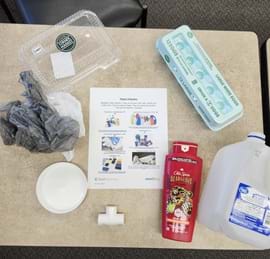
- Polymer Information Cards
- collection of sample polymers for students to see and/or touch.
- hydrogels sample: sodium polyacrylate (the solid material in baby diapers)
- elastomer samples: silicone, shoe soles, and/or rubber band
- liquid polymer samples: (poly acrylic) paint, nail polish, and/or adhesives (e.g., school glue or hot glue)
- polyelectrolyte sample: silver bandages
- fiber samples: polyester fabric, Lycra (Spandex) fabric, nylon rope
- composite sample: Formica
- plastics samples: water/soda bottle (polyethylene terephthalate, PET, ♳1), milk jugs (high-density polyethylene, HDPE, ♳2), pipes and shrink wrap (polyvinyl chloride, PVC, ♳3), grocery bag (low-density polyethylene, LDPE ♳4), bottle caps/shampoo bottle (polypropylene, PP, ♳5), and foam cups (polystyrene, PS, ♳6)
Worksheets and Attachments
Visit [www.teachengineering.org/activities/view/usm-3009-biome-robots-polymers-survival-activity] to print or download.Pre-Req Knowledge
To be successful in this activity, students should already have:
- A basic understanding of biomes and how climate and terrain influence ecosystems.
- Knowledge of plant and animal adaptations for survival in specific environments.
- The ability to read and interpret data from tables, graphs, or text-based resources.
- Familiarity with physical properties of materials (e.g., flexibility, strength, waterproofing).
- Basic collaborative skills, including sharing ideas, listening, and giving peer feedback.
Introduction/Motivation
If I were to drop you off in the wilderness of your assigned biome, what are some things you would need to research to be prepared for your stay in the biome, to have a better understanding of your biome and to survive in your biome?
[Give students 5 minutes to brainstorm and list ideas with their partner.] What ideas did you come up with? Let’s make a list. (Write student responses on the board. Possible Answers: temperature, rainfall, type of precipitation. Possible questions to ask: Does it get all four seasons, sunlight, wind? What is the terrain (e.g., rocky, muddy, sandy, icy, open water)? What types of animals live there? What types of plants live there? What types of adaptations, traits, or survival skills do plants and animals need to survive in your biome?)
Today we are going to become engineers and explore the relationship between materials science and environmental adaptation by brainstorming, designing, and planning a robot using high-performance polymers to survive and function in a specific biome. Let’s get started!
Procedure
Background
In this engineering design challenge, students explore the relationship between material science and environmental adaptation by designing a robot using high-performance polymers to survive and function in a specific biome (a large geographic area defined by its specific climate). This activity encourages critical thinking, creativity, and application of science concepts through hands-on learning.
Polymers are long chains of repeating molecular units. They can be natural (like DNA) or synthetic (like nylon), and their structure gives them a wide range of properties—flexibility, durability, water resistance, insulation, etc. High-performance polymers are engineered for extreme conditions, making them useful in advanced technology, space exploration, and biomedical applications.
Each biome has unique environmental conditions—such as extreme temperatures, high humidity, arid climates, or challenging terrain. To design a robot that can function in a biome, students must select polymers with properties that match those conditions. For example: A desert robot might need UV-resistant or heat-stable materials. A rainforest robot might require water-repellent or mold-resistant coatings.
Earth’s biomes are large, distinct regions characterized by their unique climate, vegetation, and animal life. They are typically categorized into two major types: terrestrial (land) and aquatic (water). The major biomes include:
- Savanna – A tropical grassland with scattered trees, year-round warmth, and distinct wet and dry seasons. Supports large grazing animals and predators.
- Desert – Defined by very low rainfall. Can be hot or cold, with plants and animals specially adapted to survive arid conditions.
- Rainforest – Dense forests with high rainfall and biodiversity. Warm and humid, supporting a wide variety of species.
- Temperate Deciduous Forest – Found in mid-latitudes, experiences four seasons. Dominated by trees that shed leaves in autumn.
- Tundra – Cold, treeless regions with permafrost. Found in the Arctic and high mountains, with short growing seasons.
- Taiga (Boreal Forest) – Largest land biome. Coniferous forests with long, cold winters and short, mild summers.
- Tropical Rainforest – Near the equator, consistently warm and wet with extremely high biodiversity.
- Grassland – Dominated by grasses. Includes savannas (tropical, scattered trees) and temperate grasslands (prairies).
- Saltwater/Marine Coastal – Shallow ocean areas near shorelines, rich in nutrients and biodiversity; includes estuaries, coral reefs, and tide zones.
- Saltwater/Open Ocean – Vast, deep ocean waters beyond the continental shelf. Less nutrient-rich but supports large marine life like whales and tuna.
- Freshwater Wetlands – Water-saturated ecosystems such as marshes and swamps. Rich in biodiversity, they filter water and prevent floods.
Before the Activity
- Gather samples of polymers.
- Gather colored markers or pencils.
- Make copies of a classroom set of Polymer Information Cards, a group set of Robot Design/Prototype Handout, and Robot Design Grading Rubric.
During the Activity
Day 1: (45 minutes)
- Optional: Introduce the Engineering Design Process.
Ask (5 min)
- Define the engineering challenge: In this activity, you will explore the relationship between materials science and environmental adaptation by brainstorming, designing, and planning a robot using high-performance polymers to survive and function in a specific biome.
- Put students into pairs.
Biome Research and Share (25 min)
- Assign each group a specific biome from the following:
- Savanna
- Desert
- Rainforest
- Temperate Deciduous Forest
- Tundra
- Taiga (Boreal Forest)
- Tropical Rainforest
- Grassland
- Saltwater/Marine Coastal
- Saltwater/Open Ocean
- Freshwater Wetlands
- Give each pair a Biome Research Handout.
- Give students 20 minutes to research their assigned biome.
- Instruct students to use their textbook or the internet to research their biome and to find as many of the factors listed on the board and any other information they may find significant about their biome.
- Website possibilities
- https://askabiologist.asu.edu/explore/biomes
- https://scitechinstitute.org/listing/ask-a-biologist-virtual-biomes
- Let students know that they can take notes in bullet point form and/or create a labeled illustration.
- Walk through the classroom and ask monitoring questions:
- Can you describe what the seasons are like in your biome?
- Explain why certain animals live in your biome but not in others.
- Why do some plants in your biome have thick leaves or deep roots?
- What are some physical features of the land (terrain) in your biome?
- Based on what you've learned, how would an animal need to behave to survive in your biome?
- If a plant from the rainforest were placed in a desert biome, what might happen? Why?
- How would humans need to adapt to live in your biome year-round?
- Give students 5 minutes to share and compare their findings with another pair. (Note: Students can share their findings with other groups that have the same and/or different biomes. For example, due to larger class size, two pairs may have the same assigned biome. If pairs share their findings with a group that has the same biome, they can see if there is any new information for them to share or any information they may have missed themselves.)
- Have students ask/answer these questions when sharing their work:
- What did you find out?
- Is your biome hot or cold?
- Is your biome dry or wet?
- Is your biome on land or in water?
- What is the soil or terrain?
- Is your biome crowded, are there a lot of animals and plants, biodiversity?
- What are some survival skills plants and animals have in your biome, and why do they need them?
- Are there any key features of your biome?
- Walk the room and ask questions of the students during their pair comparison discussion. Potential questions to ask:
- What similarities and differences can you find between your biome and the other group’s biome?
- How does the terrain affect the types of plants and animals that live in your biome?
- Which adaptations are most important for survival in your biome, and why?
- Do you think your biome is more or less difficult to survive in than another biome? Explain your reasoning.
- Which factor (temperature, rainfall, terrain, etc.) do you think most affects life in your biome, and why?
- Are all the animals and plants in your biome equally adapted to survive there? Why or why not?
- Optional: If you want your students to learn about all the biomes, have them complete a Biome Share Guide as they compare and share, so that students will have facts about every biome.
Polymer Research (15 minutes)
- Restate the design challenge and then briefly introduce polymers.
- Tell the students: “In this design challenge, you will create a robot using special materials called polymers. Your robot needs to work well in your specific biome. I will show you some high-performance polymers that engineers use to make strong, flexible, and useful machines. As I introduce each polymer, listen closely to how it works and what it’s good at. While I’m talking, think about your biome’s climate (like hot, cold, wet, or dry), land (flat, rocky, sandy), and the plants and animals that live there. These clues will help you choose the best polymers to build a robot that can survive and do a job in your biome!”
- Go through the eight main types of polymers using the Polymer Information Cards. Note: You can review the Polymer Information Cards using a laptop and projector, or give each group their own set of Polymer Information Cards. (Regardless, it is important to display the physical cards and physical polymer examples together.)
- Give students time to explore each physical polymer sample and its corresponding Polymer Information Cards. These concrete examples should be available to students throughout the activity so students can refer back to them through prototype design of their robot.
Day 2: (45 minutes)
- Briefly review the design challenge.
- Briefly review the polymers available.
Imagine (5 minutes)
- Give students time to brainstorm which polymers would work best for their biome.
- Give students time to brainstorm which polymers would work best for which function (e.g., visual, touch, smell, etc.).
Plan (15 minutes)
- Hand each pair a Robot Design/Prototype Handout.
- Go over the instructions:
- Fill in your assigned Biome Name.
- Use 5 different polymers in your robot design.
- You can use the same polymer more than once, in different parts of your robot.
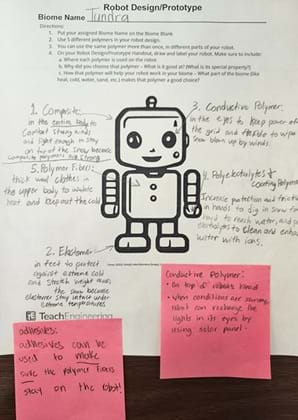
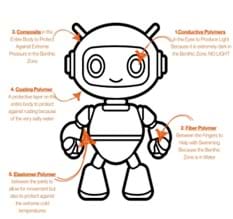
- On your Robot Design/Prototype Handout, draw and label your robot. Make sure to include:
- Where each polymer is used on the robot.
- Why you chose that polymer. What is it good at? (What is its special property?)
- How that polymer will help your robot work in your biome. What part of the biome (like heat, cold, water, sand, etc.) makes that polymer a good choice?
- Optional: Show Image 1 as an example.
- Walk around the room and monitoring questions such as the following:
- Can you tell me the name of the polymer you're using here?
- What does this polymer do really well?
- What makes this polymer different from the others?
- What is the weather like in your biome? (hot, cold, wet, dry?)
- How does your robot need to move or survive in this biome?
- How will this polymer help your robot deal with that kind of weather or land?
- What part of your biome made you pick this polymer?
- Can you show me where this polymer is being used on your robot drawing?
- Why did you put this polymer in that part of the robot?
- Do you have at least 5 different polymers in your design?
- Could you use this same robot in a different biome? Why or why not?
- If your robot had to swim, walk on sand, or survive freezing weather, would this polymer still work?
- What would happen if you used a different polymer in that spot? Would it work better or worse?
Peer Feedback (15 min)
- Have students share their robot designs with other groups in a gallery walk or small group share.
- Go over directions for sharing using the Presenter Listener Direction Handout.
- Give students 15 minutes to present and listen. Let students offer feedback for improvement for each pair’s robot.
Improve (10 min)
Groups will have an opportunity to make modifications to their robot design. They can change and/add elements.
- Give students time to make improvements and modifications to their robot design based on the feedback they received and the other robot designs.
- Give the following directions for documenting modifications on their Robot Design/Prototype Handout:
- Use a different color pencil, pen, or marker (example: red, blue, or green) to show any changes you make.
- On your Robot Design/Prototype Handout, circle the part of the robot that you changed or added.
- Next to it, write “Modified” and give a short note to indicate what you changed, and why you changed it (such as based on feedback or new thinking). Use the following sentence format: “We changed the ___ to ___ because ___.” Example: We changed the legs to a stronger polymer because our biome has rough, rocky land.
- If you need more room, flip your page over or use a sticky note to explain the modification.
- Optional: Allow students to see the Design Grading Rubric, in case they want to double check their work before submitting.
- Have students submit their work at the end of the class period.
- Use the Design Grading Rubric to assess the students’ robot designs.
Vocabulary/Definitions
adaptation: A trait or behavior that helps a plant or animal survive in its environment.
biodiversity: The variety of living things in an area.
biome: A large area with a specific climate and certain types of plants and animals.
climate: The average weather conditions in an area over a long period of time.
composites: A mix of two or more materials, one of which is usually a really strong polymer glue.
conductive polymers: Polymers that can carry electricity.
desert: A biome with very little rainfall and extreme temperatures.
elastomers: Super stretchy polymers that can handle extremely hot and cold.
grassland: A biome with wide-open spaces with mostly grasses and few trees.
hydrogels: Squishy, water-filled polymers that can absorb water.
liquid polymers: Polymers that start as liquids such as paints and glue.
plastics: Moldable, solid polymers that can be soft or hard, clear or colorful, thin or thick.
polyelectrolytes: Polymers that can dissolve in water and can carry ions.
polymer: Long chains of repeating molecules.
polymer fibers: Polymers shaped like long threads or strings.
precipitation: Rain, snow, sleet, or hail that falls from the sky.
rainforest: A warm, wet biome with lots of tall trees and biodiversity.
saltwater/marine coastal: Regions where land meets the ocean, encompassing diverse ecosystems such as estuaries, coral reefs, mangrove forests, and salt marshes.
saltwater/marine open ocean: Refers to the vast, deep-water areas of the ocean that are not near the coast or sea floor.
taiga/boreal forest: A cold biome with evergreen trees and snowy winters.
temperate forest: A biome with four seasons and trees that lose their leaves in the fall.
temperature: A measure of how hot or cold something is; part of describing a biome’s climate.
terrain: Physical features of land, such as rocky, muddy, or sandy.
tundra: A cold biome with little precipitation, frozen ground, and no trees.
wetland: A biome where the land is often flooded with shallow water.
Assessment
Pre-Activity Assessment
Brainstorm Prompt & Discussion: Prompt: “If I were to drop you off in the wilderness of your assigned biome, what are some things you would need to research to survive?” Gauge students’ prior understanding of biomes (climate, terrain, adaptations). Evidence of assessment included, with student responses shared aloud and listed on the board. This allows you to note misconceptions and redirect as needed.
Informal questioning: During the Biome Research and Biome Share time, listen for familiarity with weather, seasons, and biodiversity, the use of ecosystem-related vocabulary, general curiosity, and engagement. This helps you identify gaps in biome knowledge or research skills.
Activity Embedded (Formative) Assessment
Informal Questioning: During Polymer Learning & Robot Design, monitor and ask questions to ensure alignment between biome conditions and material properties.
Teacher Check: During development of the Robot Design/Prototype Handout, as students draw and label their robots, check the use of 5 polymers, clear labeling of materials, and reasons for use/biome relevance.
Peer Feedback: During the Robot Design share and modifications suggestion time, students assess peer work and give science-based suggestions. Observe participation, vocabulary use, and reasoning. Last, students document modification notes on their handout by explaining changes using sentences such as “We changed the ___ to ___ because ___.”
Post-Activity (Summative) Assessment
Robot Design/Prototype Handout (Final): Students submit complete design with 5 polymers labeled with purpose and biome relevance, clear drawing and notes, and thoughtful modifications highlighted and explained. Assess using the Design Grading Rubric.
(Optional) Biome Share Guide: If used, this document serves as evidence of comparative analysis between biomes. Assesses listening, note-taking, and understanding of biome diversity.
Troubleshooting Tips
Students can put the Robot Design/Prototype Handout on poster paper to have more room to write polymer modifications.
Subscribe
Get the inside scoop on all things Teach Engineering such as new site features, curriculum updates, video releases, and more by signing up for our newsletter!More Curriculum Like This

Students learn about humankind’s search for life in outer space and how it connects to robotics and engineering. This lesson provides students with intriguing information about far off (distance and time!) space missions and field robotics, and also sets up two associated robotics and arts integrati...

Copyright
© 2026 by Regents of the University of Colorado; original © 2025 University of Southern MississippiContributors
Jamie Sorrell: Sumrall High School; Sumrall, MSSupporting Program
The University of Southern Mississippi School of Polymer Science and EngineeringAcknowledgements
This activity was developed under the Research Experiences for Teachers (RET) in Engineering and Computer Science Site for Sustainable Polymer Engineering Research program in the University of Southern Mississippi’s School of Polymers and High Performance Materials, funded by National Science Foundation RET grant no. EEC 2419224. However, these contents do not necessarily represent the policies of the NSF, and you should not assume endorsement by the federal government.
Last modified: January 6, 2026
User Comments & Tips