
Lost in the Amazon
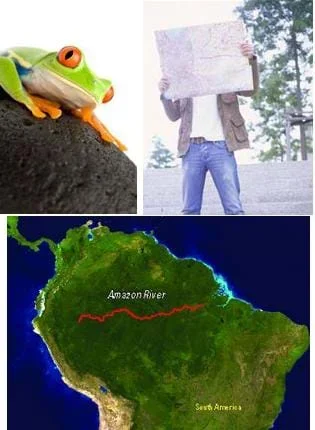 Students try to survive getting lost in the Amazon rainforestCopyright (man, frog) 2004 Microsoft Corporation, One Microsoft Way, Redmond, WA 98052-6399 USA. All rights reserved. (map) U.S. Geological Survey http://office.microsoft.com/en-us/images/results.aspx?qu=lost&ex=1#ai:MP900422950|mt:2| http://deltas.usgs.gov/rivers.aspx?river=amazon http://office.microsoft.com/en-us/images/results.aspx?qu=frog&ex=1#ai:MP900439296|
Through seven lessons and nine activities, students are guided through navigation, exploration and survival situations based in the Amazon rainforest.
The Lost in the Amazon unit provides a hypothetical scenario script to guide student teams from lesson to lesson and provide motivation for the activities. Each scene may be read aloud by the teacher to the class or students can take turns reading the scenarios out loud. Students can assume roles and act out the scenes within their groups. Working in teams encourages students to brainstorm and creatively problem solve.
Student handouts are provided to guide students through each activity; they include answers, where applicable. As with many engineering challenges, some questions are open-ended and thus, have multiple answers; in general, any answer is acceptable as long as it can be adequately justified.
The investigative, exploratory and problem solving nature of the unit is closely aligned with Colorado science standards 1, 2, 3 and 5 and mathematics standards 1, 2, 3, 4 and 5.
Engineers work in teams to invent and develop solutions to problems. Following the steps of the engineering design process, engineers first identify and define the problem or challenge. They gather information and conduct research to learn about the topics related to the problem, and they brainstorm and propose multiple possible solutions. Engineers evaluate the various potential solutions and select one that best meets the criteria for success. Testing is often done to verify that the proposed solution will solve the problem or challenge. The Lost in the Amazon unit provides a project framework in which student teams act as engineering teams to solve a number of challenges using the engineering design process.
- 3-5-ETS1-1 Define a simple design problem reflecting a need or a want that includes specified criteria for success and constraints on materials, time, or cost.
Grades 3-5
This resource focuses on the following Three Dimensional Learning aspects of NGSS:
Science & Engineering Practices- Define a simple design problem that can be solved through the development of an object, tool, process, or system and includes several criteria for success and constraints on materials, time, or cost.Do you agree with this alignment?
Disciplinary Core Ideas- Possible solutions to a problem are limited by available materials and resources (constraints). The success of a designed solution is determined by considering the desired features of a solution (criteria). Different proposals for solutions can be compared on the basis of how well each one meets the specified criteria for success or how well each takes the constraints into account.Do you agree with this alignment?
Crosscutting Concepts- People's needs and wants change over time, as do their demands for new and improved technologies.Do you agree with this alignment?
Do you agree with this alignment? - Define a simple design problem that can be solved through the development of an object, tool, process, or system and includes several criteria for success and constraints on materials, time, or cost.
The ideal implementation of this curricular unit is for students to complete the activities in sequence. However, each activity is self-contained and can be conducted on its own.
To set the scene and convey the nature of a rainforest at the beginning of the unit, show the class a video or photographs about the Amazon or another rain forest. Useful websites for information, maps and photos relating to rain forests and the Amazon include: http://www.pbs.org/journeyintoamazonia/ and http://www.junglephotos.com/amazon/.
Supporting Program
Adventure Engineering, Colorado School of Mines
Acknowledgements
Adventure Engineering was supported by National Science Foundation grant nos. DUE 9950660 and GK-12 0086457. However, these contents do not necessarily represent the policies of the National Science Foundation, and you should not assume endorsement by the federal government.
Copyright
2013 by Regents of the University of Colorado; original © 2005 Colorado School of Mines