
Simple Machines and the Rube Goldberg Challenge
Students research simple machines and other mechanisms as they learn about and make Rube Goldberg machines. Working in teams, students utilize the engineering design process to design and build their own Rube Goldberg devices with 10 separate steps, including at least six simple machines. In addition to the use of readily available classroom craft supplies, 3D printers may be used (if available) to design and print one or more device mechanisms. Students love this open-ended, team-building project with great potential for creativity and humor.
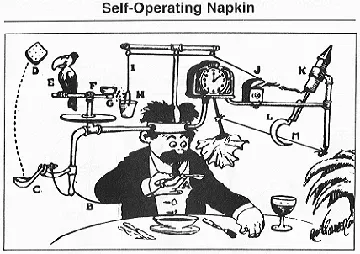 Rube Goldberg’s “self-operating napkin.”Copyright 1931 Rube Goldberg, Wikpedia (public domain) https://en.wikipedia.org/wiki/Rube_Goldberg#/media/File:Rube_Goldberg%27s_%22Self-Operating_Napkin%22_(cropped).gif
Suggested materials for device building. Feel free to provide students with additional inexpensive supplies.
- cardboard
- Popsicle sticks
- string
- marbles
- cardboard tubes
- plastic drinking straws
- plastic beverage bottles
- dominoes
- tools such as scisssors, tape, hot glue
- (optional) 3D printer and printing supplies (useful if available in the classroom)
Who can name a simple machine? What about a mechanism? How can learning about simple machines and mechanisms help us design more complex machines and devices?
Today, we are going to learn about a seemingly complex machine that is really quite simple if you break it down: a Rube Goldberg machine!
Rube Goldberg was a cartoonist, inventor, and engineer who is famous for drawing cartoons that depict overly complicated machines that perform very simple tasks, such as a “self-operating napkin.” His ideas were later adapted in movies and in television for comedic effect.
What do you know about Rube Goldberg devices? What makes a Rube Goldberg device unique?
(Show students the Rube Goldberg Device Presentation (PPTX) and introduce them to other Rube Goldberg concepts, such as those listed in the Resources section.)
Now, based on your understanding of simple machines, you will collaborate in a group to build your own Rube Goldberg machine. Your device must consist of at least 10 stages and include all six simple machines. Sketch and describe the steps of your design in your notebook.
Divide the class into teams of three or four students each. Direct them to research and plan their devices. Suggesting a planning component and having them sketch their designs (as seen in the Figure 1 example) in advance of building. This engages students in the seven-step engineering design process cycle: ask, research, imagine, plan, create, test, and improve. Teams can document this process with the Engineering Design Process Notebook (PDF).
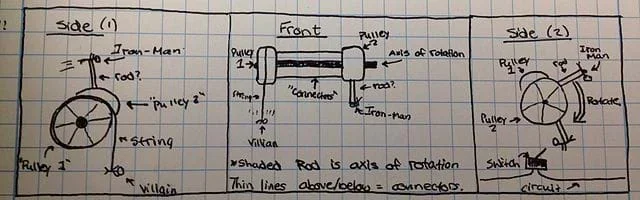 Have students sketch detailed plans of their elements of the team Rube Goldberg machine to assist in the creative process.Copyright 2013 MikeBertrand6, Wikimedia Commons CC BY-SA 3.0 https://commons.wikimedia.org/wiki/File:Rube_Goldberg_Pulley_System.JPG
Most machines and mechanisms are comprised of at least one of the six basic simple machines:
- lever: consists of a beam or rod at a fixed hinge, such as a seesaw or bottle opener
- wheel and axle: the two parts rotate together with force transferring from one machine to another, such as a doorknob or waterwheel
- pulley: a wheel on an axle or shaft that supports movement and transfers power to a cable or belt, as seen in machines that use hoists
- inclined plane: also known as a ramp; a flat surface tilted at an angle that aids in raising or lowering a load; examples are wheelchair ramps and slides
- wedge: a portable inclined plane used to separate two objects; axes, saws, and chisels as well as the blade of a knife all serve this purpose
- screw: a mechanism that converts rotational motion to linear motion, such as a corkscrew
A working knowledge of these machines provides a good foundation for designing machines that are more complex.
- Hand out supplies and give students time to build their devices.
- Print any 3D printer parts early to allow enough time for the designs to be completed.
Have teams demonstrate their devices in a gallery-style presentation; refer to the Rube Goldberg Rubric (PDF) for grading.
Have students record their challenges and successes in notebooks or design journals.
After this challenge, students should be able to:
- Identify different types of simple machines and mechanisms.
- Explain the nature of a Rube Goldberg machine.
- Recognize the use of mechanisms in everyday life.
Videos:
Show students an example of a complex Rube Goldberg Machine with the four-minute video, “OK Go – This Too Shall Pass – Rube Goldberg Machine” on YouTube.
For comedic effect, consider also screening this 1:40-minute clip on a Rube Goldberg Machine from the IFC show Portlandia.
Websites:
The official home of Rube Goldberg.
Historical information on Rube Goldberg, the cartoonist, sculptor, author, engineer, and inventor.
Contributors
Brad Whitehead
Supporting Program
Research Experience for Teachers Program, Lamar University
Acknowledgements
This material is based upon work supported by the National Science Foundation under grant no. EEC 1609339—a collaborative Research Experience for Teachers Program titled, “Incorporating Engineering Design and Manufacturing into High School Curriculum,” at Lamar University in Beaumont, TX. Any opinions, findings, and conclusions or recommendations expressed in this material are those of the authors and do not necessarily reflect the views of the National Science Foundation.
Copyright
2018 by Regents of the University of Colorado; original © 2017 Lamar University