
Creative Engineering Design: Efficient Car Design
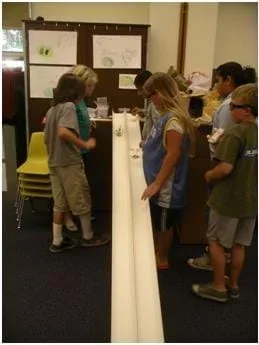 Figure 1. Example of rain gutters being used as a race track.Copyright 2009 William Surles, ITL Program, College of Engineering, University of Colorado Boulder
Students learn how the aerodynamics and rolling resistance of a car affect its energy efficiency by designing and constructing model cars out of simple materials. Students are encouraged to iterate on their models, designing and testing different cars to create the most efficient model vehicle. As students race their cars down a tilted track, they find that the most energy-efficient cars roll down the track the fastest. In an activity extension, the most aerodynamic cars also jump the farthest.
The energy use and pollution associated with transportation is one of the largest issues facing society today. By building energy-efficient cars, engineers can lower the negative impacts that cars have on the environment and ultimately help improve our lives. The energy efficiency of a car is affected by a variety of factors, including size, aerodynamics, weight, and the rolling resistance of the wheels. Engineers must know all about these factors to design better cars.
After this activity, students should be able to:
- Describe the characteristics that affect a car's energy efficiency.
- Explain how rolling resistance affects a car's energy efficiency.
- Describe how a car's shape and size are related to aerodynamics.
- STEL-7AA Illustrate principles, elements, and factors of design.
Grades 9-12
Do you agree with this alignment?
- HS-ETS1-1 Analyze a major global challenge to specify qualitative and quantitative criteria and constraints for solutions that account for societal needs and wants.
Grades 9-12
This resource focuses on the following Three Dimensional Learning aspects of NGSS:
Science & Engineering Practices- Analyze complex real-world problems by specifying criteria and constraints for successful solutions.Do you agree with this alignment?
Disciplinary Core Ideas- Criteria and constraints also include satisfying any requirements set by society, such as taking issues of risk mitigation into account, and they should be quantified to the extent possible and stated in such a way that one can tell if a given design meets them.Do you agree with this alignment?
- Humanity faces major global challenges today, such as the need for supplies of clean water and food or for energy sources that minimize pollution, which can be addressed through engineering. These global challenges also may have manifestations in local communities.Do you agree with this alignment?
Crosscutting Concepts- New technologies can have deep impacts on society and the environment, including some that were not anticipated. Analysis of costs and benefits is a critical aspect of decisions about technology.Do you agree with this alignment?
Do you agree with this alignment? - Analyze complex real-world problems by specifying criteria and constraints for successful solutions.
- HS-ETS1-2 Design a solution to a complex real-world problem by breaking it down into smaller, more manageable problems that can be solved through engineering.
Grades 9-12
This resource focuses on the following Three Dimensional Learning aspects of NGSS:
Science & Engineering Practices- Design a solution to a complex real-world problem, based on scientific knowledge, student-generated sources of evidence, prioritized criteria, and tradeoff considerations.Do you agree with this alignment?
Disciplinary Core Ideas- Criteria may need to be broken down into simpler ones that can be approached systematically, and decisions about the priority of certain criteria over others (trade-offs) may be needed.Do you agree with this alignment?
Do you agree with this alignment? - Design a solution to a complex real-world problem, based on scientific knowledge, student-generated sources of evidence, prioritized criteria, and tradeoff considerations.
Each team needs:
- 5 Popsicle® / hobby sticks
- masking tape, ~24 inches
- 4 Lifesavers® mint candies
- 3 drinking straws (small enough diameter to fit inside the mint candy holes)
- 3 index cards
- scissors
- Efficient Car Design Worksheet (PDF), one per student
To share with the entire class:
- Efficient Car Design PowerPoint (PPTX)
- rain gutter section(s), ~7 ft in length
- duct tape (or other heavy-duty tape)
- Optional: laptop and projector, for showing the PowerPoint/Google Slides presentations
- stopwatch (if racing only one car at a time)
How far do you think a typical car travels on one gallon of gas? (Answer: 20-30 miles.) Do you think all cars have the same gas mileage? Why or why not? How about a car compared to a semi-truck regarding gas mileage? What makes the difference in a vehicle's energy efficiency? (Let students offer answers.) A car's energy efficiency depends on many things, including its weight, its rolling resistance, and its aerodynamics. A car that is energy efficient can travel farther on the same amount of gas, which saves the driver money. Creating more energy-efficient cars also decreases air pollution and helps decrease greenhouse gas emissions due to automobile emissions. Also, gasoline is made from oil, a fossil fuel. Oil is a non-renewable energy source, which means that when it is used up, no more is available. For these reasons, engineers are continually figuring out ways to make cars more energy efficient by decreasing their air resistance, rolling resistance, and weight.
The aerodynamics of a car is dependent on how much air the car has to move out of the way as it travels along a road. Engineers often design cars to resemble aerodynamic animals and shapes in nature. Can you think of any aerodynamic animals? (Possible answers: Fish, birds, sharks.) These animals move through the air (or water) easily and use little energy because they are sleek in their shapes, having no sharp corners or flat surfaces facing the wind. This causes the air to flow smoothly (efficiently) over them. A sleek car moves more easily through the air than a semi-truck does, which means the car is more aerodynamic and energy efficient.
The amount of energy a car uses can also be affected by the resistance of a car's tires on the road surface. You need to be able to find the balance between the amount of resistance, or friction, needed to keep the vehicle on the road and the ability to move efficiently without it flying off the road or being "stuck" to the road. Engineers design tires that increase a car's energy efficiency by rolling smoothly while making sure they are "sticky" enough to stay safely on the road, especially through corners and on wet surfaces. A great example of this would be a NASCAR race. Have any of you watched racing on television? The tires they use are expertly engineered so that the cars can reach high speeds while staying on the track during the tight corners.
Finally, a car's weight affects its energy efficiency. Is it harder to push a loaded grocery cart or an empty one? (Answer: Loaded) How about if you had to push the grocery cart uphill? Would you rather do it empty or full? (Answer: Empty) A car's weight determines how much energy it takes to accelerate or speed up the car, and it also affects how much energy it takes to move the car up a hill. Heavier cars are less energy efficient than lighter ones. Engineers use newly created, innovative materials whenever possible to reduce the weight of cars, as well as find ways to build them smaller so fewer materials are needed, which in turn reduces the weight of the car.
All of these factors contribute to a car's energy efficiency, with some of them being more important at high speeds and others being more important at low speeds.
Today we are going to design and create efficient cars using the engineering design process. Your team’s goal will be to make your car go as fast as possible down a track. Let's get started!
Background
Refer to the introduction and motivation section for background information.
Before the Activity
- Decide which of two ways to set up the activity:
- To run the activity as a series of two cars competing against each other (that is, two separate cars being raced at once), set up two rain gutter race tracks at approximately a 30-degree angle from the ground (see Figure 1). Tape the two gutters together to ensure the tracks are even.
- To run the activity with only one car racing at a time, use a single track and a stopwatch to record individual race times.
- Gather materials and make copies of the Efficient Car Design Worksheet (PDF).
- Optional: Have the Efficient Car Design PowerPoint (PPTX) ready to show.
- Set up race brackets, depending on the number of student teams.
With the Students
- (5 min) Introduction
- Read the Introduction/Motivation. (Optional: Show the Efficient Car Design PowerPoint (PPTX).)
- Divide the class into teams of two or three students each.
- Hand out the Efficient Car Design Worksheet (PDF).
- (5 min) Brainstorm/Plan
- Have students follow the steps in the worksheet to brainstorm and plan their designs.
- (10 min) Build, Test, and Improve
- Have teams build their model cars.
- Let students use the ramps to test their cars.
- Have students make changes to improve the designs.
- (20 min) Once all students have completed their model cars and made improvements, collect all of the cars at the front of the classroom.
- Race cars against each other using double elimination to find the most energy-efficient car (that is, cars are raced twice; after each race, the winner moves on to the next round; if a car is deemed the "slowest" car in more than two races, it is eliminated from the trials). If a single track is being used, record times and eliminate the slowest cars after two runs down the track. Have students record on their worksheets the fastest time for each car.
- (5 min) As a class, discuss why the winning car was the most energy efficient by examining its aerodynamics, rolling resistance, and size.
- aerodynamics
- The ability of an object to cur through air (or water) efficiently.
- energy efficiency
- Being able to do more with less energy.
- rolling resistance
- The force of fiction acting on a rolling object by the ground to slow it down.
Pre-Activity Assessment
Class Discussion: As a class, discuss the definitions of energy efficiency and aerodynamics. Have teams come up with three different factors they think will affect the energy efficiency or aerodynamics of their model cars. Write these factors on the board for all students to refer to during the design phase.
Activity Embedded (Formative) Assessment
Car Design Worksheet: Have students follow the steps on the Efficient Car Design Worksheet (PDF). Check the teams at each step and make sure they have adequately completed the associated task. For instance, the final design should include several different viewpoints and be adequately labeled.
Post-Activity (Summative) Assessment
Post-Activity Discussion: As a class, discuss why the winning car was the most energy efficient by examining its aerodynamics, rolling resistance, and size.
Making Sense Assessment: Have students reflect on the science concepts they explored and/or the science and engineering skills they used by completing the Making Sense Assessment (PDF).
Students should be careful with the scissors. Warn students not to eat the candies, since they are handling them a lot.
- If students have trouble designing cars with rolling wheels, suggest that one way to do this is to use the drinking straws as axles and the mint candies as wheels.
- Provide students with a budget (~$700 in play money) and create a price list for the materials. Teams then must design their car to be within the budget constraint. Once teams have finalized their car design plan within budget, allow them to "purchase" materials and build their vehicles. Encourage students to reserve some funds to make later modifications (improvements) to their original designs.
- Place a ramp about 6 inches away from the bottom of the rain gutters, as shown in Figure 2. Place a fan flat on the ground blowing air upwards. Have students run their model cars down the gutters and jump them off the ramp. Measure how far where each car lands from the end of the ramp. Discuss why some cars jumped farther than other cars.
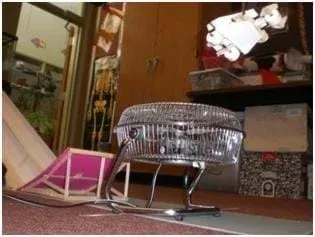 Figure 2. Example of ramp and fan set up for jumping race cars.Copyright 2009 Jacob Crosby, ITL Program, College of Engineering, University of Colorado Boulder
Horanyi, Eszter; Crosby, Jake; Surles, William; Yowell, Janet; Integrated Teaching and Learning Program, College of Engineering, University of Colorado Boulder. Cars: Engineering for Efficiency. Last Modified March 8, 2022. TeachEngineering.org. https://www.teachengineering.org/activities/view/cub_motion_activity1
Teach Engineering. Cars: Engineering for Efficiency. June 30, 2017. YouTube. https://www.youtube.com/watch?v=SW9lBhgh5SE
- ASPIRE Creative Engineering Design
- Creative Engineering Design: Paper Tower Design Challenge
- Creative Engineering Design: Efficient Car Design
- Creative Engineering Design: Straw Bridge Design Challenge
- Creative Engineering Design: Engineering Design Process & Design Thinking
- Creative Engineering Design: Creative Crash Testing Design Challenge
- Creative Engineering Design: Environmental Impact StoryMap Collection
- Creative Engineering Design: Mouse Trap Car Design Challenge
- Creative Engineering Design: Tinkercad 3D Design & EV Concept Car Workshop
- Creative Engineering Design: Carbon Footprints and Transportation
- Creative Engineering Design: Tinkercad Circuits & EV Motor Workshop
- Creative Engineering Design: Transportation Fuels Debate
- Creative Engineering Design: Model EV Design Challenge
Contributors
Eszter Horanyi; Jake Crosby; William Surles; Janet Yowell; Sabina Schill; Jennifer Taylor; Ellen Parrish
Supporting Program
Integrated Teaching and Learning Program, College of Engineering, University of Colorado Boulder
Acknowledgements
This curriculum was developed under National Science Foundation grant numbers 1941524 and 1941701. Any opinions, findings, and conclusions, or recommendations expressed in this material are those of the authors and do not necessarily reflect the views of the National Science Foundation.
Copyright
2022 by Regents of the University of Colorado