
Creative Engineering Design: Transportation Fuels Debate
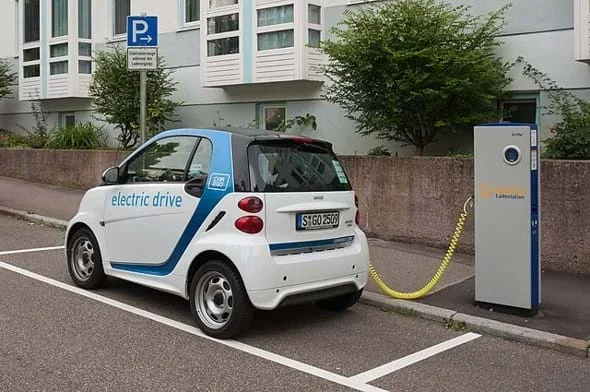 An electric Vehicle (EV) recharging its battery with electricity.Copyright 2013 Julian Herzog, Creative Commons Attribution 4.0, Wikimedia
Student teams learn about transportation fuels and then are assigned to represent the different fuels. Working cooperatively, the students develop arguments on the merits of their fuel over the others. One debate will be conducted on fuels for personal vehicles.
Student teams learn about transportation fuels, then are assigned to represent the different fuels. Working cooperatively, the students develop arguments on the merits of their fuel over the others. One debate will be conducted on fuels for personal vehicles.
After this activity, students should be able to:
- Outline their current knowledge and conduct basic research on three different vehicle fuel options (gasoline, electric, hybrid), including the pros and cons of each fueling type.
- Align facts and provide an argument on information related to the assigned topic using claims, evidence, and reasoning.
- STEL-4P Evaluate ways that technology can impact individuals, society, and the environment.
Grades 9-12
Do you agree with this alignment?
Each group needs:
- A set of Vehicle Fuels Info Sheets (Electric Vehicle Info Sheet, Gasoline Vehicle Info Sheet, and Hybrid Vehicle Info Sheet) per team
- 1 Vehicle Fuels Debate Worksheet per student
- 1 Vehicle Fuels Debate Game Board per team
- A set of YES/NO cards for each judge
- Transportation Fuels Debate Worksheet (docx)
- Transportation Fuels Debate Worksheet (pdf)
- Electric Vehicles Info Sheet (pdf)
- Gasoline Info Sheet (pdf)
- Hybrid Electric Vehicles Info Sheet (pdf)
- Making Sense Assessment (docx)
- Making Sense Assessment (pdf)
- Transportation Fuels Game Board (docx)
- Transportation Fuels Game Board (pdf)
Today we will debate the pros and cons of three transportation fuels: gasoline, electricity, and hybrid electric. Working cooperatively, we will develop arguments on the merits of each fuel type over other fuel types. We will then debate on the pros and cons of different fuels for our personal vehicles.
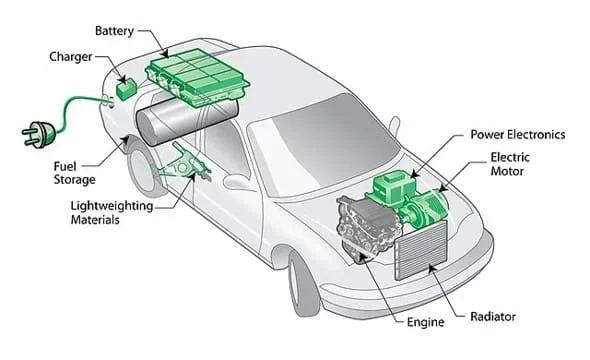 A diagram of a plug-in hybrid electric vehicle, known as a PHEV.Copyright 2009 Matt Howard, Creative Commons Attribution-Share Alike 2.0, Wikimedia
Background
Transportation plays a sizable role in our greenhouse gas emissions with transportation contributing over 33% of CO2 emissions. Electricity generation is the other major contributor to CO2 emissions, with over 36%. A person's transportation and day-to-day electrical consumption decisions make up a big part of their carbon footprint, due to the burning of fossil fuels to supply electricity and transportation fuels.
- All transportation fuels have economic, environmental, and societal advantages and disadvantages.
- Economic and environmental impacts are factors in determining the transportation fuels we use.
- Societal needs, personal beliefs, and changes to the quality of life are important considerations in determining the transportation fuels we use.
With the Students
Part 1: Vehicle Fuels Research
- Introduce the Transportation Fuels Debate to the class, using the following concepts as a guide:
- We use petroleum products for most transportation fuels today.
- Petroleum-based fuels produce emissions that can have a detrimental effect on air quality.
- There are many conventional and alternative transportation fuels.
- Some transportation fuels affect the environment more than others.
- Some transportation fuels are widely used, while others are not.
- Some transportation fuels are more expensive than others.
- Some transportation fuels are more suitable for fleet vehicles, others for personal vehicles.
- Assign the students to one of the fuel debate groups (gasoline, electricity, hybrid).
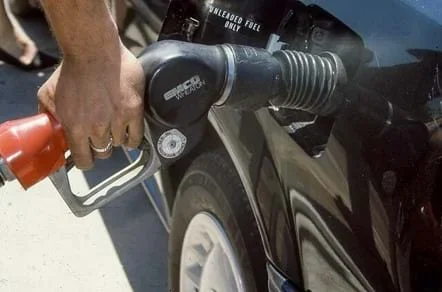 Gasoline, a fossil fuel, being filled into the tank of an internal combustion engine car.Copyright 2020 Massachusetts Department of Environmental Protection, Creative Commons Attribution-Share Alike 2.0, Wikimedia
- Distribute a copy of each of the Vehicle Fuels Info Sheets (Electric Vehicle Info Sheet, Gasoline Vehicle Info Sheet, and Hybrid Vehicle Info Sheet) and one Transportation Fuels Debate Worksheet to each student.
- Demonstrate the procedure for using the Vehicle Fuels Info Sheets to complete the Transportation Fuels Debate Worksheet.
- Have the students work together as they research their fuel type and complete their fuels debate worksheet for their assigned fuel type. Provide student support as needed
- Optional: Assign students to complete their fuel debate worksheet for their assigned fuel type (or all fuel types) as homework.
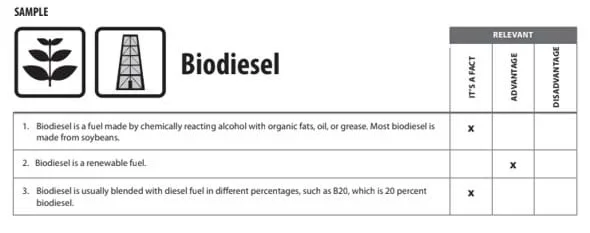 An example of how to complete the Vehicle Fuels Debate Worksheets.Copyright 2012, The NEED Project, https://shop.need.org/products/transportation-fuels-debatePart 2: Vehicle Fuels Debate Game
- Select a panel of judges. The teacher can serve as the judge, or each group can select one person from their team to serve as a judge. Each judge is given a YES/NO card.
- Begin the fuels debate game by giving the teams the following instructions:
The object of this game is to be the first team to reach the top of the Game Board. The game is played in rounds, with each team given the opportunity to move its token up by giving an advantage of its fuel. You may instead choose to move an opponent’s token down by giving a disadvantage to the opponent’s fuel.
- The teams will present their advantages or disadvantages to a panel of judges. If a team gives an advantage of its fuel and the judges agree, then the team moves up one space. An opposing team can object to the judge’s decision. The opposing team must convince the judges that the statement is not an advantage. The team that stated the advantage will then have the opportunity to defend its position. The judges will vote again and one of two things will happen. The judges may vote in favor of the defending team. In this case, the defending team maintains its new position and the opposing team moves down one space. Or the judges may decide whether the statement is a disadvantage or irrelevant. In this case, the defending team moves back to its original position.
- If a team states a disadvantage to try to move an opposing team down, then the opposing team can defend itself without penalty.
- Ask the first team to give an advantage or disadvantage. The action continues until one team reaches the top line, until time is called, or until each team has had the opportunity to begin a round. Each team should have the opportunity to begin a round.
- After the game, point out that all transportation fuels have advantages and disadvantages. Ask the class the following questions:
- Was there an obvious winner in either game?
- If the game continued, would the results change? Why or why not?
- Why do we use transportation fuels that have negative impacts on the environment?
- What are some other factors that we need to consider in our choice of transportation fuels?
- Have the students write short essays answering the following questions:
- What was the purpose of playing this game?
- What were the important concepts you learned from playing the game?
- What fuel would you most likely use for a personal vehicle and why?
- alternative fuels
- Fuels other than gasoline for powering motor vehicles, such as natural gas, methanol, or electricity.
- gasoline
- Refined petroleum used as fuel for internal combustion engines.
- electric vehicle
- Vehicle that can be powered by an electric motor that draws electricity from a battery and is capable of being charged from an external source.
- hybrid vehicle
- Vehicle that can be powered by an electric motor that draws electricity from a battery and is capable of being charged from an external source
- ice vehicle
- Vehicle powered by an internal combustion engine and one or more electric motors, which use energy stored in batteries.
Post-Activity (Summative) Assessment
Making Sense Assessment: Have students reflect on the science concepts they explored and or the engineering skills they used by completing the Making Sense Assessment.
- Have students use the internet for current information to cross-reference vehicle fuel info sheets.
Additional vehicle fuels resources:
- ASPIRE Creative Engineering Design
- Creative Engineering Design: Paper Tower Design Challenge
- Creative Engineering Design: Efficient Car Design
- Creative Engineering Design: Straw Bridge Design Challenge
- Creative Engineering Design: Engineering Design Process & Design Thinking
- Creative Engineering Design: Creative Crash Testing Design Challenge
- Creative Engineering Design: Environmental Impact StoryMap Collection
- Creative Engineering Design: Mouse Trap Car Design Challenge
- Creative Engineering Design: Tinkercad 3D Design & EV Concept Car Workshop
- Creative Engineering Design: Carbon Footprints and Transportation
- Creative Engineering Design: Tinkercad Circuits & EV Motor Workshop
- Creative Engineering Design: Transportation Fuels Debate
- Creative Engineering Design: Model EV Design Challenge
This resource is adapted from the National Energy Education Development (NEED.org) “Transportation Fuels Debate” (2012) by Jennifer Taylor
Contributors
Jennifer Taylor
Supporting Program
Integrated Teaching and Learning Program, College of Engineering, University of Colorado Boulder
Acknowledgements
This curriculum was developed under National Science Foundation grant numbers 1941524 and 1941701. Any opinions, findings, and conclusions, or recommendations expressed in this material are those of the authors and do not necessarily reflect the views of the National Science Foundation.
Copyright
2022 by Regents of the University of Colorado Boulder