
Creative Engineering Design: Engineering Design Process & Design Thinking
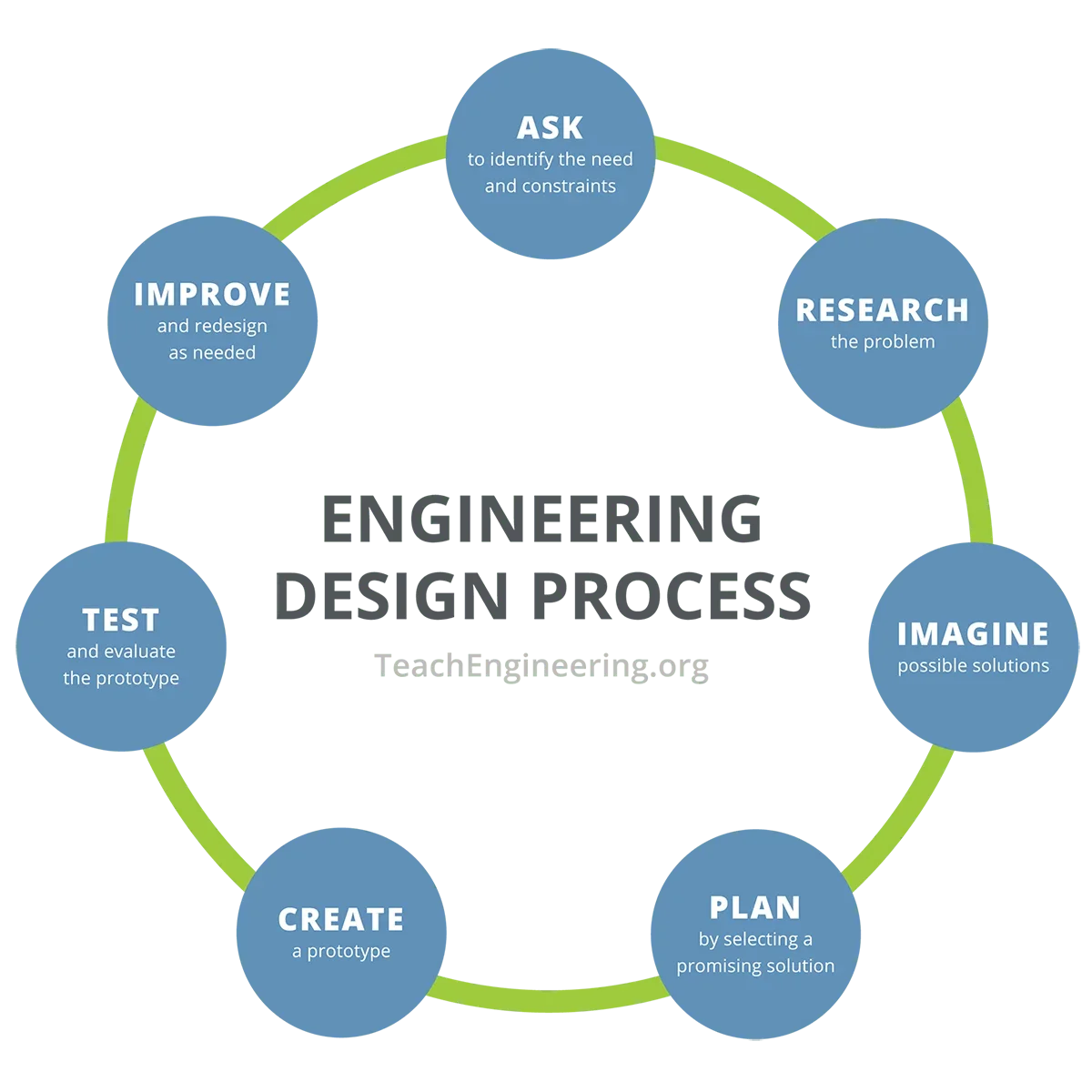 The Engineering Design ProcessCopyright TeachEngineering.org
After informally using the various Engineering Design Process (EDP) steps in the previous design challenges, students are formally introduced to the seven-step EDP: Ask, Research, Imagine, Plan, Create, Test, and Improve. Students are also introduced to Design Thinking to help them creatively problem-solve and innovate throughout the Engineering Design Process.
The Engineering Design Process (EDP) is a specific set of seven steps that engineers use to organize their ideas and refine potential solutions to engineering challenges. Embarking on an engineering design project is much more than simply describing the project; engineers must (1) gain an understanding of all the issues surrounding a particular design challenge, identify the specifications and limitations of the project, (2) research the project (including known solutions), (3) imagine possible solutions, (4) develop and plan out solutions to the project, (5) create prototypes of the best ideas, (6) test and evaluate the performance of the product and, if a design does not meet the criteria, (7) the design is reimagined and the process starts anew. The EDP is more than a straightforward cyclical path that engineers follow to solve problems. As engineers iterate on ideas to creatively find solutions, the EDP forms a complex web as they go through the process multiple times to create or improve products and processes that benefit our lives and improve the world around us.
After this activity, students should be able to:
- List the seven Engineering Design Process (EDP) steps in the correct primary sequence.
- Describe the seven EDP steps and why each is important to engineering.
- (optional) Explain the seven Design Thinking skills and provide examples in engineering.
- STEL-7CC Apply a broad range of design skills to their design process.
Grades 9-12
Do you agree with this alignment?
For the entire class to share:
- Cut up pieces of the EDP Matching Sheet (PDF) (14 pieces total, 7 terms and 7 definitions)
- 1 EDP and Design Thinking Worksheet (PDF)
- SmartBoard, computer with projector and screen/whiteboard, or large post-it notes and pens to illustrate Engineering Design Process and (optional) Design Thinking Skills
- (optional, if time allows) Cut up pieces of the Design Thinking Matching Sheet (PDF) (14 pieces total, 7 terms and 7 definitions)
After the activity, each student is given:
- 1 Teach Engineering EDP Handout (PDF):
- (optional) 1 Teach Engineering Design Thinking Handout (PDF):
After the activity, post in the classroom:
- 1 Teach Engineering EDP Poster:
(24”x36”) https://www.teachengineering.org/PDF/edp/TE_EDPTeacherMaterials_24x36.pdf (PDF)
(11”x17”) https://www.teachengineering.org/PDF/edp/TE_EDPTeacherMaterials_11x17.pdf (PDF)
- (optional) 1 Teach Engineering Design Thinking Poster:
(24”x36”) https://www.teachengineering.org/PDF/DesignThinking/DT_Handout24x36.pdf (PDF)
(11”x17”) https://www.teachengineering.org/PDF/DesignThinking/DT_Handout11x17.pdf (PDF)
Over the past few class periods, everyone took on several design challenges. Which one was your favorite? (Let students share their favorite design challenge from Newspaper Towers, Engineering for Car Efficiency, and Straw Bridges OR have students vote for their favorite design challenge and tally the votes on the board.) Why was this your favorite design challenge? (Let students share their thoughts. Potential answers may include: their design worked, it was an easy activity, they learned about trusses, they could be creative, they “won” the race, their design held the most weight, etc.)
While your teams were taking on the design challenges, you completed a worksheet for each activity. In the worksheets, you answered various sections as you worked through the challenges. Who remembers what type of information you recorded during each activity? (Answers include: Ask, Research, Imagine, Plan, Create, Test, Evaluate, Improve.)
These steps combine to form the heart of engineering that engineers use to guide their work and is known as the Engineering Design Process, also called the EDP. Today we will learn more about the EDP and the skills needed for applying this process.
Background
Engineering Design Process
The engineering design process (EDP) emphasizes collaborative, open-ended problem-solving and encourages students to learn from failure. The acronym FAIL means “first attempt in learning” and “failure” is an essential and valuable aspect of engineering as it leads to more successful and viable solutions being developed by learning from and iterating on failed results. The EDP nurtures students’ abilities to create innovative solutions to challenges in any subject!
The engineering design process is a series of steps that guide engineering teams as they solve problems. The design process is iterative, meaning that steps are repeated multiple times as needed, making improvements along the way as the engineering team learns from failure and uncovers new design possibilities to arrive at great solutions.
- Ask- Identify the Need & Constraints: Engineers ask critical questions about what they want to create, whether it be a skyscraper, amusement park ride, bicycle, or smartphone. These questions include: What is the problem to solve? What should be designed? Who is it for? What needs to be accomplished? What are the project requirements? What are the limitations? What is the goal?
- Research the Problem: Researching the problem includes talking to people from many different backgrounds and specialties to assist with researching what products or solutions already exist, or what technologies might be adaptable to the needs of the project and/or design.
- Imagine- Develop Possible Solutions: Engineering teams work together to brainstorm ideas and develop as many solutions as possible. This is the time to encourage wild ideas and defer judgment! Build on the ideas of others! Stay focused on the topic, and have one conversation at a time! Good design is all about teamwork!
- Plan- Select a Promising Solution: For many teams, this is the hardest step! Revisit the needs, constraints, and research from the earlier steps, compare the best ideas, select one solution, and make a plan to move forward with it.
- Create- Build a Prototype: Building a prototype makes ideas real! These early versions of the design solution help verify whether the design meets the original challenge objectives. Push for creativity, imagination, and excellence in design.
- Test and Evaluate the Prototype: Does it work? Does it solve the need? Communicate the results and get feedback. Analyze and discuss what works, what doesn't, and what could be improved.
- Improve- Redesign as Needed: Discuss how the solution can be improved. Make revisions. Draw new designs. Iterate the design to make the product the best it can be.
The overarching themes of the EDP are teamwork and design. Strengthen your students’ understanding of open-ended design as you encourage them to work together to brainstorm new ideas, apply science and math concepts, test prototypes, and analyze data—and aim for creativity and practicality in their solutions. Project-based learning engages learners of all ages—and fosters STEM literacy.
Design Thinking
Engineers use design thinking in a solutions-focused, human-centered way to creatively problem-solve and innovate throughout the engineering design process. Design thinking is a way of looking at and tackling real-world problems that we experience in our everyday lives, and greatly need solutions for— especially the world’s “wicked problems” that are not well defined or have clear answers, such as climate change.
Design thinking is a fluid way of reasoning to purposefully devise solutions for difficult problems rather than a series of trial-and-error steps. Design thinking is also a valuable life skill—like reading and numeracy—that can be learned and perfected with practice and applied to a wide range of careers.
- Formulating Problems - Engineers take time to observe, infer, and apply their breadth and depth of knowledge to thoughtfully frame a problem within the limits of available time, money, and resources.
- Seeking Solutions - Engineers incorporate their personal experiences and intellect with empathy and understanding for all stakeholders to develop human-centered products or services.
- Thriving in Uncertainty - The unknowns and limitations of a problem, especially “wicked problems”, offer engineers opportunities to be creative in developing innovative and practical solutions.
- Collaborating Constantly - Engineering team members bring their own perspectives and collective expertise together to scope problems and negotiate desirable, feasible, and viable solutions to problems.
- Prototyping Ideas - After generating ideas and gathering information about a problem, the rapid and rough creation of sketches and models (prototypes) inspires engineers to visualize options and inform possible solutions.
- Iterating Options - Engineers test many versions of their prototypes as they develop, implement, and evaluate possible solutions - which over time improves their understanding of the problem.
- Reflecting Frequently - Assessing and talking through iteration cycle outcomes allows engineers to simultaneously and repeatedly define and refine both their understanding of the problem and ideas for solutions.
Before the Activity
- Make copies and cut up pieces of the EDP Class Matching Activity Sheet (PDF) and Design Thinking Matching Sheet (PDF) (optional)
- Make copies of the Engineering Design Process and Design Thinking Worksheet (PDF) (one for each student).
With the Students
- (5 min) Read the Introduction/Motivation. [Note: This is a good time to recap the previous engineering design challenges (i.e., what worked, what didn’t, what the students liked, what was frustrating, how solutions were developed, tested, revised, etc.)]
- (5 min) EDP Match Up: Group students into teams of 2 (or 3 for larger classes) and give each team one piece of the Engineering Design Process (EDP) table. (Note: There are 14 pieces total, 7 terms and 7 definitions) Give teams about 5 minutes to get up from their desks, quickly talk to others, and find the matching term or definition to their piece of the EDP.
When teams find matching terms and definitions, have groups sit together. Once everyone is matched, have groups share their term read the matching definition, and explain why they feel this is a match. (This is a good time for the teacher to correct any mismatched pairs and explain why.)
After the terms and definitions of the EDP are correctly aligned, have the groups stand in a large circle with their terms and definitions in the order of the EDP (e.g. The “Ask” group is before the “Research” group, etc.)
- (5 min) Play the video: https://youtu.be/b0ISWaNoz-c (2 min).
- (10 min) Have students fill out the EDP circles (steps) on the Engineering Design Process based on the Match Up activity and video.
- Place the following image on the SmartBoard or projector for students to check their work: https://www.teachengineering.org/PDF/edp/TE_EDPTeacherMaterials_8.5x11.pdf (PDF) or provide each student with a hard copy.
- (optional; if time) Design Thinking Match Up: If there is time, repeat steps 2 and 3 using the Design Thinking cut-out pieces (PDF) (14 total). Pair up students into new teams of two and have teams match terms and definitions. Once everyone is matched, have groups share their term read the matching definition, and explain why they feel this is a match. (correct any mismatched pairs and explain why.). Have students discuss how the Design Thinking skills relate to the EDP Note: Some DT skills will carry over to multiple EDP steps.
- (10 min) Put the following image on the SmartBoard or projector: https://www.teachengineering.org/PDF/DesignThinking/DT_Handout.pdf
Have a class discussion about Design Thinking OR read the following: Engineers use design thinking in a solutions-focused, human-centered way to creatively problem solve and innovate throughout the engineering design process. Design thinking is a way of looking at and tackling real-world problems that we experience in our everyday lives, and greatly need solutions for— especially the world’s “wicked problems” that are not well defined or have clear answers, such as climate change.
Design thinking is a fluid way of reasoning to purposefully devise solutions for difficult problems rather than a series of trial-and-error steps. Design thinking is also a valuable life skill—like reading and numeracy—that can be learned and perfected with practice and applied to a variety of careers. So, what are the traits of design thinking?
- (10 min) Give students time to fill out the Design Thinking section on the Engineering Design Process and Design Thinking Worksheet (PDF). They should reflect on the design thinking skills they think they (currently) do well and the skills they think they may struggle with.
- design thinking
- A solutions-focused, human-centered way to creatively problem solve and innovate throughout the engineering design process.
- engineering design process
- A series of steps that guides engineering teams to solve engineering problems.
- iteration
- The repetition of a process.
- wicked problem
- Problem that is difficult or impossible to solve because of incomplete, contradictory, and changing requirements that are often difficult to recognize. Examples of wicked problems in today's society include things like education design, financial crises, health care, hunger, income disparity, obesity, poverty, terrorism, and sustainability.
Pre-Activity Assessment
Opening Questions: In the introduction/motivation section, recap the previous engineering design challenges (i.e., what worked, what didn’t, what did the students like, what was frustrating, etc.) with the students.
Activity Embedded (Formative) Assessment
Worksheet: Students fill out the first page of the Engineering Design Process and Design Thinking Worksheet (PDF).
Post-Activity (Summative) Assessment
Worksheet: Students reflect on design thinking skills they think they (currently) do well and the skills they think they may struggle with using the second page of the Engineering Design Process and Design Thinking Worksheet (PDF).
- ASPIRE Creative Engineering Design
- Creative Engineering Design: Paper Tower Design Challenge
- Creative Engineering Design: Efficient Car Design
- Creative Engineering Design: Straw Bridge Design Challenge
- Creative Engineering Design: Engineering Design Process & Design Thinking
- Creative Engineering Design: Creative Crash Testing Design Challenge
- Creative Engineering Design: Environmental Impact StoryMap Collection
- Creative Engineering Design: Mouse Trap Car Design Challenge
- Creative Engineering Design: Tinkercad 3D Design & EV Concept Car Workshop
- Creative Engineering Design: Carbon Footprints and Transportation
- Creative Engineering Design: Tinkercad Circuits & EV Motor Workshop
- Creative Engineering Design: Transportation Fuels Debate
- Creative Engineering Design: Model EV Design Challenge
Contributors
Jennifer Taylor; Ellen Parrish
Supporting Program
Integrated Teaching and Learning Program, College of Engineering, University of Colorado Boulder
Acknowledgements
This curriculum was developed under National Science Foundation grant numbers 1941524 and 1941701. Any opinions, findings, and conclusions, or recommendations expressed in this material are those of the authors and do not necessarily reflect the views of the National Science Foundation.
Copyright
2022 by Regents of the University of Colorado Boulder