
Creative Engineering Design: Creative Crash Testing Design Challenge
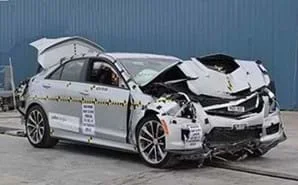 Frontal full-width crash test of a 2017 Cadillac ATS-VCopyright 2016 Karco Engineering LLC, NHTSA [public domain] Wikimedia Commons https://commons.wikimedia.org/wiki/File:V10027P015.jpg
Students utilize the full Engineering Design Process (EDP) as they become next-generation engineers working on the safety features for passenger vehicles. They are challenged to design or improve an existing passenger compartment design/feature so cars better withstand front-end collisions, protecting riders from injury and resulting in minimal vehicle structural damage.
Engineers are essential to our health and safety. Engineers are constantly innovating and designing ways to enhance passenger safety for motor vehicles. Engineers are guided by the steps of the engineering design process to improve all aspects of vehicle design, including materials durability, biodegradability, strength, rigidity, etc.
After this activity, students should be able to:
- List the seven engineering design process (EDP) steps in the correct primary sequence.
- Describe the seven EDP steps and why each is important to engineering.
- Describe existing passenger safety measures.
- STEL-7AA Illustrate principles, elements, and factors of design.
Grades 9-12
Do you agree with this alignment?
- HS-ETS1-3 Evaluate a solution to a complex real-world problem based on prioritized criteria and trade-offs that account for a range of constraints, including cost, safety, reliability, and aesthetics, as well as possible social, cultural, and environmental impacts.
Grades 9-12
This resource focuses on the following Three Dimensional Learning aspects of NGSS:
Science & Engineering Practices- Evaluate a solution to a complex real-world problem, based on scientific knowledge, student-generated sources of evidence, prioritized criteria, and tradeoff considerations.Do you agree with this alignment?
Disciplinary Core Ideas- When evaluating solutions it is important to take into account a range of constraints including cost, safety, reliability and aesthetics and to consider social, cultural and environmental impacts.Do you agree with this alignment?
Crosscutting Concepts- New technologies can have deep impacts on society and the environment, including some that were not anticipated. Analysis of costs and benefits is a critical aspect of decisions about technology.Do you agree with this alignment?
Do you agree with this alignment? - Evaluate a solution to a complex real-world problem, based on scientific knowledge, student-generated sources of evidence, prioritized criteria, and tradeoff considerations.
Each team needs:
- a few raw eggs (expect some to break during crash tests)
- provide assorted craft supplies from which students construct their basic model car; alternatively, offer a ready-made car kit such as the wooden car kit at https://www.teachersource.com/product/wooden-car-kit/energy
- assorted building materials, such as cardboard, wooden craft sticks, tag board, foam sheets, felt sheets, cotton or polyester fill, chenille stems/pipe cleaners, plastic drinking straws, string/yarn, rubber bands, balloons
- assorted tools and adhesives, such as rulers, scissors, tape, white glue, hot glue
- wooden board for a ramp, 10 inches wide x 3 to 5 feet long, to run all model cars down for crash testing; alternatively, use sturdy cardboard
- plastic sheeting, to tape against the wall and floor for mess protection during testing
- washers and duct tape, to add equal weight to all cars, to improve the crash dynamics
- smartphone or tablet, to video record the model cars in slow motion
- stopwatches, for timing crash tests
- (optional) Internet access for researching current car safety features
- Creative Crash Testing Worksheet (PDF)
For the entire class to share:
- Creative Crash Testing PowerPoint Presentation (PPTX)
- whiteboard and marker or laptop with projector
- digital scale, to measure car mass
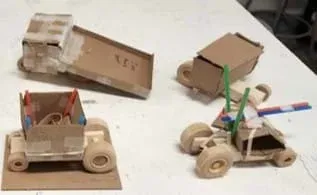 The Creative Crash Testing activity is a new take on the classic egg drop activity.Copyright 2023 Greg Nowling
Motor vehicle collisions account for 1.3 million deaths globally each year, while another 20-50 million people are injured or disabled in vehicle accidents. More than half of the collisions are caused by people who are 15-40 years old. Engineers are constantly innovating and designing ways to enhance passenger safety. Engineers are guided by the steps of the engineering design process to improve all aspects of vehicle design, including materials' durability, biodegradability, strength, rigidity, etc. Take a look at this video.
Show students the 1:35-minute “Buckle Up" PSA video, which shows many slow-motion vehicle crash tests with dummies inside, provides accident statistics, and briefly recaps how vehicle safety features (car seats, boosters, and seat belts) added over the years have saved lives.
Today you are collaborating as automotive engineering teams to create the design of the future for a vehicle passenger compartment and car safety features to keep a “passenger egg” safe and unbroken during a front-end collision test and with minimal vehicle damage. You will use the Engineering Design Process to complete this challenge. Be creative and have fun!
Background
Motor vehicle collisions account for 1.3 million deaths globally each year, while another 20-50 million people are injured or disabled in vehicle accidents. More than half of the collisions are caused by people who are 15-40 years old. Engineers are constantly innovating and designing ways to enhance passenger safety. Engineers are guided by the steps of the engineering design process to improve all aspects of vehicle design, including materials' durability, biodegradability, strength, rigidity, etc.
Before the Activity
- Gather materials
- Make copies of the Creative Crash Testing Worksheet (PDF) (one for each student).
- (optional) Prepare to show the Creative Crash Testing PowerPoint Presentation (PPTX).
With the Students
Day 1
Research, Brainstorm, Plan and Prototype
- Distribute the Creative Crash Testing Worksheet (PDF) to students. Optional: Use the Creative Crash Testing PowerPoint Presentation (PPTX) to introduce the activity.
- As a class, compile a list of safety features found on current vehicles. If students get stumped, suggest a few examples to get the ideas flowing, such as roll cages, seat belts, booster seats, airbags, headrests, or cushioned interiors, upon which students can expand and improve.
- Introduce the project constraints: Create a new vehicle safety design feature for their small-size model cars that is not currently in use, or improve an existing vehicle safety feature. A successful design protects the “passenger egg” and is durable.
- Prompt students to use this information as a jumping-off point to examine the provided building materials and note similarities, such as craft sticks being similar to metal framing bars, and foam/felt being similar to the insulation and padding incorporated into modern vehicles.
- If students work in partners or groups (best if no more than four per group), have them individually brainstorm and sketch a few ideas for what they want to build on top of the model car base, to update or come up with a new passenger compartment so the passenger survives a front-end crash with no injuries and minimal car damage. Remind students to think outside of the box beyond just wrapping the egg in a lot of padding (drivers don't drive wrapped in bubble wrap!). How can the car be designed to absorb and distribute impact forces to protect the egg?
- Teams decide on a design solution to prototype and test.
Day 2
Create
- Give teams plenty of time to build and do small rolling tests against a wall so they can see how the impact affects the materials.
- Teams document the materials they use and sketch their final designs.
- After all teams have created prototypes, use the digital scale to find the mass of each car. Having this information helps with the anecdotal conclusions about the mass and momentum of the cars.
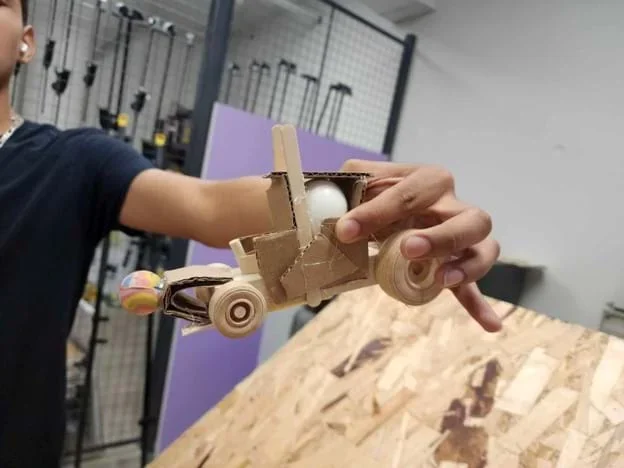 The Creative Crash Testing activity is a new take on the classic egg drop activity.Copyright 2023 Greg Nowling
Test and Analyze
- Have students use stopwatches to time their crash test runs. They should time from the moment of release to the moment of impact. They should also measure the ramp from the point of release to the wall, in meters. Record distance and time measurements. Tips: Using a smartphone or tablet to video record the testing runs in slow motion is helpful for both timing and analysis. For more reliable data, have students run multiple trials, 3-5, and average their findings. Doing this will, however, affect the car, but also serves as a good indicator for durability.
- After testing, students record whether their test runs were successful—the egg did not crack and the car structure remained intact or not.
- Students calculate how fast their cars went and the momentum of the vehicles. They examine the data for relationships.
- As a class, briefly discuss any relationships seen between the heavier cars and the amount of destruction from the crash, and the calculated momentum. Consider graphing the data. Have students write down their conclusions based on the class data—how mass affects momentum and the consequences of a front-end collision.
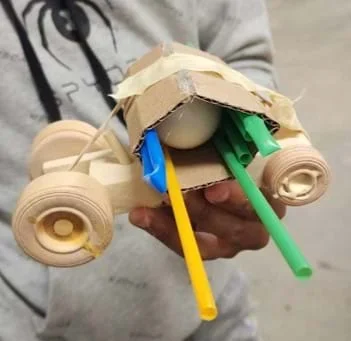 The Creative Crash Testing activity is a new take on the classic egg drop activity.Copyright 2023 Greg Nowling
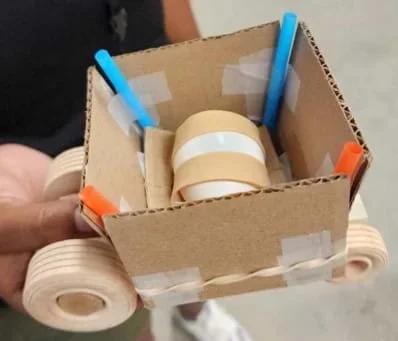 The Creative Crash Testing activity is a new take on the classic egg drop activity.Copyright 2023 Greg Nowling
Day 3
Redesign and Rebuild
- Next, teams brainstorm ways to fix the issues they found with their passenger compartment designs. For example, they might decide to beef up the roll bars, add more padding or create areas intended to compact without affecting the egg.
- After students/teams finish their redesigns/rebuilds, they measure the mass of their redesigned cars and add it to the individual or class chart.
Test and Analyze
- Students re-measure the ramp length and test their redesigned prototypes. Again, they use stopwatches to measure the time from vehicle release to impact.
- Students add their new results data to the chart. As a class, discuss the overall relationships of mass, momentum, and observational data about the egg and crash. If you asked students to graph their data, look at the graphs to visually compare mass and momentum.
- Students write down their revised conclusions about what they think the data shows.
- Recap: How does mass affect momentum in a head-on collision? As needed, guide students’ thinking about the relationship between greater mass, greater momentum, and resulting damage to the passenger compartment and possible egg injuries. Did the mass, momentum or speed consistently help to predict the outcome of injury to the passenger egg or the vehicle damage? Expect students to see some correlation between mass and the amount of damage done; the greater the mass, the greater the damage.
How is the engineering design process used in real life? As an example, car buyers who are parents might want more safety features than single people, but those features cost more, so engineers design a range of different designs that match the desires of different buyers. All products—including sneakers, airplanes, computers, phones, and video games—are the results of engineering design. Engineers follow the same guiding steps and problem-solving techniques to invent new designs and improve existing designs for products, structures, and systems that help to improve our lives. People do not usually think about following the design process steps beyond solving engineering challenges—but that is what most of us regularly do when coming up with solutions! We research to find information and figure out possible solutions, and then we move forward with the best solution, testing and improving it as we go.
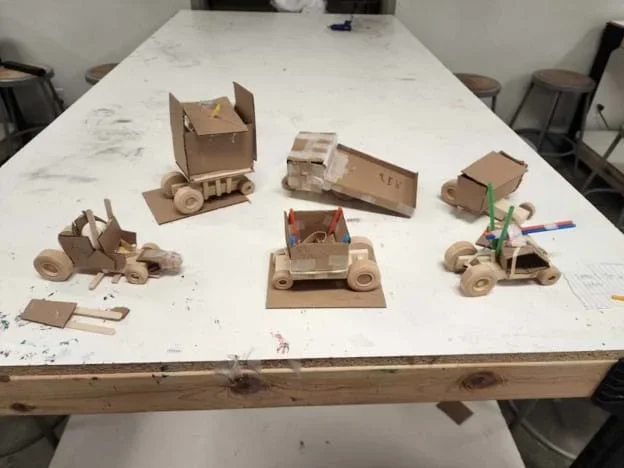 The Creative Crash Testing activity is a new take on the classic egg drop activity.Copyright 2023 Greg Nowling
- mass
- A measure of how much matter an object contains, or the total number of particles in an object.
- momentum
- The quantity of mass in motion, a product of an object’s mass multiplied by its velocity (to get a vector quantity) or speed (to get a scalar quantity)..
- speed
- The magnitude of the rate of change of an object’s position with time. The average speed of an object in an interval of time is the distance travelled by the object divided by the duration of the interval.
Pre-Activity Assessment
Opening Questions: In the introduction/motivation section, recap the EDP steps with the students.
Activity Embedded (Formative) Assessment
Worksheet: Students fill out the Creative Crash Testing Worksheet (PDF).
Post-Activity (Summative) Assessment
Worksheet: Students reflect in the Creative Crash Testing Worksheet (PDF) on ways of improving their designs and what conclusions they can draw from their various designs and tests.
Making Sense Assessment: Have students reflect on the science concepts they explored and/or the science and engineering skills they used by completing the Making Sense Assessment (PDF).
- If the wooden base car models are too light to result in much of a crash, add the same number of metal washers to the bottoms of all the cars; this additional mass results in better crashes without changing the relative comparisons.
- Pay attention to the ramp angle in relation to the wheel size and adjust the ramp angle as necessary so the cars don’t bottom out during the crash test runs.
- To ease clean-up after testing: Put eggs into small plastic bags during test runs.
- Add a materials costs column to the materials tables in the Creative Crash Testing Worksheet (PDF) so students can figure out the cost of materials and compare the overall cost efficiency of the vehicles. Set a maximum cost amount and place a value on each material type so students work within a budget constraint.
- Add a rubric component of "real-world application" assessing the realism or human application of students' vehicle safety design features.
- Compare static vs. elastic collisions by having students run cars down opposing ramps into one another.
- Study the change of force and acceleration by pushing the cars with different forces or sending cars down a longer ramp.
- Have students graph their individual/class data to compare mass and momentum visually.
- Increase the force of the egg crash tests by having students design CO2-powered cars that crash into a cinder block. This increases the testing stakes and reflect how crash tests are done in the real world.
Patterson, Beth; Kulm School; Duffield, Jace; NDSU; Integrated Teaching and Learning Program, College of Engineering, University of Colorado Boulder. Creative Crash Test Cars. Last Modified March 31, 2022. TeachEngineering.org. https://www.teachengineering.org/makerchallenges/view/nds-1746-creative-crash-test-cars-mass-momentum
Teach Engineering. Creative Crash Test Cars. July 6, 2021. YouTube. https://youtu.be/sYkoaK1iOtM
- ASPIRE Creative Engineering Design
- Creative Engineering Design: Paper Tower Design Challenge
- Creative Engineering Design: Efficient Car Design
- Creative Engineering Design: Straw Bridge Design Challenge
- Creative Engineering Design: Engineering Design Process & Design Thinking
- Creative Engineering Design: Creative Crash Testing Design Challenge
- Creative Engineering Design: Environmental Impact StoryMap Collection
- Creative Engineering Design: Mouse Trap Car Design Challenge
- Creative Engineering Design: Tinkercad 3D Design & EV Concept Car Workshop
- Creative Engineering Design: Carbon Footprints and Transportation
- Creative Engineering Design: Tinkercad Circuits & EV Motor Workshop
- Creative Engineering Design: Transportation Fuels Debate
- Creative Engineering Design: Model EV Design Challenge
Contributors
Beth Patterson (Kulm School); Jace Duffield (North Dakota State University); Sabina Schill; Jennifer Taylor; Ellen Parrish
Supporting Program
Integrated Teaching and Learning Program, College of Engineering, University of Colorado Boulder (original RET Program, College of Engineering, North Dakota State University Fargo)
Acknowledgements
This curriculum was developed under National Science Foundation grant numbers 1941524 and 1941701. Any opinions, findings, and conclusions, or recommendations expressed in this material are those of the authors and do not necessarily reflect the views of the National Science Foundation.
Copyright
2022 by Regents of the University of Colorado; original © 2016 North Dakota State University