
Creative Engineering Design: Carbon Footprints and Transportation
 Carbon footprint represents the individual’s contributions to greenhouse gas emissions from human activities that burn fossil fuels, such as gas-powered transportation.Copyright 2022, Sintegrity, Creative Commons Attribution 4.0, Wikimedia
Students are introduced to the concept of a “carbon footprint” and then explore what greenhouse gasses are by analyzing a scientific article. Next, students calculate their carbon footprint for their typical daily trip to school. Finally, students participate in a class discussion to reflect on the final Carbon Footprint Reflections worksheet section.
To help people lower their carbon footprints engineers are creating a wide range of clean energy processes and products to transform from non-renewable fossil fuels to alternative energy sources such as wind, solar, geothermal, hydropower, and biomass to power our world. Civil engineers help to decarbonize cities, for example, by installing green roofs on buildings to fight urban heat island effects and infrastructure to support electrified fleet vehicles like buses that reduce carbon emissions and improve air quality. Environmental engineers pursue “green engineering” by developing processes that conserve natural resources, improve energy efficiency, minimize waste, and reduce pollution and greenhouse gases. Materials engineers are exploring and developing ways to capture CO2 from the atmosphere and convert it into useful applications, such as carbon capture and storage in concrete. Engineering is at the heart of creating a sustainable and equitable future for everyone.
After this activity, students should be able to:
- Know what carbon footprint means.
- Assess their general individual carbon footprints.
- List ways for reducing carbon footprints.
- STEL-4P Evaluate ways that technology can impact individuals, society, and the environment.
Grades 9-12
Do you agree with this alignment?
For the entire class to share:
- 5 lb. bag of charcoal briquettes
- 1 tall, white kitchen trash bag
- 1 plastic grocery bag
- paper towels
- all-purpose cleaner
- white 8 1⁄2” x 11” paper (one for each student)
- A Closer Look at Greenhouse Gases article (one for each student)
- Carbon Footprint Worksheet (one for each student)
- (optional, if time) Road Trip Worksheet (one for each student)
- A Closer Look at Greenhouse Gases Article (pdf)
- Road Trip Worksheet (docx)
- Road Trip Worksheet (pdf)
- Making Sense Assessment (docx)
- Making Sense Assessment (pdf)
- Carbon Footprint & Transportation Worksheet (docx)
- Carbon Footprint & Transportation Worksheet (pdf)
- Carbon Footprint & Transportation Worksheet - Answer Key (docx)
- Carbon Footprint & Transportation Worksheet - Answer Key (pdf)
Transportation plays a sizable role in our greenhouse gas emissions with transportation contributing over 33% of CO2 emissions. Electricity generation is the other major contributor to CO2 emissions, with over 36%. A person's transportation and day-to-day electrical consumption decisions make up a big part of their carbon footprint, due to the burning of fossil fuels to supply electricity and transportation fuels. In this activity, you are going to consider your own choices in transportation and calculate your overall carbon footprint to consider your impacts and make informed changes.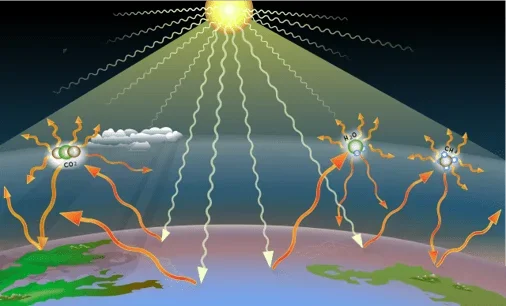 Greenhouse gasses (GHG) are naturally occurring in the Earth’s atmosphere that enable and sustain life. However, human activities that burn fossil fuels are the leading cause of increased atmospheric levels of GHGs driving human-caused climate change.Copyright 2019, A loose necktie, Creative Commons Attribution-Share Alike 4.0 International license, Wikimedia
Background
Over the past century, scientists have compiled scientific data showing that for the first time in Earth’s history the activities of one species, Homo sapiens (humans), are altering the planet’s climate. Scientific research shows a significant increase in the concentration of heat-trapping greenhouse gas (GHG) carbon dioxide (CO2) in Earth’s atmosphere since the beginning of the Industrial Revolution in the mid-1700s, which was powered by burning fossil fuels, initially coal and then petroleum. Fossil fuel use for energy enables humans to use electricity for lighting and electronics, to make homes comfortable in hot and cold weather, to cook food efficiently, to keep food for longer periods, and to travel quickly from place to place. Fossil fuels allow us to work, make and move goods, and power technology. The CO2 concentration in the atmosphere before the Industrial Revolution was stable at around 280 ppm (parts per million). Current atmospheric CO2 concentration is over 420 ppm, which is a 40% percent increase over natural levels, and GHG levels continue to rise annually.
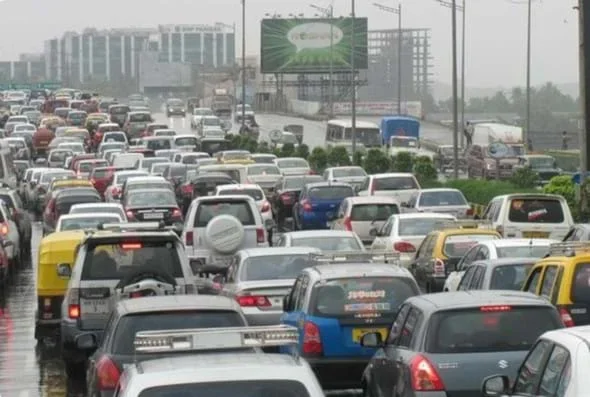 Gas-powered vehicles that burn fossil fuels are a leading source of greenhouse gas emissions into the atmosphere, especially CO2, that contribute to human-caused climate change.Copyright 2011, Lakun.patra, Creative Commons Attribution-Share Alike 4.0 International license, Wikimedia
Before the Activity
Students:
- (optional) Before this activity, have students research uses for CO2 as homework. Encourage students to find ways CO2 is used in residential, industrial, and medical settings. Students should make a list and bring the list with them to class.
Teachers:
- Make copies of the A Closer Look at Greenhouse Gases article
- Make copies of the Carbon Footprints & Transportation Worksheet
- (optional) Make copies of the Road Trip Worksheet
With the Students
- Pass out the A Closer Look at Greenhouse Gases article and the Carbon Footprints & Transportation worksheet, one to each student.
- Have students break into small groups and read the A Closer Look at Greenhouse Gases article, and complete the first activity worksheet section: Basics of Greenhouse Gases.
- Have students Think-Pair-Share about U.S. greenhouse gas emissions. (Make sure students see that CO2 is the largest manmade greenhouse gas emission. They should also see that transportation contributes a significant amount of greenhouse gas emissions.)
- Review that CO2 is usually found in a gas form. It is colorless and transparent to light. (Even though we know CO2 impacts the environment, we do not always think about it because we cannot see it.)
- Introduce the second activity worksheet section (Calculate your Carbon Footprint) by showing students the bag of charcoal briquettes. Explain that the briquettes are made almost completely of carbon. The bag of briquettes will represent the amount of carbon in one gallon of gas. The average gallon of gasoline contains about five pounds of carbon. There are typically about 100 briquettes in the bag. By dividing five pounds of carbon by 100 briquettes equals 0.05 pounds of carbon per briquette.
- Discuss the modes of transportation students take and how many miles each student travels to and from school daily.
- Calculate how many briquettes represent the carbon dioxide emissions from their transportation to and from school. Use the bags to cover the workspace and hold individual briquettes. Students can use the Carbon Footprint Worksheet for calculations.
- For the final activity worksheet section (Carbon Footprint Reflections), have a class discussion to share students’ perspectives on the concluding questions to reflect on why it is important to understand carbon footprints and why it matters.
- carbon footprint
- A measure of the amount of carbon dioxide and other carbon compounds emitted due to the consumption of fossil fuels by a particular person, group, etc.
- carbon dioxide
- A colorless, odorless gas that occurs naturally in Earth’s atmosphere. Its chemical formula is CO2, which means a molecule of CO2 consists of one carbon atom bonded to two oxygen atoms. CO2 is a greenhouse gas.
- emissions
- The production and discharge of something, such as gasses, particles, or radiation.
- greenhouse gas
- Also known as GHGs, are gases in the Earth's atmosphere that trap heat, thus warming the planet. GHGs are naturally occurring, but are also emitted by human activities.
Pre-Activity Assessment
Think-Pair-Share: After reading the A Closer Look at Greenhouse Gases article, students Think-Pair-Share about U.S. greenhouse gas emissions.
Activity Embedded (Formative) Assessment
Worksheet: Students use the Carbon Footprint Worksheet to calculate how many briquettes represent the carbon dioxide emissions from their transportation to and from school.
Post-Activity (Summative) Assessment
Letter: Students write a letter or article citing at least three suggestions for reducing carbon footprints.
Making Sense: Have students reflect on the science concepts they explored and/or the science and engineering skills they used by completing the Making Sense Assessment.
- Have students use the internet for current information to cross-reference vehicle fuel info sheets.
- Students can calculate their family’s household emissions using the Environmental Protection Agency’s Emissions Calculator at http://www3.epa.gov/carbon-footprint-calculator/. It will be most accurate if students have an energy bill from home they can reference. Other carbon calculators are easily searched online.
- ASPIRE Creative Engineering Design
- Creative Engineering Design: Paper Tower Design Challenge
- Creative Engineering Design: Efficient Car Design
- Creative Engineering Design: Straw Bridge Design Challenge
- Creative Engineering Design: Engineering Design Process & Design Thinking
- Creative Engineering Design: Creative Crash Testing Design Challenge
- Creative Engineering Design: Environmental Impact StoryMap Collection
- Creative Engineering Design: Mouse Trap Car Design Challenge
- Creative Engineering Design: Tinkercad 3D Design & EV Concept Car Workshop
- Creative Engineering Design: Carbon Footprints and Transportation
- Creative Engineering Design: Tinkercad Circuits & EV Motor Workshop
- Creative Engineering Design: Transportation Fuels Debate
- Creative Engineering Design: Model EV Design Challenge
This resource is adapted from the National Energy Education Development (NEED.org) “Exploring Climate Science” (2019) by Jennifer Taylor (pp. 18-19, 32, 62-63)
Contributors
Jennifer Taylor
Supporting Program
Integrated Teaching and Learning Program, College of Engineering, University of Colorado Boulder
Acknowledgements
This curriculum was developed under National Science Foundation grant numbers 1941524 and 1941701. Any opinions, findings, and conclusions, or recommendations expressed in this material are those of the authors and do not necessarily reflect the views of the National Science Foundation.
Copyright
2022 by Regents of the University of Colorado