
Building & Testing Model Underground Safety Caverns
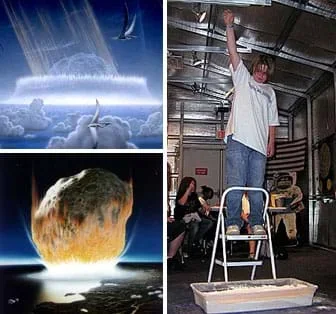 Students build and test model caverns.Copyright (drawings) Don Davis, NASA and (photo) NASA
http://www.donaldedavis.com/PARTS/K-TNASA.jpg
http://impact.arc.nasa.gov/images/mm_gallery/coastline_jpg.jpg
http://www.nasa.gov/audience/foreducators/where-astronauts-come-from_prt.htm
Students build and test model caverns.Copyright (drawings) Don Davis, NASA and (photo) NASA
http://www.donaldedavis.com/PARTS/K-TNASA.jpg
http://impact.arc.nasa.gov/images/mm_gallery/coastline_jpg.jpg
http://www.nasa.gov/audience/foreducators/where-astronauts-come-from_prt.htm
Concluding the Asteroid Impact challenge, students build model caverns and bury them in a tray of sand. They test the models by dropping a heavy ball onto them to simulate an asteroid hitting the Earth. By molding papier-mâché or clay around balloons (to form domes), or around small cardboard boxes (to form rectangular structures), students create unique models of their cavern designs. Examining how their structures survived the asteroid impact, students make improvements and impact test again, experiencing design iteration. Teams each make two mini class presentations to show the sustained damage, explain their intended improvements, and report on the success of their updated designs.
A vital part of the engineering design process involves testing possible and final solutions. This often involves building scaled models of a design solution and testing it. Lessons learned from the testing informs further improvement in the design evolution.
After this activity, students should be able to:
- Working with pre-determined design constraints, use papier-mâché to create a model structure.
- Evaluate the effectiveness of a structure against impact failure.
- Continue an iterative design process.
- Analyze and interpret data identifying ways Earth's surface is constantly changing through a variety of processes and forces such as plate tectonics, erosion, deposition, solar influences, climate, and human activity
Grade 5
Do you agree with this alignment? - Develop and communicate an evidence based scientific explanation around one or more factors that change Earth's surface
Grade 5
Do you agree with this alignment? - Gather, analyze, and communicate data that explains Earth's plates, plate motions, and the results of plate motions
Grade 7
Do you agree with this alignment?
- STEL-7R Refine design solutions to address criteria and constraints.
Grades 6-8
Do you agree with this alignment?
- MS-ESS2-2 Construct an explanation based on evidence for how geoscience processes have changed Earth's surface at varying time and spatial scales.
Grades 6-8
This resource focuses on the following Three Dimensional Learning aspects of NGSS:
Science & Engineering Practices- Construct a scientific explanation based on valid and reliable evidence obtained from sources (including the students' own experiments) and the assumption that theories and laws that describe the natural world operate today as they did in the past and will continue to do so in the future.Do you agree with this alignment?
Disciplinary Core Ideas- The planet's systems interact over scales that range from microscopic to global in size, and they operate over fractions of a second to billions of years. These interactions have shaped Earth's history and will determine its future.Do you agree with this alignment?
- Water's movements—both on the land and underground—cause weathering and erosion, which change the land's surface features and create underground formations.Do you agree with this alignment?
Crosscutting Concepts- Time, space, and energy phenomena can be observed at various scales using models to study systems that are too large or too small.Do you agree with this alignment?
Do you agree with this alignment? - Construct a scientific explanation based on valid and reliable evidence obtained from sources (including the students' own experiments) and the assumption that theories and laws that describe the natural world operate today as they did in the past and will continue to do so in the future.
- MS-ETS1-4 Develop a model to generate data for iterative testing and modification of a proposed object, tool, or process such that an optimal design can be achieved.
Grades 6-8
This resource focuses on the following Three Dimensional Learning aspects of NGSS:
Science & Engineering Practices- Develop a model to generate data to test ideas about designed systems, including those representing inputs and outputs.Do you agree with this alignment?
Disciplinary Core Ideas- Models of all kinds are important for testing solutions.Do you agree with this alignment?
- The iterative process of testing the most promising solutions and modifying what is proposed on the basis of the test results leads to greater refinement and ultimately to an optimal solution.Do you agree with this alignment?
Do you agree with this alignment? - Develop a model to generate data to test ideas about designed systems, including those representing inputs and outputs.
- papier-mâché or clay (not modeling clay)
- medium-sized balloons
- small cardboard boxes
- large plastic tubs
- sand
- small bowling ball, or other ~5 -to 7-pound object, to simulate an asteroid
- assorted additional materials that could be used to form model cavern structures, such as cleaned containers found in the recycling bin
- (optional) photographs of real impact craters on the Earth and the Moon
Now that all your hard work is done, we are going to build model caverns and test them!
Before the Activity
- Gather materials.
- If possible, find some photographs to show students of real impact craters on the Earth and the Moon.
With the Students
- Give students the choice of modeling their caverns as domes or flat-roofed structures.
- Give groups papier-mâché (or clay) and let them build their caverns.
- Let the models to set up overnight. If clay is used, the drying time may need to be extended to two to three days.
- Once dry, have each student engineering team test its cavern design.
- Start by burying the cavern in the sand. Make sure that the cavern is about 6 inches under the sand surface.
- Drop the bowling ball (or other object) from a height of 2-3 feet onto the sand.
- Excavate the cavern and inspect the damage.
- Have students present their tested caverns to the class and identify the damage that was done, if any.
- Have students come up with at least two changes that could be made to improve the design. If the cavern was not damaged, facilitate a discussion of over-design and cost versus performance.
- Have students make a new cavern with the design changes discussed during the presentation. Repeat the drying and testing steps, and then have students present their updated design and conclude by explaining whether or not and how the changes (design iteration) resulted in better performance.
- To conclude, discuss the results of the impact testing. See the Assessment section for suggested questions.
Concluding Discussion: Lead a class discussion to share and compare team results and conclusions. Evaluate student comprehension through their answers and contributions. Ask the class:
- What did you observe during the testing?
- What happened to each of the various models in the simulated impacts?
- With what you learned, would you make any changes to your team's final cavern design?
- If you had more time, what other tests and data might you do in order to obtain get more information that would help you make good decisions about creating safe underground shelters?
- Which team proposal(s) should the governor choose? And why?
For upper grades, as a way to more closely align this activity to the various rock types found in Alabraska, provide additional impact testing materials in addition to sand. Use flour to represent a softer material, sand to represent a moderately strong material, and gravel to represent a harder material. Have students select an impact material based on what rock type they decided to build their cavern in, or have each group pick an impact material at random for the sake of experimentation by the entire class.
- Adventure Engineering Challenge: Asteroid Impact
- Incoming Asteroid! What's the Problem?
- How Big? Necessary Area & Volume for Shelter
- Using Map Scales to Figure Distances and Areas
- Identifying Possible Underground Cavern Locations
- Rocks, Rocks, Rocks: Test, Identify Properties & Classify
- Ranking the Rocks for Desired Properties
- Recommendations & Presentations: Drum Roll Please
- Building & Testing Model Underground Safety Caverns
Supporting Program
Adventure Engineering, Colorado School of Mines
Acknowledgements
Adventure Engineering was supported by National Science Foundation grant nos. DUE 9950660 and GK-12 0086457. However, these contents do not necessarily represent the policies of the National Science Foundation, and you should not assume endorsement by the federal government.
Copyright
2013 by Regents of the University of Colorado; original © 2005 Colorado School of Mines