
Clay Boats
Students use a small quantity of modeling clay to make boats that float in a tub of water. The object is to build boats that hold as much weight as possible without sinking. In the process of designing and testing their prototype creations, students discover some of the basic principles of boat design, gain first-hand experience with concepts such as buoyancy and density, and experience the steps of the engineering design process.
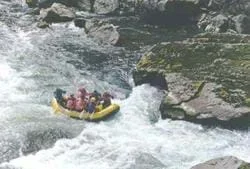 Students quickly find that when they mold clay into shapes resembling this inflatable raft, the clay floats much better than if it is molded into shapes resembling more typical boat hulls.Copyright U.S. Bureau of Land Management http://www.or.blm.gov/roseburg/images/Recreation/rafting2.jpg
Density is an important property in many materials engineering applications. Building clay boats to hold as much weight as possible is a classic engineering design problem.
After this activity, students will be able to:
- Describe a means to make a material that is denser than water (modeling clay) float.
- Describe the steps of the engineering design process used to create a dense but floatable object.
- Students will develop an understanding of the attributes of design.
Grades K-12
Do you agree with this alignment? - Students will develop an understanding of engineering design.
Grades K-12
Do you agree with this alignment? - There is no perfect design.
Grades 6-8
Do you agree with this alignment? - Design involves a set of steps, which can be performed in different sequences and repeated as needed.
Grades 6-8
Do you agree with this alignment? - STEL-7J Evaluate designs based on criteria, constraints, and standards.
Grades 3-5
Do you agree with this alignment? - STEL-7Q Apply the technology and engineering design process.
Grades 6-8
Do you agree with this alignment?
- MS-ETS1-4 Develop a model to generate data for iterative testing and modification of a proposed object, tool, or process such that an optimal design can be achieved.
Grades 6-8
This resource focuses on the following Three Dimensional Learning aspects of NGSS:
Science & Engineering Practices- Develop a model to generate data to test ideas about designed systems, including those representing inputs and outputs.Do you agree with this alignment?
Disciplinary Core Ideas- Models of all kinds are important for testing solutions.Do you agree with this alignment?
- The iterative process of testing the most promising solutions and modifying what is proposed on the basis of the test results leads to greater refinement and ultimately to an optimal solution.Do you agree with this alignment?
Do you agree with this alignment? - Develop a model to generate data to test ideas about designed systems, including those representing inputs and outputs.
- 6.P.2 Understand the structure, classifications and physical properties of matter.
Grade 6
Do you agree with this alignment?
- non-hardening modeling clay, 1/2 stick (~2 ounces or 50-60 grams) per student, plus some extra in case any get too wet to mold
- tub of water, at least 6 inches deep, per four or five students
- 100+ large washers to use as weight for boat testing, such as 1.5-inch fender washers; available at hardware stores
- paper towels (dozens)
- roll waxed paper
- masking or transparent tape
Very little introduction is required for this fun activity. In fact, this activity makes a good introduction for the associated lesson. However, if students did not already complete the Determining Densities activity portion of the Floaters and Sinkers lesson, introduce this activity by showing the class a half-stick of modeling clay and asking if they think it will float or sink in a beaker of water.
After students make their predictions, drop the clay stick into a beaker of water to demonstrate that the clay sinks. Then write on the board, "Engineering desgn challenge 1: Create an object out of clay that floats." (Then continue with the activity, as described in the Procedures section.)
With the Students: Challenge 1 (5-10 minutes)
- Have each student tape a sheet of waxed paper (~18" long) on the surface of his or her work station. This makes cleanup much easier, since wet clay gets very messy.
- If you have not already done so, write on the board, "Engineering design challenge 1: Create an object out of clay that floats." Note that the wording specifies the creation of an object as opposed to a boat. In fact, students who attempt to mold their clay into the shapes of familiar boat hulls will quickly realize that these shapes are less than ideal – at least for clay.
- Give each student a half stick of modeling clay, and place several tubs of water throughout the classroom. Let students know they can test their objects as often as they like, but advise them to pat the clay dry after testing and before shaping it into a new design.
With the Students: Challenge 2 (15-20 minutes)
- As students successfully complete Part 1, challenge them with a new goal. Write on the board, "Engineering design challenge 2: Design an object out of clay that can carry the largest load of washers possible." Show students the washers that will be used to make up the load.
- As students work, encourage them to continue making improvements every time their boats sink. Students may become competitive and want to declare a winner, and it is quite possible that a tie for the number of washers supported will occur. Should this happen, use a balance to determine the actual mass of the washers held, since slight variations exist in the masses of individual washers.
- density
- Mass per unit volume of a substance at a given pressure and temperature.
- buoyancy
- The ability to float in a liquid (or rise in a gas).
Design Process Reflection: Ask students to each write a paragraph describing in their own words the steps of the engineering design process that they followed as they created something new and unique—a clay object that floats in water.
Making Sense: Have students reflect on the science concepts they explored and/or the science and engineering skills they used by completing the Making Sense Assessment (PDF).
If students do not dry their clay adequately between tests of "seaworthiness," the clay may become too wet to work with. Have some extra clay on hand to give to students if their original portions becomes unworkable.
Expect students to have a number of observations about the shapes of successful boats, and express some curiosity about "real" boats and their design features. Assign students conduct library and Internet research to find out about boat designs and how they affect performance. Information on this subject is also covered in the Lesson Background & Concepts for Teachers section of the associated lesson.
Contributors
Mary R. Hebrank
Supporting Program
Engineering K-PhD Program, Pratt School of Engineering, Duke University
Acknowledgements
This content was developed by the MUSIC (Math Understanding through Science Integrated with Curriculum) Program in the Pratt School of Engineering at Duke University under National Science Foundation GK-12 grant no. DGE 0338262. However, these contents do not necessarily represent the policies of the NSF, and you should not assume endorsement by the federal government.
This activity was originally published, in slightly modified form, by Duke University's Center for Inquiry Based Learning (CIBL). Please visit http://ciblearning.org/ for information about CIBL and other resources for K-12 science and math teachers.
Copyright
2013 by Regents of the University of Colorado; original © 2004 Duke University