
Bees: The Invaluable Master Pollinators
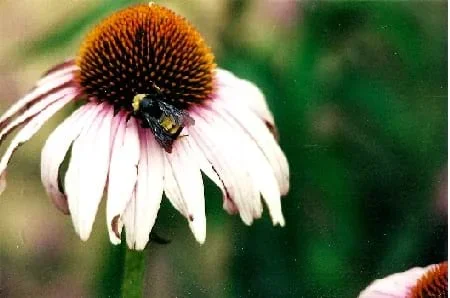 Bee pollination is important to the human food supply.Copyright 2006 Wendy Holmgren. Used with permission.
The study of biomimicry and sustainable design promises great benefits in design applications, offering cost-effective, resourceful, non-polluting avenues for new enterprise. An important final caveat for students to understand is that once copied, species are not expendable. Biomimicry is intended to help people by identifying natural functions from which to pattern human-driven services. Biomimicry was never intended to replace species. Ecosystems remain in critical need of ongoing protection and biodiversity must be preserved for the overall health of the planet. This activity addresses the negative ramifications of species decline. For example, pollinators such as bees are a vital work force in agriculture. They perform an irreplaceable task in ensuring the harvest of most fruit and vegetable crops. In the face of the unexplained colony collapse disorder, we are only now beginning to understand how invaluable these insects are in keeping food costs down and even making the existence of these foods possible for humans.
Engineering solutions are, unfortunately, not always feasible or economical compared to those "services" already provided by natural systems and organisms. This holds true for the natural functioning of wetlands compared to the civil engineering construction of levees as revealed through the devastation of Hurricane Katrina. Engineering designs have limitations.
After this activity, students should be able to:
- Distinguish between appropriate and inappropriate uses of biomimicry.
- Understand the intrinsic value of natural systems and species to the health of the planet and to ourselves.
- Be able to evaluate and question the wisdom of humans' choices in systems that replace the natural function provided inherently by ecosystems.
- Explain why bees are master pollinators and cannot be mimicked cost effectively by humans.
- STEL-4P Evaluate ways that technology can impact individuals, society, and the environment.
Grades 9-12
Do you agree with this alignment? - STEL-6F Relate how technological development has been evolutionary, often the result of a series of refinements to basic inventions or technological knowledge.
Grades 9-12
Do you agree with this alignment?
- 5-LS2-1 Develop a model to describe the movement of matter among plants, animals, decomposers, and the environment.
Grade 5
Do you agree with this alignment?
- 5.3.3 Students will describe relationships within an ecosystem.
Grades 3-5
Do you agree with this alignment?
- HS-LS2-1 Use mathematical and/or computational representations to support explanations of factors that affect carrying capacity of ecosystems at different scales.
Grades 9-12
This resource focuses on the following Three Dimensional Learning aspects of NGSS:
Science & Engineering Practices- Use mathematical and/or computational representations of phenomena or design solutions to support explanations.Do you agree with this alignment?
Disciplinary Core Ideas- Ecosystems have carrying capacities, which are limits to the numbers of organisms and populations they can support. These limits result from such factors as the availability of living and nonliving resources and from such challenges such as predation, competition, and disease. Organisms would have the capacity to produce populations of great size were it not for the fact that environments and resources are finite. This fundamental tension affects the abundance (number of individuals) of species in any given ecosystem.Do you agree with this alignment?
Crosscutting Concepts- The significance of a phenomenon is dependent on the scale, proportion, and quantity at which it occurs.Do you agree with this alignment?
Do you agree with this alignment? - Use mathematical and/or computational representations of phenomena or design solutions to support explanations.
- Science concepts. The student recognizes multiple forms of energy and knows the impact of energy transfer and energy conservation in everyday life. The student is expected to:
Grades 9-10
Do you agree with this alignment?
- capability to show students an online video
- Silence of the Bees Handout, one per student
- (optional) Our Forgotten Pollinators: Protecting the Birds and Bees article by M. Ingram, G. Nabhan, S. Buchmann: http://www.apiservices.com/articles/us/pollinators.htm
- See articles on colony collapse disorder at: https://agresearchmag.ars.usda.gov/2012/jul/colony
Are there times when biommicry is not the answer or solution? If so, when is that time? We have learned that biomimicry is applicable when a natural system or species adaptation leads humans to adopt its pattern. We modify for benefit by using the evolved "blueprint" of nature. The examples discussed in this lesson should inspire you to look for other cases. The possibility in the future of self-cleaning surfaces or colored surfaces that are paint-less broaden our acceptance of what is possible. These applications, we now know, lend themselves to the immediate benefit of reducing toxic chemical use.
Today we will watch a video that illustrates that nature's performance is sometimes superior to anything that humans can attempt to copy in replacement. Our failure to replicate in conjunction with our inability to protect and preserve a species, can ultimately lead to disastrous outcomes It is important to recognize this distinction in the role of biomimicry.
Background
The study of biomimicry and sustainable design promises great benefits in design application. It affords means by which to promote cost-effective, resourceful, non-polluting avenues for new enterprise. These "blueprints" have existed as previously underappreciated strategies by relatively unfamiliar organisms. An important final caveat, however, must still be addressed. One cannot leave students with the misunderstanding that once copied, species are expendable. Biomimicry is intended to allow humans to benefit by identifying a natural function and patterning a human driven service from it. Biomimicry was never intended as a means by which to replace a species. Ecosystems are still in critical need of protection, and biodiversity must be preserved. The overall health of our planet hinges on people understanding this point.
This final activity helps students to recognize the full force of consequence in species decline. Show them the "Silence of the Bees" online video to explain the consequences of species decline. Pollinators are a vital work force in the circles of agriculture. They perform an irreplaceable task in guaranteeing most fruit and vegetable crops are brought to harvest. In the face of the unexplained colony collapse disorder, we are only now beginning to understand how invaluable these insects are to not only keeping food costs down, but also providing these foods at all.
This video documents the essential role that bees play in providing pollination to plant species that are unable to be wind pollinated. Make sure students are aware that in the absence of pollination, fertilization does not occur, reproduction has failed and fruits and seeds are not produced. The video details the identification of colony loss, the economic value associated with this lost natural service, and the situation in China following the disappearance of bees. The video highlights the seriousness of this decrease in natural bees and the negative impact on peoples' lives. Biomimicry is discussed as a non-viable option to address the magnitude of this loss. http://www.pbs.org/wnet/nature/episodes/silence-of-the-bees/introduction/38/
Before the Activity
- Make copies of the Silence of the Bees Handout, one per student.
- It may be helpful to provide students with copies of an article discussing the role of pollination, such as the one listed in the Materials List.
With the Students
- Present the Introduction/Motivation content to the class.
- As you pass out the pre-video hadout, ask leading questions to learn students' level of knowledge of biomimicry.
- Direct students to independently answer the pre-video questions.
- As students are completing the handouts, walk around the classroom to ensure that all students are on the right track.
- Begin the video. While the video runs, continue to scan the classroom to make sure students are paying attention as they answer the questions from the video.
- When the video is over, discuss the writing assignment. Assign students to summarize in at least a single, fully-developed paragraph, their personal thoughts on the value of ecological systems and their species' roles within those systems. Do they believe the ordinary citizen fully appreciates the functions performed that we benefit directly from? As a society, should we be concerned about protecting these organisms and at what cost? Also, include possible solutions to this bee crisis.
Review students' post-writing assignment (see the Procedure section) to assess whether they have grasped the innate importance of natural systems to the well-being not only of the endemic species, but also to humans as we continue to rely on natural resources for our ability to harvest crops.
For lower grades, provide more time for group discussion.
- Sustainable Design and Biomimicry in a Desert Ecosystem
- Designing a Sustainable Guest Village in Saguaro National Park
- Food Chains and Food Webs - Balance within Natural Systems
- Biomes and Population Dynamics - Balance within Natural Systems
- Biomimicry and Sustainable Design: Nature as Engineering Marvel
- Bird Flight Adaptations: Inspiration for Aeronautical Engineering
- Bees: The Invaluable Master Pollinators
Contributors
Wendy J. Holmgren; Megan Johnston; Amber Spolarich
Supporting Program
VU Bioengineering RET Program, School of Engineering, Vanderbilt University
Acknowledgements
The contents of this digital library curriculum were developed under National Science Foundation RET grant nos. 0338092 and 0742871. However, these contents do not necessarily represent the policies of the NSF, and you should not assume endorsement by the federal government.
Copyright
2013 by Regents of the University of Colorado; original © 2006 Vanderbilt University