
From Sunlight to Electric Current
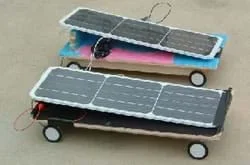 Model solar cars built by middle school students in North Carolina.Copyright 2004 Paul Klenk, Duke University
Students explore the concept of current in electrical circuits, with current defined as the flow of electrons. Then photovoltaic (PV) cell properties are introduced. Generally constructed of silicon, PV cells contain a large number of electrons BUT they can be thought of as "frozen" in their natural state. A source of energy is required to "free" these electrons if we wish to create current. Sunlight provides this energy. This leads to the principle of "conservation of energy." Finally, with a basic understanding of the circuits through Ohm's law, students see how energy from the sun can be used to power everyday items, including vehicles. Engaging students in the engineering design activity of building model solar cars helps students learn these concepts.
Acting as engineers, students build model solar cars, which helps them apply and understand Ohm's law, photovoltaic cells and conservation of energy.
At lesson end, students should be able to:
- Define current.
- Explain why a solar photovoltaic panel is like a battery.
- CCSS.Math.Content.6.SP.B.4 Display numerical data in plots on a number line, including dot plots, histograms, and box plots.
Grade 6
Do you agree with this alignment?
- Energy is the capacity to do work.
Grades 6-8
Do you agree with this alignment? - Energy can be used to do work, using many processes.
Grades 6-8
Do you agree with this alignment? - Power is the rate at which energy is converted from one form to another or transferred from one place to another, or the rate at which work is done.
Grades 6-8
Do you agree with this alignment?
- CCSS.Math.Content.6.SP.B.4 Display numerical data in plots on a number line, including dot plots, histograms, and box plots.
Grade 6
Do you agree with this alignment?
- 7.P.2 Understand forms of energy, energy transfer and transformation and conservation in mechanical systems.
Grade 7
Do you agree with this alignment? - 7.P.2.3 Recognize that energy can be transferred from one system to another when two objects push or pull on each other over a distance (work) and electrical circuits require a complete loop through which an electrical current can pass.
Grade 7
Do you agree with this alignment? - Phy.2.3 Analyze the nature of moving charges and electric circuits.
Grades 9-12
Do you agree with this alignment?
How Photovoltaic Cells Work
Energy of sunlight is transferred to electrons, allowing them to jump to the next orbital and cross the band gap. These electrons are now mobile and current will flow.
Use the Photovoltaic Cell Handout (PDF) for diagrams and an explanation of how photovoltaic cells work, including their design (layers, materials) and functionality. Following the handout, have students complete the hands-on Racing with the Sun - Creating a Solar Car activity.
For a more detailed understanding of photovoltaic cells, please see http://science.howstuffworks.com/solar-cell.htm.
How might you take the same energy that the sun provides to cook food in our solar ovens and use it to power _______ (insert any one of a number of electric devices)?
Conduct this related demonstration to grab students' attention. The electrons in silicon (Si) generally do not contain enough energy to jump the "band gap" and so they are considered frozen. To demonstrate this, a bucket filled with ice cubes can represent silicon with electrons in the frozen state. Connect the bucket to another bucket by a clear plastic tube attached towards the bottom of each bucket. Represent the sun by a hair dryer. The hair dryer melts the ice representing the release of the electrons by the sun. Additionally, the sun raises the electric potential (voltage difference from one point to another) of each PV cell (creating an electric field at the PN junction—this does not need to be taught to the students). The melted ice (water) now flows in the direction of the other bucket, representing current.
Distribute solar panels to each group of two students. With a digital multimeter (DMM), go around to each group and run a personal demonstration soliciting student input. For example, hook up the DMM leads to the solar panel when it is placed in the dark (in a desk for example). Expect students to understand that without any light energy, the panel will not create any current or voltage. Similarly, expose the panel to a bright flashlight and prompt students to explain why current and voltage now exist.
Note: For solar panels, use those that come with the Junior Solar Sprint solar car kit that will be used for the associated Racing with the Sun - Creating a Solar Car activity. Thus, this also serves as an excellent transition to the activity.
- current
- Flow of electrons.
- voltage
- Designates "electric pressure" that exists between two points and is capable of producing a flow of current when a closed circuit is connected between the two points (can also be understood with the analogy of elevation: just as a hill will have water flow down it, a voltage will have current flow in the direction from high to low).
- photovoltaic cell
- A semiconductor device that converts the energy of sunlight into electric energy.
- conductor
- A material in which electricity moves easily. That is, it is a material with low electrical resistance, one in which a fairly small voltage produces a fairly large current.
Assessment is closely tied to the Lesson Closure use of solar panels. By doing this, you can directly ascertain whether the students "get it" based on their ability to discuss and describe the behavior of the solar panels. Further questioning can easily be worked in regarding the other concepts such as current, conservation of energy, light interaction, etc., as they all relate to the PV cell.
- Exploring Solar Power
- Using Heat from the Sun
- From Sunlight to Electric Current
Contributors
Rahmin Sarabi; Roni Prucz
Supporting Program
Techtronics Program, Pratt School of Engineering, Duke University
Acknowledgements
This content was developed by the MUSIC (Math Understanding through Science Integrated with Curriculum) Program in the Pratt School of Engineering at Duke University under National Science Foundation GK-12 grant no. DGE 0338262. However, these contents do not necessarily represent the policies of the NSF, and you should not assume endorsement by the federal government.
Copyright
2013 by Regents of the University of Colorado; original © 2004 Duke University