
The Glow Show Slime Engineering Challenge
Students learn about the engineering design process and how products may be reinvented to serve new purposes. Working in groups, students design a type of slime. After creating their slime, the teacher turns out the lights and the students see that the slime they made actually glows in the dark! The groups investigate how to take their new discoveries and apply them to industrial applications. Once they have determined a use for their glowing slime, each group must build/design and test their product outside of class. The groups then create advertisements (videos, brochures, performances, etc.) for their new product(s) or application(s), and present to the judges for review similar to a “Shark Tank” environment.
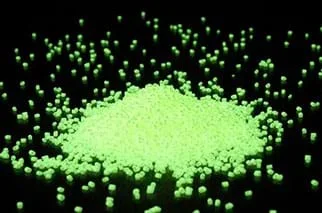 Glow-in-the-dark particles. How could this product be reinvented to serve another purpose?Copyright 2017 willemsince1977, Pixabay License, https://pixabay.com/photos/glow-glow-in-the-dark-granules-2304346/
For the glow-in-the-dark-slime (per group):
- 240 ml (1 cup) hot water
- 1 medium-sized bowl
- 110 g (4 oz.) clear non-toxic liquid glue (students may use white glue, but the slime will be opaque)
- 1 teaspoon glow powder, available online or in craft stores
- 2 teaspoons borax (sodium tetraborate or sodium borate, NOT boric acid)
- 240 ml (1 cup) measuring cup
- 1 teaspoon measuring spoon
For the entire class:
- microwave or electric tea kettle (to make hot water)
Start the The Glow Show PowerPoint Presentation (PPTX), and show students slides 1 and 2 on following the “Engineering Design Process”.
In most of your science classes you start with a problem that you need to solve. You develop possible solutions, choose the most promising one, and test it. You may have to go through many different versions and corrections (or iterations) before you come up with a good solution to the problem. What happens if that scenario is reversed?
Show students the slide 3 “What if You Had an Idea for a Product First?”
In the 1930s, a company in Cincinnati, Ohio, called Kutol Products was trying to make a paste that could be used as wallpaper cleaner. It turned out that the paste was not a great wallpaper cleaner; however, the company saw a newspaper article about children using the paste to make ornaments and other art projects. The product that we now know as Play-Doh was born!
At the University of Buffalo in the late 1960s, American engineer Wilson Greatbatch was designing a heart-recording prototype when he added the wrong resistor to a circuit. He realized that the circuit’s signal matched the electrical signal of the heart itself. Now doctors could replace old, television-sized, pacemakers with ones that fit in the palm of your hand.
Today, you are going to be engineers and innovators! First, we need a starting product. In groups, you are going to make slime. Choose a slime color and then collect your materials and start working on your product.
Put the students into groups of two or three, give them time to make their slime, and then turn out the lights. Refer to the “Resources” section below if the students are stuck. After the students finish, show slide 4 “Choose Your Product”.
What did you discover? The powder you added to your slime causes it to glow! Companies add these glowing, non-toxic particles to toys, which adds fun and entertainment value for customers. Let us think how else we could use them as a consumer product. How could glow-in-the-dark slime be useful in industry? Think as a biologist, an engineer, or as an architect. How might these professions use a product that glows in the dark?
I want you to take your starting product and change its purpose. You now have a material that glows in the dark—let’s make that useful! Where is this type of material needed?
Show slide 5 for “Now Find a Use for It”.
You are going to design a use for your material and test it. Create a journal of your initial design, testing, observations, and any iterations you make along the way.
Show slide 6 for “Promote Your Invention”.
Once you perfect your design, I want you to advertise your design. How you advertise it is up to you: a video, brochure, poster, etc. You will then set up your advertisements for the class to evaluate.
Handout The Glow Show Rubric (PDF) and The Glow Show Student Guide (PDF) to each group.
- If students need help during their product design phase, ask them the following questions:
- What industry would you like to focus on?
- How are you going to add your slime to their industry?
- For their journals, encourage them to document every step. Have them include sketches and keep everything detailed and neat in their journal.
- If students need help with their advertisements, ask them:
- What type of advertisement would you like to do?
- How are you going to show off your design and how the indicator works in your advertisement?
- As a class, students can set up their advertisements for judging. You can separate the advertisements by industry so students can see a range of applications for a particular product.
- The different categories used to judge the advertisements is up to the teacher. Some categories could be journals, the design process, advertisements, and presentations.
- If you want to scale this project down, you can limit the students to particular industries.
- To scale the project up, give them the materials and constraints and have them research how to make slime. Then, have them research applications for their creation on the internet.
- Refer to the Engineering Design Process hub on TeachEngineering to guide your students through the challenge. If documentation of the design process is desired, utilize the Engineering Design Process Notebook (PDF).
- A website for the glow-in-the-dark slime recipe: https://sciencenotes.org/easy-glow-dark-slime-recipes/
- If your students are stuck on manufacturing the slime, you may have them research on the internet to find out ways to complete their design.
Contributors
Leander Taylor III; Dr. Naomi Halas; Dr. Oara Neumann
Supporting Program
Engineering Research Center for Nanotechnology Enabled Water Treatment Systems (NEWT) RET, Rice University
Acknowledgements
This curriculum was based upon work supported by the National Science Foundation under Rice University Engineering Research Center for Nanotechnology Enabled Water Treatment Systems (NEWT) RET grant no.1449500. Any opinions, findings, and conclusions or recommendations expressed in this material are those of the authors and do not necessarily reflect the views of the National Science Foundation.
Copyright
2019 by Regents of the University of Colorado; original © 2018 Rice University