
Newton's Third Law: Blast Off! (en español)
Students make rockets that travel along a string.
- 1 tape measure
- 1 20' (6 m) length of fishing line (20-50 g weight)
- 20 balloons
- 1 straw
- 10 sheets of blank paper
- masking tape
- 1 quart-sized plastic storage bag
Rockets and rocket-propelled flight have been in use for more than 2,000 years. People in ancient China used gunpowder to make fireworks and rockets. In the past 300 years, people have gained a scientific understanding of how rockets work. Now with advanced technology, aerospace engineers make rockets fly farther, faster, higher and more accurately. Our understanding of how rockets work arises from Sir Isaac Newton's three laws of motion. It is important for engineers to understand Newton's laws because they not only describe how rockets work, but they also explain how things move and stay in place!
Procedures Overview
Students use an air-powered rocket that travels along a string to learn about Newton's laws of motion. The goal is for groups to propel their rockets as far as possible on a "tank" of fuel (in this case, air). In doing this, students determine a relationship between the amount of fuel (air) and the distance the rocket travels.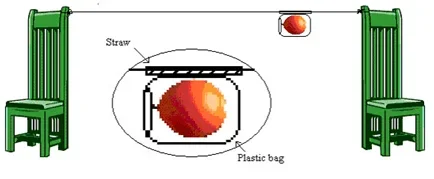
Procedure
- Show students the fishing line. Explain the engineering challenge: To propel a rocket along fishing line that is suspended between two chairs. They have three tries: using a small tank of air, a medium tank of air, and finally, a large tank of air using a single balloon.
- Show students the plastic bag, and tell them that their balloon must always fit inside the bag.
- Divide the class into student pairs. Give each group a sheet of paper and one balloon. Have students practice blowing up the balloons to determine how much air to add to represent small, medium and large "tanks" of air.
- Instruct students to blow up their balloons, reminding them that it is sometimes difficult to blow up a balloon the very first time.
- While students are blowing up their balloons, thread the fishing line through the straw. Tape the straw to a short side of the plastic bag. (Note: Do NOT tape to either of the long sides.)
- Tie one end of the fishing line to a chair; tie the other end of the line to a second chair. (If chairs are not available or do not work well, tape the fishing line to two desk tops, using enough tape to securely hold the line stretched taut.)
- Align the bag at one end of the string with the the closed side of the bag towards the center of the string length.
- When groups are ready to test their rockets, they come to the testing site (the fishing line) one at a time. They test their rockets in the following order: small tank of air, medium and large.
- Holding the neck of the blown-up balloon, place it in the storage bag. Let go of the balloon.
- Using a tape measure, measure the distance the rocket travels.
- On a blank sheet of paper, groups record the distance their rockets traveled, under column headings of Small, Medium, Large--indicating their "tanks" of air.
- If time permits, five minutes before the end time, clean up activity supplies and discuss Newton's three laws of motion:
Law #1: Objects at rest will stay at rest, and objects in motion will stay in motion in a straight line unless they are acted upon by an unbalanced force. (law of inertia)
Law #2: Force is equal to mass multiplied by acceleration (F = ma).
Law #3: For every action, there is always an opposite and equal reaction.
Wrap Up - Thought Questions
- What propelled your rocket along the string?
- What would happen to your rocket if you launched it without it being attached to the string?
- How would having the fishing line at an incline affect the performance of your rocket?
- For older students: How was each of Newton's three laws demonstrated in this activity?
This resource was modified from Action-Reaction! Rocket to create a shorter, more streamlined version suitable for informal learning settings.
This resource is also available in Spanish.
Copyright
2013 by Regents of the University of Colorado