
Measuring Our Muscles
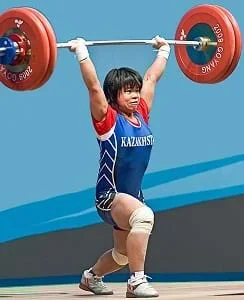 Lifting a known weight is one way to determine the strength of our muscles.Copyright Wikimedia Commons http://commons.wikimedia.org/wiki/File:Zulfiya_Chinshanlo_2009.jpg
Student teams build model hand dynamometers used to measure grip strengths of people recovering from sports injuries. They use their models to measure how much force their classmates muscles are capable of producing, and analyze the data to determine factors that influence a person's grip strength. They use this information to produce a recommendation of a hand dynamometer design for a medical office specializing in physical therapy. They also consider the many other ways grip strength data is used by engineers to design everyday products.
Biomechanical engineers must know how much force muscles of the human body are capable of producing so they can guide doctors and ergonomic designers in improving people's overall health. Doctors may use this data to assess an injury and ergonomic engineers might use it to design the operator controls in a car or airplane. To obtain this valuable information, engineers devise tools and practical ways to measure the strength of various muscles in our body.
After this activity, students should be able to:
- Construct a model hand dynamometer to quantitatively describe how much force a person's hand muscles are capable of producing.
- Explain the comparative results of the grip strength data and correlating patterns found in the data analysis.
- Develop recommendations for improvements to the model dynamometer.
- 6.1.2.b Fluently add, subtract, multiply, and divide multidigit decimals using standard algorithms for each operation.
Grade 6
Do you agree with this alignment? - 6.3.1.d.ii Summarize numerical data sets in relation to their context.
Grade 6
Do you agree with this alignment? - 6.3.1.d.ii.1 Report the number of observations.
Grade 6
Do you agree with this alignment? - 6.3.1.d.ii.2 Describe the nature of the attribute under investigation, including how it was measured and its units of measurement.
Grade 6
Do you agree with this alignment? - 6.3.1.d.ii.3 Give quantitative measures of center (median and/or mean) and variability (interquartile range and/or mean absolute deviation), as well as describing any overall pattern and any striking deviations from the overall pattern with reference to the context in which the data were gathered.
Grade 6
Do you agree with this alignment?
- Develop and design a scientific investigation about human body systems
Grade 7
Do you agree with this alignment? - Gather, analyze, and interpret data and models on the functions and interactions of the human body
Grade 7
Do you agree with this alignment?
- CCSS.Math.Content.6.NS.B.3 Fluently add, subtract, multiply, and divide multi-digit decimals using the standard algorithm for each operation.
Grade 6
Do you agree with this alignment? - CCSS.Math.Content.6.SP.B.5 Summarize numerical data sets in relation to their context, such as by:
Grade 6
Do you agree with this alignment? - CCSS.Math.Content.6.SP.B.5a Reporting the number of observations.
Grade 6
Do you agree with this alignment? - CCSS.Math.Content.6.SP.B.5b Describing the nature of the attribute under investigation, including how it was measured and its units of measurement.
Grade 6
Do you agree with this alignment? - CCSS.Math.Content.6.SP.B.5c Giving quantitative measures of center (median and/or mean) and variability (interquartile range and/or mean absolute deviation), as well as describing any overall pattern and any striking deviations from the overall pattern with reference to the context in which the data were gathered.
Grade 6
Do you agree with this alignment? - CCSS.Math.Practice.MP2 Reason abstractly and quantitatively.
Grades K-12
Do you agree with this alignment?
- Students will develop an understanding of the attributes of design.
Grades K-12
Do you agree with this alignment? - Students will develop an understanding of engineering design.
Grades K-12
Do you agree with this alignment? - Advances and innovations in medical technologies are used to improve healthcare.
Grades 6-8
Do you agree with this alignment? - STEL-7R Refine design solutions to address criteria and constraints.
Grades 6-8
Do you agree with this alignment?
- MS-ETS1-4 Develop a model to generate data for iterative testing and modification of a proposed object, tool, or process such that an optimal design can be achieved.
Grades 6-8
This resource focuses on the following Three Dimensional Learning aspects of NGSS:
Science & Engineering Practices- Develop a model to generate data to test ideas about designed systems, including those representing inputs and outputs.Do you agree with this alignment?
Disciplinary Core Ideas- Models of all kinds are important for testing solutions.Do you agree with this alignment?
- The iterative process of testing the most promising solutions and modifying what is proposed on the basis of the test results leads to greater refinement and ultimately to an optimal solution.Do you agree with this alignment?
Do you agree with this alignment? - Develop a model to generate data to test ideas about designed systems, including those representing inputs and outputs.
Each group needs:
- 4 PVC elbow joints (90°, ½-inch [1.27 cm] diameter)
- 2 PVC T-joints (¾ x ¾ x ½-inch [1.9 x 1.9 x 1.27 cm] diameter)
- 2 PVC T-joints (½ x ½ x ½-inch [1.27 cm] diameter)
- 9 PVC pipes (2.5-, 2.5-, 4-, 4-, 6-, 6-, 6-, 8-and 8-inches [6.35-cm, 10.16-cm, 15.24-cm, 20.32-cm] long; all ½-inch [1.27 cm] diameter)
- 1 PVC cross joint (all ½-inch [1.27 cm] diameters)
- string, 24 inches (61 cm) (such as kite string)
- 1 extension spring, 3-inch (7.6-cm) size
- 1 large paperclip
- plastic drinking straw or coffee stirrer, cut to 1-inch (2.5 cm) length
- cardstock, cut to 8.5 x 1.5-inch (21.6 cm x 3.8 cm) size
- Hand Dynamometer Assembly Instructions (PDF)
- Grip Strength Data Worksheet (PDF), one per person
- pen or pencil
- calculator
Note: PVC and springs are readily available at hardware stores.
For the entire class to share:
- PVC gluing cement
- calibration weight (a 15–20 lb [6-9 kg] dumbbell is ideal)
- hand saws
- pencils
- rulers
- masking tape
- scissors
A basic understanding of the muscular system. Ability to calculate averages.
Who is the strongest person in the world? How do you know s/he is the strongest? Today we are going to learn about how we can accurately measure the strength of human muscles. Biomechanical engineers are interested in knowing exactly how much force our muscles are capable of producing. With this information, they can design many everyday products. For example, a jar seal can be designed so that it is easily opened with our hands. What if the packaging of your favorite snack or the door to the restrooms required the strength of an Olympic body builder to open?! There are many reasons engineers must be able to accurately measure the capabilities of human muscles. Doctors may use the data to assess an injury, while ergonomic engineers might use it to design the operator controls in a car or airplane for comfort, safety and ease of use.
Have you ever injured your elbow or knee and felt like your arm or leg was weak as a result of the injury? Sometimes we put large stresses on our muscles during the course of regular daily activities, with heavy lifting or during sports activities. Too much stress can lead to injuries, such as extremely painful muscle strains (often called "pulled muscles"), in which muscles are actually torn. Another injury might be the overuse of an elbow or wrist, causing the tendons to overextend, or tendonitis. Often stretching and strengthening rehabilitation exercises help these muscles, tendons or ligaments recover from the injury and prevent it from happening again. Medical doctors and physical therapists who help you recover from injuries want to determine if the strength of arm or leg muscles is improving. How do you think they measure this? Medical devices and tools used by doctors to diagnosis and rehabilitate an injury are designed by biomechanical engineers.
Today, you are going to be biomechanical engineers employed by a medical practice specializing in physical therapy. The doctors need an instrument to help monitor the hand strength of a 12-year-old patient recovering from "tennis elbow," a condition in which the person applied unaccustomed force to one or more tendons in his/her elbow, leading to a weakened grip. The doctors tried to use their existing hand dynamometer, an instrument for measuring grip strength, but it was not effective for the size and strength of the young patient. You will begin by considering the design problem and any constraints or limitations on the instrument design. Then you will build a model hand dynamometer and use it to measure the strength of several students in our class. You will analyze these measurements to make a recommendation to the medical office for a similar device for their patient. Then, we will think about other ways the data you collected might be applied to real-world engineering design.
Background
The term "dynamometer" is typically associated with a device that measures the torque or power produced by an engine. However in the medical field, this term has come to describe a device used to measure the force produced by human muscles. In this activity, students construct a hand dynamometer to measure an individual's grip strength. Doctors often use a person's grip strength data to assess muscle condition following an injury and during recovery.
Engineers collect data on typical grip strength for specific audiences of people as part of designing all the products we use our hands to control in our daily lives. They design equipment, appliances, containers/lids, dials/push buttons, tools, and athletic equipment so they are ergonomic, which means minimizing fatigue and maximizing comfort.
Before the Activity
- Gather materials.
- Precut the PVC pipes for each group.
- Make copies of the Hand Dynamometer Assembly Instructions (PDF) and Grip Strength Data Worksheet (PDF).
With the Students
- Divide the class into teams of three to five students each.
- Remind students of the biomechanical engineering context provided in the introduction.
- As a class, define the design challenge: to develop and analyze an instrument to measure the grip strength of an injured 12-year-old.
- As a class, make a list of constraints that might be involved in the project, such as time, materials and physical limitations.
- Provide each group with the two handouts.
- Review the basic function and purpose of a hand dynamometer.
- Distribute materials to each group and have them start constructing their dynamometers by following the instructions.
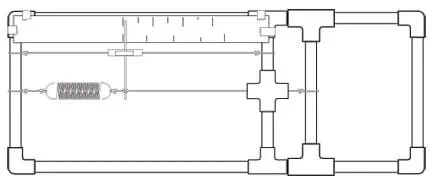 Students create a hand dynamometer.Copyright 2006 Jake Lewis, ITL Program, College of Engineering, University of Colorado at Boulder.
- Once the dynamometers are assembled, have students use them to test various students and teachers in the classroom, recording their test subject data on the worksheets.
- Next, have students calculate averages for each category of test subjects. Categories could include gender, age or height.
- Have engineering teams present their data analysis results to the class, explaining any patterns they discovered in the data, and what might be general factors influencing a person's grip strength.
- Based on their analysis, have teams make a recommendation for a hand dynamometer design for their client —a medical office who needs to monitor the hand strength of a 12-year-old patient recovering from tennis elbow.
- How would they improve their dynamometer designs for the average student in their class? How would they recommend adjusting use of the dynamometers for different people in the class? Why?
- Conclude by leading a class discussion and brainstorm using the post-activity questions provided in the Assessment section.
- biomechanics
- The study of the mechanics of a living body, especially of the forces exerted by muscles on the skeletal structure.
- dynamometer
- A device for measuring mechanical force or power. (medical) An instrument for measuring the degree of muscular power. Also called ergometer.
- engineer
- A person who applies his/her understanding of science and math to creating things for the benefit of humanity and our world.
- ergonomics
- The applied science of designing or improving equipment and products to maximize productivity and comfort by reducing operator fatigue and discomfort. Also called biotechnology, human engineering, or human factors engineering.
- force
- A "push" or "pull" that changes the motion, size or shape of a body.
Pre-Activity Assessment
Predictions: Have students predict outcomes of the activity by asking:
- How much force do you think your hand muscles are capable of producing?
- More specifically, what is your grip strength? What do you predict? 2 lbs? 200 lbs?
- Why might a person want to know his/her grip strength?
Activity Embedded Assessment
Group Question: During the activity, ask the engineering teams:
- For what purpose is the spring in your hand dynamometer? (Answer: The spring provides resistance when stretched; more force is required to stretch the spring a farther distance. The distance the spring stretches corresponds to how much force your hand uses to pull on it.)
Post-Activity Assessment
Engineering Recommendation: Biomechanical engineers often use their analysis of models to make recommendations to their clients on the development or use of medical instruments. Have students use their analysis to produce a recommendation of a hand dynamometer design for a medical office specializing in physical therapy. How would they improve their dynamometer designs for the average student in their class? How would they recommend adjusting use of the dynamometers for different types of people? Why? If time allows, have students develop a simple users' manual for their client that includes how to operate the hand dynamometer and what adjustments can be made for different individuals.
 Copyright 2004 Microsoft Corporation, One Microsoft Way, Redmond, WA 98052-6399 USA. All rights reserved.
Concluding Brainstorm: As a class, have students engage in open discussion. Remind students that in brainstorming, no idea or suggestion is "silly." All ideas should be respectfully heard. Be uncritical, encourage wild ideas and discourage criticism. Have students raise their hands to respond. Record their ideas on the board. Ask the students:
- Why might a person want to know his/her grip strength? (Possible answer: Doctors use grip strength measurement to assess muscle strength after injury and during recovery.)
- In what other ways could the grip strength data you collected be used in an engineering design? (Possible answers: Engineers design just about everything around us. Think of all the things you use your hands to open, close, move, switch, flip, turn or dial. Engineers want to know the average grip strength for the type of people that would typically use the product or controls they are designing, so they can design it to work appropriately. Examples: An engineer figured out how much resistance to build into the buttons on your music player, so they are effortless to use. The caps on medicine containers from the pharmacy are designed to require quite a bit of strength to open, as a way to prevent children from getting at the pills. This same container cap can be too difficult for arthritic adults to open. An engineer might be asked to design a lid for a container or jar that provides enough force to completely seal the container, yet the grip strength of an average person is enough to be able to remove the lid. Other grip strength measurements are used by people who design equipment and controls to be ergonomic, to minimize fatigue and maximize comfort, or to design tools and athletic equipment, such as gaming joysticks, digital watches, golf clubs, racquets, bats and gloves.)
It may be helpful for the teacher to construct a hand dynamometer in advance, so as to prepare for unexpected questions or difficulties by the students. Also, it provides the students with a better idea of how the device they are constructing should function.
If a "patient" is able to pull the hand dynamometer handle to its full extent, you might replace the spring with a stronger one in the same strength gauge, and re-do the calibration.
Have students think of ways to create devices to measure the strength of other muscles in the body. Make the challenge to measure specific muscles, not a combination of muscles.
Have students research published grip strength data and compare it to their collected grip strength data. Begin by looking at the following g websites: http://www.roymech.co.uk/Useful_Tables/Human/Human_strength.html, http://www.hf.faa.gov/docs/508/docs/hfdg/ch14.pdf (search for grip or force), http://msis.jsc.nasa.gov/sections/section04.htm#_4.9_STRENGTH (search for arm, hand, finger strength).
- For lower grades, have the teacher construct a hand dynamometer in advance and bring it to class to take measurements.
- For upper grades, have students research Hooke's Law for a spring and explain why this is important in constructing their hand dynamometers. (Answer: This law of elasticity describes the proportional relationship between the stress and strain applied to a spring at rest. For small deformations, the spring quickly regains its original shape after being deformed by a stress. For a hand dynamometer to be able to measure force repeatedly, the spring must be able to restore its original shape.)
Look online for examples and photographs of commercially-available hand dynamometers to measure grip strength. For example, see a "grip strength meter" at the UXCELL website: http://www.uxcell.com/hand-dynamometer-grip-strength-meter-p-11796.html
Look online for information about handgrip strength testing. For example, see the fitness testing data at the Top End Sports website: http://www.topendsports.com/testing/tests/handgrip.htm
Dictionary.com. Lexico Publishing Group, LLC. Accessed November 24, 2008.
Dynamometers. Wikipedia, The Free Encyclopedia. Updated July 26, 2006. www.wikipedia.org Accessed July 31, 2006.
Leveau, Barney F. Williams & Lissner's Biomechanics of Human Motion. Philadelphia, PA: W. B. Saunders Company, 1962.
Riggs, Joseph A. "Boxing Injuries." Report of the Council on Scientific Affairs. CSA Report 3-A-99. (pg. 3, beginning of fourth paragraph about force delivered in a punch) http://www.ama-assn.org/meetings/public/annual99/reports/csa/rtf/csa3.rtf Accessed November 24, 2008.
- Biomedical Engineering and the Human Body
Contributors
Jake Lewis; Malinda Schaefer Zarske; Denise W. Carlson
Supporting Program
Integrated Teaching and Learning Program, College of Engineering, University of Colorado Boulder
Acknowledgements
The contents of this digital library curriculum were developed under a grant from the Fund for the Improvement of Postsecondary Education (FIPSE), U.S. Department of Education and National Science Foundation GK-12 grant no. 0338326. However, these contents do not necessarily represent the policies of the Department of Education or National Science Foundation, and you should not assume endorsement by the federal government.
Copyright
2007 by Regents of the University of Colorado.