
Digestion Simulation
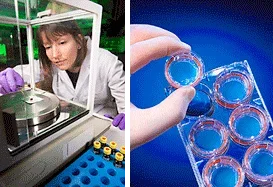 Biomedical researchers test how compounds interact with the body, which often involves simulations. For example, these small cell culture systems enable researchers to simulate digestion and nutrient absorption in a lab.Copyright Agricultural Research Service, US Department of Agriculture http://www.ars.usda.gov/is/AR/archive/oct10/nutrition1010.htm?pf=1 http://www.ars.usda.gov/is/AR/archive/aug99/iron0899.htm
To reinforce students' understanding of the human digestion process, the functions of several stomach and small intestine fluids are analyzed, and the concept of simulation is introduced through a short, introductory demonstration of how these fluids work. Students learn what simulation means and how it relates to the engineering process, particularly in biomedical engineering. Students can practice their understanding by using the associated activity to model a digestive process. The teacher demo requires vinegar, baking soda, water and aspirin.
Biomedical engineers develop medical devices that aid doctors, pharmacists and other medical professionals in their work. Some of these devices directly help the injured and infirm, such as prosthetic limbs or insulin pumps. In other cases, these devices help indirectly by simulating different life processes so that researchers can better understand what occurs naturally inside the human body and experiment with new treatment ideas.
After this lesson, students should be able to:
- Define "simulation" and explain its importance in the science and engineering fields.
- List several ways in which engineers can help people with medical problems.
- List several of the fluids our bodies use to digest food and understand how engineers simulate these fluids to perform experiments.
- The human body is composed of atoms, molecules, cells, tissues, organs, and organ systems that have specific functions and interactions
Grade 7
Do you agree with this alignment?
- Students will develop an understanding of the relationships among technologies and the connections between technology and other fields of study.
Grades K-12
Do you agree with this alignment? - Advances and innovations in medical technologies are used to improve healthcare.
Grades 6-8
Do you agree with this alignment?
- MS-LS1-3 Use argument supported by evidence for how the body is a system of interacting subsystems composed of groups of cells.
Grades 6-8
This resource focuses on the following Three Dimensional Learning aspects of NGSS:
Science & Engineering Practices- Science knowledge is based upon logical and conceptual connections between evidence and explanations.Do you agree with this alignment?
Disciplinary Core Ideas- In multicellular organisms, the body is a system of multiple interacting subsystems. These subsystems are groups of cells that work together to form tissues and organs that are specialized for particular body functions.Do you agree with this alignment?
Crosscutting Concepts- Systems may interact with other systems; they may have sub-systems and be a part of larger complex systems.Do you agree with this alignment?
- Advances in technology influence the progress of science and science has influenced advances in technology.Do you agree with this alignment?
Do you agree with this alignment? - Science knowledge is based upon logical and conceptual connections between evidence and explanations.
A basic knowledge of the parts of the digestive system and how they interact, as provided in the Teacher Background section or in the Introduction/Motivation section of the Teach Engineering Digestive System lesson.
The first step in the human digestive process occurs in the mouth and involves the grinding of food by the teeth and exposure of the food to the digestive enzymes in saliva. From here, food passes through the esophagus into the stomach. Food is moved along during digestion through involuntary muscular actions called peristalsis.
The human stomach is a J-shaped organ that is hollow and muscular. The churning and squeezing actions of the stomach break the food into even smaller pieces and mix it with the gastric acid and enzymes secreted by the stomach lining. The environment of the stomach is acidic, about pH 1.5, which is due to the low pH of gastric acid (which contains hydrochloric acid). While the acid helps to break down food to some degree, its primary function is to create an environment in which the food can react with the various enzymes that are also present. The artificial stomach does a much better job of simulating the environment of the stomach than the simple class demo due in part to the fact that all of the various enzymes and secretions are included in the right proportions. While some nutrients are absorbed in the stomach, most nutrients are absorbed in the small intestine.
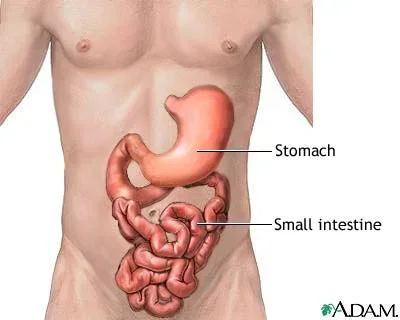 Position of the human stomach and small intestine.Copyright 2008 MedlinePlus, National Library of Medicine, National Institutes of Health http://www.nlm.nih.gov/medlineplus/ency/images/ency/fullsize/8940.jpg
The small intestine is the next organ encountered by food on its way through the digestive tract. Here, food is mixed with a variety of new excretions including bile. Bile is created by the liver and stored in the gallbladder prior to being excreted into the small intestine. Bile is alkaline in nature, and therefore neutralizes the gastric acid and creates a basic environment (~ pH 9). This basic environment promotes the reaction of a whole new set of enzymes that are produced by the pancreas and the small intestine lining. Most of the nutrients your body needs for survival are absorbed from the food during this process.
After the small intestine, food passes through the large intestine and eventually out of the body. While simplistic, the demo/simulation presented in the Introduction/Motivation section provides a basic introduction to the digestion process as well as a general understanding of the concept of simulation.
For more information about the digestion process see the National Institute of Health's National Digestive Diseases Information Clearinghouse (NDDIC) about "Your Digestive System and How it Works" at: https://www.niddk.nih.gov/health-information/digestive-diseases/digestive-system-how-it-works
For more information about simulation, see Wikipedia's description at: https://en.wikipedia.org/wiki/Simulation
(In advance, gather materials for a class demonstration: 1 uncoated aspirin tablet [really inexpensive "uncoated" generic aspirin works best] and 1 enteric-coated aspirin tablet, two clear plastic cups, 1 cup vinegar, 1.5 teaspoons baking soda, pinch of salt, half cup water.)
Did you know that biomedical engineers recently created the world's first artificial stomach? It mimics many of the activities that take place in your body and can even throw up! You might be wondering what anyone would want to do with a machine that works like a digestive system and throws up on occasion. In reality, this machine is expected to be very beneficial to scientists, doctors and pharmacists who want to know more about how our bodies work. What happens to your food or medicine after you swallow it? How does your body absorb food or medicine into your system? This is very important to know!
Have you ever heard of a disease called diabetes? You may know someone with this disease. When a person has diabetes, they are unable to process sugar when it gets into their blood, and this can lead to shock or even death if it is not regulated. One way this new machine benefits people is by helping doctors and researchers understand how fast certain foods are digested by the body and absorbed into the blood stream. This could lead to improvements in the understanding and treatment of diabetes.
Biomedical engineers are continually researching and designing new types of medical devices to help doctors and other medical professionals help people. Many of the most revolutionary medical devices were developed by biomedical engineers. Today, we want to think specifically about what types of environments biomedical engineers might try to simulate (imitate) in order to better understand what happens in our bodies. Can you think of some examples? (Possible examples: simulating blood flow around a blocked artery; simulating the digestion of a food or medicine; simulating the mending of a broken bone; simulating the absorption of a poison or harmful substance by your skin, lungs or digestive system; simulating the healing of a wound; etc.)
Let me demonstrate how a biomedical engineer might use simulation (mimicking real life processes) to better understand how a medication is processed by the body. Let's use a simple model of the digestive system and represent the stomach by a cup filled with vinegar and the small intestine by a cup filled with water and baking soda. We use vinegar to represent the stomach because it is an acid similar to the gastric acid that is squirted on food by our bodies while it is in the stomach. We use baking soda and water to represent the small intestine because together they form a base similar to bile, one of the main digestive juices squirted on food while it is in the small intestine. Let's test a medication that is commonly used to relieve pain or fever — aspirin. Unfortunately, aspirin can also make your stomach hurt. To keep this from happening, researchers developed several different types of coatings to keep aspirin from being digested until after it has passed through the stomach and into the small intestine. Let's do a quick test on one of these coatings to see how well it works.
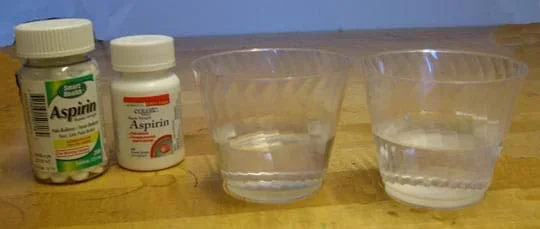 Demo materials and setup.Copyright 2008 Jacob Crosby, ITL Program, University of Colorado Boulder
(Demo procedure: Fill a clear plastic cup with vinegar. Fill a second clear plastic cup with a mixture of 1.5 teaspoons baking soda, a pinch of salt, and half a cup of water.)
This is a regular, uncoated aspirin tablet. (Show the students.) This is an enteric-coated aspirin tablet. (Show the students. Then drop both tablets into the cup containing vinegar.) This demonstration represents what happens in our stomachs, because the acidity of vinegar is similar to that of stomach acid. (Expect the uncoated aspirin tablet to dissolve in about 10 seconds, while the enteric-coated tablet remains unchanged [the outside coating might start to dissolve a little].).
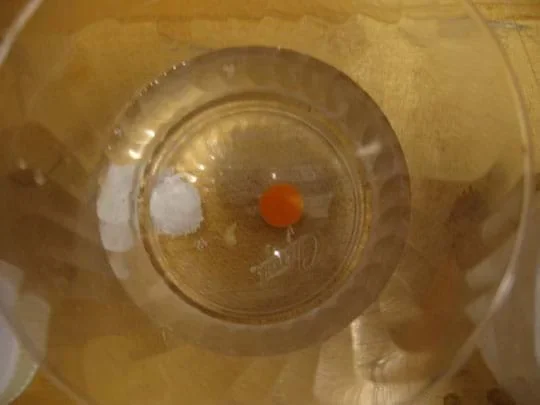 Uncoated aspirin dissolving in vinegar.Copyright 2008 Jacob Crosby, ITL Program, University of Colorado Boulder
(After a short amount of time has passed, take the enteric-coated aspirin out of the vinegar-filled cup and place it in the baking soda / water mix.) Now I'm moving the coated aspirin out of the vinegar and into a baking soda and water mixture. This simulates the moving of food and the gastric acid mix from your stomach into your small intestine. Watch the outside coating of the aspiring tablet. (The outside coating dissolves immediately in a cloud of bubbles — the acid and base reacting. The entire tablet might take 10-15 minutes to dissolve, but students get the point from seeing the coating dissolve.) The baking soda and water mix represents an environment similar to that of the small intestine.
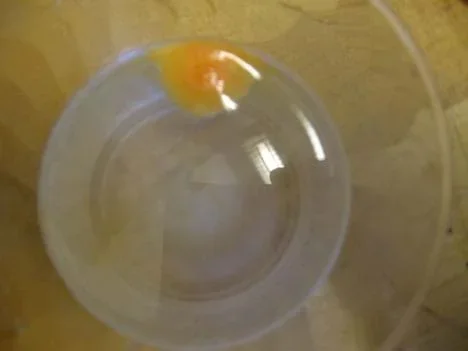 Enteric-coated aspirin after some time in the baking soda and water mix.Copyright 2008 Jacob Crosby, ITL Program, University of Colorado Boulder
How is this demonstration similar to the human digestive system? (Listen to student explanations.) From seeing this demonstration, where in the body would you expect each table to be likely to dissolve? And why? (Answer: Expect the uncoated aspirin to dissolve in the stomach in the acidic environment; expect the coated aspirin to not dissolve in the stomach, but later, past the stomach, in the small intestine.) Why might it be a good idea to test new medicines in a simulated environment rather than on a real person? Have students use their new knowledge with the Protect That Pill design activity to maximize the effects of a protective coating for a candy pill to survive within a stomach.
In many situations it is helpful to simulate an activity before it is actually carried out. Simulation has saved a lot of human lives and provided engineers and researchers with much valuable information. Hopefully, the artificial stomach will continue this process by providing us with information about how certain medications and foods are processed by our digestive systems. Can you think of any other examples of simulation being used by engineers as a research tool? (Possible examples: Simulating car crashes with dummies that represent people, testing bridge and building designs, testing strength of rope [or other materials] before using it for rope climbing [or other purposes], testing airplane designs in wind tunnels before they are built, etc.)
- bile
- A bitter, alkaline, yellow or greenish liquid, secreted by the liver, which aids in absorption and digestion, especially of fats.
- biomedical engineering
- The application of engineering techniques to the understanding of biological systems and the development of therapeutic technologies and devices. Kidney dialysis, pacemakers, synthetic skin, artificial joints, and prostheses are some products of biomedical engineering. Also called bioengineering.
- diabetes
- A disorder of carbohydrate metabolism characterized by inadequate production or use of insulin, resulting in high glucose levels in the blood and urine, excessive urination and persistent thirst, as well as other complications such as infection and blindness.
- digestion
- The process by which food is converted into substances that can be absorbed and assimilated by the body.
- enteric-coated aspirin
- Aspirin that has been treated to pass through the stomach unaltered and dissolve in the intestines.
- gastric acid
- Digestive secretions of the stomach glands consisting chiefly of hydrochloric acid, mucin and several enzymes.
- peristalsis
- Involuntary muscular actions that moves food along during digestion.
- simulation
- Imitating the behavior of some situation or process, especially for the purpose of study or experimental testing.
- small intestine
- The long, narrow, coiled section of the intestine that extends from the stomach to the beginning of the large intestine. Nutrients from food are absorbed into the bloodstream from the small intestine. In mammals, the small intestine is composed of the duodenum, jejunum and ileum.
- stomach
- The enlarged, saclike portion of the alimentary canal, one of the principal organs of digestion, located in vertebrates between the esophagus and the small intestine.
Pre-Lesson Assessment
Drawing: Test students' prior knowledge of the digestive system by asking them to draw and label a simple diagram including all of the major digestive organs in sequence. If necessary, allow them to use their textbooks or other source of information for help. If more digestive system background is needed, review material in the Digestive System lesson.
Post-Introduction Assessment
Disscussion: Lead a classroom discussion about the importance of using simulation to do experiments rather than performing tests on humans. On the board, make a list of the advantages and disadvantages of using simulation.
Lesson Summary Assessment
Artificial Organ Design: Have students draw their own design for a machine that simulates one of the major organs in the human digestive system. Remind student to label areas in which a distinguishing organ characteristic is simulated (for example, a simulated stomach might include an apparatus that mixes food with acid and enzymes).
Have students use the internet to find several examples of simulation being used to perform experiments, and present their coolest finding to the class.
To further students' understanding of the human digestive system, conduct Bobbin Cave's kinesthetic class activity in which students act out each digestive function of the organs, tissues and cells in the tract as the food particles come to them, as described at: http://www.accessexcellence.org/AE/AEC/AEF/1995/cave_digest.html.
Dictionary.com. Lexico Publishing Group, LLC. Accessed December 20, 2008. (Source of some vocabulary definitions, with some adaptation) http://www.dictionary.com
Eisenberg, Anne. "What's Next? The Virtual Stomach (No, It's Not a Diet Aid)." Published October 31, 2002. The New York Times. Accessed December 20, 2008. http://query.nytimes.com/gst/fullpage.html?res=9807EFDC103FF932A05753C1A9649C8B63
Glah, Raymond P. A Gut Issue—Measuring Iron Bioavailability. Published August 1999. Agricultural Research Magazine. Vol. 47. No. 8. Accessed August 18, 2011. (Invention of an "artificial gut" to analyze the amount of iron biologically available to us from our food and supplements.) http://www.ars.usda.gov/is/AR/archive/aug99/iron0899.pdf
The Human Gastrointestinal Intestinal (GI) Tract. Last updated July 30, 2007. Kimball's Biology Pages. Accessed December 20, 2008. http://users.rcn.com/jkimball.ma.ultranet/BiologyPages/G/GITract.html
Nalamothu, Krishna. World's First Artificial Stomach. Published November 16, 2006. Health Updates, India. Accessed August 18, 2011. http://www.healthupdates.in/tag/artificial-stomach/
Mandelbaum, Robb. Model Stomach Takes Digestion Out of the Body: Why food engineers, pharmaceutical companies, and organic farmers are lining up for the artificial organ. Published December 2007. IEEE Spectrum magazine, Institute of Electrical and Electronics Engineers . Accessed August 18, 2011. http://spectrum.ieee.org/biomedical/devices/model-stomach-takes-digestion-outside-the-body
"Scientists Create Artificial Gut: UK scientists have built an artificial stomach to simulate human digestion." Last updated November 10, 2006. BBC News: Health. Accessed December 20, 2008. http://news.bbc.co.uk/2/hi/health/6136546.stm
Contributors
Jacob Crosby; Malinda Schaefer Zarske; Denise W. Carlson
Supporting Program
Integrated Teaching and Learning Program, College of Engineering, University of Colorado Boulder
Acknowledgements
The contents of this digital library curriculum were developed under a grant from the Fund for the Improvement of Postsecondary Education (FIPSE), U.S. Department of Education and National Science Foundation GK-12 grant no. 0338326. However, these contents do not necessarily represent the policies of the Department of Education or National Science Foundation, and you should not assume endorsement by the federal government.
Copyright
2008 by Regents of the University of Colorado.