
Engineering Bones
 The human skeletonCopyright NASA http://virtualastronaut.tietronix.com/textonly/act15/text-skeletonpuz.html
Students extend their knowledge of the skeletal system to biomedical engineering design, specifically the concept of artificial limbs and joints. Students relate the skeleton as a structural system, focusing on the leg as structural necessity. They learn about the design considerations involved in the creation of artificial limbs, including materials and sensors.
Biomedical engineering is the application of engineering techniques to the understanding of biological systems and the development of therapeutic technologies and devices. One type of biomedical engineering is the field of prostheses, or artificial body parts. Since leg bones are important to our body structure, biomedical engineers design prosthetic legs to handle the stresses of a moving body. To design better prostheses, they consider and experiment with various materials. Kidney dialysis, pacemakers, hearing aids and synthetic skin are other products of biomedical engineering.
After this lesson, students should be able to:
- Explain how engineers are involved with design related to the human skeletal system.
- Identify some of the necessary features of a prosthetic limb.
- Describe several design criteria that go into choosing the material for a prosthetic limb.
- The human body is composed of atoms, molecules, cells, tissues, organs, and organ systems that have specific functions and interactions
Grade 7
Do you agree with this alignment?
- Students will develop an understanding of the relationships among technologies and the connections between technology and other fields of study.
Grades K-12
Do you agree with this alignment? - Advances and innovations in medical technologies are used to improve healthcare.
Grades 6-8
Do you agree with this alignment?
- CCC.4.6-8.4 Systems may interact with other systems; they may have sub-systems and be a part of larger complex systems.
Grades 6-8
Do you agree with this alignment?
Some familiarity with the human skeletal system; see information in the Lesson Background section.
The Human Skeleton
An adult human skeleton contains 206 bones. Babies are born with more bones, of which some eventually grow together to make 206. Human bones have a wide variety of sizes and shapes. The smallest bone is the tiny stirrup bone in the inner ear, and the largest is the femur (thigh bone). The structure of a bone consists of compact bone, soft bone marrow and sponge bone.
The human skeleton has several functions. Bones contain calcium and store many minerals for our bodies. The soft bone marrow part of each bone, located inside the hollow center of the bone, produces red blood cells for the circulatory system. Of great importance, the skeleton serves as the body's structure. It keeps the body in shape, protects internal organs and enables movement. We would be shapeless blobs without our bones.
Joint Types
The many different bones in the human body are connected to each other in different ways, enabling different types of movements. Four different types of joints include:
A ball and socket joint is similar to a car's stick shift lever, in that it can move around freely. The shoulder and hip joints are both ball and socket joints. Note that you can move your arm in many more ways than just up and down, or right and left; you can also move it diagonally, and in between all those positions.
A hinge joint moves like a door, allowing 180 degrees of motion, but only in one direction. Your elbows and upper parts of your fingers are hinge joints. You can easily move them up and down in just one direction, and they can never get past 180 degrees (because you cannot bend them backwards).
The vertebrae in the backbone are considered semi-movable joints because each vertebra has very limited movement. Overall, the backbone is flexible because when all the small movements of the vertebrae are combined, the back is able to move in many ways.
Immovable joints do not allow movement at all. Some immovable joints are in your skull. When a baby is born, some skull bones are not yet joined all the way together. During the first two years of life, the bones grow together like a jigsaw puzzle, forming immovable joints.
What about "double joints"? This phrase is used to describe an exceptionally flexible joint (not two joints). While double joints are common in children, most grow out of them because joints become less flexible as we age.
Notable Bones
Different bones have different functions, sizes and shapes. Facts about some important bones:
- Cranium: Also known as the skull, the cranium is made of 27 bones, most with fixed joints. The primary purpose of the cranium is to protect the brain.
- Jaw bone: The mandible is the lower jaw, moving up and down, and left and right. The maxilla is the upper jaw; it is part of the cranium and does not move.
- Hip bone: Also known as the pelvis, your hip bone helps you stand upright and move. Because it supports the body's weight, it is critical to the body's structure. It also protects the intestines.
- Lower leg bone: The tibia and fibula make up a lower leg. The tibia is in front and supports the body's weight, which is why it is larger than the fibula. The fibula is in back and controls ankle movement.
- Ribs and sternum: The ribs wrap around to protect the chest, including the heart and lungs. The sternum is the breastbone, where the ribs are connected in front.
- Spine: Also known as the backbone, the spine consists of 26 bones or vertebrae, which are separated from each other by cartilage. The vertebrae/cartilage arrangement makes the spine very flexible.
- Femur: The femur, or thigh bone, is important for body structure, and it is the longest bone in the body.
- Lower arm bone: Two bones make up the lower arm. The radius is along the thumb side and the ulna is along the pinky side. These bones are interesting because when the wrist twists they can cross over each other.
- Upper arm bone: The upper arm bone is called the humerus.
- Hand bone: Each hand consists of 27 bones. The bones in the palm are called metacarpals, the bones in the fingers are phalanges, and the bones in the wrist are carpals.
- Foot bone: Each foot has 26 bones. The bones in the ankle are called tarsals, the bones in the foot are metatarsals, and the bones in the toes are phalanges (same name as the bones in the fingers).
What would you look like without your skeleton? Well, you would have a very different shape, your vital organs would be unprotected, and you would move in a different way. Your skeleton serves as your body's structure; it gives your body shape and stability. Structure is what gives you the ability to stand (or be in any other position); just like a building's structure is what enables it to stand.
But what about people who have do not have some of these structural bones, such as legs? The technology of prosthetic limbs has recently advanced tremendously. Today we will learn about the structural importance of our skeletons, as well as how biomedical engineers design artificial bones, especially leg bones, to help others.
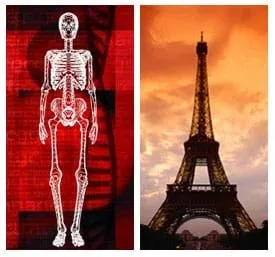 Why are leg bones thicker than arm bones? More support is needed at the bottom of the human body because it holds more weight, similar to the structure of the Eiffel Tower.Copyright (left) National Institute of Environmental Health Sciences, http://www.ehponline.org/docs/2003/111-10/ss.html (right) 2004 Microsoft Corporation, One Microsoft Way, Redmond, WA 98052-6399 USA. All rights reserved.
Different bones have different primary functions. The most important function of your ribs and skull are to protect your heart, lungs and brain — some very essential organs! The main function of your hand bones is to enable movement so that you can hold things. What bones have the primary function of structure, or holding up your body? The bones that hold the entire weight of your body are very important for structure, such as the leg bones, hip bone and backbone. Structure is the reason that your femur, or thigh bone, is so large and thick. Think about a building, such as the Eiffel Tower in Paris, France. The thickest parts of its structure are at the bottom, because the entire weight of the tower rests on the bottom supports. In terms of structure, the leg bones (bottom supports) are the most important bones in our bodies. Since they are also critical for movement, it is very hard to live without them.
Biomedical engineers study the strength and durability of our bones so that they can replicate them to make prostheses (plural for prosthesis), which are artificial devices to replace body parts. Some prostheses are external and sometimes even removable, such as artificial arms and legs. These prostheses are important for amputees (people who have had a limb removed). Other kinds of prostheses are internal and permanent, such as hip and knee replacements. These kinds of prostheses are used when the original body part is not missing, but is instead badly damaged from an injury or illness (such as osteoarthritis).
How do engineers design prostheses? Let's think about an implant for a total knee replacement. What does a knee do? (Have students brainstorm ideas). A healthy knee is amazing! The strongest and largest joint in your body, the knee lets you move your lower leg back and forth as well as twist slightly. The knee is stabilized by ligaments and cartilage. The meniscus acts as a shock absorber in between the long bones of your knee.
What are the criteria and constraints that a biomedical engineers needs to think about when designing a prosthetic knee? (Again, have students brainstorm). A replacement knee needs to be able to move the way a real knee can move. It needs to able to support body loads and be flexible enough to bend without breaking. It must be strong and durable. The replacement knee must be shock absorptive. It must be lightweight, so that a person does not have difficulty moving around. The replacement knee must be biocompatible (it must not cause the patient to have an adverse immune reaction). It should also last a very long time, so that the patient does not need multiple knee replacements.
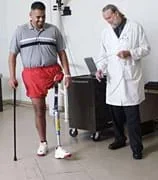 Copyright Walther Thill, US Department of Veteran's Administration https://www.myhealth.va.gov/mhvPortal/anonymous.portal?_nfpb=true&_nfto=false&_pageLabel=spotlightArchive&contentPage=spotlight/spotlight_prosthetics.html
To satisfy the criteria and constraints that we just talked about, biomedical engineers need to carefully select materials. Knee replacements have metal parts that go where the bone used to be. Titanium alloys and cobalt-chromium are often used for these metal parts because they have similar mechanical behavior to bone and do not easily break down in the body (steel would quickly break down). The meniscus is replaced with a plastic part, often made of ultra-high weight polyethylene. This part needs to absorb shock and be very durable. There is still a lot of work to be done in prosthetic knee design. Current knee and hip prostheses last only 10 to 15 years. This is not long enough for younger patients! Therefore, biomedical engineers research how new materials could improve the lifespan of these prostheses. One way that biomedical engineers are working on making prostheses last longer is by modifying the prosthetic's surface. Implant materials now often have textured or porous coatings that help the surrounding bone grow into and fuse with the prosthesis. Some materials, such as tantalum, can be manufactured to be porous structures without the need for a coating. All in all the choice of materials is key to biomedical technologies, and continues to be researched to better replicate the functions of the original body part.
For external prosthetics, such as a prosthetic leg for an amputee, biomedical engineers must think about how the prosthesis will communicate and connect with the body. Students can act as engineers with the associated actvities Prosthetic Party: Build and Test Replacement Legs and Sticks and Stones Will Break That Bone! by designing and prototyping biomedical solutions for various medical cases.
A simple type of sensor might be a harness around the shoulder to control a prosthetic arm. A simple connection to the body for a prosthetic leg might be a cuff on the thigh attached to a belt around the waist. Although these methods work, they do not always produce lifelike movements, and may be uncomfortable or burdensome.
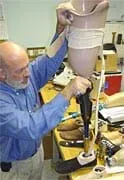 Copyright Bobbi Gruner, US Department of Veteran's Administration https://www.myhealth.va.gov/mhvPortal/anonymous.portal?_nfpb=true&_nfto=false&_pageLabel=spotlightArchive&contentPage=spotlight/spotlight_prosthetics.html
To solve these problems, newer sensor technologies are being developed that are much more accurate and small. Some sensors work by sensing small electrical changes in nearby muscles or nerves, and transmitting that data into prosthesis movement. These sensors are implanted into the body, which is actually less painful than other methods. Modern sensors are becoming more and more lifelike. One artificial knee was designed to sense the joint position and the way the weight of the body comes down onto the knee, and then adjust to that person's walking style by continuously changing resistance to motion. Think of this as similar to doors you may have seen that automatically close, but do so gradually so that they never slam; these doors also work by employing a changing resistance to motion. This artificial knee is just like the door, but is able to adapt to a person's particular walking style, making it move more like a real leg. Sensors and joints are becoming more realistic and lifelike in design, as engineers develop artificial legs that work smoothly and comfortably.
Today we discussed that our leg bones, as well as prosthetic legs, must hold up the weight of our entire body. We learned several important design considerations for creating useful prosthetic legs. What are they? (Answer: Strength, durability, weight, endurance, shock absorption.) We also learned about the growing biotechnology of prostheses, and artificial limbs that are becoming more and more lifelike and useful. Sensors and joints are becoming more realistic and lifelike in design as engineers develop artificial legs that work smoothly and comfortably. The biomedical technology of prostheses continues to improve as engineers keep working to create better solutions to help people who need replacement limbs.
- amputee
- A person who has had a limb removed.
- biocompatible
- The condition of being compatible with living tissue or a living system by not being toxic or injurious and not causing immunological rejection. Source: Merriam-Webster Dictionary, http://www.merriam-webster.com/dictionary/biocompatibility
- bioengineering
- The use of artificial tissues, organs or organ components to replace damaged or absent parts of the body, such as artificial limbs and heart pacemakers. Source: The Oxford Pocket Dictionary of Current English, http://encyclopedia.com/doc/1O999-bioengineering.html
- biomedical engineer
- A person who blends traditional engineering techniques with the biological sciences and medicine to improve the quality of human health and life. Biomedical engineers design artificial body parts, medical devices, diagnostic tools, and medical treatment methods.
- biomedical engineering
- The application of engineering techniques to the understanding of biological systems and the development of therapeutic technologies and devices. Kidney dialysis, pacemakers, synthetic skin, artificial joints, and prostheses are some products of biomedical engineering. Also called bioengineering.
- engineer
- A person who applies his/her understanding of science and math to creating things for the benefit of humanity and our world.
- prosthesis
- An artificial body part to replace a missing one. Plural: prostheses.
- prosthetic
- A specialty of medicine and engineering that designs, constructs and fits artificial limbs and body parts (prostheses).
- structure
- That which gives something shape and stability.
Pre-Lesson Assessment
Discussion Questions: Ask some discussion questions to get students to think about the upcoming lesson. After soliciting answers, explain that the questions will be answered during the lesson.
- How important are our bones?
- What problems might we have if we did not have some of our bones?
- What are some materials that might be useful for creating artificial limbs? Why?
- Who knows how many bones are in each of our bodies?
- What are some of the functions of our bones?
- Who has ever had a broken bone? When your bone fractures, what does it need to heal? (Discussion points to make: A bone needs time to heal, which is why you wear a cast, splint and/or sling to protect and immobilize it. The bone cells regenerate and replace the missing tissue while you wear the cast. Bone is alive and is able to heal by itself, similar to when you get a scrape and your skin heals itself.)
Post-Introduction Assessment
Question/Answer: Ask students the following questions and have them raise their hands to respond. Write their answers on the board.
- How many bones are in the human body? (Answer: 206)
- What are some purposes of the human skeletal system? (Answers: They give our bodies structure, protect vital organs, and the joints allow us to move. They also store minerals and produce red blood cells.)
- Which bones have a primary purpose to protect organs? (Answers: Skull, ribs, hip bone, etc.)
- Which bones have a primary purpose to enable movement? (Answers: Hand bones, foot bones, back bone, neck bones, etc.)
- Which bones have a primary purpose to provide structure? (Answers: Leg bones, hip bone, back bone, etc.)
- What do we call a person who has lost a body part? (Answer: Amputee.)
- What are some important characteristics that a prosthetic leg must have? (Answers: Be strong, durable, lightweight, long-lasting, shock absorptive, lifelike sensors and movement, comfortable connections to the body, etc.)
Lesson Summary Assessment
Journal Entry: Have students respond to the following questions by writing a short paragraph in their journals or on a sheet of paper:
- Engineers create things to benefit the health of future generations, such as better artificial limbs and prosthetics. Describe some features that you think the perfect prosthetic leg would have. (It may even be better than a real leg!)
- Have you seen any media advertisements involving amputees or prosthetic limbs? What effects do you think the advancement of prosthetic technologies have on how society views amputees? (Ask students if they have seen any TV commercials that show athletes with prosthetic limbs.)
What amazing things are being done with prosthetics today? Have students conduct research and report back to the class. See attached example of a successful low-cost foot prosthetic, Jaipur Prosthetic Example (PDF). Might the use of prosthetics give people unfair advantage? One study indicated that the prosthetic legs a double-amputee sprinter uses provide less air resistance than normal legs.
Space travel has generated interest in the effects of space environments on the human body, including the skeletal system. We now know that some astronauts lose up to 12% of their weight-bearing bone mass while on the space station. The spine, hip and leg bones lose an average of ~1% of their mass each month. They regain most of their bone mass in the months following their return from space, but not all of it. Have students investigate the impact of space conditions on human bones and report back to the class.
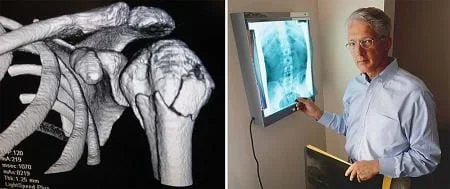 Engineers design imaging tools such as CT scans and x-rays for improved medical diagnostics.Copyright (left) 2007 Denise W. Carlson. Used with permission, (right) 2004 Microsoft Corporation, One Microsoft Way, Redmond, WA 98052-6399 USA. All rights reserved.
Engineers also design many medical tools, devices and methods to better diagnose and repair human bones. For example, x-ray machines help us see bone and teeth structure without invasive surgery. Have students investigate these tools, devices and methods and report back to the class. Examples include: splints, casts and pins; tissue engineering; replacement bones, joints and cartilage; MRI (magnetic resonance imaging) and CT (computer tomography) scans, ultrasound and x-ray equipment.
Are the skeletons of males and females the same? Have students hypothesize and investigate. Answer: Males and females have slightly different skeletons, including a different elbow angle. Males have slightly thicker and longer legs and arms; females have a wider pelvis and a larger space within the pelvis, through which babies travel when they are born. Source: http://www.enchantedlearning.com/subjects/anatomy/skeleton/Skelprintout.shtml
Have students research some intriguing "big questions," about the human body, such as, Can engineers learn from the human body? Amphibians are able to grow replacement limbs, so why can't we? Can we enhance the human body mechanically? Can we control artificial limbs with our brains? Can our bodies heal themselves? Start at the Inside Out Discover Anatomy website: http://www.rigb.org/insideout/anatomy/
Good front and back human body skeleton diagram with bones identified. See "Bone Up on Bones," at http://virtualastronaut.tietronix.com/textonly/act16/text-skeletonact.html
Great information (in English or Spanish) on bones at the KidsHealth website page. Topics include: What are bones made of? How Bones Grow, Your Spine, Your Ribs, Your Skull, Your Hands, Your Legs, Your Joints, and Taking Care of Bones. See "The Big Story on Bones," at http://kidshealth.org/kid/htbw/bones.html
To compare buildings to the human body's systems see: http://library.thinkquest.org/J0110521/Parts%20and%20life%20of%20a%20building.htm
Artificial Limb. The Columbia Encyclopedia, Sixth Edition 2007. Columbia University Press. Accessed October 9, 2008. http://www.encyclopedia.com/topic/artificial_limb.aspx#3-1E1:artifLim-full
Bones of the Human Body, The Human Skeleton, Kidport Reference Library - Science. 2004. Kidport. Accessed October 9, 2008. http://www.kidport.com/RefLib/Science/HumanBody/BodyBones.htm
Bones in Space, Bone Up on Bones, Virtual Astronaut Activities. Last updated September 20, 2005. The Virtual Astronaut, Houston, TX. Accessed October 9, 2008. http://virtualastronaut.tietronix.com/textonly/act16/text-skeletonact.html
Dictionary.com. Lexico Publishing Group, LLC. Accessed October 9, 2008. (Source of some vocabulary definitions, with some modifications) http://www.dictionary.com
Double Joints, A Moment of Science Library. Last updated January 9, 2003. The Trustees of Indiana University. Accessed October 9, 2008. http://amos.indiana.edu/library/scripts/doublejoints.html
The Human Skeleton: Anterior and Posterior Views, pp 45-46. Forensic Anthropology. University of New England. Accessed October 9, 2008. (good handouts for identifying human bones) http://www-personal.une.edu.au/~pbrown3/skeleton.pdf
Human Skeleton Printout. 2005. EnchantedLearning.com. Accessed October 9, 2008. (Use the unlabeled human skeleton print out as a student worksheet; must be a member to access) http://www.enchantedlearning.com/subjects/anatomy/skeleton/Skelprintout.shtml
Levine, Brett, et al. "Porous tantalum in reconstructive surgery of the knee: a review." The journal of knee surgery 20.3 (2007): 185-194.
Joints in the Human Skeleton. Last updated December 4, 2006. The Open Door Team. Accessed October 9, 2008. (good photographs of various joint types) http://www.saburchill.com/chapters/chap0008.html
Total Knee Replacement. American Academy of Orthopaedic Surgeons. Accessed August 13, 2014. http://orthoinfo.aaos.org/topic.cfm?topic=a00389
Shute, Nancy. Building a Better Limb: Veterans are inspiring a big push to create thought-controlled prosthetics. Posted July 23, 2006. U.S. News & World Report, www.usnews.com, July 31, 2006 issue. Accessed October 9, 2008. http://health.usnews.com/usnews/health/articles/060723/31arm.htm
Ward, Logan. Breakthrough Awards 2005. Published November 2005 issue. Popular Mechanics, Hearst Communications, Inc. Accessed October 9, 2008. (Innovators of new products that represent benchmarks of engineering) http://www.popularmechanics.com/technology/engineering/news/1762911
Contributors
Megan Podlogar; Malinda Schaefer Zarske; Denise W. Carlson
Supporting Program
Integrated Teaching and Learning Program, College of Engineering, University of Colorado Boulder
Acknowledgements
The contents of this digital library curriculum were developed under a grant from the Fund for the Improvement of Postsecondary Education (FIPSE), U.S. Department of Education and National Science Foundation GK-12 grant no. 0338326. However, these contents do not necessarily represent the policies of the Department of Education or National Science Foundation, and you should not assume endorsement by the federal government.
Copyright
2007 by Regents of the University of Colorado.