
Biomedical Engineering and the Human Body
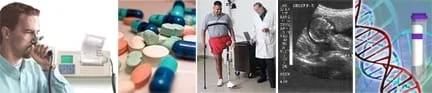 Engineers are increasingly involved in design for the human body.Copyright (left to right) Medline Plus, US National Library of Medicine, National Institutes of Health; http://www.nlm.nih.gov/medlineplus/ency/imagepages/1142.htm; Maine Center for Disease Control and Prevention; http://www.maine.gov/dhhs/boh/images/VariousPills.jpg; Walther Thill, US Department of Veteran's Administration; https://www.myhealth.va.gov/mhvPortal/anonymous.portal?_nfpb=true&_nfto=false&_pageLabel=spotlightArchive&contentPage=spotlight/spotlight_prosthetics.html; Jim Gathany, US Department of Health and Human Services; http://phil.cdc.gov/PHIL_Images/04182000/00005/Ultrasound_lores.jpg; President's DNA Initiative, US Department of Justice http://www.dna.gov/training/evidence/
Overview of topics by lesson: 1) skeletal system, 2) muscular system, 3) circulatory system, 4) respiratory system, 5) digestive system, 6) auditory-hearing sensory system, 7) vision sensory system, 8) reproductive system, 9) genetics, and 10) skeletal system.
Engineers are increasingly involved in design for the human body. Biomedical engineers create artificial limbs using materials and sensors to replicate natural function and movement. Understanding the muscular system enables engineers to design everyday tools, appliances and products. Other engineers design medical solutions to improve health and address disorders. This may take the form of devices, implants, machines, medicines and technologies (diagnostic equipment, pacemakers, surgical techniques, hearing aids, laser eye surgery, ultrasound, amniocentesis, in-vitro fertilization, pain medicine). Engineers also apply their understanding of DNA to numerous real-world applications. As part of their design work, engineers create flow charts, prototypes and models, and make technical presentations, to learn, test and communicate their work.
- CCSS.Math.Content.6.NS.B.3 Fluently add, subtract, multiply, and divide multi-digit decimals using the standard algorithm for each operation.
Grade 6
Do you agree with this alignment?
- MS-ETS1-1 Define the criteria and constraints of a design problem with sufficient precision to ensure a successful solution, taking into account relevant scientific principles and potential impacts on people and the natural environment that may limit possible solutions.
Grades 6-8
This resource focuses on the following Three Dimensional Learning aspects of NGSS:
Science & Engineering Practices- Define a design problem that can be solved through the development of an object, tool, process or system and includes multiple criteria and constraints, including scientific knowledge that may limit possible solutions.Do you agree with this alignment?
Disciplinary Core Ideas- The more precisely a design task's criteria and constraints can be defined, the more likely it is that the designed solution will be successful. Specification of constraints includes consideration of scientific principles and other relevant knowledge that is likely to limit possible solutions.Do you agree with this alignment?
Crosscutting Concepts- The uses of technologies and any limitations on their use are driven by individual or societal needs, desires, and values; by the findings of scientific research; and by differences in such factors as climate, natural resources, and economic conditions.Do you agree with this alignment?
- All human activity draws on natural resources and has both short and long-term consequences, positive as well as negative, for the health of people and the natural environment.Do you agree with this alignment?
Do you agree with this alignment? - Define a design problem that can be solved through the development of an object, tool, process or system and includes multiple criteria and constraints, including scientific knowledge that may limit possible solutions.
The following schedule provides a suggested order of the lessons and activities. However, you may choose to only teach some of the activities – as your time and priorities permit.
- Engineering Bones lesson
- Prosthetic Party: Build and Test Replacement Legs activity
- Sticks and Stones Will Break That Bone! activity
- Muscles, Oh My! lesson
- The Artificial Bicep activity
- Measuring Our Muscles activity
- Body Circulation lesson
- Clearing a Path to the Heart activity
- Breathe In, Breathe Out lesson
- Polluted Air = Polluted Lungs activity
- Digestion Simulation lesson
- Protect That Pill activity
- My Mechanical Ear Can Hear! lesson
- Sounds All Around activity
- Biomedical Devices for the Eyes lesson
- Protect Those Eyes activity
- We've Come a Long Way, Baby! lesson
- You're the Expert activity
- DNA: The Human Body Recipe lesson
- DNA Profiling & CODIS: Who Robbed the Bank? activity
- DNA Build activity
- Bone Fractures and Engineering lesson
- Repairing Broken Bones activity (requires multiple 60-minute periods to complete; suggest 60 minutes on five different days)
Optional: Show students the What Is Engineering? video)
Supporting Program
Integrated Teaching and Learning Program, College of Engineering, University of Colorado Boulder
Acknowledgements
This digital library content was developed by the Integrated Teaching and Learning Program under National Science Foundation GK-12 grant no. 0338326. However, these contents do not necessarily represent the policies of the National Science Foundation, and you should not assume endorsement by the federal government.
Copyright
2007 by Regents of the University of Colorado