
DNA Build
Students reinforce their knowledge that DNA is the genetic material for all living things by modeling it using toothpicks and gumdrops that represent the four biochemicals (adenine, thiamine, guanine, and cytosine) that pair with each other in a specific pattern, making a double helix. They investigate specific DNA sequences that code for certain physical characteristics such as eye and hair color. Student teams trade DNA "strands" and de-code the genetic sequences to determine the physical characteristics (phenotype) displayed by the strands (genotype) from other groups. Students extend their knowledge to learn about DNA fingerprinting and recognizing DNA alterations that may result in genetic disorders.
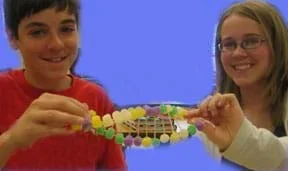 Students model DNA using gumdrops and toothpicks
Biomedical engineers study which specific DNA sequences code for certain characteristics as they investigate genetic disorders such as color blindness, Down syndrome, cystic fibrosis and hemophilia. Engineers develop technologies to recognize certain DNA mutations. Biomedical engineers study genes and DNA to develop technologies that could manipulate or replace genes that are damaged or missing. Gene therapy has many implications for the diagnosis, treatment and possibly prevention of human diseases such as cancer, cystic fibrosis and heart disease.
After this activity, students should be able to:
- Explain that certain DNA sequences code for specific characteristics.
- List several types of engineers and engineering technologies that rely on DNA sequences.
- Investigate basic gene sequences to determine the genotype and phenotype of an individual.
- Use direct and indirect observations, evidence, and data to support claims about genetic reproduction and traits of individuals
Grade 8
Do you agree with this alignment? - Develop, communicate, and justify an evidence-based scientific explanation regarding the functions and interactions of the human body
Grade 7
Do you agree with this alignment?
- Genetic engineering involves modifying the structure of DNA to produce novel genetic make-ups.
Grades 6-8
Do you agree with this alignment?
- MS-LS3-1 Develop and use a model to describe why structural changes to genes (mutations) located on chromosomes may affect proteins and may result in harmful, beneficial, or neutral effects to the structure and function of the organism.
Grades 6-8
This resource focuses on the following Three Dimensional Learning aspects of NGSS:
Science & Engineering Practices- Develop and use a model to describe phenomena.Do you agree with this alignment?
- Apply scientific ideas to construct an explanation for real-world phenomena, examples, or events.Do you agree with this alignment?
Disciplinary Core Ideas- Genes are located in the chromosomes of cells, with each chromosome pair containing two variants of each of many distinct genes. Each distinct gene chiefly controls the production of specific proteins, which in turn affects the traits of the individual. Changes (mutations) to genes can result in changes to proteins, which can affect the structures and functions of the organism and thereby change traits.Do you agree with this alignment?
- In addition to variations that arise from sexual reproduction, genetic information can be altered because of mutations. Though rare, mutations may result in changes to the structure and function of proteins. Some changes are beneficial, others harmful, and some neutral to the organism.Do you agree with this alignment?
Crosscutting Concepts- Complex and microscopic structures and systems can be visualized, modeled, and used to describe how their function depends on the shapes, composition, and relationships among its parts, therefore complex natural structures/systems can be analyzed to determine how they function.Do you agree with this alignment?
- Models can be used to represent systems and their interactions.Do you agree with this alignment?
Do you agree with this alignment? - Develop and use a model to describe phenomena.
Each group needs:
- toothpicks, ~25
- multicolored gumdrops, ~30
- paper or plastic plate, to work on so the table stays clean from loose sugar
- 1 DNA color key (as found on the DNA Build Color Key (PDF); cut apart to create three color keys)
- 1 DNA identity card (as found on the DNA Build Identity Key (PDF), cut apart to create 15 unique DNA identity cards)
- blank sheet of paper, for coding notes and sketching
- pencil
For the entire class to share:
- overhead transparency of the DNA Build Identity Key (PDF)
- overhead projector
An understanding that DNA is the genetic material for all living things.
We have all heard about DNA, but what exactly is DNA and why is it important to us? DNA stands for deoxyribonucleic acid and is made up of billions of biochemicals. DNA is the genetic material for all living things — this means that you, me, flowers, dogs, elephants and even viruses contain DNA. You can think of DNA as the "recipe" for living things — it provides the instructions for every part of the organism. In humans, 99.99% of our DNA is exactly the same as every other person's. Why is there a 0.01% difference? This small amount of DNA is what determines our physical differences such as eye color, hair color, height, etc. Even though our DNA is almost all the same, every single person (except for identical twins) has a unique DNA "recipe."
Where in our bodies is DNA located? DNA is stored in the nucleus of each cell where it is best protected from damage. Each nucleus contains 23 pairs (23 from your mom and 23 from your dad) of DNA, called chromosomes. This DNA is folded over and over into VERY small bundles — much too small for the human eye to see.
DNA is organized into shorter segments called genes. Think about a gummy candy worm as the entire strand of DNA, but each colored segment is a different gene. Genes are specific sequences of DNA that code for certain characteristics. The DNA sequence is called the genotype — this is the recipe — and the characteristics are called the phenotype — this is the cake!
DNA is made of four biochemicals called nucleotide bases (or just "bases"). Think of these as the ingredients in the recipe. They are: adenine, thymine, guanine and cytosine. To make things easier, people usually abbreviate these as A, T, G and C. These four bases pair with each other in a very specific way: A always pairs with T and G always pairs with C. One gene usually contains 10,000 to 15,000 base pairs!
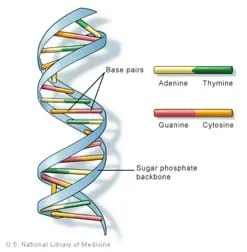 DNA is a double helix formed by base pairs attached to a sugar-phosphate backbone.Copyright Michael Stroeck, US National Library of Medicine. http://ghr.nlm.nih.gov/handbook/basics/dna
Why is it important to understand genes and base pair sequences? Have you ever heard of color blindness, Down syndrome, cystic fibrosis or hemophilia? Well, biomedical engineers work with others in the scientific and medical fields to help improve health care and quality of life. They study DNA to help us understand genetic disorders like these. As engineers develop technologies to recognize certain DNA mutations and where they are located, they work with geneticists to diagnose, treat and prevent these disorders.
Genetic engineers study genes and DNA to understand things like DNA replication, cloning and genetically-modified organisms such as food and crops. Genetic engineers have helped us advance our crop technologies and make synthetic (artificial) insulin for people with diabetes.
DNA can also identify people — even better than fingerprints. DNA is found in all of our cells: hair, teeth, bones, blood and saliva. We can leave our DNA behind when we drink from a cup, use a toothbrush, shed hair or cut ourselves on something sharp. Because of this, DNA is used for "DNA fingerprinting" — or describing the unique DNA recipe for a person. Even 0.01% difference is enough to distinguish one person from another when it comes to collecting evidence from a crime scene.
Using DNA in a crime investigation does have its limitations. The probability of laboratory error or contamination — errors made when collecting and running the DNA samples — must be factored into the results. It is always best to consider DNA fingerprinting along with other evidence. Biomedical engineers create the tools, equipment and processes to accurately collect and examine DNA evidence for crime and paternity cases. They are always working to make the laboratory errors fewer and the machines for identifying the gene sequences more accurate.
Today, we are going to practice determining the phenotypes (physical characteristics) of persons from their DNA. We are going to work together to make models of human DNA and swap them with each other to decode. Like biomedical engineers, let's break down DNA gene sequences into individual traits to describe the people to which the DNA belongs.
Background
Remind students that DNA is composed of four nucleotide bases: adenine (A), thymine (T), guanine (G) and cytosine (C). These four bases pair with each other in a very specific way: A always pairs with T and G always pairs with C.
Before the Activity
- Gather materials and make photocopies or printouts (as described next).
- For every three groups (of two students each), print one copy of the DNA Build Color Key (PDF); cut along the dotted lines to create three color keys from each sheet.
- Print one copy of the DNA Build Identity Key (PDF) and cut out the 15 DNA identity cards (one per group).
- Create an overhead transparency of the DNA Build Identity Key (PDF) and display it on an overhead projector.
With the Students: Part 1
- Divide the class into groups of two students each.
- Hand out supplies to each pair of students: 1 plate, ~25 toothpicks ~30 gumdrops, 1 DNA identity card and 1 color key.
- Explain that the color key contains the three-base genotypes that code for certain phenotypes (physical characteristics).
- Explain that the DNA identity cards contain the names and physical characteristics of various people, different for every team. This is the person's DNA that the team will construct. Remind students to keep this person's identity a secret from the other groups (for now).
- For each physical characteristic on the identity cards (phenotype), refer to the color key and have groups write down in columns the sequences of letters (genotypes, using A, T, G and C) for their persons. Then, have students write the corresponding base pairs in second columns. This is where the background knowledge above will come into play. A always pairs with T and G always pairs with C. (For example, if the genotype for brown eyes is TGG, you would use the color code for the gum drops to find the conjugate pairs of ACC.) The associated YouTube video is a great visual resource to show this example.
- Allow enough time (~15-20 minutes) for teams to build the strand of DNA for their persons. For DNA building tips, see Figures 1 and 2 and the next section.
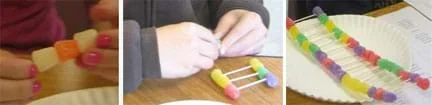 Figure 1a-b-c. Students construct a gumdrop DNA strand.Copyright 2008 Megan Schroeder, ITL Program, University of Colorado at Boulder.
- Once all groups have completed building, have them trade DNA strands, and by working backwards from the strand only (no peeking at the identity cards), each group should determine whose DNA they have (by referring to the possible identities shown with the overhead projector). Students really enjoy this "decoding" part!
- Have students check with the original creator teams of the DNA strands to see if they determined the right DNA identities. Discuss with the class: How many groups were able to name the right identity for their DNA strands? What made decoding difficult?
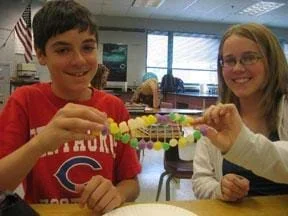 Figure 2. Students show off their completed gumdrop DNA double helix model.Copyright 2008 Megan Schroeder, ITL Program, University of Colorado at Boulder.
Suggested DNA Building Steps
It is easiest to construct the DNA strand by following these steps:
- While referring to the identity card and color key, write down in a column the base letters (A, T, G and C; genotype) and the corresponding base pairs in a second column for the first physical characteristic (phenotype).
- Next, build each "gene" in the first column of three bases by placing three gumdrops (of the correct colors) on one toothpick (see Figure 1a). Refer to the color key.
- Once all five "genes" from one column are built, repeat the process to build the corresponding base sequences from the second column of letters.
- Connect the base pairs by placing a toothpick between each of the three gumdrops — this creates five "ladders" for each gene (see Figure 1b).
- Now connect all the genes by sticking the end of the toothpicks with the gumdrops together. Be sure to keep the genes in the correct order and orientation (see Figure 1c).
- Finally, gently twist the entire strand to shape the double helix (see Figure 2)!
With the Students: Part 2
- Tell the students that they are biomedical engineers working with a city's police department. They have developed a technology that allows them to isolate several gene sequences in human DNA. The technology has helped them come up with the color keys that they used earlier (in Part 1).
- The police have several crime cases in which they need help finding a suspect. They would like to know the phenotype (physical characteristics) of the person from the DNA samples taken from blood and hair evidence. The students' task is to break down the gene sequences in the sample and identify some physical characteristics of the person. According to their color keys, what does the person look like? Have them draw preliminary sketches or descriptions of the persons on blank sheets of paper.
- Sample DNA 1: TGGGCTTAAGGGATA (Answer: Brown eyes, blonde hair, right-handed, medium height, round nose.)
- Sample DNA 2: TGCGTCTTAGAACAT (Answer: Hazel eyes, red hair, left-handed, short height, pointy nose.)
- Sample DNA 3: TGGGTGTAAGGGGTA (Answer: Brown eyes, black hair, right-handed, medium height, long nose.)
- Conclude by leading a class discussion about biomedical engineering and genetic disorders, as described in the Assessment section. For this post-activity assessment, have students use their color keys to look at a few more DNA samples for indications of genetic disorders.
- biomedical engineer
- A person who blends traditional engineering techniques with the biological sciences and medicine to improve the quality of human health and life. Biomedical engineers design artificial body parts, medical devices, diagnostic tools, and medical treatment methods.
- chromosome
- A group of genes; humans have 23 pairs of chromosomes (46 total) in a cell nucleus.
- deoxyribonucleic acid
- abbreviated DNA. The genetic material for all living things; located in the cell nucleus.
- gene
- A section of DNA that carries information to determine characteristics or traits.
- genotype
- The specific sequence of DNA in a gene.
- hazel
- Light golden-brown or yellowish-brown color (as the color of a hazelnut).
- model
- (noun) A representation of something for imitation, comparison or analysis, sometimes on a different scale. (verb) To make something to help learn about something else that cannot be directly observed or experimented upon.
- nucleotide bases
- The parts of RNA and DNA involved in pairing; they include cytosine, guanine, adenine, thymine (DNA) and uracil (RNA), abbreviated as C, G, A, T and U. They are usually simply called bases in genetics. Also called base pairs or bases.
- phenotype
- The outward, physical characteristic(s) expressed by a gene sequence.
Pre-Activity Assessment
Discussion Questions: Ask the students and discuss as a class.
- Why do we look like our parents? (Answer: Each of us receives genetic information from each of our parents.)
- Where in our bodies is genetic information stored? (Answer: All genetic information is in our DNA, located in the nucleus of each cell.)
Activity Embedded Assessment
Question/Answer: While students are building their DNA strands, ask them the following questions:
- What is DNA? (Answer: DNA is the genetic material for all living things.)
- What is a gene? (Answer: A gene is a segment of DNA that codes for a specific trait.)
- Is there a way to have different characteristics with the same DNA sequence? (Answer: No, DNA sequencing is unique for each characteristic.)
- What is DNA fingerprinting? (Answer: DNA fingerprinting is describing a person using DNA evidence from a biological sample, such as blood, saliva, tissue or hair.)
- Do all humans have the same DNA? Explain. (Answer: No, humans share about 99.99% of DNA. Only identical twins share 100% of their DNA).
- What type of engineer would work with DNA and genes? (Answer: A biomedical engineer.)
- How are engineers involved in DNA and gene sequencing? (Answer: Biomedical engineers study which specific DNA sequences code for certain characteristics in order to recognize genetic disorders such as color blindness, Down syndrome, cystic fibrosis and hemophilia. Engineers design technologies that recognize certain DNA mutations and work with geneticists to diagnose and prevent the disorders.)
Post-Activity Assessment
Biomedical Engineering and Genetic Disorders Discussion: Most genetic disorders are associated with an alteration of DNA. For example, color blindness can be associated with a single mutation (change) on any of 19 different chromosomes and multiple different genes. These genetic disorders can be either numerical or structural. Numerical disorders occur when a DNA chromosome is either missing or has an extra copy. For example, Down syndrome is an example in which three copies of a DNA chromosome exist, instead of two. Structural disorders occur when a portion of a DNA chromosome is missing or replicated or moved to the wrong place. Have students discuss how an engineer might be able to develop technologies that look for specific gene changes or mutations in DNA. Using the color key, which of the following DNA samples might have a genetic disorder? What is the alteration? (Note: None of the following examples result in real disorders, but they each illustrate a type of change in the gene sequence of the DNA piece.)
- AGGAGGGCCTAAGGGGTA (Answer: Duplication of the AGG gene.)
- TGGGCTGTTATA (Answer: Deletion of a gene.)
- TGCGTGGTATAAGGG (Answer: Gene in the wrong place. This translocation is usually seen when one chromosome attaches to an entirely different chromosome, or portions of two different chromosomes have been exchanged.)
Groups may need to trade with other groups from their given gumdrop supply, as the gumdrop colors are different on each color key.
When connecting all the genes together, be sure to keep the genes in the correct order and orientation, or else they won't be able to be decoded by another team.
Have students research a specific genetic disorder and write a one-page summary about it, including a description of which chromosome is affected and the associated mutation. Examples include Down syndrome, color blindness, hemophilia and cystic fibrosis.
- For lower grades, it may help to build one DNA strand as a class before students build on their own. Shorten the activity by constructing only two or three of the five characteristics (for example, just hair and eye color).
About R&D - Research & Development. Updated November 27, 2008. GlaxoSmithKline plc. www.gsk.com
Bachor, Kevin. Fun Facts (about DNA). The Best Detergent for Plentiful DNA Extraction, Cirque du Soleil, Ecole Nationale de Cirque, 2006 Canada Wide Virtual Science Fair. http://www.virtualsciencefair.org/2006/bach6k2/Funfacts.htm
Contributors
Megan Schroeder; Malinda Schaefer Zarske; Janet Yowell; Denise W. Carlson
Supporting Program
Integrated Teaching and Learning Program, College of Engineering, University of Colorado Boulder
Acknowledgements
The contents of this digital library curriculum were developed under a grant from the Fund for the Improvement of Postsecondary Education (FIPSE), U.S. Department of Education and National Science Foundation GK-12 grant no. 0338326. However, these contents do not necessarily represent the policies of the Department of Education or National Science Foundation, and you should not assume endorsement by the federal government.
Copyright
2007 by Regents of the University of Colorado.