
My Mechanical Ear Can Hear!
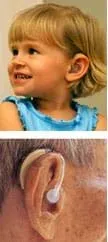 External hearing aids consist of a microphone, amplifier and receiver.Copyright (left) Centers for Disease Control and Prevention, http://www.cdc.gov/ncbddd/ehdi/CDROM/resources/unilateral_loss.html, (right) US Attorney General http://www.attorneygeneral.gov/press.aspx?id=3290
Students are introduced to various types of hearing impairments and the types of biomedical devices that engineers have designed to aid people with this physical disability. Worn by young and old, hearing aids are electronic devices that amplify sound at different levels for different pitches. Students learn about the hearing process and ways in which hearing can be lost.
Engineers have designed many types of hearing-aid devices to target specific hearing problems — from the most familiar outer-ear hearing aids, to tiny devices that are surgically implanted in the inner ear. Materials, circuits, programs and comfort are addressed by teams of engineers who design products that help young and old people regain the use of a very important sense.
After this lesson, students should be able to:
- Explain the process of hearing and identify ways in which hearing can be lost.
- Explain how hearing aids are used, how they have been designed to address different hearing problems, and describe their different components.
- Identify the types of engineers who design these devices, be able to describe the difficulties with each design, and suggest possible solutions.
- The human body is composed of atoms, molecules, cells, tissues, organs, and organ systems that have specific functions and interactions
Grade 7
Do you agree with this alignment?
- Students will develop an understanding of the relationships among technologies and the connections between technology and other fields of study.
Grades K-12
Do you agree with this alignment? - Technological advances have made it possible to create new devices, to repair or replace certain parts of the body, and to provide a means for mobility.
Grades 3-5
Do you agree with this alignment? - Advances and innovations in medical technologies are used to improve healthcare.
Grades 6-8
Do you agree with this alignment?
- MS-LS1-3 Use argument supported by evidence for how the body is a system of interacting subsystems composed of groups of cells.
Grades 6-8
This resource focuses on the following Three Dimensional Learning aspects of NGSS:
Science & Engineering Practices- Use an oral and written argument supported by evidence to support or refute an explanation or a model for a phenomenon.Do you agree with this alignment?
Disciplinary Core Ideas- In multicellular organisms, the body is a system of multiple interacting subsystems. These subsystems are groups of cells that work together to form tissues and organs that are specialized for particular body functions.Do you agree with this alignment?
Crosscutting Concepts- Systems may interact with other systems; they may have sub-systems and be a part of larger complex systems.Do you agree with this alignment?
- Scientists and engineers are guided by habits of mind such as intellectual honesty, tolerance of ambiguity, skepticism, and openness to new ideas.Do you agree with this alignment?
Do you agree with this alignment? - Use an oral and written argument supported by evidence to support or refute an explanation or a model for a phenomenon.
A basic understanding of the properties of sound and the parts and functions of the ear.
The Structure of the Ear (see attached Human Ear Anatomy Visual Aid (PDF))
The outer ear consists of the pinna, earlobe, ear canal and tympanic membrane (or eardrum). The pinna is the curved outer region of the visible part of the ear that collects sound waves and directs them into the ear canal. The ear canal acts much like a tube. The sound waves bounce back and forth along its length until they reach the eardrum and the middle ear.
The middle ear consists of three tiny bones collectively called the occicles; they are the malleus (or hammer), the incus (or anvil), and the stapes (or stirrup). The malleus acts like a mallet; it hits the incus, which vibrates in turn and causes the stapes to vibrate also. As the stapes vibrates, it tugs on the oval window and sends sound vibrations into the inner ear.
The inner ear consists of the cochlea and auditory nerves (or hair cells). The snail-shaped cochlea is filled with a fluid and the hair-like auditory nerves. As the vibrations pass into the cochlea, the fluid moves, which cause the auditory nerves to shift, sending an electrical signal to the brain. The brain detects these electrical signals as sound.
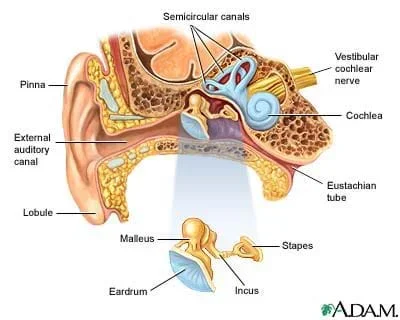 Ear anatomy.Copyright Medline Plus, National Institutes of Health, public domain image http://www.nlm.nih.gov/medlineplus/ency/imagepages/1092.htm
Sources of Hearing Loss
Conductive hearing loss is a mechanical problem in the outer or middle ear that blocks the conduction of sound. Causes of conductive hearing loss include: blockage of the ear canal, perforation of the tympanic membrane (eardrum), mechanical difficulties in the bones of the middle ear, or fluid accumulation in the middle ear. Conductive hearing loss is often reversible
Sensorineural hearing loss occurs when hair cells in the cochlea become unresponsive or damaged and no longer send impulses to the brain. Causes of sensorineural hearing loss include: aging, brain tumors, viral infection in the inner ear, genetics, loud noises, mumps or meningitis. Sensorineural hearing loss is permanent.
Engineers to the Rescue
Biomedical engineers study the function of the ear and develop systems that solve hearing problems, whether they are conductive or sensorineural.
Electrical engineers develop the tiny circuits that control the microphones and amplifiers that work together to convert sound waves to electrical impulses.
Material engineers develop the encasement that holds the hearing-aid components. A hearing aid must be made of a durable, flexible plastic and shaped to fit comfortably in the ear or ear canal. Refer to the associated activity Sounds All Around for students to learn more about the engineering concepts behind the design of a hearing aid and then design, build and test their own hearing-aid devices.
Types of Hearing Aids
External hearing aids are devices intended for those with mild to moderate hearing loss, and are worn in the ear, in the canal, completely in the canal, or behind the ear.
- Digital and programmable hearing aids are instruments that contain a computer chip programmed by a computer. This technique offers a way to match a particular hearing loss with the amplification that the user needs most.
- Conventional hearing aids are devices that use conventional electronics to produce quality, amplified sound at all levels of intensity. Because these devices are not programmable, many users find that some sounds are amplified too much, while others are not amplified enough.
Internal hearing aids (implants)
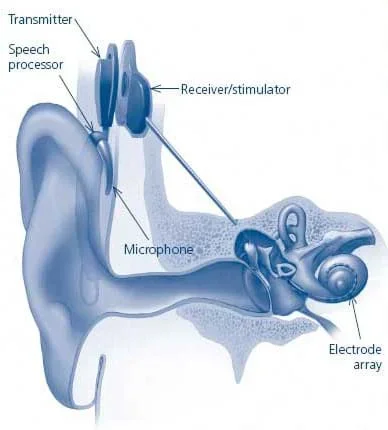 Ear with cochlear implant.Copyright US National Institutes of Health, Medical Arts & Photography Branch http://www.nidcd.nih.gov/health/hearing/ear_coch_img.htm
- Unlike hearing aids that amplify sound waves, the inner component of cochlear implants are surgically implanted into the inner ear to stimulate the hair cells in the cochlea with electrical impulses. The external components, which attach to the skull behind the ear, include a microphone to gather sound waves, a speech processor to select and arrange sounds picked up by the microphone, and a transmitter to convert the sound into electrical impulses. The internal components include connecting wires and an electrode array to collect the impulses from the transmitter, sending them to different parts of the auditory nerve. This device is intended for those with severe hearing loss or deafness.
- Ossicular implants are small pieces of metal, usually titanium, surgically implanted in the occicles to replace damaged bones in the middle ear and improve the conduction of sound. This method to improve hearing is still in the process of development.
The Newest Hearing Aid Being Developed by Engineers
Biomedical engineers have developed a new idea that could lead to a very small hearing-aid device. The concept includes a tiny nanoparticle and a transmitter. The magnetically responsive nanoparticle is implanted in the inner ear and the transmitter is worn outside the ear. The transmitter produces a magnetic field, causing the nanoparticle, and the tissue in which it is implanted, to move, which sends a signal to the brain.
Who can name all five human senses? (Answer: Sight, touch, taste, smell and hearing.) Now, can you name the parts of the body that we use for these senses? (Answer: Eyes, nerves, tongue, nose, ear.) Good! Today, we are going to talk about one of these senses: hearing. Have you ever wondered what it would be like if you suddenly lost your hearing? You would no longer be able to listen to your favorite music, hear important alarms, or talk on the phone with your friends! Can you think of other reasons why hearing is so important? Loss of hearing is considered to be a physical disability.
People can lose their hearing in many ways. Can you think of any? (Possible answers: Extremely loud construction or machinery sounds, attending too many loud music concerts, setting the volume too high on earphones, diseases, genetics.) Did you know that listening to music through headphones can damage your ears if the volume is too high? As fun as it is to jam to your iPod, exposing your ears to loud sounds for a long period of time can cause hearing loss. Hearing damage accumulates over time, and once it is gone, often it does not come back!
Engineers have come up with devices to help people who have trouble hearing. Not all hearing impairments are the same; for example, some people have difficulties hearing only high-pitched sounds, others may have trouble hearing voices, while others may be on the verge of deafness. For this reason, engineers have designed different types of hearing aids to help with the needs of a variety of hearing impairments. These devices are called adaptive (or assistive) devices and include hearing aids, cochlear implants and ossicular implants. All the hearing-assistive devices represent a major achievement in biomedical engineering, and are just one way in which engineers have had a major impact on the daily lives of many children and adults!
To understand how these devices work, we must first recall the parts of the ear. (If necessary, show students a diagram or overhead transparency of the human ear anatomy, such as the attached Human Ear Anatomy Visual Aid (PDF).) Your ears are much more than what you can see on the outside of your head! Can anyone name the three sections of the ear? (Answer: Inner ear, middle ear and outer ear.) Conductive hearing loss occurs in the middle or outer ear, when a mechanical problem blocks the conduction of sound. Sensorineural hearing loss occurs in the inner ear, when hair cells in the cochlea become unresponsive or damaged and no longer send impulses to the brain. Since conductive hearing loss and sensorneural hearing loss have different causes, engineers design different types of hearing aids for each type of ear problem.
A variety of hearing-aid components help increase sound to the ear. The primary hearing-aid components a include a microphone (gathers sound waves and converts them to electrical impulses), an amplifier (increases the amplitude, or strength, of the impulses), a receiver (converts the electrical impulses created by the microphone back into sound waves and directs them into the ear canal), and a battery (an energy source). Other components that might be found in digital and programmable hearing aids include computer chips, software programming for different settings (allows a user to manually change hearing-aid settings for different sound environments such as for conversation, telephone talking, or noisy public places), and switches to control volume and settings.
Today we will learn more about hearing-aid devices and the engineers required to design them.
Sounds like fun to me! Are you ready? Let's start by thinking about which type(s) of engineer might create hearing aids. Talk it over with the people next to you and then we'll discuss as a class. (Answer: Biomedical, electrical and material engineers.)
Who can explain to me how the components of our ears enable us to hear? (Refer to an ear anatomy diagram, as necessary.) How might people end up with a hearing loss? What's the difference between a conductive hearing loss and a sensorineural hearing loss? (Listen to student descriptions.) How are hearing aids designed differently to address each of these hearing loss situations? What are their different components? While improving the hearing for someone with a conductive (middle or outer ear) hearing problem is much easier than for someone with a sensorineural hearing problem, both types of hearing aids continue to be redesigned and improved by engineers.
What are some problems patients may find in the design of their hearing aids? (Have students brainstorm example problems, as described in the Assessment section.) How might engineers improve these devices?
How do different types of engineers contribute to the design of hearing aids? (Have students re-evaluate their list of engineers who contribute to hearing-aid designs, as described in the Assessment section.) Biomedical engineers creatively improve the quality of life for humans by solving the physical problems of our bodies and senses that prevent us from living fulfilling lives. One example includes research on improving the hearing aid so the quality of sound produced is improved, and the device is smaller and more sensitive to individual patient needs. Engineers are investigating and testing ways to recreate the necessary electrical impulses produced in the inner ear to assist those with sensorineural (inner ear) hearing problems.
Since one of the continuing goals of scientists and engineers is to develop technologies that help people with physical disabilities, can you think of other physical disabilities and the devices engineers have developed to help patients cope? (Example answers: Eye glasses, wheel chairs, pacemakers and prosthetic limbs.)
- adaptive device
- (or assistive device ) A biomedical instrument developed by engineers to assist individuals with a wide range of disabilities to improve their ability to live healthy, independent lives.
- amplifier
- Increases the amplitude, or strength, of sound impulses.
- biomedical engineering
- The application of engineering techniques to the understanding of biological systems and the development of therapeutic technologies and devices. Kidney dialysis, pacemakers, synthetic skin, artificial joints, and hearing aids are examples of biomedical engineering products.
- conductive hearing loss
- A mechanical problem in the outer or middle ear that blocks the conduction of sound.
- inner ear
- Consists of the cochlea and the auditory nerves (or hair cells).
- microphone
- Gathers sound waves and converts them to electrical impulses.
- middle ear
- Consists of three tiny bones collectively called the occicles; they are the malleus (or hammer), the incus (or anvil) and the stapes (or stirrup).
- outer ear
- Consists of the pinna, the earlobe, the ear canal and the tympanic membrane (or eardrum).
- physical disabilitiy
- The inability of the body to function normally, caused by a bodily defect or injury.
- receiver
- Converts the electrical impulses created by the microphone back into sound waves and directs them into the ear canal.
- sensorineural hearing loss
- Occurs when hair cells in the cochlea become unresponsive or damaged and no longer send impulses to the brain.
Pre-Lesson Assessment
Worksheet: Prior to the introduction, have students complete the What's in Your Ear? Worksheet to evaluate their understanding of the parts of the human ear. Before proceeding, discuss the answers as a class. Also discuss ear problems that might occur and what situations might lead to hearing loss.
Post-Introduction Assessment
Which Type of Engineers? Have students make a list of the types of engineers who develop hearing-aid devices and the issues they must address. Next, introduce the different types of hearing-aid devices and the components of each, including the latest research being done (see the Lesson Background section). Be sure to address the specific issues for which each device is designed.
Lesson Summary Assessment
Revisit Your Answers: Have students re-evaluate their list of engineers and their responsibilities in the development of hearing aids. Now knowing more about hearing aids, it should be easier for students to recognize which types of engineers are important for these designs. Ask them to add and/or make changes to their original list.
Review: Using what they learned, have students describe how the body is a system of multiple interacting subsystems.
Brainstormingt: Have students brainstorm some problems that patients may find in the design of their hearing aids and how engineers might improve the devices. Example problems with external hearing aids include:
- The device blocks the ear canal and caused the patient's own voice to sound muffled.
- The device is cosmetically unappealing and uncomfortable to wear.
- The device produces unwanted feedback due to background noises carried through the microphone.
- Certain sounds are amplified too much while other sounds are not amplified enough.
Ask the class if anyone has a family member who uses a hearing aid. Invite this person into the classroom to discuss his/her hearing loss, how the problem came about, and the type of hearing aid s/he uses to improve his/her hearing. Have him/her describe the features of the device and if s/he has encountered any issues while using the hearing aid.
Introduce students to the decibel reading of various noises and why high-level readings damage hearing. Have students arrange sound types and decibel readings from the lowest to highest decibel levels. See the Teach Engineering Sound Lines activity.
Have students examine how we know sound exists by listening to and seeing sound waves, then describing sound in terms of its pitch, volume and frequency. This ties together how biomedical engineers study sound waves to help people who cannot hear or talk. See the Teach Engineering Seeing and Feeling Sound Vibration activity.
To further students' understanding of sound energy, have them identify different pitches and frequencies as they create high- and low-pitch sound waves with a vibrating ruler and a straw kazoo. See the Teach Engineering Pitch & Frequency activity.
See a labeled graphic of a hearing-aid device at Illinois Sound Beginning's website: http://www.illinoissoundbeginnings.org/hearingaids.html
See an ear anatomy diagram at this Medline Plus Medical Encyclopedia website: http://www.nlm.nih.gov/medlineplus/ency/imagepages/1092.htm
The Ear, Atlas of the Body: http://www.medem.com/medlib/article/ZZZYXNW46JC
For short movies on hearing loss and hearing tests, see About.com's Deafness website, "What are Coclear Implants?" by Blausen Medical: http://video.about.com/deafness/Cochlear-Implants.htm
Kid's Health, Your Ears: http://kidshealth.org/kid/htbw/ears.html
Bellis, Mary. Innovations for the Hearing Impaired, Cochlear Implants – Bionic Ear. About.com – Inventors. Accessed February 11, 2009. http://inventors.about.com/od/hstartinventions/a/deaf_4.htm
Bellis, Mary. Innovations for the Hearing Impaired, Hearing Aids. About.com – Inventors. Accessed February 11, 2009. http://inventors.about.com/od/hstartinventions/a/deaf_3.htm
Hearing Aid Styles. American Hearing Aid Associates. Accessed November 3, 2010. http://www.ahaanet.com/hearing-aid-styles.html
How Hearing Aids Work. Hearing Aids 101. Accessed February 11, 2009. http://www.hearingaids101.com/how-hearing-aids-work.aspx
Ruben, Dr. Robert J. Hearing Loss and Deafness. Last reviewed/revised April 2007. The Merck Manual. Accessed February 11, 2009. http://www.merck.com/mmhe/sec19/ch218/ch218a.html
Seeney, Charles E. and Dormer, Kenneth J., inventors. US Patent 7344491 – Method and apparatus for improving hearing, issued March 18, 2008. Patent Storm. Accessed February 11, 2009. http://www.patentstorm.us/patents/7344491/description.html
Contributors
Lesley Herrmann; Jessica Todd; Emily Weller; Sara Born; Malinda Schaefer Zarske; Denise W. Carlson
Supporting Program
Integrated Teaching and Learning Program, College of Engineering, University of Colorado Boulder
Acknowledgements
The contents of this digital library curriculum were developed under a grant from the Fund for the Improvement of Postsecondary Education (FIPSE), U.S. Department of Education and National Science Foundation GK-12 grant no. 0338326. However, these contents do not necessarily represent the policies of the Department of Education or National Science Foundation, and you should not assume endorsement by the federal government.
Copyright
2008 by Regents of the University of Colorado.