
Sound Line
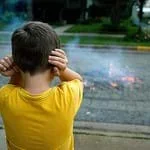 High noises can cause hearing damage.Copyright 2010 Ben Husmann, Flickr http://www.flickr.com/photos/benhusmann/5499502593/
Students learn the decibel reading of various noises and why high-level readings damage hearing. Sound types and decibel readings are written on sheets of paper and students arrange the sounds from the lowest to highest decibel levels. If available, students use a decibel meter to measure sounds.
Understanding the level of decibels is necessary for engineers to successfully design devices to fix hearing damage and make new equipment. Bioengineers have invented devices to treat deafness, including hearing aids, cochlear implants, placing tubes in the eardrum, and replacing part of the bones in the middle ear with wires. Cochlear implants are an electronic device that gives a deaf person a sense of sound by surgically implanting the devices under the skin behind the ear. The device contains a microphone, a speech processor, a transmitter and electrodes. Together, they collect and send impulses to the brain. A person with a cochlear implant cannot actually hear as a normal person does, but it allows them to have a relationship with speech and hear the environment around them. A great understanding of the ear and its physiology is necessary to design these devices.
After this activity, students should be able to:
- Explain that loud sounds can damage hearing.
- Describe the amplitude of sound as measured in decibels.
- Explain how engineers design technologies to help with hearing loss or injury.
- 3.1.3.a Represent and solve problems involving multiplication and division.
Grade 3
Do you agree with this alignment?
- Assess further scientific explanations regarding basic human body system functions
Grade 5
Do you agree with this alignment?
- CCSS.Math.Content.3.OA.A Represent and solve problems involving multiplication and division.
Grade 3
Do you agree with this alignment?
- Technological advances have made it possible to create new devices, to repair or replace certain parts of the body, and to provide a means for mobility.
Grades 3-5
Do you agree with this alignment?
- 4-PS4-1 Develop a model of waves to describe patterns in terms of amplitude and wavelength and that waves can cause objects to move.
Grade 4
This resource focuses on the following Three Dimensional Learning aspects of NGSS:
Science & Engineering Practices- Develop a model using an analogy, example, or abstract representation to describe a scientific principle.Do you agree with this alignment?
- Science findings are based on recognizing patterns.Do you agree with this alignment?
Disciplinary Core Ideas- Waves, which are regular patterns of motion, can be made in water by disturbing the surface. When waves move across the surface of deep water, the water goes up and down in place; there is no net motion in the direction of the wave except when the water meets a beach. (Note: This grade band endpoint was moved from K-2.)Do you agree with this alignment?
- Waves of the same type can differ in amplitude (height of the wave) and wavelength (spacing between wave peaks).Do you agree with this alignment?
Crosscutting Concepts- Similarities and differences in patterns can be used to sort and classify natural phenomena.Do you agree with this alignment?
Do you agree with this alignment? - Develop a model using an analogy, example, or abstract representation to describe a scientific principle.
To share with the entire class:
- 20 pieces of 9 inch x 12 inch white construction paper
- small 3 inch x 5 inch piece of paper
- yarn or string, 5 feet in length
- tape
- 5 wide-tipped magic markers in black, red, orange, yellow and green
- (optional) decibel meter, for extension activity
- Math Decibel Worksheet (PDF), one per student
Have you ever heard a sound that was so loud that you had to cover your ears? Why did you cover your ears? Did the sound hurt you? It probably did! Without thinking about it, you covered your ears to protect them from the damage of loud sounds. Knowing that loud sounds can damage hearing is important in preventing hearing loss and deafness. Short exposure to sounds that are extremely loud can cause pain or even damage hearing, while long exposure to loud sounds can have the same affect.
How do we measure how loud a sound is? Well, the loudness of sound is measured in something called decibels. There is a wide range of sound decibels, but humans can hear in a range from 0 dB (called the threshold of hearing, or how soft a sound can be) to over 130 dB (called the threshold of pain, because it hurts your ears). Because of the large difference in noise between a whisper and a jet engine, each decibel level represents an increase of 10 times the previous number. That means that a decibel level of 20 is 10 times louder than a level of a 10. A decibel level of 30 is 10 times louder than a 20, or 100 times louder than a 10. Wow! Sound loudness increases pretty fast!
How do we protect our ears from the loud sounds that can cause hearing problems? While it's true that engineers often make the devices that are loud enough to damage ears, they also work to help protect people from hearing loss or injury. There are engineers that specifically work on acoustics or how sounds are heard and how to protect people from the dangerous sound levels. Engineers have created technologies for eliminating some sound from noisy rooms or areas, such as sound barriers around airports or busy roads. Engineers also develop the technology to help people who already have some hearing loss, such as hearing aids, cochlear implants, and replacing part of the bones in the middle ear with wires.
In this activity, we are going to learn more about decibels and the loudness of sound. We are going to play a game in which we arrange some sounds in increasing decibel order. Are you ready to play?
Before the Activity
- Gather materials and make copies of the math worksheet.
- Using the Common Sounds Chart (PDF), pick and write out the sound and the decibel level of 20 different noises on individual pieces of white 9" x 12" construction paper. Write the sound on top and the decibel level below it and then tape over the decibel level using a smaller 3" x 5" piece of paper.
- Note: It is helpful to use a red marker to write the numerical decibel levels in the Danger Zone, such as for Boom Cars (a car equipped with an extremely powerful stereo system that is being played with the volume and bass levels turned up and the car windows rolled down) and Jet Engines. Print in orange the decibel levels in the Damage Zone. For the zone below this, between decibel level readings of 70 to 100, use purple. For the decibel levels under 65dB, use green. Write the sound names in black so that the color-coding does not help the students in the game.
With the Students
- Ask the students: "What would you do if you woke up and could not hear?" What do engineers do to help people who cannot hear? What are some ways that people communicate? (With their voices, hands...)
- Explain to the students that the loudness of sound, also called the amplitude, can be measured. Engineers use a decibel meter to measure the amplitude of sounds. Some sounds are so loud that the vibrations that enter the ear actually bend or even break the sensory hairs in the cochlea. Hearing loss or deafness will occur if people are exposed to extremely loud sounds for short periods of time or to loud sounds for long periods of time.
- Have two students stand up in front of the group, each holding one end of the length of yarn. Have them coordinate to slowly lift and lower their arms so that a wave can be seen in the yarn. Point out that as students lift and lower their arms more, the peaks and valleys of the wave become larger, demonstrating greater amplitude. Next, have students rapidly raise and lower their arms, to demonstrate a greater frequency. Explain how this visual model represents sound waves. Tell the class that on a much smaller scale, the molecules in the air moves up and down like the yarn.
- If a decibel meter is available, show the children the meter.
- Explain that the unit we use to measure length might be inches or meters, volume might be cups of liters, and sound is in decibels (deci means ten or tenth + bell).
- Next, explain that sounds range from very quiet to very loud. The softest sound a human can hear is about 10 decibels (dB), while the loudest sound a human can hear is about 145 decibels (dB). The louder sounds can be dangerous to our ears. 6. Explain, or write on the board, that the range for
"Danger Zone" sounds are 121 – 145dB (red)
"Damage Zone" sounds are 103-120dB (orange)
"Below 15 Minutes Only Zone" sounds are 70 – 100dB (purple)
"Comfortable Zone" sounds are under 65dB (green)
- Explain that this is a guessing game that the class will play two (or three) times (depending on class size).
- Ask for 10 student volunteers, and have them stand in the front of the room.
- Give 10 students a "sound" (piece of paper with the name of a sound prepared ahead of time; the decibel level for the sound should be color coded and covered with a piece of paper.)
- Explain that the class is going to arrange the students at the front of the class in a "Sound Line" from softest sound to loudest sound.
- When the class has arranged the students, have them guess the approximate decibel level of each sound.
- When the class is sure they have the sounds in order, have the students remove the covering on the decibel level to see if they are correct.
- If the students are not correctly arranged, have them rearrange themselves.
- Each student should introduce himself or herself to the rest of the class. "I am a Boom Car, and I have a decibel level of 145 which can really hurt your hearing" or "I am a Whisper with a decibel reading of 30 decibels, and I won't hurt your hearing."
- The students who have introduced themselves now get to be the audience, and ask for 10 more volunteers to repeat the game using different sounds.
- For advanced students use <, > or = to rate the different sounds.
Pre-Activity Assessment
Brainstorming: In small groups, have the students engage in open discussion. Remind students that no idea or suggestion is "silly." All ideas should be respectfully heard. Ask the students:
- What are examples of some loud sounds and soft sounds? List sounds on the board.
Activity Embedded Assessment
Group Question: During the activity, ask the groups:
- Name some sounds that are dangerous for your hearing. What kind of precautions can you take to prevent hearing loss?
Formation: As a way to actively engage all students and assess their knowledge, have them participate in ranking the various sounds during the decibel activity.
Post-Activity Assessment
Problem Solving/Worksheet: Have students complete the Math Decibel Worksheet by calculating the total number of seconds that each decibel level would be associated. Students should be able to calculate at least the first three levels. Consider allowing students to work in groups or use a calculator.
If time is short, eliminate the part of the activity where the children introduce themselves, but be sure to point out which sounds are in the Danger Zone, Damage Zone, etc.
Using a decibel meter, teams of students can measure and chart the sounds around the school. They can name the sound, record the level and note if the sounds are in the danger, damage, limit exposure or comfortable zone. The lunchroom is a good place to use the decibel meter.
Make a decibel scale booklet! Distribute a copy of the Decibel Scale of Common Sounds for each pair of students. Layer three pieces of paper in one stack, fold in half to make a small booklet, staple the booklet along the fold, make a cover for the book, and number the pages from 1 to 9. As a class, brainstorm events that can be drawn in the booklet for different sounds, as they go from soft to loud.
Another type of booklet – Make a decibel scale booklet (above), but tell the students that they will be comparing decibel scale levels by relating them to time. More specifically, a level ten noise will be 10 seconds. Since a level twenty noise is 10 times louder, it will also be 10 times bigger in terms of seconds (10x10=100 seconds). As a class, brainstorm events that can be drawn in the booklet for each event. For example, ten seconds could be the time it takes to get on the bus, pack up a backpack, get the class to be quiet, etc. On each page of the booklet, have students illustrate an event that describes the amount of time associated with each level.
Note: The time periods given are approximate. If a level ten on the decibel scale is 10 seconds, a level twenty would be 10*10 = 102 = 100 seconds or 1 minute and 40 seconds. Have students calculate the exact time knowing that there are 60 seconds in a minute, 60 minutes in an hour. Students can be allowed to use calculators. Or have students express the time period a third way. For example, a 50 dB is 100,000 seconds, which is approximately 1 day and four hours. Students could express this as 28 hours knowing that there are 24 hours in a day, or 1 and 1/6 day, or 1,680 minutes, etc.
For upper grades, students can rate sounds using <, >, and =.
Contributors
Jessica Todd; Emily Weller; Sara Born; Denali Lander; Malinda Schaefer Zarske; Janet Yowell
Supporting Program
Integrated Teaching and Learning Program and Laboratory, University of Colorado Boulder
Acknowledgements
The contents of this digital library curriculum were developed under a grant from the Fund for the Improvement of Postsecondary Education (FIPSE), U.S. Department of Education and National Science Foundation GK-12 grant no. 0338326. However, these contents do not necessarily represent the policies of the Department of Education or National Science Foundation, and you should not assume endorsement by the federal government.
Copyright
2006 by Regents of the University of Colorado