
The Beat Goes On
In this activity, students learn about their heart rate and different ways it can be measured. Students construct a simple measurement device using clay and a toothpick, and then use this device to measure their heart rate under different circumstances (i.e., sitting, standing and jumping). Students make predictions and record data on a worksheet.
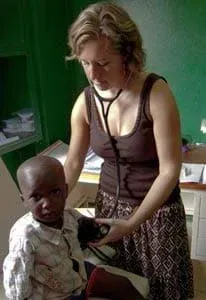 Students learn about their heart rateCopyright National Institute of Health. Fogarty International Center http://www.fic.nih.gov/News/PublishingImages/2010/ghm-manning.jpg
Engineers help doctors by developing devices to detect heartbeats such as stethoscopes and machines that monitor the heart rate of a person when they are sick or exercising. NASA engineers used the same technology that the fuel pumps in the Space Shuttle uses to help design a tiny ventricular assist pump to help pump blood through the body and regulates a heartbeat. There are many pumps that have been designed by engineers that mimic the pumping action of the heart in the human body.
After this activity, students should be able to:
- Explain the mechanics behind a pulse.
- Describe how to measure a heart rate and what affects heart rate.
- List the importance of medical equipment designed by engineers to locate and monitor heart rates.
- 3.1.3.d Solve problems involving the four operations, and identify and explain patterns in arithmetic.
Grade 3
Do you agree with this alignment?
- Analyze and interpret data to generate evidence that human systems are interdependent
Grade 5
Do you agree with this alignment? - Assess further scientific explanations regarding basic human body system functions
Grade 5
Do you agree with this alignment?
- CCSS.Math.Content.5.NBT.B.5 Fluently multiply multi-digit whole numbers using the standard algorithm.
Grade 5
Do you agree with this alignment?
- Technological advances have made it possible to create new devices, to repair or replace certain parts of the body, and to provide a means for mobility.
Grades 3-5
Do you agree with this alignment? - STEL-2I Describe the properties of different materials.
Grades 3-5
Do you agree with this alignment?
- SEP.4.3-5.2 Develop a model using an analogy, example, or abstract representation to describe a scientific principle.
Grade 4
Do you agree with this alignment?
For each group:
- Attached Heartbeat Worksheet (one per group) and Heartbeat Math Worksheet (one per student)
- a 1" cube or ball of modeling clay (any color)
- 1 round toothpick
- stopwatch
For entire class to share:
- stethoscope (optional)
- empty 1-gallon milk/water jug (optional)
A basic understanding of the human heart and its role in the circulatory system would allow students to get more out of the lesson.
Have you ever heard your heart beating? The doctor listens to your heartbeat when you have a check-up or other visit. What is that sound the doctor is hearing? What exactly makes your heart beat? Well, the heart creates a beat because it works like a pump. The heart is similar to a water pump that brings water to the sinks all around your house. Instead of water, however, the heart pushes blood through your body in blood vessels. This pumping action causes high-pressure power surges of blood that travel from the heart through the body, in a pulse. Each power surge repeats itself almost every second. In order to detect the power surge, or feel your pulse, a vessel carrying the pumped blood, such as an artery, must be near the surface of your skin. Some vessels are better than others for feeling your pulse; however, we can find pulse points (locations where a vessel is close to the surface) all over the body for measuring heart rates. Some examples of good pulse points include: the radial artery in the wrist, the anterior tibial artery on the front of the ankle, the popliteal artery in the back of the knee, the femoral artery in the groin, the brachial artery in the inside of the elbow, and the carotid artery in the neck. Don't worry, you do not need to remember the names of all these points, but it is good to know where they are located.
The lub-dub sound you are hearing when you listen to your hearth is the sound of the valves in your heart opening and closing. ("Lub" is when the two upper chambers, or the atriums, are pumping the blood into the ventricles, and "dub" is when the ventricles are pumping the blood to either the lungs or the body.) The harder your body is working (i.e., exercising), the faster your heart pumps blood through your body. Size is another thing that affects how fast the heart beats. Very large mammals can have a heartbeat of 20 to 30 BPM (beats per minute) and very small animals can have heart rates exceeding 500 BPM. The average human heart rate is around 60-100 BPM (resting), which means it beats more than 30 million times per year and about 2.5 billion times in a 70-year lifetime.
The pulse is used as a guide for the health of the heart, and detecting irregularities helps to predict if arteries are clogged (which may lead to heart attacks). If an ambulance is called to help someone who is injured, the medical technicians immediately check the person's pulse to see how they are doing. If the pulse is too fast or too slow, it can be a sign that something is very wrong and can determine the next course of action. Engineers help doctors by developing devices to detect heartbeats such as stethoscopes and image devices (little cameras) that allow doctors to see clogged blood vessels. Engineers also develop machines that monitor the heart rate of a person when they are sick or exercising.
In this activity, we test our heart rates by counting our pulses after certain activities. Then, we will think like engineers to come up with ideas on how to monitor how healthy our heart is using our heart rate.
Before the Activity
- Gather all activity materials.
- Print out the Heartbeat Worksheet (one per group) and Heartbeat Math Worksheet (one per student).
- Prepare an overhead of the locations of the pulse on the body.
With the Students
- Ask students if they can see their heart beating. Discuss with students that our heartbeat can be heard and sometimes felt, but not always seen without some assistance. Engineers design special instruments to help doctors monitor the heart rate and pulse of patients in a hospital.
- Divide students in groups of three: one person will be a recorder, one person will be a timer and the third person will be a pulse measurer.
- Have students predict how many heartbeats they think will occur in one minute as they listen to their pulse. They should record this number on their Heartbeat Worksheet.
- Demonstrate how to find a pulse on the left side of the neck.
- Have students practice until they are able to feel the pulse and count accurately.
- Have students count their pulse for one minute while sitting and record it in the proper section of the record chart. (Note: the teacher may want to time one minute, having all groups begin and end their counting at the same time.)
- Pass out activity materials to each group.
- If not already flat, flatten the bottom of the clay.
- Insert the toothpick into the clay.
- Place 1 group member's wrist, palm side up, on the table, while the person is sitting.
- Place the clay on the wrist, and move the clay around on the palm side of the wrist until the toothpick starts to vibrate back and forth.
- Count the number of vibrations that the toothpick makes in one minute.
- Have the recorder write the data on the Heartbeat Worksheet observation chart and label the units as BPM (beats per minute).
- Repeat steps 10-13 with each member of the group.
- Ask students if their own heart beats at the same rate all the time. Ask them to record their answer on their worksheet.
- Have students check their pulse one at a time, using their pulse meter after each of the following activities and record the results on their observation chart.
- Count after standing for one minute.
- Count after jumping in place for one minute.
- Ask students to share their findings with the class. When was their heartbeat the fastest? The slowest?
- (Optional) Explain how the stethoscope is used. Let everyone listen to his or her heartbeat. Be sure to clean the earpiece after each use (alcohol wipes work well). Discuss what students heard and record comments on board. Talk to the students about how engineers design medical devices such as stethoscopes.
- When might you want to know if your heart is beating too fast? How about too slow? What have you learned today that would help you design a heart monitor? Engineers design instruments such as heart monitors to help track the heart rates of patients in hospitals or ambulances. Have students come up with ideas on how to monitor how healthy our heart is using our heart rate. (If time, have them sketch their ideas on paper.)
- Have students complete the Heartbeat Math Worksheet to calculate the number of times their heart pumps in a day or year.
Pre-Activity Assessment
Class discussion: Solicit, integrate and summarize student responses.
- Can you see your heart beating? How do you know your heart is beating? Does the rate of your heart beat ever change?
Prediction: Have the students predict their heart rate when they are sitting still and record predictions on the board.
Activity Embedded Assessment
Worksheet: Have the students record measurements and follow along with the activity on their Heartbeat Worksheet. After students have finished their worksheet, have them compare answers with their peers.
Post-Activity Assessment
Prediction Analysis: Have students compare their initial predictions with their test results, as recorded on the worksheets. Ask the students to explain why their prediction was correct or incorrect. Discuss reasons why their predictions were either too high or too low.
Math Worksheet: Have students work through the Heartbeat Math Worksheet to calculate their heart rate. Students should answer the challenge questions on the bottom of the data sheet and discuss. If available, bring in an empty gallon of milk or water to show how much blood is pumped in 1 minute (1.7 gallon).
Make sure that students are checking their pulse correctly. It may help to demonstrate process to the students first. Students must keep their wrist still to see the pulse movements with the toothpick. If they move their hand around a lot, they may get a false reading.
Students should get a number between 70 – 140 beats per minute for each trial.
Some students may have a weak pulse. Try to move the pulse meter around enough to get the toothpick to move. If this does not work, try to measure the pulse from the neck. You can also pick the person in the group who has the strongest pulse to use the pulse meter.
Create a large table of data with the heart rates of the entire class.
Repeat this activity with the students taking their pulse in other areas of the body such as, wrist and underarm.
Repeat the procedure for even more various activities; i.e., running in place for one minute, eating lunch, first thing in the morning, at the end of the school day, etc. Compare this data to data recorded earlier.
Have the students take the heartbeat of other family members (possibly even pets) and compare the results to their own for homework.
For older students, discuss what causes the heart rate to increase: stress, exercise, clogged blood vessels. Discuss the link to blood pressure. Blood pressure equals the Cardiac output multiplied by the total peripheral resistance. Cardiac output is heart rate multiplied by stroke volume, or the amount of blood pumped with each beat. Total peripheral resistance is a measure of the blood vessels resistance to flow.
For younger students: It may be easier to time one minute as a class and have the students start and stop counting together. Also, the math worksheet may be best as a class activity on the board. The challenge questions could be given to advanced math students.
Contributors
Jessica Todd; Sara Born; Denali Lander; Malinda Schaefer Zarske; Janet Yowell
Supporting Program
Integrated Teaching and Learning Program and Laboratory, University of Colorado Boulder
Acknowledgements
The contents of this digital library curriculum were developed under a grant from the Fund for the Improvement of Postsecondary Education (FIPSE), U.S. Department of Education and National Science Foundation GK-12 grant no. 0338326. However, these contents do not necessarily represent the policies of the Department of Education or National Science Foundation, and you should not assume endorsement by the federal government.
Copyright
2004 by Regents of the University of Colorado.