
Engineering and the Human Body
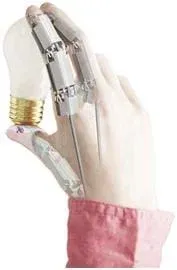 A human hand superimposed with mechanical fingersCopyright Oak Ridge National Laboratory http://www.ornl.gov/info/ornlreview/v40_2_07/article14.shtml
This unit covers the broad spectrum of topics that make-up our very amazing human body. Students are introduced to the space environment and learn the major differences between the environment on Earth and that of outer space. Students dive into the different components that make up the human body: muscles, bones and joints, the digestive and circulatory systems, the nervous and endocrine systems, the urinary system, the respiratory system, and finally the immune system.
Engineers, particularly biomedical engineers, need to understand how our body systems work in order to help take care of our bodies on Earth and in space. The human body has many examples of joints, which engineers can mimic when designing machines. Specifically, in thinking about our skeleton while not on Earth, biomedical engineers who work at NASA are especially interested in how outer space affects astronauts' bones. And, aerospace engineers need to understand the immune system and how it is affected in space in order to prepare for longer missions (while astronauts are further away from the medical resources on Earth).
Furthermore, engineers continue to help protect the human heart by developing technological devices to repair it, such as artificial heart valves to replace faulty valves. Artificial hearts were developed by engineers to keep hospitalized patients alive while they are waiting for a heart transplant. What about our brains? Engineers develop better ways to save the brain from trauma and disease. They develop surgical and imaging equipment, as well as brain-saving devices, such as bicycle and motorcycle helmets. And for the visually impaired, engineers create sight devices from glasses to advanced sight tools (including a light sensor imbedded into the back of the eye) for people who cannot see at all or have difficulty seeing. Biomedical engineers create devices to aid people who have lost or are lacking full hearing capabilities. Engineers are also working on a drug that can keep astronauts from getting space-motion sickness, which is caused by conflicting sensory inputs.
Other life-saving measures are undertaken by chemical engineers, who study the immune system in order to develop treatments for people with compromised immunity, and vaccinations, antibiotics, disinfectants, and sterilizers are designed by engineers in order to help keep people healthy. Additionally, environmental engineers work on keeping the air we breathe and the water we drink free of toxins via air purifiers and water filters.
Clearly, engineers play a huge part in keeping the human body safe and healthy, both on Earth and in space.
(optional: Show students the What Is Engineering? video)
- 3-5-ETS1-1 Define a simple design problem reflecting a need or a want that includes specified criteria for success and constraints on materials, time, or cost.
Grades 3-5
This resource focuses on the following Three Dimensional Learning aspects of NGSS:
Science & Engineering Practices- Define a simple design problem that can be solved through the development of an object, tool, process, or system and includes several criteria for success and constraints on materials, time, or cost.Do you agree with this alignment?
Disciplinary Core Ideas- Possible solutions to a problem are limited by available materials and resources (constraints). The success of a designed solution is determined by considering the desired features of a solution (criteria). Different proposals for solutions can be compared on the basis of how well each one meets the specified criteria for success or how well each takes the constraints into account.Do you agree with this alignment?
Crosscutting Concepts- People's needs and wants change over time, as do their demands for new and improved technologies.Do you agree with this alignment?
Do you agree with this alignment? - Define a simple design problem that can be solved through the development of an object, tool, process, or system and includes several criteria for success and constraints on materials, time, or cost.
- 3-5-ETS1-3 Plan and carry out fair tests in which variables are controlled and failure points are considered to identify aspects of a model or prototype that can be improved.
Grades 3-5
This resource focuses on the following Three Dimensional Learning aspects of NGSS:
Science & Engineering Practices- Plan and conduct an investigation collaboratively to produce data to serve as the basis for evidence, using fair tests in which variables are controlled and the number of trials considered.Do you agree with this alignment?
Disciplinary Core Ideas- Tests are often designed to identify failure points or difficulties, which suggest the elements of the design that need to be improved.Do you agree with this alignment?
- Different solutions need to be tested in order to determine which of them best solves the problem, given the criteria and the constraints.Do you agree with this alignment?
Do you agree with this alignment? - Plan and conduct an investigation collaboratively to produce data to serve as the basis for evidence, using fair tests in which variables are controlled and the number of trials considered.
- MS-LS1-3 Use argument supported by evidence for how the body is a system of interacting subsystems composed of groups of cells.
Grades 6-8
This resource focuses on the following Three Dimensional Learning aspects of NGSS:
Science & Engineering Practices- Use an oral and written argument supported by evidence to support or refute an explanation or a model for a phenomenon.Do you agree with this alignment?
Disciplinary Core Ideas- In multicellular organisms, the body is a system of multiple interacting subsystems. These subsystems are groups of cells that work together to form tissues and organs that are specialized for particular body functions.Do you agree with this alignment?
Crosscutting Concepts- Systems may interact with other systems; they may have sub-systems and be a part of larger complex systems.Do you agree with this alignment?
- Scientists and engineers are guided by habits of mind such as intellectual honesty, tolerance of ambiguity, skepticism, and openness to new ideas.Do you agree with this alignment?
Do you agree with this alignment? - Use an oral and written argument supported by evidence to support or refute an explanation or a model for a phenomenon.
TThe following schedule provides a suggested order of the lessons and activities. However, you may choose to only teach some of the activities – as your time and priorities permit.
- Spaced Out lesson, Move Your Muscles! lesson
- Walk, Run, Jump! activity
- Muscles, Muscles Everywhere activity
- Our Amazing Skeleton lesson
- Fascinating Friction! activity
- Digestive System lesson
- Design Devices to Help Astronauts Eat: Lunch in Outer Space! activity
- The Heart of the Matter lesson
- Blood Cell Basics activity
- The Beat Goes On activity
- Nerve Racking lesson
- 20/20 Vision activity
- Sound Line activity
- Engineering a Mountain Rescue Litter activity
- Unlocking the Endocrine System lesson
- Endocrine Excitement! activity
- Just Passing Through lesson and Kidney Filtering activity
- Out of Breath lesson
- Creating Model Working Lungs: Just Breathe activity
- Fighting Back! lesson
- Hot or Not activity
Supporting Program
Integrated Teaching and Learning Program, College of Engineering, University of Colorado Boulder
Acknowledgements
The contents of these digital library curricula were developed under grants from the Fund for the Improvement of Postsecondary Education (FIPSE), U.S. Department of Education, and the National Science Foundation (GK-12 grant no. 0338326). However, these contents do not necessarily represent the policies of the U.S. Department of Education or National Science Foundation, and you should not assume endorsement by the federal government.
Copyright
2009 by Regents of the University of Colorado