
Model Greenhouses
Students learn about the advantages and disadvantages of the greenhouse effect. They construct their own miniature greenhouses and explore how their designs take advantage of heat transfer processes to create controlled environments. They record and graph measurements, comparing the greenhouse indoor and outdoor temperatures over time. Students are also introduced to global issues such as greenhouse gas emissions and their relationship to global warming.
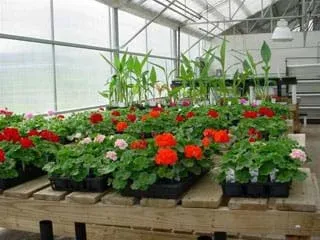 Greenhouses are designed to capture sunlight to create a controlled environment suitable for gardening.Copyright Copyright © Northwest Missouri Psychiatric Rehabilitation Center, http://www.dmh.mo.gov/nmprc/services.htm
An engineer might design and build a greenhouse to create a controlled environment for growing many different types of plants. With a greenhouse, a grower can monitor and adjust the amount of heat, light and water plants receive, enabling optimal growing conditions, which allows for an extended growing season. As an additional design component of many energy-efficient houses, greenhouses contribute to a house's overall energy efficiency by providing a space for year round home grown vegetables and flowers.
After this activity, students should be able to:
- List the benefits (cost saving, efficiency) of using a greenhouse.
- Explain the greenhouse effect in depth.
- Provide an in-depth explanation of the greenhouse effect.
- HS.1.2.a Reason quantitatively and use units to solve problems.
Grades 9-12
Do you agree with this alignment? - HS.2.4.c.i Solve linear equations and inequalities in one variable, including equations with coefficients represented by letters.
Grades 9-12
Do you agree with this alignment? - HS.3.1.b Summarize, represent, and interpret data on two categorical and quantitative variables.
Grades 9-12
Do you agree with this alignment? - HS.3.1.b.ii Represent data on two quantitative variables on a scatter plot, and describe how the variables are related.
Grades 9-12
Do you agree with this alignment?
- Use appropriate measurements, equations and graphs to gather, analyze, and interpret data on the quantity of energy in a system or an object
Grades 9-12
Do you agree with this alignment? - Develop, communicate, and justify an evidence-based scientific explanation that shows climate is a result of energy transfer among the atmosphere, hydrosphere, geosphere and biosphere
Grades 9-12
Do you agree with this alignment?
- CCSS.Math.Content.HSA-REI.B.3 Solve linear equations and inequalities in one variable, including equations with coefficients represented by letters.
Grades 9-12
Do you agree with this alignment? - CCSS.Math.Content.HSF-LE.A.1b Recognize situations in which one quantity changes at a constant rate per unit interval relative to another.
Grades 9-12
Do you agree with this alignment? - CCSS.Math.Content.HSN-Q.A Reason quantitatively and use units to solve problems.
Grades 9-12
Do you agree with this alignment? - CCSS.Math.Content.HSS-ID.B Summarize, represent, and interpret data on two categorical and quantitative variables
Grades 9-12
Do you agree with this alignment? - CCSS.Math.Content.HSS-ID.B.6 Represent data on two quantitative variables on a scatter plot, and describe how the variables are related.
Grades 9-12
Do you agree with this alignment? - CCSS.Math.Practice.MP2 Reason abstractly and quantitatively.
Grades K-12
Do you agree with this alignment? - CCSS.Math.Practice.MP4 Model with mathematics.
Grades K-12
Do you agree with this alignment?
- Students will develop an understanding of the effects of technology on the environment.
Grades K-12
Do you agree with this alignment? - Students will develop an understanding of the attributes of design.
Grades K-12
Do you agree with this alignment? - Students will develop an understanding of engineering design.
Grades K-12
Do you agree with this alignment? - Energy resources can be renewable or nonrenewable.
Grades 9-12
Do you agree with this alignment?
- HS-ESS3-4 Evaluate or refine a technological solution that reduces impacts of human activities on natural systems.
Grades 9-12
This resource focuses on the following Three Dimensional Learning aspects of NGSS:
Science & Engineering Practices- Design or refine a solution to a complex real-world problem, based on scientific knowledge, student-generated sources of evidence, prioritized criteria, and tradeoff considerations.Do you agree with this alignment?
Disciplinary Core Ideas- Scientists and engineers can make major contributions by developing technologies that produce less pollution and waste and that preclude ecosystem degradation.Do you agree with this alignment?
- When evaluating solutions it is important to take into account a range of constraints including cost, safety, reliability and aesthetics and to consider social, cultural and environmental impacts.Do you agree with this alignment?
Crosscutting Concepts- Engineers continuously modify these technological systems by applying scientific knowledge and engineering design practices to increase benefits while decreasing costs and risks.Do you agree with this alignment?
- Feedback (negative or positive) can stabilize or destabilize a system.Do you agree with this alignment?
Do you agree with this alignment? - Design or refine a solution to a complex real-world problem, based on scientific knowledge, student-generated sources of evidence, prioritized criteria, and tradeoff considerations.
- HS-ETS1-1 Analyze a major global challenge to specify qualitative and quantitative criteria and constraints for solutions that account for societal needs and wants.
Grades 9-12
This resource focuses on the following Three Dimensional Learning aspects of NGSS:
Science & Engineering Practices- Analyze complex real-world problems by specifying criteria and constraints for successful solutions.Do you agree with this alignment?
Disciplinary Core Ideas- Criteria and constraints also include satisfying any requirements set by society, such as taking issues of risk mitigation into account, and they should be quantified to the extent possible and stated in such a way that one can tell if a given design meets them.Do you agree with this alignment?
- Humanity faces major global challenges today, such as the need for supplies of clean water and food or for energy sources that minimize pollution, which can be addressed through engineering. These global challenges also may have manifestations in local communities.Do you agree with this alignment?
Crosscutting Concepts- New technologies can have deep impacts on society and the environment, including some that were not anticipated. Analysis of costs and benefits is a critical aspect of decisions about technology.Do you agree with this alignment?
Do you agree with this alignment? - Analyze complex real-world problems by specifying criteria and constraints for successful solutions.
Each group needs:
- 6 acrylic or Plexiglas squares, approximately 10 to 12 inches (25 to 30-cm ) per side
- hot glue gun and glue sticks
- soil and plant
- thermometer
- clear, wide strapping tape
- Greenhouse Design & Testing Worksheet (PDF)
- (optional) structural frame made of wood, metal or plastic
For the entire class to share:
- saws, to cut acrylic or Plexiglas
A basic understanding of the properties of light, including the visible spectrum, reflection and refraction of light. Students should concurrently be taking Algebra 1 in order to complete the worksheet calculations.
Have you ever noticed that often, after entering a car that has been in the sun all day, the interior is very warm, and may even be uncomfortably hot. This is not just due to hot weather; it happens because the design of the car lets heat enter, but not escape. This situation is not to be confused with the greenhouse effect. Although the situations are similar, the analogy is incorrect. The greenhouse effect refers to the process by which radiation from the sun is absorbed and reflected by the Earth's surface; some of the reflected radiation makes its way back through the atmosphere, and some is absorbed by greenhouse gas molecules that then re-emit the radiation in all directions in the atmosphere warming the surface of the Earth. As you have probably heard many times, the greenhouse effect has the potential to harm the Earth due to its contribution to global warming — but without it, our Earth would not be warm enough for us to live on!
The process by which a greenhouse works is very different from the greenhouse effect. A greenhouse consists of a structure made entirely of a highly-transparent material, such as glass or plastic. The transparent material lets heat enter in the form of radiation, but does not let this heat escape (at least not very quickly). Heat is absorbed by inside objects and materials through radiation, and then released to the rest of the interior space through convection. The most important aspect of a greenhouse is that a person can control the interior environment, which is helpful when growing plants, especially in climates in which gardening would not normally be favorable.
So how can using a greenhouse improve the energy efficiency of a typical house? To start, it uses the light and heat emitted by the sun to create an exceptional environment for plant life. To do this with conventional heating and lighting would cost quite a lot. It also allows people to grow their own vegetables, herbs and flowers rather than buying them from a market. Designing a greenhouse as an addition to any home gives the inhabitants the opportunity to grow their own vegetables and plants at usually less cost than a grocery store. This saves energy in the form of electrical lights and heaters, as well as the energy that would be used to package the store-bought foods and transport them to the grocery store and to your home.
In the future, engineers may design and build enormous skyscraper greenhouses that are able to grow all kinds of fruits and vegetables, eliminating the need for goods to be transported into major cities. These would allow cities to become self sufficient and help to prevent widespread deforestation.
Today you will have the opprtunity to construct your own miniature greenhouses. By analyzing the global challenge, we will be able to specify criteria and constraints for the designs.
Background
How Greenhouses Work: Greenhouses operate on four principals: radiation, transmittance, absorption and convection. Through this process, people are able to harvest energy from the sun and use it to maintain a warm and humid indoor environment conducive for plants to grow.
- Step 1: Radiation and Transmittance — Almost all the heat within a greenhouse comes directly from the sun through radiation. This energy is radiated through the Earth's atmosphere and transmitted through glass (or other transparent material) to the interior of the greenhouse.
- Step 2: Absorption — Once energy from the sun reaches the inside of the greenhouse, it must be absorbed. It helps to have a surface that absorbs almost all the energy that hits it (for example, something dark; soil works well). Whatever is inside the greenhouse continues to absorb this energy.
- Step 3: Convection — Once energy is absorbed within the greenhouse, heat is transferred throughout the space through convection. Cooler air falls to the bottom and gets heated up by the absorbing surface, and the process repeats. Because convection is the way the rest of the greenhouse gets heated, it is important to tightly seal the entire structure. Even opening the door for a short period of time can significantly reduce the indoor temperature.
The result of this process is an indoor environment much warmer than normally achievable without a greenhouse. If the temperature gets too high, it is easy to adjust it by opening a window or door to let out some heat.
A greenhouse design can be modified to account for specific capacitance or temperature needs. While changing the slope of the walls and roof does not change the amount of radiation entering, changing the dimensions does. A larger surface area leads to a larger amount of transmitted radiation. To harness all this radiation, a large absorptive surface is also required. For a higher-heat greenhouse, the floor surface area should be maximized while the volume of the overall greenhouse should be minimized (to allow for less space to be heated with the same amount of radiation). Of course, engineers must remain within certain constraints while designing them this way. For a larger capacity, a greenhouse simply needs more volume with a considerable amount of radiation still being transmitted. Greenhouses should be designed to optimally suit the specific needs of the user, so engineers must understand any necessary design modifications.
The Greenhouse Effect and Climate Change: The greenhouse effect is often confused with the process that occurs within an actual greenhouse. The greenhouse effect refers to a process in which reflected radiation from the Earth's surface is absorbed and re-emitted by greenhouse gases, rather than getting passed back into the atmosphere. It prevents the loss of heat by radiation, rather than convection, as in a typical greenhouse. It is important to distinguish between the two because they are easily confused.
Climate change refers to a significant change in average weather patterns over a long period of time in a particular region. It is attributed to several factors such as variations in solar intensity, and the Earth's orbit, and more recently, greenhouse gas emissions. Studying how the climate changes helps to distinguish between natural dynamic climate patterns and more recent forced climate patterns such as those caused by global warming. This kind of information is critical in analyzing the worldwide problem of global warming.
Vertical Farming: Vertical farming is a conceptual form of agriculture suitable for implementation in urban high-rises. These multi-story greenhouses would enable year-round crop production with exceptional benefits. Food for urban centers could be produced without the trouble of weather-related failure or transportation expenses. These buildings could make cities of the future completely self sufficient, reducing deforestation by returning farmland to nature. Currently the concept of vertical farming has not become a reality, but it is likely to revolutionize food production in the next 50 years.
Solar Geometry: It is important to consider the position of the sun and place the greenhouse on the land so that it receives sunlight during all times of the year. For this to happen, it must be completely exposed to the south (assuming its location is in the northern hemisphere). Placement should take into consideration any nearby trees or structures to the south of the greenhouse that may block the winter sun, which is much lower in the sky.
Before the Activity
- Gather materials.
- (optional) To save class time, pre-cut acrylic or Plexiglas squares.
- Make copies of the Greenhouse Design & Testing Worksheets (PDF), one per team.
With the Students
- Divide the class into groups of two or three students each.
- Provide each team with a worksheet.
- Have students sketch and build their model greenhouses (see Part 1 on the worksheets). Limit greenhouse sizes to about 1 sq ft (a 10 x 10-inch [25 x 25-cm] base is a good starting point). See Figure 1 for an example sketch with dimensions noted.
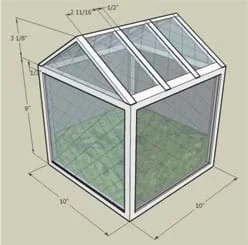 Figure 1. An example greenhouse model design sketch.Copyright Copyright © Landon B. Gennetten, ITL Program, University of Colorado at Boulder.
- Have students cut (or provide already-cut) pieces of acrylic or Plexiglas for the greenhouse bases, walls and roofs.
- Have students glue pieces together to form the base and walls of the house (do not attach the roof yet). They may use some form of structural members between the acrylic pieces, as depicted in Figure 1.
- Direct students to fill the bottom of the greenhouse with soil and a plant.
- Instruct each group to insert a thermometer somewhere inside. If the thermometer does not fit inside, it can extend out of one of the joints, as long as the overall structure is sealed.
- Next, have students attach the roof using tape as a temporary seal for one of the pieces (to allow access to the inside). Remind students to make sure any gaps are filled in and that the structure is air tight when they are ready for testing.
- On a sunny day, bring the class outside to test their greenhouses. Follow Part 2 of the worksheet for testing procedures. As a control, also record the ambient outdoor temperatures (outside the greenhouse) at each time interval.
- Once testing is complete, bring the class back inside to complete the graphing and analysis portions (Parts 3 and 4) of their worksheets.
- Have students compare results with one another and discuss the overall results as a class.
- Conclude by continuing the class discussion, incorporating questions provided in the Assessment section. If time permits (or as a homework assignment), ask students to re-engineer their model greenhouses, as described in the Assessment section.
- absorbance
- The ability of a medium to absorb radiation.
- greenhouse
- A structure with transparent walls and roof used for the cultivation of plants under controlled conditions.
- greenhouse effect
- The warming of the Earth's surface due to greenhouse gases.
- greenhouse gases
- Gases that contribute to the greenhouse effect (mainly carbon dioxide, methane and water).
- global warming
- The recent trend of increasing world surface temperatures, thought to be caused by pollutants and their "entrapment" of heat.
- model
- (noun) A representation of something for imitation, comparison or analysis, sometimes on a different scale. (verb) To simulate, make or construct something to help visualize or learn about something else (as a product, process or system) that is difficult to directly observed or experimented upon.
- radiation
- Energy that is radiated or transmitted in the form of rays, waves or particles.
- transmittance
- The amount of light that passes through an object.
Pre-Activity Assessment
Question/Answer: Have students first discuss amongst themselves, and then discuss as a class.
- What kind of heat transfer does a greenhouse use to gain heat? How is it able to do this? (Answer: The greenhouse gains heat through solar radiation. It is able to do this because radiation does not require a medium and can easily be transmitted through transparent or nearly transparent materials [such as glass].)
- What kind of heat transfer does the greenhouse prevent (between the inside and outside)? How does this help the greenhouse operate? (Answer: The greenhouse prevents convection heat transfer between the indoor and outdoor air. This allows the indoor air to be heated up while keeping it from exchanging with the cooler outdoor air. Because the greenhouse is sealed up, it only loses heat through conduction.)
Activity Embedded Assessment
Worksheet: Have teams complete the Greenhouse Design & Testing Worksheet (PDF); review their answers to gauge their mastery of the subject.
Post-Activity Assessment
Re-Engineering: Ask students how they could improve their model greenhouse and have them sketch or test their ideas.
Concluding Discussion Question/Answer: Ask students and discuss as a class.
- Why is it important for engineers to understand the principles behind which a greenhouse operates? (Answer: An understanding of the way greenhouses work helps engineers design structures for optimal energy efficiency.)
- How does the inclusion of a greenhouse add to the energy efficiency of a house? (Answer: Including a greenhouse in the design of a house enables additional solar energy to be harnessed and used for anything from growing plants to space heating in the winter season. The addition of a greenhouse has the potential to save a great deal of money and energy in any household.)
- Careful with the saws, hot glue guns and hot glue.
If a model greenhouse has difficulty retaining heat, make sure it is completely sealed so no air can leak out.
Have students work as a class to design and build a larger greenhouse that can hold more plants.
Have teams evaluate their models considering solar geometry, thinking about the position of the sun in relation to their greenhouses. Where would they place their greenhouses next to a house? For example, a greenhouse is best placed in an area that receives sunlight during all times of the year.
Have students design and build a small scale "vertical farm" by working together to create a multi-story greenhouse. Learn more about this idea at The Vertical Farm Project, http://www.verticalfarm.com/.
- For younger students, offer the worksheet's final analysis math calculation as a challenge question.
Greenhouse Effect. Updated December 4, 2008. Wikipedia, The Free Encyclopedia. Accessed December 4, 2008. http://www.gov.mb.ca/agriculture/crops/greenhouse/bng01s04.html
Greenhouse Heating and Venting: A guideline for determining heating and venting requirements of a greenhouse. March 2006. Manitoba Agriculture, Food, and Rural Initiatives. Accessed December 3, 2008. http://www.gov.mb.ca/agriculture/crops/greenhouse/bng01s04.html
The Vertical Farm Project - Agriculture for the 21st Century and Beyond. 2008. The Vertical Farm Project, Environmental Health Science of Columbia University, New York, NY. Accessed December 3, 2008. http://www.verticalfarm.com/
Contributors
Landon B. Gennetten; Lauren Cooper; Malinda Schaefer Zarske; Denise W. Carlson
Supporting Program
Integrated Teaching and Learning Program, College of Engineering, University of Colorado Boulder
Acknowledgements
The contents of this digital library curriculum were developed under a grant from the Fund for the Improvement of Postsecondary Education (FIPSE), U.S. Department of Education and National Science Foundation GK-12 grant no. 0338326. However, these contents do not necessarily represent the policies of the Department of Education or National Science Foundation, and you should not assume endorsement by the federal government.
Copyright
2007 by Regents of the University of Colorado.