
Heat Transfer
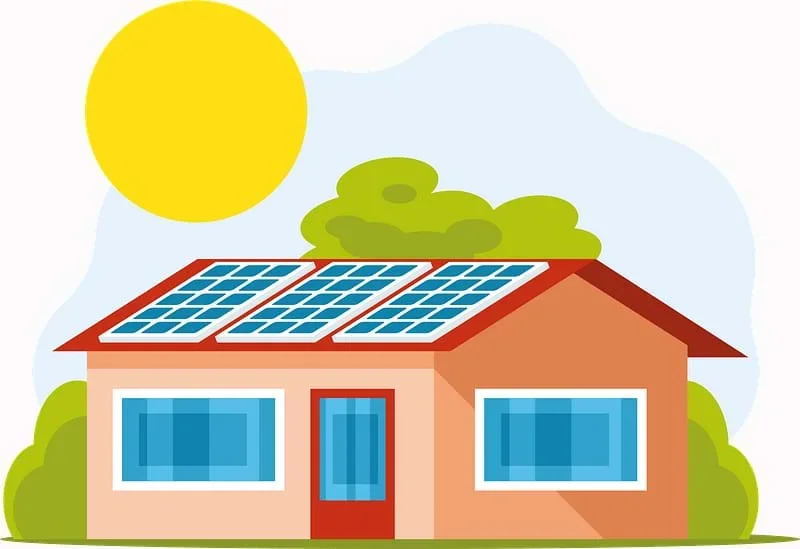 Capturing solar energy to use within a house.Copyright 2020 Creazilla, CC0 1.0 Universal (CC0 1.0).
https://creazilla.com/nodes/59572-solar-panels-on-roof-clipart
Capturing solar energy to use within a house.Copyright 2020 Creazilla, CC0 1.0 Universal (CC0 1.0).
https://creazilla.com/nodes/59572-solar-panels-on-roof-clipart
Students explore heat transfer and energy efficiency using the context of energy efficient houses. They gain a solid understanding of the three types of heat transfer: radiation, convection and conduction, which are explained in detail and related to the real world. They learn about the many ways solar energy is used as a renewable energy source to reduce the emission of greenhouse gasses and operating costs. Students also explore ways in which a device can capitalize on the methods of heat transfer to produce a beneficial result. They are given the tools to calculate the heat transferred between a system and its surroundings.
Energy transfer, and specifically the transfer of thermal energy, is a fundamental area of study for all engineers. Radiation makes the Earth habitable for humans, and provides us with renewable solar energy. Convection is the backbone of the mechanics behind air flow in buildings and the air exchange in a typical home. Conduction makes it possible to heat a five-gallon saucepan all the way to the handle from just a single flame beneath it. Almost unlimited forms of heat transfer are evident everywhere in our world and their importance is significant, especially to the field of engineering. For example, in designing a building's ventilation system, engineers consider the heat transfer of the building to its surroundings as well as the internal heat transfer. Likewise, they select materials that either minimize or maximize the transfer of heat through particular components to optimize efficiency.
After this lesson, students should be able to:
- Explain in detail the three types of heat transfer, and give examples of each.
- Explain why certain materials are better than others for transferring heat.
- Apply what they have learned about heat transfer and materials to real-world problems.
- Use direct and indirect evidence to develop and support claims about the conservation of energy in a variety of systems, including transformations to heat
Grades 9-12
Do you agree with this alignment?
- Energy resources can be renewable or nonrenewable.
Grades 9-12
Do you agree with this alignment? - STEL-4P Evaluate ways that technology can impact individuals, society, and the environment.
Grades 9-12
Do you agree with this alignment?
A basic understanding of insulators and conductors.
Conduction: The transfer of energy by conduction is possible because of the kinetic energy produced from collisions between atoms and molecules in a substance. As thermal energy is transferred, hotter molecules possess higher kinetic energy and collide with colder ones, thereby increasing the energy of the colder molecules. This process continues throughout a substance until thermal equilibrium is achieved. Different materials transfer heat at different rates—according to their specific properties. The rate at which a material transfers thermal energy through itself is called its thermal conductivity. The opposite of this is thermal resistance, which measures the ability of a material to resist the transfer of heat. Insulator materials are measured in terms of thermal resistance, rather than thermal conductivity.
Thermal Conductivity: Thermal conductivity is the quantity of heat transmitted during a specific time through a thickness of material, in a direction normal (perpendicular) to a surface of area. Refer to the hands-on design associated activity, Solar Water Heater, to illustrate this concept with a real world example. Thermal conductivity may be measured mathematically using the following equation:

Convection: Convection is the transfer of heat through a fluid medium, such as water or air. For example, as air is heated, it becomes less dense than the surrounding air, causing it to rise and carry its thermal energy with it. Cooler air sinks, due to its higher density. Heat transferred by convection flows from areas of higher pressure to areas of lower pressure, which is the cause for weather patterns that we observe every day.
Radiation: Radiation is heat radiated in the form of rays or waves. This energy transfer occurs via waves that do not require a medium through which to travel. Radiation is how heat from the sun reaches us after traveling through mostly empty space. Radiation energy is transferred mostly in the form of infrared light, but some is also visible light.
Evaporation: When the atoms or molecules of a liquid (such as water) are exposed to a significant volume of gas, they tend to spontaneously enter the gaseous state, or evaporate. This happens because the molecules near the fluid's surface are constantly moving in all different directions at random speeds, and colliding with one another. During these collisions, a few molecules gain enough kinetic energy to push them past the boiling point of water, causing them to evaporate and become water vapor. But, most of the molecules do not have enough energy to do this, which is why liquids do not instantly turn into vapor. Boiling water significantly increases the energy of the molecules, which, in turn, speeds up the evaporation process.
Cooling by Way of Evaporation: When liquid water evaporates, heat transfers from the higher temperature of the air (through convection) to the lower temperature of the water, cooling the air. One might think that the temperature of the water would increase until thermal equilibrium between the air and water is reached, but this does not happen. Because energy is required for the water to evaporate in the first place, the heat that is transferred to the water ends up being used to facilitate the process of evaporation. So, the temperature of the water remains below the temperature of the air. The process of evaporative cooling continues until the air is fully saturated, or at 100% relative humidity. As the relative humidity of the air increases however, the process becomes less effective as less water is able to evaporate. Refer to the associated activity Swamp Cooler for a hands-on design illustration where student teams design and build evaporative cooler devices (swamp coolers), to learn about the process that cools water during the evaporation of water.
 Copyright 2004 Microsoft Corporation, One Microsoft Way, Redmond, WA 98052-6399 USA. All rights reserved.
Every day, the sun's thermal energy travels through 91 million miles (146 million km) of empty space all the way to earth. The sun's energy is the driving force for all life systems that exist on our planet today. Without a way to transfer this energy from the sun to the earth, we would be in big trouble. And, this is just one example of why the transfer of thermal energy is such an important concept to humans. Without a way to transfer this thermal energy, the earth wouldn't be what it is today. The sun's energy is radiated to us in the form of heat and visible light. And, it is the predominant source of renewable energies used throughout the world today.
The physics behind the transfer of thermal energy explains how we are able to harness renewable energy from the sun and convert it to energy that we can use in our daily lives. The transfer of heat between substances at different temperatures occurs in three different ways: conduction, convection, and radiation. All three are part of our everyday experiences. Conduction is the transfer of heat through a specific material, such as heat moving through a metal pot being heated on the stove. Convection is the transfer of heat through a fluid such as water or air, instead of a material. You can experience this by lying down on the floor of your house. The air down low is cooler, right? This is because warmer air rises towards the ceiling, leaving the cool air behind, low to the ground. Situations in which heat is transferred through a fluid medium (air) are examples of convection. Radiation is energy that is radiated or transmitted in the form of rays, waves or particles. An everyday example of this is the heat that you feel on your skin from sunlight.
Insulation and Conduction
 Copyright 2004 Microsoft Corporation, One Microsoft Way, Redmond, WA 98052-6399 USA. All rights reserved.
Why is it that some materials feel colder to the touch than others? It is not necessarily because one material is at a colder temperature. Rather, it is because some materials are better conductors than others. This basically means that they are better at transferring thermal energy throughout themselves. For example, a tile floor feels colder to your bare foot than carpeting (at the same temperature) because the tile transfers thermal energy out of your foot much faster than the carpet. Materials that do not conduct very well are the ones we use for insulation to limit the transfer of heat as much as possible. Metals such as copper, on the other hand, provide optimal transfer of thermal energy and are useful when trying to heat something up more quickly.
(Teacher demonstration: Place a beaker of water on a Bunsen burner and bring the water to boil. Place a piece of copper tubing in the water, so that one end is sticking out. Ask the students the following question.) Can you identify all three forms of heat transfer in this demonstration? (Answer: Convection is happening as the water transfers heat throughout itself [cold water falls, while hot water rises within the beaker]. Heat is conducted through the copper pipe from the submerged end to the exposed end. Heat is radiated from the burner and outward from the beaker [demonstrate by holding hands close to the beaker, without actually touching it].)
Energy transfers are constantly occurring and re-occurring all around us. Some engineers study methods of energy transfer because they design mechanical systems that produce the necessary energy to keep the air in buildings comfortable and of good quality. Some examples of these systems are swamp coolers, air conditioners and hot water or air heating systems.
We've learned that heat can be transferred in three different ways. What are they? (Answer: Conduction happens by vibrating molecules within a material, convection occurs through air or water, and radiation happens via rays, waves or particles that carry energy.) Using different materials, we can either maximize heat transfer (with high conductance), or prevent it as much as possible (using insulators). Knowing this about materials is useful in the design of all kinds of things we use everyday. In what ways do we see materials being used because they are good conductors or good insulators? (Possible answers: Conductors such as copper-bottomed sauce pans and steel radiators. Insulators such as a thermal coffee cup, oven mitts or walls in your home.)
Engineers apply their knowledge of the principles of heat transfer to the design of many products for people to use. They also use heat transfer concepts to explore emerging technologies that use renewable resources and are less destructive to the environment — which helps us all. An understanding of how energy transfers opens up endless possibilities for engineering solutions.
- conduction
- The transfer of heat through a substance by direct contact of atoms or molecules.
- convection
- The transfer of heat by circulation of a gas (such as air) or liquid (such as water).
- emissivity
- The difference between the amount of heat being absorbed, and the amount being reflected by an object. The lower the emissivity, the less heat is absorbed and the more heat is reflected. This ability is highly dependent on color; black objects absorb more heat than white objects.
- evaporation
- The process whereby atoms or molecules in a liquid state gain enough energy to become a gas or vapor.
- greenhouse gases
- Gases that trap the heat of the sun in the earth's atmosphere, producing the greenhouse effect. The two major greenhouse gases are water vapor and carbon dioxide.
- radiation
- Heat radiated in the form of rays or waves (such as rays from the sun).
- renewable energy
- Energy generated from resources that are unlimited, rapidly replenished or naturally renewable such as wind or solar energy.
- solar energy
- Energy derived from the sun in the form of solar radiation.
- specific heat capacity
- The amount of heat that must be added or removed from a unit mass of that substance to change its temperature by one degree.
- thermal conductivity
- The rate at which a material transfers thermal energy through itself.
- thermal equilibrium
- A state in which all parts of a system are at the same temperature.
- thermal resistance
- The rate at which a material resists the transfer of heat through itself.
Pre-Lesson Assessment
Group Discussion: Ask the students and discuss as a class:
- Why is it important to understand the way that energy is transferred through a particular medium (such as air or water)? (Answer: If we can understand the way heat is transferred, we can use this understanding to create more efficient and more logical systems.)
Post-Introduction Assessment
Group Discussion: Ask the students and discuss as a class:
- What is the importance of material selection in choosing a pipe for a hot water system? (Answer: It is important to choose a pipe with a high thermal conductivity (such as copper) so that the heat transfers very quickly and with minimal loss.)
Lesson Summary Assessment
Concept Reflections / Journal Writing: Have students reflect on the principles of heat transfer, and write a journal entry on their thoughts. Ask the students:
- How can we capitalize on the principles of heat transfer to improve the way we live? (Answers will vary. Example answer: By analyzing heat transfer, we have a way to find problem areas within a system, and then solve them, resulting in optimization of resources. By experimenting with new mediums and materials, we make progress to improve technology for the benefit of everyone.)
Have students find out what kind of water heating system is in their home, and then research the advantages and disadvantages of this type of system.
See great animations and examples of all three types of heat transfer at this Wisconsin Online Resource Center website: http://www.wisc-online.com/objects/index_tj.asp?objID=SCE304.
Departmental course outline for Algebra 1. Lexington High School Mathematics, Lexington, MA. Accessed February 5, 2008. http://lps.lexingtonma.org/site/default.aspx?PageType=3&ModuleInstanceID=1574&ViewID=7b97f7ed-8e5e-4120-848f-a8b4987d588f&RenderLoc=0&FlexDataID=1133&PageID=1353
Evaporation. Last updated December 5, 2007. Wikipedia, The Free Encyclopedia, Wikimedia Foundation, Inc. Accessed February 5, 2008. http://en.wikipedia.org/wiki/Evaporation
Heat Transfer. Last updated October 9, 1999. Theoretical Physics, University of Winnipeg, Canada. Accessed February 5, 2008. http://theory.uwinnipeg.ca/mod_tech/node74.html
Glossary of Teat Transfer Terms. eFunda, Engineering Fundamentals. Accessed February 5, 2008. http://www.efunda.com/formulae/heat_transfer/home/glossary.cfm
Jarvis, Laurie, and Deb Simonson. Heat Transfer: Conduction, Convection, Radiation. Fox Valley Community College, Wisconsin Online Resource Center (WISCONLINE.ORG Consortium). Accessed February 5, 2008. http://www.wisc-online.com/objects/index_tj.asp?objID=SCE304
Contributors
Landon B. Gennetten; Lauren Cooper; Malinda Schaefer Zarske; Denise W. Carlson
Supporting Program
Integrated Teaching and Learning Program, College of Engineering, University of Colorado Boulder
Acknowledgements
This digital library content was developed by the Integrated Teaching and Learning Program under National Science Foundation GK-12 grant no. 0338326, and the Discovery-Learning Apprentice Program at CU-Boulder's College of Engineering and Applied Science. However, these contents do not necessarily represent the policies of the National Science Foundation, and you should not assume endorsement by the federal government.
Copyright
2007 by Regents of the University of Colorado.