
Circuits
 Circuits are everywhere in your house.Copyright 2006 Microsoft Corporation, One Microsoft Way, Redmond, WA 98052-6399 USA. All rights reserved.
Students are introduced to several key concepts of electronic circuits. They use the hands-on associated activity to learn about some of the physics behind circuits, the key components in a circuit and their pervasiveness in our homes and everyday lives. Students learn about Ohm's law and how it is used to analyze circuits.
To design and create the endless number of devices and processes that use electricity and circuits, engineers require a basic understanding of electricity and the physics behind circuits. Electrical engineers design the circuitry for the products we use every day. They also design computers and telecommunication devices, lighting and wiring for buildings, and operating electric power stations. Electrical engineers address energy conservation in our homes and businesses by developing better ways to design and implement circuits and electronic devices to efficiently use and ultimately save energy.
After this lesson, students should be able to:
- Define electric current and voltage.
- Explain the relationship between voltage, current and resistance (Ohm's law).
- List several different circuit components.
- Use appropriate measurements, equations and graphs to gather, analyze, and interpret data on the quantity of energy in a system or an object
Grades 9-12
Do you agree with this alignment?
- Power systems must have a source of energy, a process, and loads.
Grades 9-12
Do you agree with this alignment?
A basic understanding of electricity, including closed and open circuits.
How Batteries Work
The way batteries produce charge is a matter of chemistry. In a battery, electrons move from its positive terminal to its negative terminal, through the wires and circuitry of the device, and back into the positive terminal of the battery. This is called a closed circuit. As one coulomb of charge worth of electrons (-1.601 x 10⁻¹⁹ coulombs of charge) moves from the positive terminal to the negative terminal of the battery, an increase in energy occurs, equal to 9 joules. The calculation for this is shown below, where EP is the electric potential.
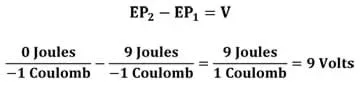
(Note: The values for EP1 and EP2 could have been anything, so long as their difference was equal to 9, since this is the battery's voltage; much like potential energy, one must set the data upon which all other measurements are taken. In the case of voltage, engineers often use ground, or 0 volts, as their initial datum. Thus, there is 0 EP at one terminal. Also, the charge is negative because electrons have a negative charge.) At the negative terminal, the 1 coulomb of charge worth of electrons has a certain energy; after traveling to the positive terminal, the energy has increased by 9 joules due to the difference in the electric potential found in the battery. This process is illustrated in Figure 1.
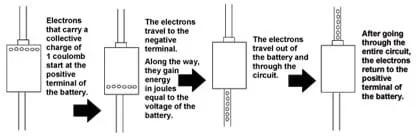 Figure 1. How voltage works in a battery.Copyright 2008 Tyler Maline, ITL Program, College of Engineering, University of Colorado Boulder
This calculation also involves polarity. Each voltage, and therefore each battery, has a positive and negative terminal; the negative terminal is the lower (often ground, or zero) electric potential. If the electrons in a circuit flow from the positive terminal to the negative terminal of any voltage source (as seen in Figure 1), the voltage source supplies energy. But, if the electrons are going the opposite direction, in the negative and out the positive terminal, the source is absorbing energy. This is the basic idea for rechargeable batteries.
Common Circuit Components
Every circuit in the world, though, is not made up of just a voltage source (such as a battery) and a resistor or two. Numerous circuit components can be added to enable some fascinating tasks to be accomplished. Following are some of the most common circuit components.
Capacitors are components that store energy in an electric field. This is often obtained by charging two parallel plates equally, but oppositely. In this case, one plate has an excess of protons and the other has an excess of electrons. This scenario results in an electric field between the two plates because of the difference in charge. This electric field stores energy for release at a later time. Capacitors cannot create energy, they simply store energy obtained through the flow of current between the plates. Figure 2 illustrates the entire process, from when the capacitor is first accumulating charge, and thus energy, to being fully charged.
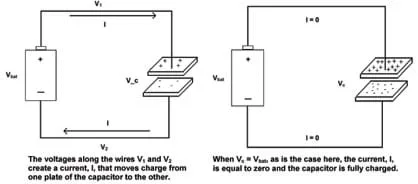 Figure 2. Parallel-plate capacitor being charged by a battery.Copyright 2008 Tyler Maline, ITL Program, College of Engineering, University of Colorado Boulder
The capacitance (C) of a capacitor is the important quantity associated with capacitors. It is defined as the ratio of the charge (Q) and the voltage of the capacitor:

The capacitance unit is the farad, defined as 1 coulomb per volt. Most capacitors never have a capacitance of one farad and often most capacitors are measured in microfarads (μF). One classic application of a capacitor is a camera flash. The energy to create a flash is stored using a capacitor. To create a flash when taking a photograph, the capacitor is discharged, releasing its stored energy in the form of light.
Inductors are common circuit components that use a magnetic field to store energy. Inductors are most commonly created by wrapping a coil of wire around some core, called a solenoid. They are used to produce an inductance. The inductance is analogous to a capacitor and the capacitance as a way to measure the amount of energy stored in the magnetic field produced when a current runs through the coils of a solenoid. The unit of inductance is the henry (H). Unlike resistors and voltage, equations defining the physics of inductors and capacitors involve knowing single-variable calculus, which is more advanced than this lesson.
Transistors are circuit components made of a semi-conductor (a material that sometimes acts like an insulator and sometimes like a conductor) and are often used as an amplifier or a switch. Transistors are considered the building blocks for all modern electronic devices including computers and cell phones. They are often found in integrated circuits; for example, an advanced microprocessor in a computer has upwards of 1.7 billion transistors in it. They are the biggest reason for the advancement of electronics in the 20th century.
Integrated circuits are common components found in electronic circuits. These specialized circuits are designed to perform a given task and are often made up of several other components such as resistors, capacitors, inductors, transistors and diodes. The individual components of an integrated circuit are all manufactured onto a single silicon crystal (chip) at the same time. Examples of integrated circuits include operational amplifiers, microprocessors and logic circuits. The increasingly efficient and rapid production of integrated circuits has led to a low per-chip cost, paving the way for rapid technological advancement of electronic devices.
Do you know why a cell phone must have a battery or why a computer must be plugged in to work? (Answer: Those devices need electricity to work.) Did you know that a battery or the power coming from the outlet in the wall is part of an electrical circuit? When a battery is placed in the cell phone or when a computer is plugged in, the circuit in the device is completed or "closed," allowing electric current to flow.
Circuits can be found all around us — in our homes, schools and businesses. Electrical engineers are most commonly associated with the development of circuits, but they are not the only engineers who work with and know about circuits. Most engineers must understand electricity and the physics behind circuits so they can design any devices that use electricity. Mechanical engineers, for example, use circuits when designing motors. Aerospace engineers use circuits when designing controls for spacecraft. Today we are going to learn about some of the physics behind circuits and also about some of the key components that are used to create circuits.
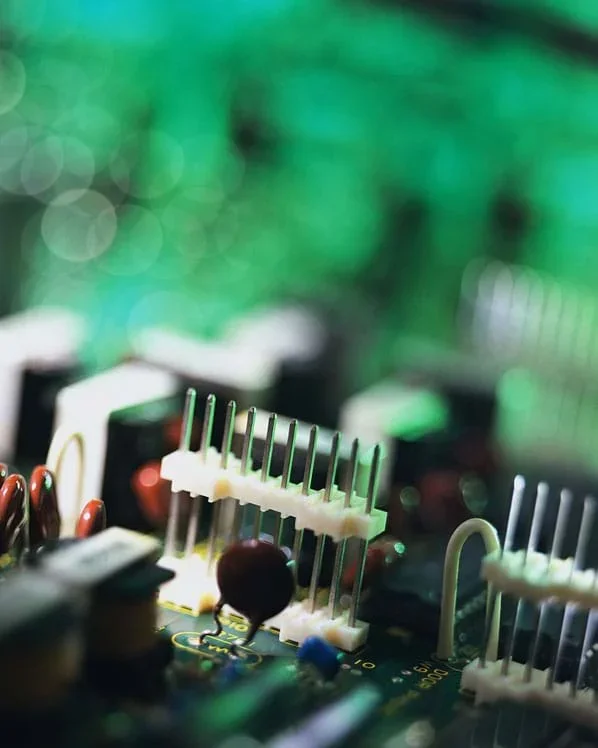
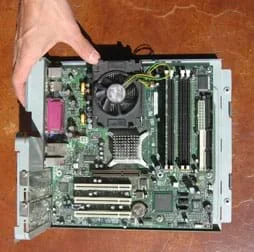 The circuitry inside your computer might look something like this.Copyright 2008 Denise W. Carlson, ITL Program, University of Colorado Boulder
To begin to understand circuits and electricity, let's start with electric current. Electric current is the flow of positive charge. It is essentially a measure of the number of positive charges that pass across a set boundary (a point in space, the cross section of a wire, etc.) per unit of time. (Note: in an actual circuit the moving charges are electrons, which contain a negative charge. Therefore electric current is actually defined as moving opposite the path taken by electrons.)
The unit of electric current is the unit of charge (coulomb) per second. A coulomb per second is also called an ampere (A) or amp for short. Currents found in household devices are generally around 1 amp. However in electronic devices such as stereos and computers, the current is often on the scale of milliamps (1mA = 10-3A) or microamps (1μA = 10-6A).
The two types of current are: alternating current and direct current. Alternating current comes out of your typical wall sockets in homes, schools and businesses. It is called "alternating" because the direction of the current is constantly changing. In the US, the alternating current from wall sockets is at 60 Hz (Hertz). This means that the current is changing directions 60 times every second. Direct current is the current produced by batteries. It always travels in one direction. Current is important because the moving charges carry energy and have a potential to do work.
Voltage is a measure of the difference in electrical potential between any two points. The unit for voltage is joules per coulomb (energy per charge), which has been given the name volt (V). Electrical potential is the potential energy per unit charge (joules/coulomb) associated with an electric field. Voltage is similar to the difference in gravitational potential energy for an object due to its height. Just like with gravitational potential energy, electric potential is only useful when we analyze the difference between two points. Any time a voltage measurement is taken, it is measured between two points (which is why a multimeter has two prongs). Voltage also has what is called polarity, or a positive and negative end (similar to a magnet with a north and south pole). Polarity is important in determining whether an element in a circuit is absorbing energy or supplying energy.
For a good example of voltage, let's look at how a battery works. Every battery has a voltage rating associated with it, for example, 1.5 volts for a D battery, 9 volts, 12 volt car batteries. This means that a 9 volt battery placed into an electronic device has 9 joules of electric potential energy between its two terminals. This battery provides the device with 9 joules of energy for each coulomb of charge it moves across the length of the battery.
Now that we have defined and discussed voltage and electric current, let's talk a little about circuits. One main physics relationship used for the analysis of all circuits is known as Ohm's law. Ohm's law states that the voltage across a resistor is proportional to the current flowing through the resistor. In equation form, it looks like this:
V=IR
where V is the voltage across the resistor, I is the current flowing through the resistor and R is the resistance of the resistor.
The unit of resistance is Ohms (Ω). Ohm's law provides us with a definition for a resistor. A resistor is an object that produces a voltage drop across its terminals in order to resist the flow of electric current through it. Note that Ohm's law works only when the resistance of the component is constant. Many components, such as a light bulb or a diode, do not have a constant resistance. Components with a constant R are called ohmic and components in which R varies are considered nonohmic. The relationships described by Ohm's law give us a way to calculate variables like the current through a resistor, or the voltage across a resistor, in a circuit. Ohm's law is important in the analysis of circuits when the current or voltage across a resistor is unknown.
Several components can be built into a circuit for different uses. Some of these components include resistors (any two terminal objects that provide a voltage drop in order to oppose the flow of current through it), capacitors (stores energy in an electric field), inductors (stores energy inside of an electric field) and transistors (commonly used as an amplifier or a switch). An integrated circuit is one that has been designed to perform a given task and is often made up of several other components such as resistors, capacitors, inductors and transistors. The individual components of an integrated circuit are all manufactured onto a single silicon crystal (chip) at the same time. Transistors and the integrated circuit are both integral in the modern electronic revolution that has brought about cell phones, computers and the many electronic devices we use every day.
Circuits have many functions when designing energy-efficient houses. They can be designed to turn on lights when a person enters a room and to turn off after no one has been around for a while. They are used to regulate the air temperatures inside buildings by controlling the heating and air conditioning equipment (Refer to the Designing a Thermostat activity to have students investigate circuit components and design their own thermostat application). They can even be used to control water temperature, the amount of light entering a room, and storage of energy from photovoltaic systems for later use.
Today, we started our study of circuits by first learning about electric current and voltage. What was the important mathematical expression in physics that relates voltage and current? That's right – Ohm's law, which describes the relationship between current and voltage and provides us with a definition for a resistor.
Circuits are the backbone of electronics. Without circuits we would not have many of the things we take for granted in our everyday lives. Circuits are also good for automating processes and allowing for greater energy efficiency by controlling many routine tasks. Circuits can be designed to turn on lights when a person enters a room and to turn them off after people have left. They can regulate and control heating and cooling systems to create desired air temperatures in houses and buildings. They can tell your computer when to turn off the screen if it has not been used in a while. What other things do you know about that contain circuits?
- alternating current
- Current that is constantly changing directions, such as the electric current accessible via wall sockets in our homes and businesses.
- ampere
- The unit of measure for electric current. Defined as 1 coulomb per second.
- capacitance
- The ability of the electric field in a capacitor to store energy. The main measurement of capacitors. Defined as the ratio of the charge and the voltage of the capacitor.
- capacitor
- A circuit component that stores energy inside of an electric field.
- closed circuit
- A circuit that allows current to flow.
- coulomb
- The unit of measure for charge.
- direct current
- Current that travels in only one direction, such as the current supplied from a battery.
- electric current
- The flow of positive charges through a conductor (wire, plate, electric field).
- electrical potential
- A measure of the potential energy contained in an electric field.
- farad
- Unit of measure for capacitance or electric capacity. Named for engineering physicist Michael Faraday.
- inductance
- The ability of a magnetic field to store energy. The main measure of an inductor.
- inductor
- A circuit component that stores energy inside of a magnetic field.
- integrated circuits
- Circuits built onto a silicon crystal, or chip, that contain many common circuit components and are designed to perform some defined task.
- ohm's law
- The statement of the physics relationship that for any circuit, the strength of an electric current (I) is directly proportional to the voltage (V) and inversely proportional to the resistance (R) of the circuit. V = IR
- resistance
- A measure of an object's ability to restrict the flow of current through it.
- resistor
- Any two terminal objects that provide a voltage drop in order to oppose the flow of current through it.
- transistor
- A semiconductor that is commonly used as an amplifier or a switch. It is the building block of all modern circuitry including computers and cell phones.
- volt
- The unit of measure of voltage. Defined as a joule per coulomb.
- voltage
- A measure of the difference in electrical potential between two points in an electric field.
Pre-Lesson Assessment
Discussion Question: Solicit, integrate and summarize student responses by writing their answers on the board. Ask the students:
- What things do you use every day that have electric circuits? (Possible answers: Computers, cell phones, iPods, stereos, TVs, cars, etc.)
Post-Introduction Assessment
Brainstorming: As a class, have students engage in open discussion. Remind them that in brainstorming, no idea or suggestion is "silly." All ideas should be respectfully heard. Take an uncritical position, encourage wild ideas and discourage criticism of ideas. Have students raise their hands to respond. Write their ideas on the board. Ask the students:
- How might circuits be used to make a device or a home more energy efficient? (Possible answers: A digital thermometer with an on / off point, a circuit that automatically turns off a light when it is not needed, computer/monitor/copier screensavers/sleep mode that use less energy if inactive for a while, an automatic coffee pot that turns off by itself, etc.)
- Many automatic processes use circuits to accomplish a task. Thermostats, automatic light switches, motors, and home security systems all use circuits. Besides common electronic devices such as stereos, iPods, computers, cell phones, video games, TVs, DVD players, what other things in our world use circuits? (Possible answers: Cars, thermostats, automatic light switches, sprinkler systems, automatic doors, traffic lights, cross walk buttons, remote controls, voice mail, motors, home security switches, assembly lines/factories/plants, etc.)
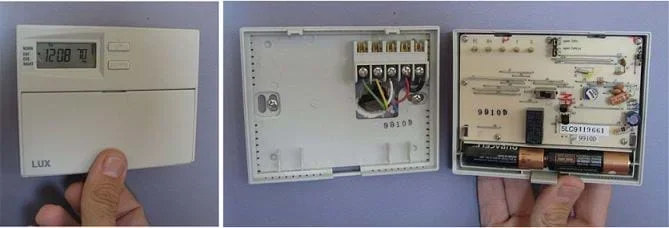 This digital thermostat regulates home heating and cooling to provide efficient energy use.Copyright 2008 Denise W. Carlson, ITL Program, University of Colorado Boulder
Lesson Summary Assessment
Math Application: Write the equation, I = V ÷ R, on the board. Remind students that this is called Ohm's law. Explain that I = current = flow of electric charge through the circuit (this remains constant through a closed circuit), V = voltage = batteries used, and R = resistance = bulbs used. Challenge the students to answer the following questions in terms of Ohm's law:
To increase the energy efficiency of their home, a Colorado family installed a solar panel on its roof. They want to add another solar panel to increase their ability to store energy for the winter.
- What happens to the current (I) when they add another solar panel (V)? (Answer: The current increases.)
- What happens to the current (I) when they add an appliance to their circuit (R)? (Answer: The current decreases.)
- What happens to the current (I) when they have an open switch? (Answer: The current (I) = 0 since no electrons can move through the circuit.)
Assign students to research different types of thermostats. Several types of electrical and mechanical thermostats exist. Have them describe the way a digital thermostat works.
Electrical engineers often work with controls of systems, including telecommunications controls. Engage students in a discussion about telecommunications and its importance in today's society.
Hambley, Allan R., Electrical Engineering: Principles & Applications, Third Ed. Upper Saddle River, NJ: Pearson Education Inc., 2005.
Contributors
Tyler Maline; Lauren Cooper; Malinda Schaefer Zarske; Denise W. Carlson
Supporting Program
Integrated Teaching and Learning Program, College of Engineering, University of Colorado Boulder
Acknowledgements
The contents of this digital library curriculum were developed under a grant from the Fund for the Improvement of Postsecondary Education (FIPSE), U.S. Department of Education and National Science Foundation GK-12 grant no. 0338326. However, these contents do not necessarily represent the policies of the Department of Education or National Science Foundation, and you should not assume endorsement by the federal government.
Copyright
2007 by Regents of the University of Colorado.