
Zero-Energy Housing
Students investigate passive solar building design with a focus solely on heating. They learn how insulation, window placement, thermal mass, surface colors, and site orientation play important roles in passive solar heating. They use this information to design and build their own model houses, and test them for thermal gains and losses during a simulated day and night. Teams compare designs and make suggestions for improvements.
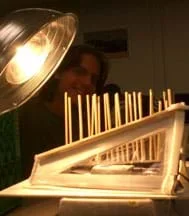 How can we design our houses to passively use the "free" energy from the sun for heating?
Passive solar heating techniques gain more attention when conventional energy costs and global climate change concerns increase. Engineers are at the center of designing solutions to address these issues and they place a lot of attention on passive solar heating as a means of reducing our dependence on non-renewable energy sources. Passive solar design is best incorporated into new buildings and structures; it is more challenging to add to existing buildings.
After this activity, students should be able to:
- Model a few techniques used in passive solar heating.
- Explain the importance of passive solar heating.
- Identify the role an engineer plays in passive solar design.
- HS.3.1.b Summarize, represent, and interpret data on two categorical and quantitative variables.
Grades 9-12
Do you agree with this alignment? - HS.3.1.b.ii Represent data on two quantitative variables on a scatter plot, and describe how the variables are related.
Grades 9-12
Do you agree with this alignment? - HS.3.1.c.i Interpret the slope and the intercept of a linear model in the context of the data.
Grades 9-12
Do you agree with this alignment?
- Develop, communicate, and justify an evidence-based scientific explanation regarding the costs and benefits of exploration, development, and consumption of renewable and nonrenewable resources
Grades 9-12
Do you agree with this alignment?
- CCSS.Math.Content.HSS-ID.B Summarize, represent, and interpret data on two categorical and quantitative variables
Grades 9-12
Do you agree with this alignment? - CCSS.Math.Content.HSS-ID.B.6 Represent data on two quantitative variables on a scatter plot, and describe how the variables are related.
Grades 9-12
Do you agree with this alignment? - CCSS.Math.Content.HSS-ID.C.7 Interpret the slope (rate of change) and the intercept (constant term) of a linear model in the context of the data.
Grades 9-12
Do you agree with this alignment? - CCSS.Math.Practice.MP4 Model with mathematics.
Grades K-12
Do you agree with this alignment?
- Students will develop an understanding of the attributes of design.
Grades K-12
Do you agree with this alignment? - Students will develop an understanding of engineering design.
Grades K-12
Do you agree with this alignment? - Evaluate final solutions and communicate observation, processes, and results of the entire design process, using verbal, graphic, quantitative, virtual, and written means, in addition to three-dimensional models.
Grades 9-12
Do you agree with this alignment? - STEL-4P Evaluate ways that technology can impact individuals, society, and the environment.
Grades 9-12
Do you agree with this alignment?
- HS-ETS1-2 Design a solution to a complex real-world problem by breaking it down into smaller, more manageable problems that can be solved through engineering.
Grades 9-12
This resource focuses on the following Three Dimensional Learning aspects of NGSS:
Science & Engineering Practices- Design a solution to a complex real-world problem, based on scientific knowledge, student-generated sources of evidence, prioritized criteria, and tradeoff considerations.Do you agree with this alignment?
Disciplinary Core Ideas- Criteria may need to be broken down into simpler ones that can be approached systematically, and decisions about the priority of certain criteria over others (trade-offs) may be needed.Do you agree with this alignment?
Do you agree with this alignment? - Design a solution to a complex real-world problem, based on scientific knowledge, student-generated sources of evidence, prioritized criteria, and tradeoff considerations.
- HS-ETS1-3 Evaluate a solution to a complex real-world problem based on prioritized criteria and trade-offs that account for a range of constraints, including cost, safety, reliability, and aesthetics, as well as possible social, cultural, and environmental impacts.
Grades 9-12
This resource focuses on the following Three Dimensional Learning aspects of NGSS:
Science & Engineering Practices- Evaluate a solution to a complex real-world problem, based on scientific knowledge, student-generated sources of evidence, prioritized criteria, and tradeoff considerations.Do you agree with this alignment?
Disciplinary Core Ideas- When evaluating solutions it is important to take into account a range of constraints including cost, safety, reliability and aesthetics and to consider social, cultural and environmental impacts.Do you agree with this alignment?
Crosscutting Concepts- New technologies can have deep impacts on society and the environment, including some that were not anticipated. Analysis of costs and benefits is a critical aspect of decisions about technology.Do you agree with this alignment?
Do you agree with this alignment? - Evaluate a solution to a complex real-world problem, based on scientific knowledge, student-generated sources of evidence, prioritized criteria, and tradeoff considerations.
Each group needs:
- 32 x 20-inches sheet of 1/8-inch foam core board (this is one half of the standard foam core board sheet, typically available with the dimensions of 1/8-inch x 32-inches x 40-inches [.32 x 81 x 102-cm]; this is about 9 sq ft or .84 sq m)
- 1 sq ft (.09 sq m) thin clear plastic
- 4 sq ft (.37 sq m) aluminum foil
- 2 sq ft (.19 sq m) thin rubber (any kind)
- 2 sq ft (.19 sq m) black fabric (any kind)
- pencils, erasers and white or graph paper for designing and graphing
- (optional) Excel software for recording and graphing group data
- Design Challenge Handout (PDF), one per group
- Analysis & Results Worksheet (PDF), one per group
For the entire class to share:
- hot glue guns and/or tacky glue
- scissors
- utility knife
- thumbtacks
- scotch tape
- masking tape
- protractor
- straight edge (metal ruler)
For one testing station (you may want more than one station):
- 300-watt light bulb
- desk or clamp lamp (that can safely accommodate a 300-watt light bulb)
- floor or box fan
- ice
- bucket or plastic container (for the ice)
- thermometer (alternative: use a laptop and HOBO data loggers to automatically take and record temperature readings at specified intervals)
- watch or timer to determine 30-second intervals
- Teacher Testing Steps (PDF)
Students should know how to graph data and find the slope of a line from a graph.
Imagine if we could heat houses without the use of ANY electrical or gas heaters! Think about the positive effects it would have on people all around the world. Millions of people would be able to stay warm all through the winter, save money on energy bills, and lower the greenhouse gas emissions. Interest in passive solar design is growing rapidly because of the increasing cost of energy as well as growing concerns about global climate change. This has inspired engineers to develop new techniques for passive heating and cooling that can be more easily incorporated into existing buildings and homes.
Passive solar heating brings us closer to a "zero-energy solution" than people might think. Of all the heating methods, passive solar offers the cheapest up-front costs, best reliability, easiest maintenance, and no ongoing demand for energy to operate. Unfortunately, passive solar heating is not an instant replacement to conventional heating methods because homes would need to be re-designed around the various methods to maximize the amount of heating produced. And, even then it sometimes does not produce enough heat as is desired. For now, engineers combine passive solar heating with conventional methods to reduce the need for energy-guzzling heating appliances.
Although passive solar design might seem new to you, the basic principles have been around for centuries. In years past, Native Americans who lived in harsh desert locations built partially-underground homes that kept them cool during the day and warm at night. They also built adobe homes in cliff-side caves that were chosen because the winter sun warmed them and the summer sun couldn't reach them. Today, engineers are expanding upon these principles to apply them to the many and varied homes that we all live in, so we can be efficient in our energy usage and save some money on our heating bills.
An important part of a good passive solar design is excellent insulation. This is true for any HVAC (heating, ventilating and air conditioning) system, but it is especially important in passive design because passive solar heating does not produce as much heat as conventional methods. So — it is important that the heat produced is not wasted. While a number of materials exist to create well-insulated walls, ranging from spray-on foam to hay bales, it is important to remember to insulate the other parts of your house — all the places that separate the inside from the outside. These places include the roof/ceiling, and windows and doors. For example, windows let considerably more heat escape to the outside than the walls of your home.
Windows are another important component of passive solar designs. You don't want to have too many windows for a good passive solar design. On the other hand, while a windowless building would have the best insulation, would you want to live in it? Rather than eliminate windows altogether, you can install high-quality, double-pane windows and place them in strategic locations. Double pane windows are much better insulators than single pane ones. (In fact, engineers have designed many types of high-tech windows that are helpful for good passive solar design.) For heating purposes, windows are best placed primarily on the equator-facing wall so that they can let sunlight in. Windows, placed in the right locations, can bring in the most sunlight without losing too much heat.
Once the sunlight comes into a room, two other aspects of passive solar design become important: thermal mass and surface color. You probably already know that darker colors absorb more sunlight than lighter colors, so, for passive solar heating, we would want darker colors on the outside and inside of a building. A good thermal mass is a material that can absorb lots of heat and release it slowly when the surrounding temperature starts to go down. A few materials with a high thermal mass are concrete, bricks and water. When used properly, these materials absorb the heat from the sunlight coming through windows and then release that heat throughout the night. Using windows, darker colors, and thermal masses, we can create a passive solar heating design that warms up a house during the day and keeps it warm throughout the night. The trick comes in finding the right amount of each item to be used and integrating it into a house.
Another point to consider is the amount of space being heated. Larger volumes of space need more heat to make the same gain in temperature as a smaller volume. So a smart passive solar design would limit the space that needs heating to as little as necessary.
The final component to remember in passive solar design is the overall orientation of your design elements. Do you know which way the sun comes up and goes down and shines all day long? You must know from which direction the sun shines so you can place your walls and windows intended to capture the sunlight facing in that direction. Also, if you know the regular direction of cold wind, it is smart to position and design the house to block or divert that wind, to minimize it cooling your house (which makes heating it more difficult).
One of the most unique and fun aspects about passive solar heating is that it can be done in almost an unlimited amount of ways. So engineers who design passive solar heating systems can be as creative as they want!
Background
The goal for students is to design and build a one-bedroom model house within the provided design constraints, utilizing passive solar heating design to warm up the house as much as possible and then sustain that temperature as long as possible. The design goal, design constraints, passive solar techniques, and other important information for the student teams are provided in the Design Challenge Handout. (PDF)
Once built, teams test their model house designs to compare ideas and results, and see what design modifications worked best and which did not work so well. See the Teacher Testing Handout (PDF) for a description of how to go about testing the model houses.
Provide students with a variety of materials that can be used a number of ways. Below are examples of how some materials might be used:
- Foam core board: for walls and roofing, to mimic insulation and thermal mass
- Thin clear plastic: to let light in as windows, to heat up the homes
- Aluminum foil: to imitate metal surfaces; while not a thermal mass, it does reflect heat and light
- Thin rubber: to imitate a thermal mass
- Black fabric: while not a thermal mass, it absorbs a lot of heat from light
- Glue: besides holding the house together, it serves as a final insulator to seal up any cracks and small air leaks in the model homes
Encourage students to think creatively and come up with their own designs. See Figure 1 for examples of student-designed and -created model passive solar houses in the testing phase.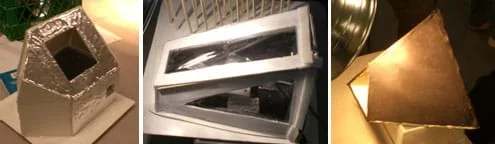 Figure 1: Three examples of model houses designed by student teams.Copyright 2009 Jon MacNeil, ITL Program, College of Engineering, University of Colorado at Boulder.
Before the Activity
- Gather materials and set up a testing station(s).
- Make copies of the Design Challenge Handout (PDF), and Analysis & Results Worksheet (PDF), one each per team.
With the Students
- Introduce passive solar design for purposes of heating and its primary design considerations and methods, as described in the Introduction/Motivation section.
- Briefly describe to the students what they will be designing during the activity (see the "goal" on the Design Challenge Handout).
- Divide the class into groups of two or three students each.
- Hand each group a Design Challenge Handout. Have them look over the handout; answer any questions they may have.
- Have the teams brainstorm ideas and discuss possible passive solar heating techniques using the materials provided. Encourage them to design unique houses. For example, they do not necessarily have to have the traditional four walls.
- Once teams have come up with several ideas, have them choose one and sketch it on paper. Double-check their designs to make sure they meet the requirements before handing them their materials.
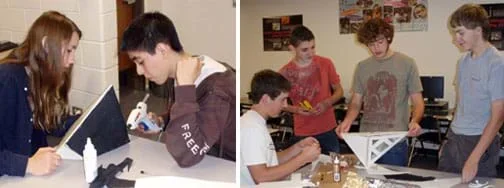 Figure 2: Student teams work together to construct their model passive solar design homes.Copyright 2009 Malinda Schaefer Zarske, ITL Program, College of Engineering, University of Colorado at Boulder.
 - Give the teams time to build (see Figure 2). This will take the most time, perhaps five 50-minute periods (about 250 minutes total). Keep them on task by setting interim deadlines.
- Once the groups are done building their model homes, set up a testing area and give each team the Analysis & Results Worksheet. Then, start conducting the tests (see Figure 3) as described in the Teacher Testing Steps attachment. Have teams record their data on their worksheets.
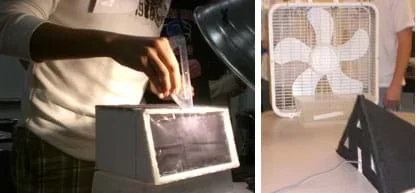 Figure 3: Testing the solar passive design model homes during simulated daytime and nighttime conditions.Copyright 2009 (left) Malinda Schaefer Zarske and (right) Jon MacNeil, ITL Program, College of Engineering, University of Colorado at Boulder.
 - Have students finish the Analysis & Results Worksheet when their testing is done.
- Direct each group to prepare a 5-10 minute presentation of their model house results, discussing the concepts in their original passive solar design, its successes and failures, and how they would improve on it.
- hvac
- Acronym that stands for "heating, ventilating, and air conditioning", which is an area of design and research for civil engineers.
- insulation
- Material that prevents the transfer of heat.
- passive solar design
- Using the sun's energy, the geographical climate, and the properties of different materials to heat and cool buildings.
- thermal mass
- Construction material incorporated into passive solar design because of its high heat storage capacity. Possible materials include floors and walls made of concrete, tile, brick, masonry, stone, soil and water.
Pre-Activity Assessment
Class Discussion: Lead a discussion with the students about passive solar heating and how it might impact the world if it became more effective and widespread than conventional heating methods in use today.
Activity Embedded Assessment
Design Review: Midway through the building phase, have groups give brief presentations to the class (or just the teacher) discussing their designs. Make sure they discuss the passive solar heating techniques they are using. Allow time for questions from their peers.
Post-Activity Assessment
Summary Presentations: Direct each team to prepare a 5-10 minute presentation of their model house results, discussing the concepts in their original passive solar design, its successes and failures, and how they would improve on it.
Company Proposal: Ask student to imagine that they work for an engineering company that wants to sell a passive solar heating design to some building contractors. Have them write letters to their boss explaining why their design is the best fit for the community.
- Use caution when cutting materials with a utility knife.
- Make sure the lamp you use can safely accommodate a 300-watt light bulb.
Before students begin to design and build, tell them the size of the testing thermometer, because in order to make good readings during the testing phase, it must fit through the house door and entirely inside, and be able to be read through a window.
The testing takes awhile and groups may lose interest when you can only test one group at a time. Have students use the time to complete other assignments. Or, shorten the time by making available more than one testing station if you have the supplies.
Have students re-test their model homes by adjusting the lamp (sunshine) angle to represent summer and winter solar exposures, and then comparing the results to see which models perform better in different seasons.
Have students redesign their model houses on paper to incorporate passive solar cooling techniques. Go a step further by having them make the modifications to their model houses and then re-test to see how quickly they can cool down their houses.
- For lower grades, limit the discussion of passive solar heating techniques to insulation, windows and surface colors. Have teams choose one or two techniques to incorporate into their model houses.
- For upper grades, encourage students to research additional passive solar heating techniques beyond those introduced and then incorporate what they find in their model houses.
Passive Solar Design. Choices for the Home Construction, Consumer Energy Center, California Energy Commission. Accessed October 22, 2009. http://www.consumerenergycenter.org/home/construction/solardesign/index.html
Passive Solar Design. Sustainable Sources. (Provides a great introduction to solar design, including "rules of thumb," and many diagrams that illustrate thermal storage, ventilation and other techniques) Accessed October 22, 2009. http://www.greenbuilder.com/sourcebook/PassiveSol.html
Contributors
Jonathan MacNeil; Malinda Schaefer Zarske; Denise W. Carlson
Supporting Program
Integrated Teaching and Learning Program, College of Engineering, University of Colorado Boulder
Acknowledgements
The contents of this digital library curriculum were developed under a grant from the Fund for the Improvement of Postsecondary Education (FIPSE), U.S. Department of Education and National Science Foundation GK-12 grant no. 0338326. However, these contents do not necessarily represent the policies of the Department of Education or National Science Foundation, and you should not assume endorsement by the federal government.
Copyright
2008 by Regents of the University of Colorado.