
Energy-Efficient Housing
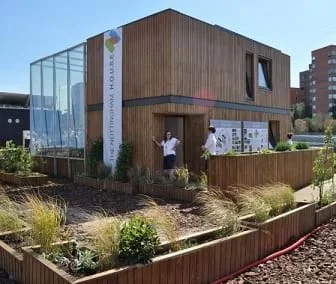 Students learn about designing energy-efficient smart housing that is environmentally friendlyCopyright 2011 Robshipman, Wikipedia https://en.wikipedia.org/wiki/Creative_Energy_Homes#/media/File:CEH_Nottingham_House.jpg
Overview of topics by lesson: 1) heat transfer, especially solar water heaters and swamp coolers, 2) electrical circuits, including designing a thermostat, 3) lighting, especially daylighting and greenhouses, 4) renewable and non-renewable energy sources, especially water and wind power, and 5) passive solar design, especially for heating.
Engineers are the creative people who are always coming up with ingenious and better ways to provide us with reliable and energy-efficient shelter. Energy-efficiency means performing some task so it uses the least amount of energy possible. Using energy wisely might involve conserving and minimizing the initial energy required to create an engineered product or system, and/or designing its ongoing energy use to be as minimal as possible and/or use renewable energy sources. Engineers design energy-efficient technologies for buildings, homes, transportation, power systems and industry to reduce consumption and expense of our energy resources.
- CCSS.Math.Content.HSA-REI.B.3 Solve linear equations and inequalities in one variable, including equations with coefficients represented by letters.
Grades 9-12
Do you agree with this alignment? - CCSS.Math.Content.HSN-Q.A.1 Use units as a way to understand problems and to guide the solution of multi-step problems; choose and interpret units consistently in formulas; choose and interpret the scale and the origin in graphs and data displays.
Grades 9-12
Do you agree with this alignment?
- MS-ETS1-2 Evaluate competing design solutions using a systematic process to determine how well they meet the criteria and constraints of the problem.
Grades 6-8
This resource focuses on the following Three Dimensional Learning aspects of NGSS:
Science & Engineering Practices- Evaluate competing design solutions based on jointly developed and agreed-upon design criteria.Do you agree with this alignment?
Disciplinary Core Ideas- There are systematic processes for evaluating solutions with respect to how well they meet the criteria and constraints of a problem.Do you agree with this alignment?
Do you agree with this alignment? - Evaluate competing design solutions based on jointly developed and agreed-upon design criteria.
- MS-PS3-5 Construct, use, and present arguments to support the claim that when the kinetic energy of an object changes, energy is transferred to or from the object.
Grades 6-8
This resource focuses on the following Three Dimensional Learning aspects of NGSS:
Science & Engineering Practices- Construct, use, and present oral and written arguments supported by empirical evidence and scientific reasoning to support or refute an explanation or a model for a phenomenon.Do you agree with this alignment?
- Science knowledge is based upon logical and conceptual connections between evidence and explanations.Do you agree with this alignment?
Disciplinary Core Ideas- When the motion energy of an object changes, there is inevitably some other change in energy at the same time.Do you agree with this alignment?
Crosscutting Concepts- Energy may take different forms (e.g. energy in fields, thermal energy, energy of motion).Do you agree with this alignment?
Do you agree with this alignment? - Construct, use, and present oral and written arguments supported by empirical evidence and scientific reasoning to support or refute an explanation or a model for a phenomenon.
- Day 1: Heat Transfer lesson
- Day 2: Solar Water Heater activity
- Day 3: Swamp Cooler activity
- Day 4: Circuits lesson
- Day 5-6: Designing a Thermostat activity
- Day 7: Design of Lighting Systems: Light It Up! lesson
- Day 8-12: Daylighting Design activity
- Day 13-15: Model Greenhouses activity
- Day 16: Off the Grid lesson
- Day 17-19: Power Your House with Water activity
- Day 20-23: Power Your House with Wind activity
- Day 24: Passive Solar Design lesson
- Day 24-30: Zero-Energy Housing activity
Supporting Program
Integrated Teaching and Learning Program, College of Engineering, University of Colorado Boulder
Acknowledgements
This digital library content was developed by the Integrated Teaching and Learning Program under National Science Foundation GK-12 grant no. 0338326, and the Discovery-Learning Apprentice Program at CU-Boulder's College of Engineering and Applied Science. However, these contents do not necessarily represent the policies of the National Science Foundation, and you should not assume endorsement by the federal government.
Copyright
2007 by Regents of the University of Colorado