
Passive Solar Design
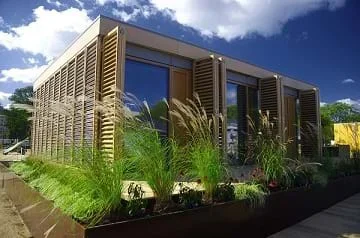 Students learn about passive solar design for buildingsCopyright https://en.wikipedia.org/?title=Solar_energy#/media/File:Technische_Universit%C3%A4t_Darmstadt_-_Solar_Decathlon_2007.jpg
Students are introduced to passive solar design for buildings — an approach that uses the sun's energy and the surrounding climate to provide natural heating and cooling. They learn about some of the disadvantages of conventional heating and cooling and how engineers incorporate passive solar designs into our buildings for improved efficiency.
A widespread interest in passive solar design is growing as energy costs increase and the realities of global climate change become apparent. Organizations, companies, schools and families are looking to engineers to make it happen. Civil engineers study and design the heating, ventilating and air conditioning (HVAC) systems in existing and newly-constructed buildings, suggesting ways to incorporate more passive solar design techniques to lower costs and energy use, minimize maintenance, reduce greenhouse gas emissions, and provide comfortable indoor environments for people.
After this lesson, students should be able to:
- Describe drawbacks to standard heating and cooling appliances.
- Define passive solar design.
- Identify a few different passive solar design techniques.
- Describe the role that engineers play in passive solar design.
- Develop, communicate, and justify an evidence-based scientific explanation regarding the costs and benefits of exploration, development, and consumption of renewable and nonrenewable resources
Grades 9-12
Do you agree with this alignment?
- Energy resources can be renewable or nonrenewable.
Grades 9-12
Do you agree with this alignment? - STEL-4P Evaluate ways that technology can impact individuals, society, and the environment.
Grades 9-12
Do you agree with this alignment?
- HS-ESS3-1 Construct an explanation based on evidence for how the availability of natural resources, occurrence of natural hazards, and changes in climate have influenced human activity.
Grades 9-12
This resource focuses on the following Three Dimensional Learning aspects of NGSS:
Science & Engineering Practices- Construct an explanation based on valid and reliable evidence obtained from a variety of sources (including students' own investigations, models, theories, simulations, peer review) and the assumption that theories and laws that describe the natural world operate today as they did in the past and will continue to do so in the future.Do you agree with this alignment?
Disciplinary Core Ideas- Resource availability has guided the development of human society.Do you agree with this alignment?
- Natural hazards and other geologic events have shaped the course of human history; [they] have significantly altered the sizes of human populations and have driven human migrations.Do you agree with this alignment?
Crosscutting Concepts- Empirical evidence is required to differentiate between cause and correlation and make claims about specific causes and effects.Do you agree with this alignment?
- Modern civilization depends on major technological systems.Do you agree with this alignment?
Do you agree with this alignment? - Construct an explanation based on valid and reliable evidence obtained from a variety of sources (including students' own investigations, models, theories, simulations, peer review) and the assumption that theories and laws that describe the natural world operate today as they did in the past and will continue to do so in the future.
The heating and cooling systems inside buildings are powered by different sources of energy, not just electricity. Air conditioning units are usually powered by electricity while central heating units are often powered by gas. (The power amounts provided to run certain appliances mentioned in the Introduction/Motivation section are given in watts of electricity only; this is just to keep it simple, so that a comparison can be made.) Whether gas or electricity is used, the point is still the same: appliances that heat and cool buildings use extremely large amounts of energy.
Passive solar design is an important aspect of building design because people and businesses are looking to save money on energy costs and be environmentally responsible. Passive solar should not be confused with active solar design or photovoltaic solar cells. While active solar design is similar to passive, it uses small amounts of energy to help transport the heat created. For example, if a solar wall heats up air that then naturally rises, it is called passive solar; if a fan was used to help move the air, then it would be considered "active." Active solar design still uses considerably less energy than standard methods of heating and cooling; its small amount of energy used greatly increases its ability to move hot and cold air around. Photovoltaic solar cells are solar panels used to generate electricity; they could be coupled with active solar designs so that the small amount of power needed comes entirely from "clean" energy.
The key aspects of passive solar design are: thermal mass, insulation, angle and direction of the sun (orientation), windows (placement and operable), overhangs and shading, ventilation and circulation, surface colors, and geographical location (see Figure 1).
How much power do you think that the average traditional light bulb uses, in watts? (Answer: 60-100 watts.) What about a large window unit air conditioner? (Answer: 1,440 watts.) How about an electric water heater? (Answer: 3,800 watts.) These are just a few of the appliances people use in their homes everyday that require electricity. (Remember: 750 watts = 1 horsepower)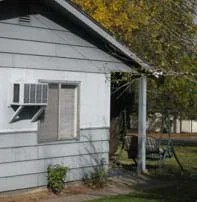 Electric air conditioners use a lot of energy to cool the insides of our houses, while sunshine coming in our windows heats up the insides of our homes.Copyright 2009 Denise W. Carlson, ITL Program, College of Engineering, University of Colorado at Boulder
The appliances that create hot or cold temperatures in our buildings require large amounts of energy and although they work rather well, they have two main drawbacks. The first drawback is the cost associated with running these devices. The average US family spends approximately $1,900 a year on energy of all kinds, including electricity and gas, with about half of that cost due to just heating and cooling the house. That means a family spends about $950 a year to control the temperature inside its home — and that cost goes up considerably for larger homes.
The second issue has to do with the greenhouse gases emitted due to the production of energy needed for these appliances. Most electricity and gas are created by methods that pollute the atmosphere with greenhouse gases such as carbon dioxide. So, the more energy we use, the more greenhouse gases are emitted. Civil engineers who study and design heating, ventilating, and air conditioning (HVAC) systems look for ways to reduce these negative effects of heating and cooling. One way is to make the appliances more energy efficient so that they use less energy to do the same job. Even when made very efficient, most of these modern appliances still require large amounts of energy to do the job. If the standard appliances used could be replaced, or at least complimented, by methods of heating and cooling that require no human-made energy, this would solve the problem! This is where passive solar design comes in.
Passive solar design is the utilization of the sun's energy, the geographical climate, and the properties of different materials to heat and cool buildings. It includes a variety of methods that use no human-made energy to operate and can reduce the amount of energy needed for heating and cooling by considerable amounts.
If you have ever spent some time in the sun on a hot day, you know that the sun has an incredible ability to heat things up. Think of how hot the inside of a car gets after it has been in the sun for awhile. Tapping the sun's power is useful in working towards becoming more energy efficient because its energy is free and in near endless supply. That's why we consider solar energy a "renewable" source of energy.
The simplest method of passive solar heating is sunlight shining through windows. Since we know that the sun rises higher in the sky during the summer than in the winter, engineers and architects design buildings that allow sunlight through the windows during the winter months when the building needs heating, but block the sunlight during the summer to help keep the building cool (see Figure 1). Students can apply their own creative thinking to design, build and test model houses using methods of passive solar heating including insulation, window placement, thermal mass, colors, and site orientation with the associated activity Zero-Energy Housing.
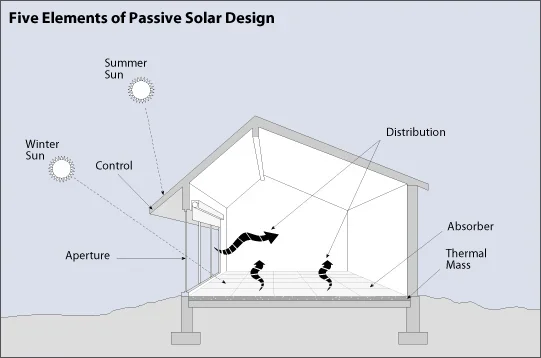 Figure 1. Working together, the five elements of passive solar design constitute a complete and successful passive solar home design: aperture/collector (south-facing windows), absorber ([usually] hard and dark surface of wall or floor material), thermal mass (actual material that retains and stores heat), distribution (circulation of heat through natural conduction, convection and radiation) and control (roof overhangs, blinds, awnings, shade trees). Notice the differing angles of the sun between winter and summer.Copyright Energy Efficiency & Renewable Energy, US Department of Energy http://www.energysavers.gov/your_home/designing_remodeling/index.cfm/mytopic=10270
After sunset, have you ever felt the warmth from a big rock or a concrete bench that has been in the sun all day? The rock and the bench absorbed and stored the heat, and released it slowly. Working in the same way, a key passive solar technique is for the radiant heat of sunlight that enters a building to be absorbed by a thermal mass inside the structure. A thermal mass might be a big wall or area of floor that is composed of a construction material that is able to absorb large amounts of heat, such as concrete, brick, tiles or even water. As the sun sets and the air temperature lowers, the thermal mass slowly releases the heat it gathered all day to help maintain a comfortable indoor temperature through the night. In the summer, the same thermal mass can draw warmth from the surrounding air to cool a space. In all seasons, the ability of thermal mass to store heat helps to maintain a uniform temperature.
Working with these ideas, the most successful human-engineered product using the sun's energy for heating is called the SolarWall. This construction product uses sunlight to heat up metal panels attached a short distance away from the wall of a building. The air in the void between the panels and the building heats up as the metal panels heat up. The heated air naturally rises to the top of the building and into heating ducts that distribute it throughout the building. A SolarWall uses no energy to operate and can displace up to 50% of the necessary heating for buildings.
Unfortunately, passive solar cooling has not made as much progress as passive solar heating. The two main ideas behind solar cooling are ventilation and the prevention of heat from entering the building. Proper ventilation is achieved by strategically placing windows so that as much air as possible can be circulated when open. One way to prevent heat from entering a building is to design the building with thermal mass on the outside so that it absorbs the heat before entering the building. Another method is to plant large deciduous trees so they shade the building from direct sunlight during the summer months.
Whether we are discussing passive solar heating or cooling, the buildings' geographical location and orientation play important roles. For example, to take advantage of passive solar heating and cooling, a building in the US must be designed so its windows and main living spaces are located on the south side of the house. That way, the windows that face the sun can heat up the spaces people are in more often. Windows located on the north side do not let in any direct sunlight and allow more heat to escape than a solid wall. This is one reason that building orientation is important. Geographical location must be considered because different places have different climates. In some regions, clouds block the sun more often than not, so they would not be good locations to rely on the sun for heating. If a region's prevailing wind comes from the west, windows placed on the west and east sides would allow for the greatest airflow. When considering all the passive solar techniques, it is important to use the correct ones based on the climate. Is your house benefiting from passive solar design, or not? Notice where the sun strikes your windows on different sides of your house at different times of the year. The south-facing window under the eaves of this house adds no solar heat gain to the inside space when the summer sun is high in the sky.Copyright 2009 Denise W. Carlson, ITL Program, College of Engineering, University of Colorado Boulder
Talking about heating and cooling would be incomplete if we did not talk about another important aspect of any HVAC system, passive or not, and that is insulation. Without a properly insulted building, no matter how good its heaters and air conditioners are, the hot or cold air will escape to the outside. This wastes a lot of energy because appliances work to heat or cool the building AND the outside air! It is extremely important in passive solar design not to waste the heated or cooled air.
Passive solar design is being integrated more and more into newer homes because of the ease of implementation (it is easier to design it that way in the first place, rather than go back and move windows and re-orient your house once it is built!), and even more so in large buildings because of the great amount of energy that can be saved. The really cool part about it is that it can be done in nearly limitless ways, so engineers can be as creative in the building design as they want.
Passive solar uses the sun's energy and material properties for heating and cooling of interior spaces. Why is passive solar design becoming more popular and more likely to be incorporated into our buildings and houses? (Answer: Due to the increasing cost of energy and the growing concern for global climate change.) Engineers often use passive solar design to compliment conventional methods of heating and cooling in order to reduce energy costs and greenhouse gas emissions without sacrificing comfort.
What are the most important aspects of passive solar design? (Answers: Insulation, window placement, thermal mass, ventilation and circulation, angle and direction of the sun, surface colors, and geographical location). Engineers who work with passive solar design must know about these subjects, and how to apply them in creative ways to maximize the benefits of passive solar design, while making structures that are aesthetically pleasing.
(Conduct additional lesson summary assessment activities as described in the Assessment section.)
- civil engineer
- A person who designs the structures of our human-built environment (including buildings, airports, skyscrapers, harbors, dams, roads, bridges, water systems) or supervises their construction or maintenance.
- hvac
- Acronym that stands for "heating, ventilating, and air conditioning."
- passive solar design
- Using the sun's energy, the geographical climate, and the properties of different materials to heat and cool buildings.
- thermal mass
- Construction material incorporated into passive solar design because of its ability to absorb, store and distribute large amounts of heat. Possible materials include floors and walls made of concrete, tile, brick, masonry, stone, soil and water.
- watt
- The SI unit of measurement for power. (SI = international system of units)
Pre-Lesson Assessment
Brainstorming: As a class, have students engage in open discussion to brainstorm the definition for passive solar design. Remind students that in brainstorming, no idea or suggestion is "silly." Respectfully listen to all ideas. Take an uncritical position, encourage wild ideas and discourage criticism of ideas. Write their ideas on the board.
Post-Introduction Assessment
Brainstorming Revisited: Have the class revisit the definition(s) of passive solar design that they brainstormed before the lesson began. Would they make any modifications?
Lesson Summary Assessment
Where Have You Seen It?: Divide the class into small groups and ask teams to list all the examples of passive solar heating that they have encountered and where. (Possible examples: Homes, schools, stores, offices, hospitals, public buildings, museums.) Which methods did they notice were effective? Which were not?
Group Discussion: Have students discuss what passive solar design techniques they would use in their own home and why.
Group Research: Divide the class into smaller groups to conduct Internet searches on different types and aspects of passive solar design. Have students pick their favorite ones and present them to the class. Note: Not all techniques can be found under the search term "passive solar design," so make sure students understand the definition enough to be able to broaden their search. Possible topics: solar orientation, overhangs, awnings, shading, insulation, air sealing, window location and placement, operable windows, glazing type, clerestory windows, cross ventilation, thermal storage wall systems, roof pond systems, material color, thermal chimney, open floor plan, sunroom, windbreaks, wing walls, etc. Remember that passive solar includes design elements and techniques for summer comfort, not just for winter heating.
Another way to save electricity by using the sun's energy is called "daylighting." Have students conduct the Daylighting Design activity, in which they design and build a model house from foam core board and incorporate a daylighting system based on their observations and calculations of the optimal use of available sunlight (from a desk lamp) to their structure.
See two short videos (3-4 minutes long each) that show actual SolarWall installations for passive solar design at Conserval Engineering Inc.'s website at http://solarwall.com/en/products/solarwall-video-ekostv.php
Five Elements of Passive Solar Home Design, Your Home, Energy Savers. Last updated March 24, 2009. Energy Efficiency & Renewable Energy, US Department of Energy. Accessed October 22, 2009. http://www.energysavers.gov/your_home/designing_remodeling/index.cfm/mytopic=10270
Passive Solar Design. Choices for the Home Construction, Consumer Energy Center, California Energy Commission. Accessed October 22, 2009. http://www.consumerenergycenter.org/home/construction/solardesign/index.html
Passive Solar Design. Sustainable Sources. (Provides a great introduction to solar design, including "rules of thumb," and many diagrams that illustrate thermal storage, ventilation and other techniques) Accessed October 22, 2009. http://www.greenbuilder.com/sourcebook/PassiveSol.html
Passive Solar Design – Thermal Mass. Consumer Energy Center, California Energy Commission. Accessed October 22, 2009. http://www.consumerenergycenter.org/home/construction/solardesign/thermal.html
SolarWall – Specializing in solar heating (solar air heating and ventilation), solar agriculture. Conserval Engineering Inc. Accessed October 22, 2009. http://www.solarwall.com
Contributors
Jonathan MacNeil; Malinda Schaefer Zarske; Denise W. Carlson
Supporting Program
Integrated Teaching and Learning Program, College of Engineering, University of Colorado Boulder
Acknowledgements
The contents of this digital library curriculum were developed under a grant from the Fund for the Improvement of Postsecondary Education (FIPSE), U.S. Department of Education and National Science Foundation GK-12 grant no. 0338326. However, these contents do not necessarily represent the policies of the Department of Education or National Science Foundation, and you should not assume endorsement by the federal government.
Copyright
2008 by Regents of the University of Colorado.