
Off the Grid
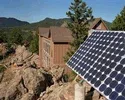 "Off the grid" solar home in Coal Creek Canyon, CO.Copyright National Renewable Energy Laboratory http://www.nrel.gov/data/pix/searchpix.cgi?display_type=verbose&max_display=5&skip_hf=1&query=%5E05488
Students learn and discuss the advantages and disadvantages of renewable and non-renewable energy sources. They also learn about our nation's electric power grid and what it means for a residential home to be "off the grid."
Engineers learn the concepts of energy, work and power as they design products and process that use renewable and non-renewable energy sources. Mechanical engineers must know these fundamental physics concepts to design things such as cars, roller coasters and biomechanical devices. Civil and environmental engineers might use these concepts as they create devices such as dams and wind turbines that harness renewable energy sources.
After this lesson, students should be able to:
- Define renewable and non-renewable energy sources.
- Describe some advantages and disadvantages to using renewable energy sources to power a home.
- Explain what it means for a house to be "off the grid."
- Climate is the result of energy transfer among interactions of the atmosphere, hydrosphere, geosphere, and biosphere
Grades 9-12
Do you agree with this alignment? - Develop, communicate, and justify an evidence-based scientific explanation regarding the costs and benefits of exploration, development, and consumption of renewable and nonrenewable resources
Grades 9-12
Do you agree with this alignment?
- Energy resources can be renewable or nonrenewable.
Grades 9-12
Do you agree with this alignment? - STEL-4Q Critue whether existing and proposed technologies use resources sustainably.
Grades 9-12
Do you agree with this alignment?
- HS-ESS3-1 Construct an explanation based on evidence for how the availability of natural resources, occurrence of natural hazards, and changes in climate have influenced human activity.
Grades 9-12
This resource focuses on the following Three Dimensional Learning aspects of NGSS:
Science & Engineering Practices- Construct an explanation based on valid and reliable evidence obtained from a variety of sources (including students' own investigations, models, theories, simulations, peer review) and the assumption that theories and laws that describe the natural world operate today as they did in the past and will continue to do so in the future.Do you agree with this alignment?
Disciplinary Core Ideas- Resource availability has guided the development of human society.Do you agree with this alignment?
- Natural hazards and other geologic events have shaped the course of human history; [they] have significantly altered the sizes of human populations and have driven human migrations.Do you agree with this alignment?
Crosscutting Concepts- Empirical evidence is required to differentiate between cause and correlation and make claims about specific causes and effects.Do you agree with this alignment?
- Modern civilization depends on major technological systems.Do you agree with this alignment?
Do you agree with this alignment? - Construct an explanation based on valid and reliable evidence obtained from a variety of sources (including students' own investigations, models, theories, simulations, peer review) and the assumption that theories and laws that describe the natural world operate today as they did in the past and will continue to do so in the future.
A basic understanding of energy and different types of energy sources.
Renewable energy sources include solar, wind, hydro (water), biomass/biofuels, and geothermal. Non-renewable energy sources include oil/petroleum, natural gas, coal, and nuclear/uranium. See below for more information about each.
Solar Power
Solar power is generated by converting sunlight to either thermal or electric energy. Thermal energy (heat) from the sun has been used for thousands of years to heat water and spaces (homes, greenhouses) and to cook. To convert the sun's energy to electricity, photovoltaic cells (PV cells for short) are most often used, although solar power plants do exist. When light hits a PV cell, some reflects back, some passes right through and some is absorbed. The absorbed light causes electrons to flow in the PV cell, creating a current and a voltage (electricity), which can power everything from watches to calculators to cars and homes.
Using PV cells has several advantages over fossil fuels, primarily its minimal environmental impact because no water is required for cooling and no by-products result from the process. Since PV cells convert the sun's energy directly into electricity, making mechanical generator systems are unnecessary. PV cells can be installed in whatever size is needed. Solar power plants work almost the same as conventional power plants by using steam to turn a turbine and converting that mechanical energy into electricity with a generator. The only difference is that instead of burning a fossil fuel to produce the steam, sunlight heats a fluid that produces steam that turns turbines. By not burning fossil fuels, solar power plants have less environmental impact. The only disadvantages to using solar power are that the amount of sunlight hitting the Earth's surface is dependent on time of day, time of year, location, and the weather conditions, and that the energy provided to any one place at any one time by the sun is so small that large areas are needed for any practical use of the sun's energy.
Due to growing concerns over climate change, many cities, states, and countries have enacted new laws to both incentivize investment in solar power systems and mandate that utility companies derive a specific percentage of their energy from solar and other renewable sources. For example, in New Jersey by 2021, utilities must obtain at least 22.5% of their electricity from renewable sources; at least 4.1% of all electricity must be provided specifically by solar energy. The most advantangeous locations for installing solar energy systems in the U.S. are typically in the Southwest, though local incentives such as those in New Jersey help spur solar installations throughout the country. In other countries where non-renewable natural resources are less available or citizens are highly concerned about issues such as climate change, solar power has become very popular. Germany, for instance, has relatively less sunshine than many other countries, yet has the most solar power capacity in the world due to the people's support for renewable energy.
Wind Power
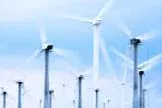 A wind farm.Copyright Microsoft Corporation, One Microsoft Way, Redmond, WA 98052-6399 USA. All rights reserved.
Wind is a natural phenomenon caused by the sun's uneven heating of the Earth. We can take advantage of the kinetic energy associated with air molecules in the wind to generate electrical energy. The process to generate energy from the wind is similar to the process used in hydropower generation. The kinetic energy of the air is transferred to turbines to make them spin, which turns generators that produce electricity. Wind energy generation is an ideal source of energy in places with open space and frequently high winds. By combining many wind turbines in one location, engineers create wind farms.
Wind energy is preferred over fossil fuels because it produces no pollutants. The only complaints with wind power are its negative effect on bird populations and the sight of 20-story tall, 200 foot wide wind turbines in the middle of open space. Then again, some prefer the sight of wind farm over the alternative of fossil fuel-burning power plant smokestacks and pollution. And, newer wind turbines are less likely to kill birds because of their wider blades and slower spin speed. One other disadvantage is that the wind does not always blow, thus energy generation is not always possible, requiring supplementation with other energy sources until the wind picks up again.
Wind farms are particularly effective in locations with relatively flat, treeless terrains such as in the Great Plains and Texas. Another advantageous location for wind installations is offshore in shallow waters. This presents a larger engineering challenge, however, since building the foundations for turbines in water is more complex. Like solar energy, some countries have made great changes to their laws, requiring more wind power installations in an effort to be less reliant on non-renewable sources. In Denmark, for example, the government has begun an initiative to use only renewable energy sources by 2050, much of which will be generated by wind turbines. Refer to the associated activity Power Your House with Wind for students learn how engineers harness the energy of the wind to produce power by following the engineering design process as they prototype and test two types of model wind turbines.
Hydro Power
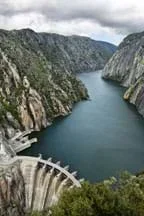 The Hoover Dam on the Colorado River in Nevada produces great amounts of electricity for people in nearby states.Copyright Microsoft Corporation, One Microsoft Way, Redmond, WA 98052-6399 USA. All rights reserved.
People have been using energy generated from water (hydro power) for thousands of years for applications such as grinding grain and running sawmills. To do this, engineers design turbines that are spun by the flow of the water, which then creates electricity using a generator. One method is to place the turbines in a swiftly-flowing river where the fast moving water has enough kinetic energy to transfer it to the turbines and spin them. Another approach is to place the turbines under a flow of falling water, taking advantage of the water's transformation of potential energy into kinetic energy and transferring the water's kinetic energy to the turbines.
To accomplish both of these methods, dams are often built. When energy demand increases, the dam releases more water to spin the turbines and thus generate more energy. For example, the hydroelectric Hoover Dam in Nevada blocks the Colorado River in southern Nevada. When energy demand is high in places like Las Vegas and California, operators increase the flow of water through the dam so more energy is generated.
Hydropower is an efficient way to generate energy. It is a renewable source of energy because the Earth's water cycle continuously replenishes the water in the river the dam is blocking. Hydropower also does not pollute the water or the air. One criticism of the use of hydropower is that you must build a dam to generate the energy. By damming a river, we disturb the surrounding environment and animals' natural habitats. Engineers continually work to find solutions that minimize environmental problems caused by dams. Students can learn more about how engineers design devices that use water to generate electricity by building model water turbines and measuring the resulting current produced in a motor with the associated activity Power Your House with Water.
Biomass/Biofuels
The largest renewable source of energy found in the world is biomass or biofuels. Biomass is simply organic material made from plants and animals. It can be as simple as burning wood or dung for heat. Other forms of biomass include crops such as corn, waste and alcohol fuels. Biomass contains stored energy from the sun, originally generated by plants through photosynthesis. When biomass is burned, this energy is released as heat (thermal energy). Wood and garbage can also be burned to produce the steam needed to drive steam-powered turbines. Burning biomass is not our only option for releasing the stored energy in biomass. Often crops such as corn and sugar cane are fermented to produce ethanol and other alcohol fuels. Biodiesel is fuel that can be created using left-over food products such as vegetable oils and animal fats.
 Wood is an example of a biomass energy source.Copyright Microsoft Corporation, One Microsoft Way, Redmond, WA 98052-6399 USA. All rights reserved.
Biomass is considered a renewable energy source because more trees and crops can be planted. For thousands of years, wood has been the most commonly used type of biomass, most often for heating and cooking. Unfortunately, when burned, all biomass releases carbon dioxide, which is a greenhouse gas. However, the growing of plants for use as an energy source takes in about the same amount of CO2 during photosynthesis so the net production of the gas is small. Biofuels (ethanol and biodiesel) have advantages over gasoline because they are renewable, safe, biodegradable, and reduce the amount of air pollution. However, currently not all cars can use these fuels.
Another major detriment to biofuels is the land and energy required to produce them. For instance, corn ethanol has been highly criticized due to the amount of energy (often gasoline) required to operate the farming equipment used for corn production. Furthermore, using fertile land to grow crops which in turn power automobiles rather than feed humans is looked upon skeptically by many. Engineers are currently developing a more sustainable system that will convert non-food plants (such as switch grass and algae) grown on less-desirable land into usable fuels.
Geothermal Energy
Just like the sun, the Earth generates energy at its core; we call this geothermal energy and use it as an energy resource. A geothermal power plant is like a regular power plant except that no fuel is burned to heat water into steam, because the steam comes directly from the Earth, tapped by deep wells. This is what makes geothermal energy a naturally occurring process, or a renewable resource. Volcanoes, hot springs and geysers are all examples of geothermal energy at the surface of the Earth. Engineers take advantage of geothermal energy through underground geothermal reservoirs that are made from ground water heated by magma as it creeps closer to the surface of the Earth. When this water is really close to the surface, engineers design systems that pump the water directly into homes and businesses for heating purposes. For deeper underground reservoirs, we drill very deep wells into the Earth and pump the hot water or steam to the surface to run turbines that produce electricity.
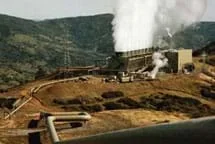 Geothermal power plant at The Geysers in northern California.Copyright Energy Efficiency and Renewable Energy, US Department of Energy http://www1.eere.energy.gov/geothermal/geysers.html
Geothermal energy is a good alternative to fossil fuels because the direct use of geothermal energy has almost no negative impact on the environment and is continually available. A geothermal power plant releases almost no carbon dioxide pollution since fossil fuels are not being burned to produce the steam to turn the turbines.
Oil/Petroleum
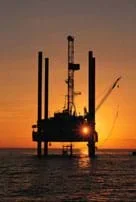 Offshore drilling to find fossil fuel oil reserves.Copyright Microsoft Corporation, One Microsoft Way, Redmond, WA 98052-6399 USA. All rights reserved.
The oil we use for energy generation begins as crude oil found deep underground in reservoirs accessed through drilling. The crude oil is pumped out, transported and refined into petroleum. Almost 50% of harvested petroleum is used for gasoline and another 15% is used for diesel fuel. Other uses for petroleum include heating oil and jet fuel. Petroleum is also used in the production of many everyday items such as ink, crayons, bubble gum, dishwashing soap, deodorant, eyeglasses, records, tires, plastics and heart valves.
Despite the myriad uses of petroleum, many disadvantages exist in the production and use of this limited fossil fuel resource. The production and burning of petroleum release pollutants and carbon dioxide into the atmosphere, harming the environment, disrupting the Earth's' natural carbon cycle (and thus the planet's climate), and impacting the health of people worldwide. Drilling also affects marine and land habitats though the technology has improved towards reducing the negative effects of drilling. The world's reliance on oil is of concern because when we reach the point at which our use surpasses the production of crude oil, we will be forced to limit our consumption of oil and find alternative energy sources.
Natural Gas
Natural gas is a fossil fuel, having formed from the remains of plants and animals that died millions of years ago. Like oil, natural gas is found deep underground in reservoirs that must be accessed by drilling. The biggest US uses for natural gas are for industry and electricity production. Natural gas is also an essential raw material for products such as paint, fertilizer, plastics, dyes, photographic film, medicines and explosives. Since natural gas is an odorless, tasteless, invisible gas, a chemical is added to it during production to give it a sulfur-like (rotten egg-like) smell so its presence can be detected. The burning of natural gas releases pollutants and CO2 into the atmosphere (although less than other fossil fuels) and affects the surrounding environment. And, the risk always exists that leaking natural gas can cause explosions. The drilling process is disruptive to marine and land habitats although technology is improving to reduce the negative side effects of drilling.
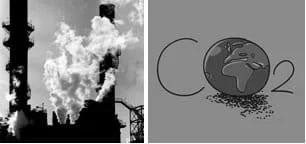 Burning fossil fuels to generate electricity releases pollutants and CO2 into the Earth's atmosphere.Copyright Microsoft Corporation, One Microsoft Way, Redmond, WA 98052-6399 USA. All rights reserved.
Recently in the U.S., new advances in removal techniques, particularly induced hydraulic fracturing (also known as "fracking") have allowed for increased natural gas extraction. This production increase has lowered heating bills and improved local economies due to the availability of well-paying jobs in the industry. However, many citizens ardently oppose these new developments. Worries over contaminated groundwater, greenhouse gas emissions, and even increased seismic activity have casted much doubt over the validity of fracking.
Coal
Coal is another fossil fuel that consists mostly of carbon. Through surface or underground mining, coal is extracted from the Earth and most often burned in power plants to generate electricity. Coal is also an important industry resource in the production of steel, cement and paper. Surface mining consists of removing the topsoil, rocks and dirt above coal deposits. Once the coal is completely extracted, the rock, dirt and topsoil are all returned and the land is used for other purposes. For deposits that are hundreds of feet below the Earth's surface, the coal is extracted through underground mining methods and shipped to plants to clean it of unwanted materials (rock, dirt and ash) in order to increase its heating efficiency.
The burning of coal has many adverse effects on the surrounding environment. Like the other fossil fuels, when burned, it releases pollutants and CO2 into our atmosphere, including sulfur, which when mixed with oxygen gas forms sulfur dioxide, which, when combined with rain, creates destructive 'acid rain." Surface mining disrupts and often destroys the local habitat, particularly when entire forests must be removed before the coal can be retrieved. Additionally, harsh chemicals such as mercury and cyanide are used during the extraction process, which can leak into the local water supply. LIke the production of energy from many other sources, including natural gas and wind power, coal mining sites are often cause for fervent disputes between mining companies and local citizens, who may be wary of environmental damage yet may welcome economic development.
Nuclear/Uranium
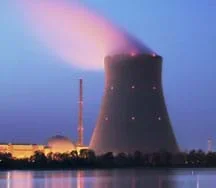 In a nuclear power plant, atoms are split apart to generate electricity.Copyright Microsoft Corporation, One Microsoft Way, Redmond, WA 98052-6399 USA. All rights reserved.
Nuclear power uses uranium to produce electricity by taking advantage of the energy found in the nucleus of atoms. The bonds that hold atoms apart are extremely strong and can provide a lot of energy. Two different ways exist to extract energy from the nucleus of atoms. The first is nuclear fusion, which is the combining of atoms to form a larger atom; this is how the sun generates its energy. Nuclear fission is the splitting apart of an atom into smaller atoms; this is how nuclear weapons work and also how energy is created in nuclear power plants. The most common element used in nuclear energy generation is U-235, an isotope of uranium; this element undergoes fission relatively easily and is the only fissile element that naturally exists in large quantities. Nuclear power plants produce electricity by using the heat released from a chain reaction to heat water to produce steam to turn turbines and generate electricity.
Compared to fossil fuels, nuclear power plants are very clean. They produce no pollutants or CO2, though processing the uranium releases a small amount of pollutants. Disposing of nuclear waste is the biggest environmental concern because the highly-radioactive parts of nuclear power plants pose dangers to humans, wildlife and plants. Currently, unwanted highly-radioactive waste is buried deep underground.
Due in large part to nuclear power plant accidents at Three Mile Island in Pennsylvania and Chernobyl in the Ukraine, no new nuclear power plants have been built in the U.S. for many years. Germany has taken an even firmer stance on nuclear power, declaring that it will shut down all of the country's nuclear power plants by 2022. The impetus for the declaration was a nuclear plant meltdown in Japan which was caused by an earthquake and ensuing tsunami. However, the energy source has many proponents. France, for instance, which strives for energy security, garners about 75% of its electricity from nuclear plants. Developments in reliability and safety are keys to the industry's future success.
From where do most homes and businesses get their power? ("A power plant" will probably be the most common response.) How does a power plant generate most of that power? (Answer: From the burning of fossil fuels [hydrocarbons], such as coal, oil and natural gas.) Are there any other ways in which power can be generated? (Possible answers: From the sun, wind or water.) Solar power, wind power and hydroelectric power are all ways in which energy-efficient homes and businesses can generate power. We call these renewable energy sources.
What is the difference between renewable energy sources and non-renewable energy sources? (Take suggestions from the students.) Renewable energy sources are naturally replenished in a short period of time; think of solar, hydro and wind power. Renewable energy sources account for about 13% of the energy generated in the world (in 2004). By contrast, non-renewable energy sources are all the sources for energy that are not replenished naturally in a short period of time; think of coal, oil (petroleum), natural gas, propane and nuclear power (uranium). We call coal, oil and natural gas "fossil fuels" because they are created from the remains of animals and plants that died millions of years ago (hydrocarbons). Most of the world's energy is generated through using non-renewable energy sources; in 2004, 87% of the world's energy was generated u sing non-renewable energy sources. Oil accounts for about 34%, gas accounts for 21%, and coal accounts for 25%.
Pros: Renewable energy sources offer many advantages to traditional (non-renewable) energy sources. The biggest one is that renewable energy sources do not derive power from the burning of fossil fuels. By not burning fossil fuels, less pollution and carbon dioxide is released into the Earth's atmosphere. Another advantage is that these energy sources do not run out; they provide us with an endless supply of power. And, they also do not require the costs to drill for oil and gas, or dig for coal.
Cons: Criticisms of renewable energy include being unreliable. While this is true to an extent (you cannot tap the sun's power if it is cloudy or dark), by designing for several renewable energy sources and storage options, you can minimize this limitation so that even if the wind is not blowing or the sun is not shining, you still have power. Many people criticize renewable energy technologies as being unsightly (solar panels, wind turbines, dams), which may be viewed as a matter of personal preference. Fossil fuel-burning power plants are not usually attractive either.
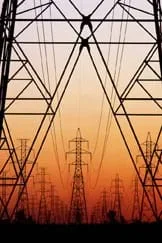 Most of us are "on the grid," using electricity generated at huge power plants and distributed many miles to reach our homes and schools.Copyright Microsoft Corporation, One Microsoft Way, Redmond, WA 98052-6399 USA. All rights reserved.
By taking advantage of energy from renewable energy sources, homes can be built "off the grid." Does anyone know what it means to be "off the grid?" What is "the grid?" (Take suggestions from the students.) Being "off the grid" means that a house does not require electricity from a power plant or energy company. Instead, the house is designed to generate enough electricity on its own to meet its power needs. A true "off the grid" home does not use any water, power or sewer services from any public utilities. These homes have systems in place on site to provide clean water, electricity and waste water disposal. Why would someone want to design an "off the grid" house? (Take ideas from students.) In some cases, the utilities are too far away to affordably access, or the home is not occupied year round (remote cabin or fire watch tower), or people do not want to be dependent on utility companies and their rising costs. Others are concerned about the local and global environments and strive to reduce their dependence on non-renewable energy sources that can cause many adverse environmental effects. For example, the citizens of Scandinavia have come to rely heavily on wind power rather than fossil fuels. Denmark has set a goal to use only renewable energy sources by 2050.
Some states provide financial incentives to encourage homeowners who are connected to the grid to incorporate renewable energy technologies into their homes as a way to save the costs and environmental consequences of utility expansion, which would require having larger batteries to store more power on site.
As we learn more about the types of renewable energy sources that can be used to power energy-efficient houses, we will also learn how engineers consider renewable and non-renewable energy sources in their designs of buildings and energy storage. Does anyone know what kinds of engineers design devices that take advantage of renewable energy sources? (Example answer: Civil, electrical, environmental and mechanical engineers work together to design the dams, solar panels, electrical and battery systems, and turbines that generate energy from solar, wind and water power.) Today we are going to learn more about several kinds of renewable energy sources and whether or not they are feasible for our energy-efficient buildings.
Can someone give me a definition for what a non-renewable energy source is? That's right! A non-renewable energy source is one that is not replenished in a short period of time naturally by the Earth. What would be some renewable energy sources? Renewable-energy sources include water, wind, the sun, and even the Earth itself. What are some reasons why we might want to use renewable energy sources over non-renewable energy sources? (Possible answers: Cleaner, less pollution, less reliance on other countries, unlimited supply, will not run out, etc.) Those are all great answers. What are some reasons for using non-renewable energy sources? (Possible answers: They might be less expensive because infrastructure for production and use as a resource is already largely in place, etc.)
Renewable energy is a topic of debate in today's scientific and political worlds. Engineers just happen to be right in the middle of it. Many people feel we are close to permanently damaging the Earth because of our current consumption of non-renewable energies. Others argue that the Earth has always gone through cycles similar to what is presently occurring. Many people feel we should change to using more renewable energy sources regardless of whether or not we are permanently affecting the Earth and the climate because it is the responsible thing to do to reduce the pollutants and toxins released into the air through the consumption of fossil fuels. Thousands of engineers work for oil companies, just like thousands who work for companies devoted to producing renewable energy technologies. One important aspect of engineering is the consideration of the impacts of energy products or processes on individuals, the economy and the environment. Together, engineers work to determine the best possible solutions to our community issues involving energy sources and efficiency.
- biofuel
- Fuel created using biomass.
- biomass
- An energy source that consists of biological and organic materials.
- conservation of energy
- A physical law stating that energy can neither be created nor destroyed.
- energy
- The ability of an object to do work.
- energy transfer
- The process through which energy is converted from one form to another.
- geothermal energy
- Energy generated from the radioactive decay of particles found in the Earth's core.
- hydro energy
- Energy generated from the movement or falling of water.
- joule
- The unit of measure for energy and work. Equal to 1 N-m or 1 kg*m2/s2.
- kinetic energy
- An object's energy due to its motion.
- non-renewable energy source
- An energy source that is not replenished in a short period of time.
- photovoltaic cells
- Circuits that convert the sun's light directly into electricity.
- potential energy
- The energy stored in an object based on its position.
- power
- The rate at which an object does work.
- renewable energy
- Energy derived from a renewable source.
- renewable energy source
- An energy source that is replenished naturally in a short period of time.
- solar energy
- Energy that is generated from the sun's light.
- watt
- The unit of measure for power. Equal to 1 joule/sec.
- wind energy
- Energy generated from the blowing of the wind.
- work
- The mechanical transfer of energy from one object to another.
Pre-Lesson Assessment
Accessing Prior Knowledge: Ask students the following questions and discuss as a class:
- What are some non-renewable energy sources? Make a list.
- What are some renewable energy sources and what makes them renewable? Make a list.
Post-Introduction Assessment
Compare/Contrast: Have students compare and contrast non-renewable vs. renewable energy sources. What are some characteristics both sources share? (Possible answer: They are used to generate electricity.) In what ways do they differ? (Possible answer: Most non-renewable energy sources emit pollutants and toxins into the air as a side effect of their production and use.) Why are people interested in using more renewable sources? (Possible answer: People may have concerns over environmental damage and climate change.)
Lesson Summary Assessment
Class Discussion: Ask students the following questions and discuss as a class:
- In what ways are one or more of the non-renewable energy sources similar to renewable energy sources? (Possible answers: Fossil fuels are replenished naturally via the carbon cycle, but it is not in a short period of time [millions of years]. Nuclear power plants emit little to no pollutants and toxins into the air.)
- Do you think it is best to spend money developing renewable energy sources and technologies, developing ways to burn fossil fuels more cleanly, developing ways to remove the pollutants from the air that are released by the burning of fossil fuels, or developing other ways to make non-renewable energy cleaner? Use what you have learned as support to construct an argument for different answers. Have students make a claim and defend their position to their classmates.
- A developer wants to install 50 new wind turbines on a farm near your home. What are some advantages and disadvantages to this plan? (Possible answers: Advantages - local economic activity, pollution-free energy; Disadvantages - possibly higher electric rates, possibly aesthetics/disruption of views)
Have students investigate buildings or homes in their area that are "off the grid." Do any local utilities or power companies offer incentive programs to encourage renewable energy efforts by homeowners to be tied back into the grid?
Watch the 10-minute KQED Quest story, "Geothermal Heats Up," at the Calpine "The Geysers" website: http://www.geysers.com about geothermal energy and the largest US geothermal power plant, located in northern California.
Energy Facts: Sources of Energy, Renewable and Non-Renewable. Energy Kid's Page, Energy Information Administration. (energy facts, fun & games, energy history, classroom activities) Accessed March 31, 2009. http://www.eia.doe.gov/kids/energyfacts/index.html
Renewables in Global Energy Supply: An IEA Fact Sheet. Published January 2007. International Energy Agency. Accessed January 6, 2008. http://www.iea.org/textbase/papers/2006/renewable_factsheet.pdf
Contributors
Tyler Maline; Lauren Cooper; Malinda Schaefer Zarske; Denise W. Carlson
Supporting Program
Integrated Teaching and Learning Program, College of Engineering, University of Colorado Boulder
Acknowledgements
The contents of this digital library curriculum were developed under a grant from the Fund for the Improvement of Postsecondary Education (FIPSE), U.S. Department of Education and National Science Foundation GK-12 grant no. 0338326. However, these contents do not necessarily represent the policies of the Department of Education or National Science Foundation, and you should not assume endorsement by the federal government.
Copyright
2007 by Regents of the University of Colorado.