
Power Your House with Water
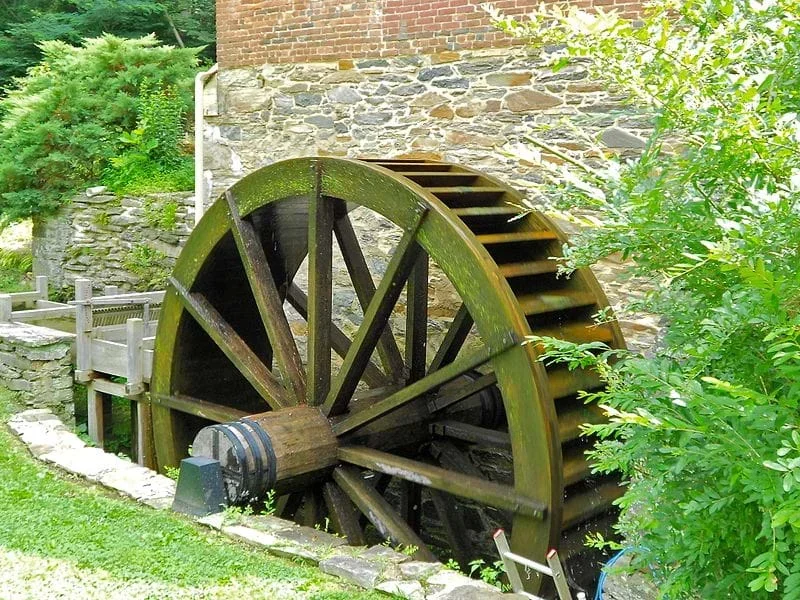 Generating power from water has a long, successful history.Copyright Smallbones 2013. https://commons.wikimedia.org/wiki/File:Kirk_Mills_water_wheel.JPG
Students learn how engineers design devices that use water to generate electricity by building model water turbines and measuring the resulting current produced in a motor. Student teams work through the engineering design process to build the turbines, analyze the performance of their turbines and make calculations to determine the most suitable locations to build dams.
Throughout time, people have used the energy of falling and flowing water to produce power—from waterwheels used to grind grain to modern hydroelectric dams to power cities. Engineers design many of these technologies. In some areas, water is a reliable, clean and inexpensive renewable energy source suitable to replace fossil fuel-burning power plants. Today civil, mechanical, environmental and electrical engineers work together to harness the energy of water and generate electricity from that resource.
After this activity, students should be able to:
- Design, build and test a model wind turbine.
- Describe how water turbines transfer the energy of water into electricity.
- List several advantages and disadvantages for using hydroelectric power.
- HS.2.4.c.i Solve linear equations and inequalities in one variable, including equations with coefficients represented by letters.
Grades 9-12
Do you agree with this alignment?
- Develop, communicate, and justify an evidence-based scientific explanation regarding the potential and kinetic nature of mechanical energy
Grades 9-12
Do you agree with this alignment? - Use appropriate measurements, equations and graphs to gather, analyze, and interpret data on the quantity of energy in a system or an object
Grades 9-12
Do you agree with this alignment?
- CCSS.Math.Content.HSA-CED.A.4 Rearrange formulas to highlight a quantity of interest, using the same reasoning as in solving equations.
Grades 9-12
Do you agree with this alignment? - CCSS.Math.Content.HSA-REI.A.2 Solve simple rational and radical equations in one variable, and give examples showing how extraneous solutions may arise.
Grades 9-12
Do you agree with this alignment? - CCSS.Math.Content.HSA-REI.B.3 Solve linear equations and inequalities in one variable, including equations with coefficients represented by letters.
Grades 9-12
Do you agree with this alignment? - CCSS.Math.Content.HSA-REI.B.4b Solve quadratic equations by inspection (e.g., for x² = 49), taking square roots, completing the square, the quadratic formula and factoring, as appropriate to the initial form of the equation. Recognize when the quadratic formula gives complex solutions and write them as a ± bi for real numbers a and b.
Grades 9-12
Do you agree with this alignment? - CCSS.Math.Content.HSN-Q.A.1 Use units as a way to understand problems and to guide the solution of multi-step problems; choose and interpret units consistently in formulas; choose and interpret the scale and the origin in graphs and data displays.
Grades 9-12
Do you agree with this alignment?
- A prototype is a working model used to test a design concept by making actual observations and necessary adjustments.
Grades 9-12
Do you agree with this alignment? - Energy resources can be renewable or nonrenewable.
Grades 9-12
Do you agree with this alignment?
- HS-PS3-3 Design, build, and refine a device that works within given constraints to convert one form of energy into another form of energy.
Grades 9-12
This resource focuses on the following Three Dimensional Learning aspects of NGSS:
Science & Engineering Practices- Design, evaluate, and/or refine a solution to a complex real-world problem, based on scientific knowledge, student-generated sources of evidence, prioritized criteria, and tradeoff considerations.Do you agree with this alignment?
Disciplinary Core Ideas- Criteria and constraints also include satisfying any requirements set by society, such as taking issues of risk mitigation into account, and they should be quantified to the extent possible and stated in such a way that one can tell if a given design meets them.Do you agree with this alignment?
- At the macroscopic scale, energy manifests itself in multiple ways, such as in motion, sound, light, and thermal energy.Do you agree with this alignment?
- Although energy cannot be destroyed, it can be converted to less useful forms—for example, to thermal energy in the surrounding environment.Do you agree with this alignment?
Crosscutting Concepts- Energy cannot be created or destroyed—it only moves between one place and another place, between objects and/or fields, or between systems.Do you agree with this alignment?
- Modern civilization depends on major technological systems. Engineers continuously modify these technological systems by applying scientific knowledge and engineering design practices to increase benefits while decreasing costs and risks.Do you agree with this alignment?
Do you agree with this alignment? - Design, evaluate, and/or refine a solution to a complex real-world problem, based on scientific knowledge, student-generated sources of evidence, prioritized criteria, and tradeoff considerations.
Each group needs:
- cylindrical block of wood, at least 1 inch (2.54 cm) in diameter and about 8 inches (20 cm) long
- Water Turbine Worksheet (PDF)
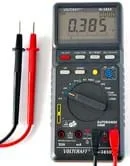 An example digital multimeter.Copyright 2005 André Karwath, Wikimedia Commons http://commons.wikimedia.org/wiki/File:Digital_Multimeter_Aka.jpg
For the entire class to share:
- 1 or 2 multimeters or voltmeters
- 2 double-ended alligator clip wire test leads
- 1-2 DC hobby motors (available at RadioShack [suggested part numbers: 273-223, 273-047 or 273-106] or hobby stores; make sure the shaft does not have a gear on it)
- drill
- drill bit with a size equal to the diameter shaft of the hobby motor
- two blocks of 2 x 4 wood, each about 5 inches (12.7 cm) long
- two 2.5-inch (6.35 cm) nails or screws
- hammer or screwdriver
- one 3-5-inch (7.6-12.7 cm) piece of PVC pipe with an interior diameter that is slightly larger than the diameter of the blocks of cylindrical wood used for turbine construction
- various materials from which turbine blades can be constructed, such as index cards, plastic bottles, paper or plastic cups, cardboard, particle board, thick poster board, foam board, thin dowel rods, bamboo skewers, etc.
- scissors
- glue
- strong tape, such as duct tape or packing tape
- water
- pitcher, plastic bottles or cups to hold and pour water (the more the better)
A basic understanding of the concepts of kinetic and potential energy, work and power. To complete the worksheet, ability to solve basic algebraic equations.
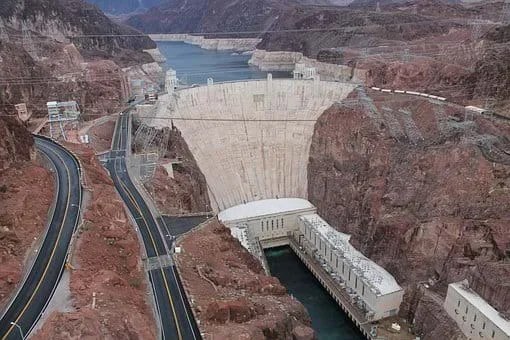 Hoover Dam, Nevada, USA.Copyright Pixabay.com 2018.
https://pixabay.com/photos/hoover-dam-colorado-river-nevada-3780254/
Hoover Dam, Nevada, USA.Copyright Pixabay.com 2018.
https://pixabay.com/photos/hoover-dam-colorado-river-nevada-3780254/
How many of you have ever seen the Hoover Dam in Nevada or seen a picture of Hoover Dam? One reason for building the Hoover Dam was to help keep silt and sediment out of the Colorado River. Does anyone know what other role the Hoover Dam plays? That's right; it is also a power plant. The Hoover Dam converts energy from the moving water of the Colorado River into electricity. Hydroelectric power plants are found all over the world. When the Hoover Dam was completed in 1935, it was the largest electricity-generating power plant in the world. Currently it is only the 58th biggest hydroelectric power plant in the world. Engineers continue to make significant improvements in the design of dams to harness the power of water.
Hydroelectric power plants like the Hoover Dam produce electricity from the flow of the water through the dam. Once the water reaches the turbines of the Hoover Dam, it is traveling at about 38 meters per second (85 mph). Given that the entire flow of the Colorado River goes through the Hoover Dam, that flow contains a lot of kinetic energy. The water gets this kinetic energy because of a drop in elevation from the reservoir to the outlet. This drop in height converts the water's potential energy into kinetic energy. The difference in the height of the water is known as the head.
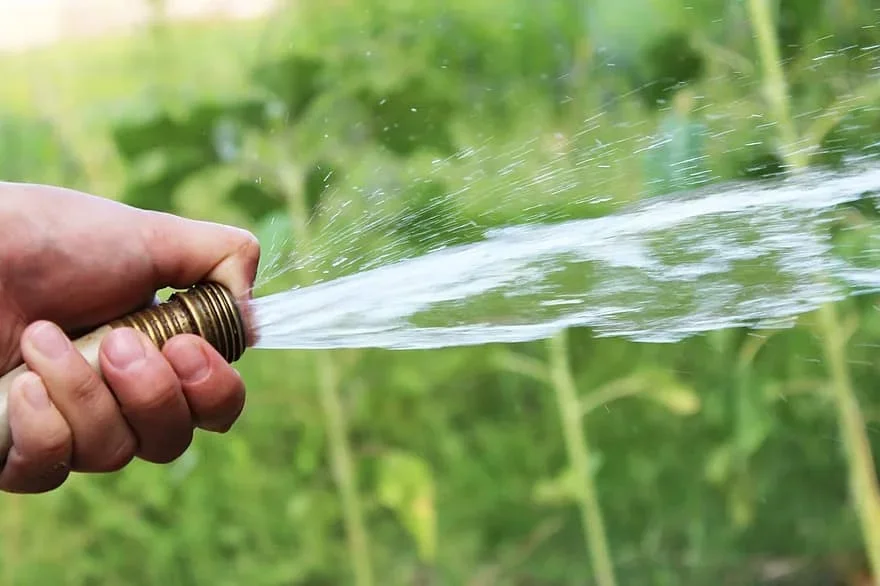 An example of the law of conservation of mass: Holding a thumb over the water flowing from a hose forces the water through a smaller opening, speeding up the flow.Copyright Pikist.com 2020.
https://www.pikist.com/free-photo-viwpg
An example of the law of conservation of mass: Holding a thumb over the water flowing from a hose forces the water through a smaller opening, speeding up the flow.Copyright Pikist.com 2020.
https://www.pikist.com/free-photo-viwpg
The water is also sped up by forcing the flow through a smaller opening, similar to the effect when you place a finger over a faucet or hose. What you are doing is decreasing the area of the flow of the water, and to make up for the decrease in area, the water flows faster (in keeping with the law of conservation of mass). By combining the two effects, narrowing the cross-section through which the water flows and increasing the energy transfer from potential to kinetic, engineers designed the Hoover Dam to generate a maximum of 2,080 megawatts of power.
Dams like the Hoover Dam are also able to control their power output. When demand is high, adjustments are made so more water flows through and more electricity is produced. Hydroelectric power is not always generated in the same way as the Hoover Dam. Some hydroelectric technologies use just the head between a reservoir and the outlet to generate electricity. Instead of a dam, other hydropower plants just use a small canal to channel the river water through a turbine. Still other plants only pump water through a pipe and then turbines, using the flow of the river to generate electricity.
How a turbine works is fairly simple. Water strikes the turbine blades and spins the turbine, which is connected to a generator with a shaft. The shaft turns the generator causing it to produce a current. The electricity generated is sent through power lines of the power grid to where it is needed. Not all the water's energy transfers into electrical energy; during the transfer, some energy is lost through friction between the shaft and generator, and between water and the blades. Even so, many turbines operate at efficiency ratings of greater than 90%.
Several different types of turbines are currently in use around the world. They each have advantages and disadvantages related to the amount of head and the flow rate of the water. Engineers must analyze everything about the dam, river and resultant reservoir to determine the best type of turbine to use.
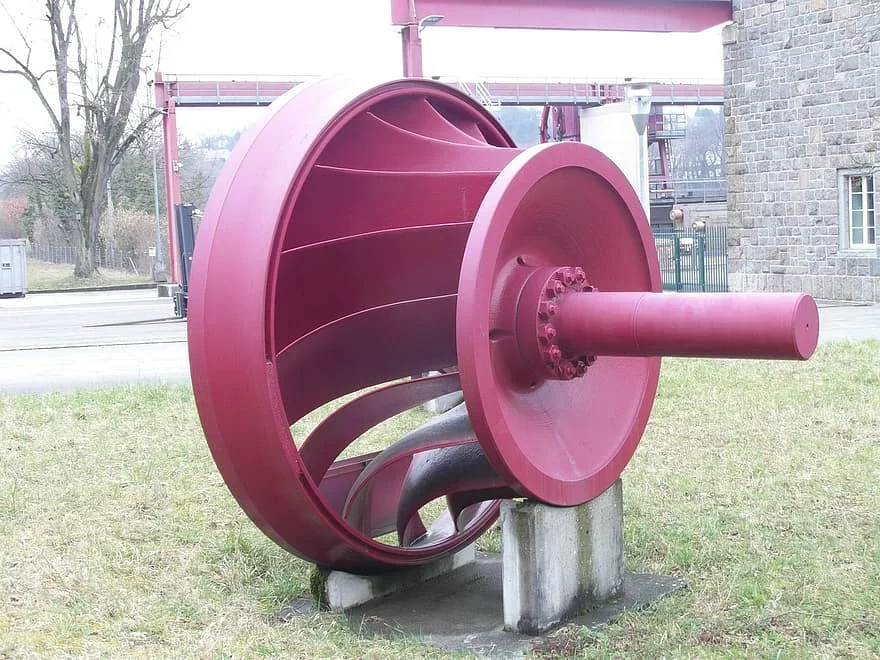 Example turbines. Notice the blade shapes.Copyright Pikist.com 2020.
https://www.pikist.com/free-photo-idehr
Example turbines. Notice the blade shapes.Copyright Pikist.com 2020.
https://www.pikist.com/free-photo-idehr
Traditionally, power plants used coal to generate electricity. Why might a community want to use water instead of coal as a source of energy and electricity for its buildings? Coal is an example of a non-renewable energy source, or an energy source that is not naturally replenished in a short amount of time. Water though, is a renewable energy source. The Earth's water cycle ensures that rivers and lakes are kept full. Water is also a cleaner way to produce electricity because pollutants and carbon dioxide are not released into the atmosphere during the process. Burning coal releases numerous pollutants into the air affecting people's health and disturbing the environment. One way engineers help us increase the use of renewable energy sources is by designing and building hydroelectric dams.
The Hoover Dam is an example of a huge hydroelectric power plant that generates enormous amounts of electricity for the nation's power grid. But hydroelectric power is a viable renewable resource at smaller scales, too; it is what some people use when they live in remote areas near year-round streams. In thinking about designing an energy-efficient house, taking advantage of water power is one way to generate some "off the grid" electricity and increase the efficiency of our housing design. Today we are going to develop and analyze water turbine models and how they could be used to generate some electricity for energy-efficient houses.
Background
For dams that generate power through a difference in elevation of the water, the calculation of the power output can be achieved in a few mathematical steps. Start by finding the energy of the system. If you know the head of the water (or the difference in the height of the water), then the potential energy of the water in the reservoir is equal to:

where PE is the potential energy, m is the mass of the water, g is the acceleration due to gravity (9.8 m/s2), and h is the head of the water. This potential energy can be transferred into kinetic energy using the following equation:

where v is the velocity of the water. Since energy can never be created or lost (law of conservation of energy), the potential energy is equal to the kinetic energy of the system. Use the kinetic energy to determine the velocity of the water flowing through the turbines.
The power generated by a dam is related to the flow rate of the water. The flow rate of the water is simply the volume over time (most common units are m3/s). The easiest way to calculate the flow rate of water is to first calculate or determine the water's velocity. The velocity of the water multiplied by the cross-sectional area it is flowing through gives you the flow rate, Q.

The mass flow rate of the water is simply the mass of the water over time, or kg/s. Use the following equation to calculate the mass flow rate:

where Q is the flow rate and ρ is the density of water (1,000 kg/m3). (Note: any variable with a dot over it simply means that variable is over time. So ṁ [mass flow rate] is simply the mass divided by time.) The power generated by this flowing water is then simply:

Before the Activity
- A few days before the activity, have students gather and bring from home a variety of plastic bottles, cardboard and other materials from which turbine blades can be made.
- Gather materials and make copies of the Water Turbine Worksheet (PDF), one per group.
- Drill a hole on one end of each cylindrical block of wood equal in diameter to the diameter of the shaft of the hobby motor. Place the hole as close to the exact center of the wood as possible.
- Assemble the turbine testing device(s) using the wooden blocks, nails or screws, PVC pipe, DC motor, duct tape and alligator clip wires, as shown below.
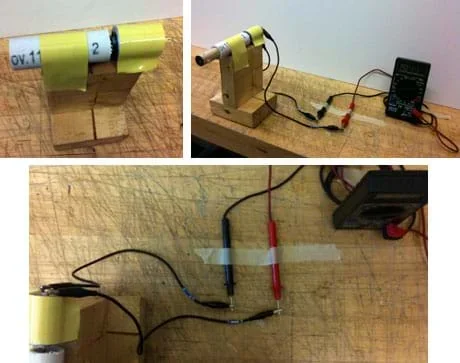 Assemble the class turbine testing device. Nail or screw together the two wooden blocks. Tape the PVC pipe and motor on top of the wooden block base. Connect the motor to a multimeter.Copyright 2009 Jacob Crosby, ITL Program, University of Colorado Boulder
 - In this activity, each group creates a turbine on their own cylindrical blocks of wood and then takes turns placing their turbines on the class turbine testing device(s) to measure voltage.
With the Students
- Divide the class into groups of three students each.
- Distribute the worksheets and blocks of wood.
- In a class discussion, generate the problem that the students are trying to solve by designing water turbines; this should include how to generate electricity for a house using a renewable energy source.
- In groups, have students brainstorm how they might design their water turbines. Possible questions to address: How many blades? How to space them? From what material should we make the blades? What shape for the blades? Have students record all their brainstorm ideas on their worksheets.
- From a review of their brainstorming exercise results, have each group agree upon one design to build for their turbine model. Direct them to draw their designs on their worksheets and explain why they chose that design.
- Next, have each group use the available materials to build a prototype of their turbine based on the design. Note: Since the motor will be placed directly into the cylindrical block of wood, make sure students attach their turbine blades to the end opposite of the hole drilled into the wood block; this prevents the motor from falling directly in the path of water during testing.
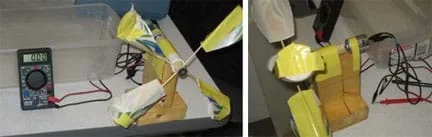 Front and side view of activity setup with a hobby motor and multimeter connected to one team's block of wood and prototype water turbine.Copyright 2009 Jason Crosby, ITL Program, College of Engineering, University of Colorado Boulder
 - Once a group has finished building its turbine, have the team go outside or over a large sink to test how well it works.
- For testing, have a group put the end of the model turbine through the PVC pipe on the testing device and onto the shaft of the motor. You may want to tape the front end of the testing device to the surface it is sitting on in order to prevent movement during testing. Once the turbine is connected, have one student pour water onto the turbine. Have the teacher or another student measure and record the length of time the water hits the blades.
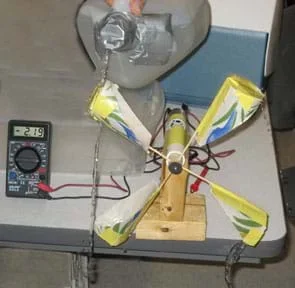 A student team's prototype water turbine design being tested by steadily pouring water from above the blade scoops.Copyright 2009 Jason Crosby, ITL Program, College of Engineering, University of Colorado Boulder
 - Have each group take turns pouring water over the blades of its turbine from three different heights, recording the data on the worksheet.
- Have students complete the calculations and analysis on their worksheets.
- Conclude with a class discussion to review and compare the groups' findings. What improvements would they make? Where would they locate turbines near their energy efficient houses? See additional post-activity discussion questions in the Assessment section.
- Have student teams present their designs to the rest of the class, as described in the Assessment section.
- conservation of energy
- A physical law stating that the energy of a system must stay constant and that energy cannot be created.
- conservation of mass
- A physical law stating that mass can neither be created nor destroyed.
- energy
- The ability of an object to do work.
- energy transfer
- The process through which energy is converted from one form to another.
- generator
- A device that converts mechanical energy into electrical energy.
- head
- Elevation difference of water between two locations.
- hydro energy
- Energy generated from the movement or falling of water.
- kinetic energy
- An object's energy due to its motion.
- non-renewable energy source
- An energy source that is not replenished in a short period of time.
- potential energy
- The energy stored in an object based on its position.
- renewable energy
- Energy derived from a renewable source.
- renewable energy source
- An energy source that is replenished naturally in a short period of time.
- voltmeter
- An instrument that measures voltage.
- water turbine
- A mechanical device that generates electricity from moving water.
- work
- The mechanical transfer of energy from one object to another.
Pre-Activity Assessment
Brainstorming: In small groups, have students engage in open discussion. Remind students that no idea or suggestion is "silly." All ideas should be respectfully heard. Ask the students:
- How can water be used to generate energy and electricity?
- What are some advantages in creating and using hydroelectric power?
- What are some disadvantages?
Activity Embedded Assessment
Worksheet: Have students complete the activity worksheet. Review their answers to gauge their mastery of the subject.
Post-Activity Assessment
Class Discussion: As a class, discuss the following:
- What parts of your designs seemed to produce greater efficiencies in the turbines' abilities to convert water's energy into electricity?
- What parts of your designs seemed to produce lower efficiencies?
- How could we combine different design ideas from all the groups into one turbine that might have a greater efficiency than the individual turbines?
Class Presentation: Have student groups present their designs to the rest of the class. Require them to include descriptions of how well the waterwheels worked and what improvements they might make to their designs.
- Take care not to perform the turbine testing at a location where the floor will become slippery when wet.
- Keep water from falling directly onto the motor. A little splashing is okay, but since some electrical connections are involved, a lot of water could potentially damage the motor or harm a student.
Some motors have easy-to-spot connectors (two pieces of metal sticking out of the motor with a hole in the middle) that make attaching wires and multimeters/voltmeters to the motor leads straightforward, while others do not. If using a motor in which the connectors are absent on the motor, look for (at least) two slits for connectors on opposite sides of the motor. Have students place the leads of the wires or multimeters in two of these slits. If more than two slits, have students place the leads in one pair of the slits and turn the shaft of the motor manually. If the multimeter/voltmeter reads a voltage or current when the shaft spins, then these are the connectors. If it does not, then the other pair of slits is the connector. Have students check the motor for a voltage and current reading on the multimeter/voltmeter.
One easy way to measure voltage from the motor is to attach electrical wire to the motor connectors and use alligator clips on the ends of the multimeter/voltmeter leads. You can create one or more testing stations this way, and the students can just attach their water turbines to the set-up.
Have each team work with another group to combine parts of both designs to create a turbine that has a better efficiency rating than either group's original turbine prototypes. Have students write a short paragraph or two describing what they would add and eliminate, and why they think these changes would make their new turbine have a greater efficiency than the individual turbines they originally made.
Problem Solving—Energy and Water Flow: Have students solve the following math problems:Problem Solving—Energy and Water Flow: Have students solve the following math problems:
- A kilowatt hour (kWh) is often used when discussing electrical energy usage. Show that the units of a kWh are equivalent to the unit of energy, the joule. (Hint: Watt = J / s)
 Answer to problem 1.
- The power associated with an elevation difference of a flowing fluid is given above to be: P = (mass flow rate)gh. Show that the units of this equation are equivalent to the SI units of power, watts.
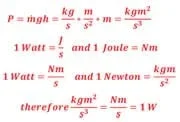 Answer to problem 2.
For younger students, eliminate the mathematical analysis from the worksheet.
See an excellent graphic showing the key parts of a hydropower plant, including the reservoir, intake, control gate, penstock, generator, turbine, transformer, powerhouse, outflow and power lines at this HowStuffWorks website: http://people.howstuffworks.com/hydropower-plant1.htm
Bonsor, Kevin. How Hydropower Plants Work. September 6, 2001. HowStuffWorks.com. Accessed March 31, 2009. http://people.howstuffworks.com/hydropower-plant1.htm
Hoover Dam, Visiting Hoover Dam. Last reviewed March 2009. Lower Colorado Region, Bureau of Reclamation, US Department of the Interior. Accessed March 31, 2009. http://www.usbr.gov/lc/hooverdam/
Hydropower Basics. Last updated January 8. 2008. Wind and Hydropower Technologies Program, Energy Efficiency and Renewable Energy, US Department of Energy. (how hydropower works, types of hydropower plants, types of hydropower turbines, glossary of terms) Accessed March 31, 2009. http://www.eere.energy.gov/basics/renewable_energy/hydropower.html
Contributors
Tyler Maline; Lauren Cooper; Malinda Schaefer Zarske; Denise W. Carlson
Supporting Program
Integrated Teaching and Learning Program, College of Engineering, University of Colorado Boulder
Acknowledgements
The contents of this digital library curriculum were developed under grants from the Fund for the Improvement of Postsecondary Education (FIPSE), U.S. Department of Education and National Science Foundation (GK-12 grant no. 0338326). However, these contents do not necessarily represent the policies of the DOE or NSF, and you should not assume endorsement by the federal government.
Copyright
2007 by Regents of the University of Colorado