
Watt Meters to Measure Energy Consumption
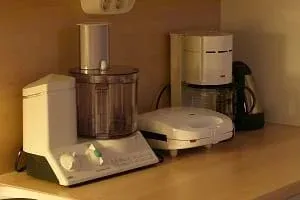 How much energy and power do electrical devices generate?Copyright Wikiedia Commons http://upload.wikimedia.org/wikipedia/commons/1/17/Small_appliance.jpg
Students use watt meters to measure the power required and calculate energy used from various electrical devices and household appliances.
Evaluating energy consumption is the first step engineers take when trying to reduce energy consumption. This step is part of the "understand the problem" and "gather information" steps in the problem solving spiral (and the engineering design process).
After this activity, students should be able to:
- Calculate energy use.
- Analyze how changing behaviors and appliances affects the amount of energy used.
- CCSS.Math.Content.6.NS.B.2 Fluently divide multi-digit numbers using the standard algorithm.
Grade 6
Do you agree with this alignment? - CCSS.Math.Content.6.NS.B.3 Fluently add, subtract, multiply, and divide multi-digit decimals using the standard algorithm for each operation.
Grade 6
Do you agree with this alignment? - CCSS.Math.Content.6.RP.A.3b Solve unit rate problems including those involving unit pricing and constant speed.
Grade 6
Do you agree with this alignment? - CCSS.Math.Content.6.RP.A.3d Use ratio reasoning to convert measurement units; manipulate and transform units appropriately when multiplying or dividing quantities.
Grade 6
Do you agree with this alignment?
- Energy can be used to do work, using many processes.
Grades 6-8
Do you agree with this alignment?
- recognize and apply mathematics in contexts outside of mathematics
Grades -1-12
Do you agree with this alignment?
- Energy is a property of many substances and is associated with heat, light, electricity, mechanical motion, sound, nuclei, and the nature of a chemical. Energy is transferred in many ways.
Grades 5-8
Do you agree with this alignment? - Mathematics is important in all aspects of scientific inquiry.
Grades 5-8
Do you agree with this alignment? - Electrical circuits provide a means of transferring electrical energy when heat, light, sound, and chemical changes are produced.
Grades 5-8
Do you agree with this alignment? - Communicate scientific procedures and explanations. With practice, students should become competent at communicating experimental methods, following instructions, describing observations, summarizing the results of other groups, and telling other students about investigations and explanations.
Grades 5-8
Do you agree with this alignment? - Use mathematics in all aspects of scientific inquiry. Mathematics is essential to asking and answering questions about the natural world. Mathematics can be used to ask questions; to gather, organize, and present data; and to structure convincing explanations.
Grades 5-8
Do you agree with this alignment?
- 6.NS.2 Fluently divide multi-digit numbers using the standard algorithm.
Grade 6
Do you agree with this alignment? - 6.NS.3 Fluently add, subtract, multiply, and divide multi-digit decimals using the standard algorithm for each operation.
Grade 6
Do you agree with this alignment? - 6.RP.3.b Solve unit rate problems including those involving unit pricing and constant speed.
Grade 6
Do you agree with this alignment? - 6.RP.3.d Use ratio reasoning to convert measurement units; manipulate and transform units appropriately when multiplying or dividing quantities.
Grade 6
Do you agree with this alignment?
- CCC.5.6-8.6 Energy may take different forms (e.g. energy in fields, thermal energy, energy of motion).
Grades 6-8
Do you agree with this alignment? - SEP.12.6-8.1 Use mathematical representations to describe and/or support scientific conclusions and design solutions.
Grades 6-8
Do you agree with this alignment? - SEP.7.6-8.4 Collect data to produce data to serve as the basis for evidence to answer scientific questions or test design solutions under a range of conditions.
Grades 6-8
Do you agree with this alignment? - DCI.ESS3.C.6-8.4 Typically as human populations and per-capita consumption of natural resources increase, so do the negative impacts on Earth unless the activities and technologies involved are engineered otherwise.
Grades 6-8
Do you agree with this alignment?
Each group needs:
- 1 electrical appliance, such as a blender, drill, electric tooth brush, cell phone, phone charger, computer or laptop, copier, overhead projector, TV, boom box, holiday lights (old, big incandescent ones and new LED type); groups rotate through these items
- watt meter (for example, do an Internet search for "Kill-A-Watt EZ Plug Power Meter" or "Watts Up Portable Plug In Power Meter," $20-$100 each)
- Student Worksheet (PDF), one per student
To share with the entire class:
- Enough extension cords/power strips so that all appliances can be plugged in. Especially note how much space the watt meter takes; on most standard wall outlets it is not possible to plug in two simultaneously.
How do you use energy in your homes? (Expect students to be good at answering this by now!) We generally require both heat (often directly from fossil fuels) and electric power for appliances, entertainment, etc. In this class, we'll focus on the electric energy (really electromagnetic energy) used in typical households. Recall the basic concepts we learned regarding power and energy:
- energy = power x time, (units: kWh = W/1000 x hours)
OR
- power = energy /time (units: W = (kWh)1000 / h)
- power = volts x amps (P= I V)
- volts: a measure of potential for electricity; such as the height of water behind a dam (120 V = standard household voltage in the US).
- current: a measure of the flow of electricity, such as the flow rate of water through the dam
How do we know how much electricity an appliance is consuming?
- Look at the appliance rating – watts? Amps? Watts = amps x volts (It is helpful to have examples, such as a hair dryer, to show this.)
- Look at tables of "average" wattage. (Note the age of the appliance, such as a refrigerator, and refer to tables in the Home Energy Audit activity.)
- Reinforce concepts:
- energy = power x time,
- (kWh = W/1000 x hours)
- so appliances that are used for a long time but at a lower wattage might consume the same energy as appliances used for short time periods at high wattage (power)
Before class:
- Distribute the appliances and watt meters around the room, making sure each has access to an electrical outlet.
With the students:
- If students have never used watt meters, show them how to use them.
- Complete the watt meter activity. Use the watt meter (distribute, play with these with various devices – hair dryer, microwave, coffee pot, computer, etc.) Suggst that students measure power draw when appliances are off as well as on.
- Discuss findings, including leaking electricity.
- Distribute the Home Energy Audit activity; explain that they can enter data onto the hard copy provided or use the Excel spreadsheet. Students can also enter data into the Central Maine Power version that is menu-driven; see link.
- How much does electricity cost? Provide average electricity cost or look at energy bills to determine current and local costs for your community.
- Conclude by carefully reviewing with students what they need to accomplish with the home energy audit homework and explain why it is so important for their semester project. (They need to fully understand the problem before trying to solve it.)
Worksheets: Collect and examine student worksheet to assess if they were able to complete the activity and calculate energy consumption accurately.
This activity was originally published by the Clarkson University K-12 Project Based Learning Partnership Program and may be accessed at http://internal.clarkson.edu/highschool/k12/project/energysystems.html.
Contributors
Jan DeWaters; Susan Powers; Clarkson and St. Lawrence University Students (K-12 Project Based Learning Partnership Program)
Supporting Program
Office of Educational Partnerships, Clarkson University, Potsdam, NY
Acknowledgements
This activity was developed under National Science Foundation grant nos. DUE 0428127 and DGE 0338216. However, these contents do not necessarily represent the policies of the National Science Foundation, and you should not assume endorsement by the federal government.
Copyright
2013 by Regents of the University of Colorado; original © 2008 Clarkson University