
NXT Ball Shooter
Legacy Curriculum
Hey there! This curriculum is no longer being curated or supported. It may contain materials that are no longer available or outdated information. Please use this document for reference.
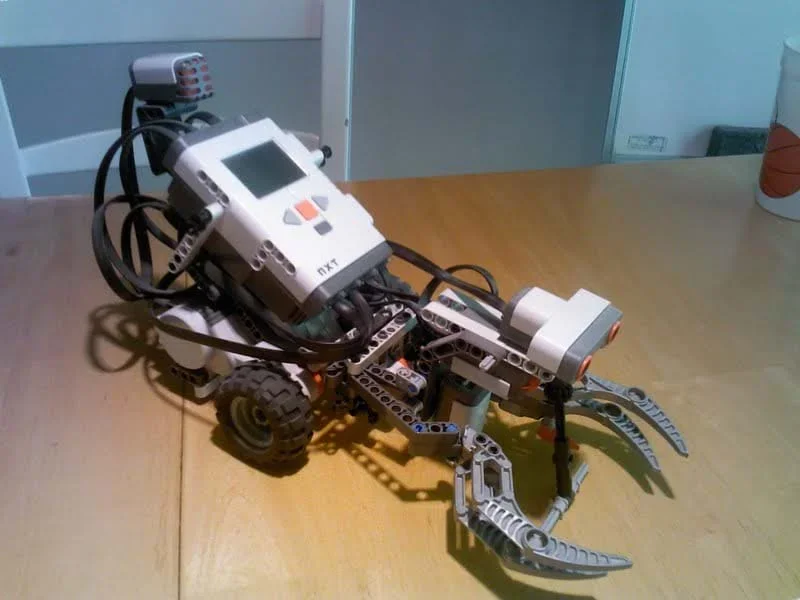 A LEGO MINDSTORMS NXT 2.0 robot.Copyright Wikimedia Commons http://commons.wikimedia.org/wiki/File:NXT_mindstorm.jpg
This activity helps students understand how a motor in a LEGO® MINDSTORMS® robot uses electricity produced by the battery to move a robot to do useful work in the form of throwing a ball. Students relate the concepts of electricity and battery to the movement of the LEGO NXT motor and connected links.
**Note: This activity uses the retired LEGO NXT robot which is no longer available for purchase.
Engineers design a wide range of electrical circuits for various electronic devices that we use everyday. Through this activity, students see how an electrical circuit is important for the flow of electricity, which ultimately powers electric devices. In the activity, students design a program to perform a particular task, which helps to cultivate in them a basic understanding of how robots can be operated via programming instructions that drive the motors.
After this activity, students should be able to:
- Explain that energy from the battery is converted from chemical energy into electrical energy, electricity, which is used to run the motors of the LEGO NXT robot, which convert electrical energy into mechanical energy, thus making the robot move.
- Program an NXT robot to move its motor so that it shoots the balls from the ring attached to the motor.
- STEL-1J Develop innovative products and systems that solve problems and extend capabilities based on individual or collective needs and wants.
Grades 6-8
Do you agree with this alignment?
- Describe how new technologies have helped scientists make better observations and measurements for investigations (e.g., telescopes, electronic balances, electronic microscopes, x-ray technology, computers, ultrasounds, computer probes such as thermometers)
Grade 5
Do you agree with this alignment?
- 3-5-ETS1-1 Define a simple design problem reflecting a need or a want that includes specified criteria for success and constraints on materials, time, or cost.
Grades 3-5
This resource focuses on the following Three Dimensional Learning aspects of NGSS:
Science & Engineering Practices- Define a simple design problem that can be solved through the development of an object, tool, process, or system and includes several criteria for success and constraints on materials, time, or cost.Do you agree with this alignment?
Disciplinary Core Ideas- Possible solutions to a problem are limited by available materials and resources (constraints). The success of a designed solution is determined by considering the desired features of a solution (criteria). Different proposals for solutions can be compared on the basis of how well each one meets the specified criteria for success or how well each takes the constraints into account.Do you agree with this alignment?
Crosscutting Concepts- People's needs and wants change over time, as do their demands for new and improved technologies.Do you agree with this alignment?
Do you agree with this alignment? - Define a simple design problem that can be solved through the development of an object, tool, process, or system and includes several criteria for success and constraints on materials, time, or cost.
- 4-PS3-2 Make observations to provide evidence that energy can be transferred from place to place by sound, light, heat, and electric currents.
Grade 4
This resource focuses on the following Three Dimensional Learning aspects of NGSS:
Science & Engineering Practices- Make observations to produce data to serve as the basis for evidence for an explanation of a phenomenon or test a design solution.Do you agree with this alignment?
Disciplinary Core Ideas- Energy can be moved from place to place by moving objects or through sound, light, or electric currents.Do you agree with this alignment?
- Energy is present whenever there are moving objects, sound, light, or heat. When objects collide, energy can be transferred from one object to another, thereby changing their motion. In such collisions, some energy is typically also transferred to the surrounding air; as a result, the air gets heated and sound is produced.Do you agree with this alignment?
- Light also transfers energy from place to place.Do you agree with this alignment?
- Energy can also be transferred from place to place by electric currents, which can then be used locally to produce motion, sound, heat, or light. The currents may have been produced to begin with by transforming the energy of motion into electrical energy.Do you agree with this alignment?
Crosscutting Concepts- Energy can be transferred in various ways and between objects.Do you agree with this alignment?
Do you agree with this alignment? - Make observations to produce data to serve as the basis for evidence for an explanation of a phenomenon or test a design solution.
- 4-PS3-4 Apply scientific ideas to design, test, and refine a device that converts energy from one form to another.
Grade 4
This resource focuses on the following Three Dimensional Learning aspects of NGSS:
Science & Engineering Practices- Apply scientific ideas to solve design problems.Do you agree with this alignment?
Disciplinary Core Ideas- Possible solutions to a problem are limited by available materials and resources (constraints). The success of a designed solution is determined by considering the desired features of a solution (criteria). Different proposals for solutions can be compared on the basis of how well each one meets the specified criteria for success or how well each takes the constraints into account.Do you agree with this alignment?
- Energy can also be transferred from place to place by electric currents, which can then be used locally to produce motion, sound, heat, or light. The currents may have been produced to begin with by transforming the energy of motion into electrical energy.Do you agree with this alignment?
- The expression "produce energy" typically refers to the conversion of stored energy into a desired form for practical use.Do you agree with this alignment?
Crosscutting Concepts- Science affects everyday life.Do you agree with this alignment?
- Energy can be transferred in various ways and between objects.Do you agree with this alignment?
- Engineers improve existing technologies or develop new ones.Do you agree with this alignment?
- Most scientists and engineers work in teams.Do you agree with this alignment?
Do you agree with this alignment? - Apply scientific ideas to solve design problems.
Each group of two or three students needs a LEGO MINDSTORMS NXT kit with software:
- LEGO MINDSTORMS NXT robot, such as the NXT Base Set (5003402) for $159.98 at https://shop.education.lego.com/legoed/en-US/catalog/product.jsp?productId=5003402& isSimpleSearch=false&ProductLine=NXT
- LEGO MINDSTORMS Education NXT Software 2.1, available as a single license (2000080) for $39.97 or a site license (5003413) for $271.96 at https://shop.education.lego.com/legoed/en-US/catalog/product.jsp?productId=prod120017&isSimpleSearch=false&ProductLine=LEGO+MINDSTORMS+Education+NXT
- computer, loaded with NXT 2.1 software
The teacher needs a computer with Internet connection and a projector to be able to shows a video to the class.
Students should have completed the What Is a Robot? lesson to introduce them to the LEGO NXT robot and the basics of its programming.
This activity is part of the How Does a Robot Work? lesson. Through this activity, students implement the concepts discussed in the lesson and come to understand how electricity is crucial for the working of a robot or any electrical device.
Before the Activity
- Make copies of the Student Activity Sheet on slide 3 of the Activity PowerPoint.
- Either build the ball shooters prior to class for each group or allow additional activity time for the students to build them in groups.
With the Students
- Divide the class into student pairs.
- Play the following 30-second video to show students the NXT ball shoorter that they will be building: https://www.youtube.com/watch?v=_k8bqWySzk4
- Instructions for building the ball shooter are provided at http://www.nxtprograms.com/NXT2/ball_shooter/steps.html and in the attached PowerPoint Presentation. (PPTX)
- Hand out the student activity sheets.
- The main purpose of this activity is to teach students about programming. Direct students to follow the programming steps starting on slide 15.
- system
- A group of interdependent components functioning as a unified whole; a set of methods or rules governing behavior.
- robot
- A machine that gathers information about its environment (senses) and uses that information (reads program) to follow instructions to do work (acts).
Embedded Assessment: Have students answer the three questions on the Student Activity Sheet (slide 3) as they complete the activity. As a class, discuss their answers to assess their comprehension of the subject matter.
- Keep a safe distance from the NXT robots when they are shooting the balls in the ring.
Parker, Dave. NXT Ball Shooter. nxtprograms.com. Accessed 10/26/11. ttp://www.nxtprograms.com/NXT2/ball_shooter/steps.html
Contributors
Kalyani Upendram; Ajay Nair; Satish Nair
Supporting Program
GK-12 Program, Computational Neurobiology Center, College of Engineering, University of Missouri
Acknowledgements
This curriculum was developed under National Science Foundation GK-12 grant no. DGE 0440524. However, these contents do not necessarily represent the policies of the National Science Foundation, and you should not assume endorsement by the federal government.
Copyright
2013 by Regents of the University of Colorado; original © 2010 Curators of the University of Missouri