
Physics Tug of War
Students learn about Newton's second law of motion: force = mass x acceleration. In other words, a heavy object requires a greater force to move than a lighter object. In a tug-of-war experimental setup using paperclips, rubber bands and text books, they collect data and make calculations, seeing that the force required to move a book is proportional to the weight of the book. They relate their conclusions to how engineers use their understanding of this relationship to determine how much force is needed to move airplanes.
 A tug of war depicts the distribution of force.Copyright 2005 David Goehring, Flickr (CC BY 2.0) https://www.flickr.com/photos/carbonnyc/37085152 https://creativecommons.org/licenses/by/2.0/
Engineers apply their understanding of Newton's laws of motion when designing objects that move. Newton's second law states that the force required to move an object is proportional to the mass of that object. So engineers who design airplanes apply this relationship, knowing that the heavier the airplane, the more force it requires to move. Further, they also consider that to create a larger force requires more fuel, which is more expensive and releases more pollutants into the environment.
After this activity, students should be able to:
- Explain that the force needed to accelerate an object is proportional to its mass and weight.
- Explain how Newton's second law of motion applies to airplanes.
- Generate conclusions based on experimental data.
- 5.1.2.c Add, subtract, multiply, and divide decimals to hundredths.
Grade 5
Do you agree with this alignment? - 7.1.2.c Solve real-world and mathematical problems involving the four operations with rational numbers.
Grade 7
Do you agree with this alignment? - 6.1.2.a Fluently divide multi-digit numbers using standard algorithms.
Grade 6
Do you agree with this alignment?
- Use tools to gather, view, analyze, and report results for scientific investigations about the relationships among mass, weight, volume, and density
Grade 6
Do you agree with this alignment?
- CCSS.Math.Content.6.NS.B.2 Fluently divide multi-digit numbers using the standard algorithm.
Grade 6
Do you agree with this alignment? - CCSS.Math.Content.6.NS.B.3 Fluently add, subtract, multiply, and divide multi-digit decimals using the standard algorithm for each operation.
Grade 6
Do you agree with this alignment? - CCSS.Math.Content.6.SP.B.5 Summarize numerical data sets in relation to their context, such as by:
Grade 6
Do you agree with this alignment? - CCSS.Math.Content.6.SP.B.5a Reporting the number of observations.
Grade 6
Do you agree with this alignment? - CCSS.Math.Content.6.SP.B.5b Describing the nature of the attribute under investigation, including how it was measured and its units of measurement.
Grade 6
Do you agree with this alignment?
- STEL-3G Explain how knowledge gained from other content areas affects the development of technological products and systems.
Grades 6-8
Do you agree with this alignment?
- MS-PS2-2 Plan an investigation to provide evidence that the change in an object's motion depends on the sum of the forces on the object and the mass of the object.
Grades 6-8
This resource focuses on the following Three Dimensional Learning aspects of NGSS:
Science & Engineering Practices- Plan an investigation individually and collaboratively, and in the design: identify independent and dependent variables and controls, what tools are needed to do the gathering, how measurements will be recorded, and how many data are needed to support a claim.Do you agree with this alignment?
- Science knowledge is based upon logical and conceptual connections between evidence and explanations.Do you agree with this alignment?
Disciplinary Core Ideas- The motion of an object is determined by the sum of the forces acting on it; if the total force on the object is not zero, its motion will change. The greater the mass of the object, the greater the force needed to achieve the same change in motion. For any given object, a larger force causes a larger change in motion.Do you agree with this alignment?
- All positions of objects and the directions of forces and motions must be described in an arbitrarily chosen reference frame and arbitrarily chosen units of size. In order to share information with other people, these choices must also be shared.Do you agree with this alignment?
Crosscutting Concepts- Explanations of stability and change in natural or designed systems can be constructed by examining the changes over time and forces at different scales.Do you agree with this alignment?
Do you agree with this alignment? - Plan an investigation individually and collaboratively, and in the design: identify independent and dependent variables and controls, what tools are needed to do the gathering, how measurements will be recorded, and how many data are needed to support a claim.
Each group needs:
- 15-20 extra large, heavy paperclips
- 6-7 6-inch rubber bands OR, make a 6-10-inch chain of 10-15 smaller rubber bands
- 3 identical hardcover books about one-half-inch thick; such as math books, encyclopedias, dictionaries
- 1 yardstick
- masking tape; share a roll among all groups
- Physics Tug of War! Worksheet (PDF), one per student
Newton's second law of motion uses a mathematical equation to say that the force needed to move an object is proportional to the object's mass. This means that if a person who is 100 pounds pushed off of a person who is 200 pounds (twice as heavy), then the person who weighed 100 pounds would accelerate backwards twice as fast. If the second person was 10 times heavier than the first, then the person who weighed 100 pounds would accelerate backwards 10 times as fast.
Can you think of any time that this has happened to you? Maybe on the playground or during sports? If you throw a tennis ball and a basketball with the same amount of force, which can you throw father? (Answer: Tennis ball.)
Newton's second law of motion:
F = m * a
force = mass * acceleration
Gravitational acceleration = 9.8 m/s2
Engineers must consider the weight and mass of object when designing. This is especially important for airplanes because they are much heavier than the air molecules that they are pushing against. This means that the airplanes have to push A LOT of air.
Before the Activity
- Test the activity to fine-tune the materials. Specifically, make sure that the books are light enough to permit the side with two books to move in Part 2 of the experiment. If the books are too heavy, the stack of two books will not move at all.
- Gather materials and make copies of the Physics Tug of War! Worksheet (PDF).
With the Students
- Conduct the pre-assessment true/false voting exercise, as described in the Assessment section.
- Present to the class the Introduction/Motivation content.
- Divide the class into groups of 2-4 students each. Hand out the materials and worksheets.
- Experimental setup: Using four paperclips and two 6-inch rubber bands (or a chain of smaller rubber bands 6-10-inches long), attach a rubber band/paperclip sling to each of two books; see Figure 1 for an example of how to configure the sling. Bend the free end of each paperclip to make a right-angled hook. Insert each hook into the book's spine, or use masking tape to attach the hooked paperclip to the outside book end. The object is to have the rubber bands pull the books toward each other. Refer to the experimental setup on the worksheet.
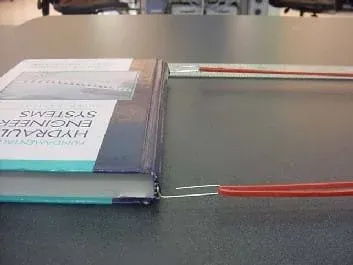 Figure 1. A textbook attached to rubber bands.Copyright 2003 Tom Rutkowski, College of Engineering, University of Colorado Boulder
- Place the experimental setup on a smooth surface, such as a wooden table or laminate countertop.
- Lay down the yardstick in front of the books (see Figure 2) so you can see where the books are located in relation to one another; position them 6-10-inches apart.
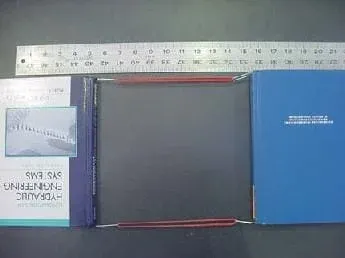 Figure 2. The experimental setup of the books.Copyright 2003 Tom Rutkowski, College of Engineering, University of Colorado Boulder
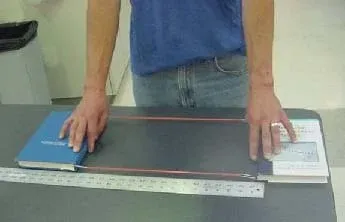 Figure 3. The experiment: pulling the books apart.Copyright 2003 Tom Rutkowski, College of Engineering, University of Colorado Boulder
- Experiment Part 1—One book vs. one book: Pull the books apart a few inches (see Figure 3). Read the numbers on the yardstick that correspond to the inside edges of each book (the area spanned by the rubber band slings). Have students record this number on the worksheets.
- Now let the books go. Expect them to move the same distance towards each other.
- On the worksheets, record the position where the books collide or come to rest.
- Repeat steps 7-9 for three trials (that is, three times).
- Experiment 2—One book vs. two books: Stack two books on top of one of the books being measured, and run the experiment three more times. If twice as many books are on one side, expect the lighter side to move twice as far as the heavier side.
- For each experiment, have students subtract the initial position of each book relative to the final position of the books. Expect the distances to be nearly proportional to the weight of each stack of books. A stack of two books moves only one-half the distance of a single book.
- Data analysis: As a class, discuss what students learned from the experiment. Have students share their results and conclusions. Make sure they understand that this activity demonstrates Newton's second law of motion: the force required to move an object is proportional to the mass of the object. In the experiment, the stretched rubber bands pull on both books equally, and both books move towards each other equally (assuming they are the same weight) when the rubber bands are released. When one book is stacked higher (with two books total), the pulling force only moves the stack half as far as the single book. Large airplanes weigh a lot and, therefore, require a large force to move them.
- Have students complete their worksheet questions and hand them in.
- To condlude, administer the remaining assessment activities—math problems, student-generated questions, and roundtable questions—as described in the Assessment section.
Pre-Activity Assessment
Voting: Ask a true/false question and have students vote by holding thumbs up for true and thumbs down for false. Tally the votes and write the number on the board. Give the right answer.
- True or False: Most airplanes are made from steel. (Answer: False, aluminum.)
- True or False: Newton's second law of motion states that a heavy object requires a greater force to move than a lighter object. (Answer: True)
Activity Embedded Assessment
Worksheet: Have students use the Physics Tug of War Worksheet (PDF) to guide them through the activity, recording measurements and answering questions. After students have finished their worksheets, have them compare their answers with their peers. Discuss as a class.
Math Problems: Have students practice some Newton's second law of motion math problems such as the following:
- How much force is required to accelerate a 2 kg mass at 3 m/s2? (Answer: F = 2 kg * 3 m/s2 = 6 N)
- Given a force of 100 N and an acceleration of 10 m/s2, what is the object's mass? (Answer: m = 100 N/ 10 m/s2 = 10 kg)
Post Activity Assessment
Student-Generated Questions: Have each student come up with one question of their own to ask the rest of the class. Be prepared to help some students form questions. Have students take turns asking their questions to the class.
Real-World Roundtable: Have students form teams of 3–5 students each. Ask the class a question that has many possible answers and relates the concepts they learned to everyday situations. Have students on each team make a list, each one writing an answer and passing the paper on to the next person. Then, as a class, have each team share its responses.
- What situations can you think of that demonstrate Newton's second law of motion in action? (The force needed to move an object is proportional to the object's mass.) Any examples at school? On the playground? In sports? At home? In traffic?
Be careful not to place hands between the sliding books, as they could get pinched.
Do not pull apart the books so far that the rubber bands break or the books are sent flying.
If using multiple small rubber bands, it is important to use the same number and sequence of rubber bands in each chain so that they pull with the same force.
Make sure that the paperclips are secured to the book so that they remain in place when the rubber bands are stretched. In addition, caution students not to pull the rubber bands too far because they may pull the paperclips out of the books.
It helps to use the same size books if possible. Books that come in sets, like condensed journals or encyclopedias, work well for this activity.
If small scooters are available, such as the low square type with four weels used in gym class, or even a few skateboards, roller blades or rolling office chairs. Have students sit on the scooters and push off of each other with their feet. This enables them to see and feel how larger students do not move as far as smaller students. Take care that kids do not fall off the scooters and hurt themselves if they lose their balance or push off too hard. If just a few rolling items are available, conduct as a class demo..
- For younger students, to help them understand the problem, do the math on the classroom board first before they try to do the division on their own.
- Give older students a problem in which the mass is known for two objects pushing off of each other as well as the distance that one of the objects moves. Challenge them to use this known information to solve for the unknown distance the other object moved.
- Up, Up and Away! - Airplanes
- Can You Take the Pressure?
- May the Force Be with You: Lift
- May the Force Be with You: Weight
- Bend That Bar
- Physics Tug of War
- May the Force Be with You: Thrust
- May the Force Be with You: Drag
- Take Off with Paper Airplanes
- Airplane Tails & Wings: Are You in Control?
- Airplanes Everywhere: Land, Water, Sky, Oh My!
- Will It Fly?
- Future Flights: Imagine Your Own Flying Machines!
Contributors
Tom Rutkowski; Alex Conner; Geoffrey Hill; Malinda Schaefer Zarske; Janet Yowell
Supporting Program
Integrated Teaching and Learning Program, College of Engineering, University of Colorado Boulder
Acknowledgements
The contents of this digital library curriculum were developed under grants from the Fund for the Improvement of Postsecondary Education (FIPSE), U.S. Department of Education and National Science Foundation (GK-12 grant no. 0338326). However, these contents do not necessarily represent the policies of the Department of Education or National Science Foundation, and you should not assume endorsement by the federal government.
Copyright
2004 by Regents of the University of Colorado